• Our new ticketing site is now live! Using either this or the original site (both powered by TrainSplit) helps support the running of the forum with every ticket purchase! Find out more and ask any questions/give us feedback in this thread!

Forth Bridge restrictions

Status
Not open for further replies.

Aictos

Established Member
Joined
28 Apr 2009
Messages
10,403
With the restrictions in place on the bridge, why are the line speeds so low for trains using it especially freight?

What work would have to be done to raise the line speeds to 60mph or even 70mph for passenger trains and to raise the line speed to 40mph or even 50mph for freight services keeping in mind the weight limits?

The bridge has a speed limit of 50 mph (80 km/h) for passenger trains and 20 mph (32 km/h) for freight trains. The weight limit for any train on the bridge is 1,422 tonnes (1,442,000 kg) although this is waived for the frequent coal trains, provided two such trains do not simultaneously occupy the bridge.

Both lines across the Forth Bridge are signalled bi-directionally to allow all traffic to be worked over one line, in both directions, while the other line is out of use and under possession for engineering work. For all pre-planned work, a temporary speed restriction of 20 m.p.h. will be imposed for right-direction movements. Wrong-direction movements are subject to a 20 m.p.h. permanent speed restriction.


Obviously there has to be reasons for the restrictions to be in place but with work, surely they could be eased?
 
Sponsor Post - registered members do not see these adverts; click here to register, or click here to log in
R

RailUK Forums

jopsuk

Veteran Member
Joined
13 May 2008
Messages
12,774
120 year old steelwork is your answer. Lovingly looked after, yes, and over-engineered, but still, rather old.
 

route:oxford

Established Member
Joined
1 Nov 2008
Messages
4,949
What pleasure would there be in crossing the bridge if it were to speed across so quickly you'd miss it?

Besides, we've already lost 2 of the Forth Bridges, best to look after the three that remain. :)
 

rail-britain

Established Member
Joined
12 Aug 2007
Messages
4,102
I would hate to go any faster than 50mph, especially on the exposed sections at each end
The speed limit not only takes into account the track and bridge condition, but also the weather conditions
When the wind is above 50mph it can affect trains quite severly, and when the wind speed is above something like 80mph no trains are permitted
I remember being on one southbound sleeper which had to wait at Inverkeithing until the wind speed had dropped, even then when we crossed it was horrendous
 

At_traction

Member
Joined
5 Aug 2010
Messages
291
When the wind is above 50mph it can affect trains quite severly, and when the wind speed is above something like 80mph no trains are permitted
I remember being on one southbound sleeper which had to wait at Inverkeithing until the wind speed had dropped, even then when we crossed it was horrendous

Was it the sway of the bridge or wind buffeting carriages?
 

Chris125

Established Member
Joined
12 Nov 2009
Messages
3,267
Location
Isle of Wight
If the Forth Bridge swayed in high winds i think there'd be a lot more than just a 50mph restriction!

Chris
 

ainsworth74

Forum Staff
Staff Member
Global Moderator
Joined
16 Nov 2009
Messages
31,081
Location
Redcar
If the Forth Bridge swayed in high winds i think there'd be a lot more than just a 50mph restriction!

Personally if it didn't move at all I would be more worried of it just snapping in half! Small movements in the wind is not a bad thing when it comes to large structures.
 

At_traction

Member
Joined
5 Aug 2010
Messages
291
Small movements in the wind is not a bad thing when it comes to large structures.

And any such sense (or at least measureable movement) is accentuated by the span of a structure. One would expect those sensuously cantilevered portions to show a certain level of movement in high winds, even with all the on-the-safe-side overengineering.

http://www.edinburgharchitecture.co.uk/images/jpgs/forth_rail_bridge_35.jpg

With the neighbouring road bridge the swaying would be even more pronounced due to the length of the span and the method of support.
 

rail-britain

Established Member
Joined
12 Aug 2007
Messages
4,102
Was it the sway of the bridge or wind buffeting carriages?
Both, the driver walked back and sat in the Lounge Car for about an hour before we proceeded (at 20mph which probably made it all the worse)
On arrival in Edinburgh he was shocked how they let the train proceed with such a high wind
The issue wasn't the main section, it was the two exposed sections at each end
In the middle the main issue was just the wind
 

YorkshireBear

Established Member
Joined
23 Jul 2010
Messages
9,664
in engineering terms now things are designed to move, makes them way stronger as said thigns that dont move snap.....

a gust could easily pick up a carriage at them heights
 

Eng274

Member
Joined
19 Aug 2010
Messages
796
I think 50mph is a perfectly fine speed limit for the bridge, not too slow but not too fast that it detracts from the pleasure of the ride. There was one occasion 2 or 3 years back where bride traffic was halted for a short period due to high winds.

Regarding the durability of the bridge, i was told some engineers examined the bridge's displacement recently using geomatic technology and lasers; by displacement, i mean the distance a point has moved from its original location. For the age of the bridge, the designers in the 1880s had anticipated a column member displacement of about 4 feet, but the actual displacement was only a few centimetres!

To say that bridge is solid is an understatement; the huge pins (not to be confused with rivets) that hold it together were engineered with a safety factor of 28, ie. design strength = 28 x maximum load. It would be thought of as foolish to over-engineer a bridge so much today, but I personally would rather have a bridge that surpasses, rather than falls short of, it's design specification - see the 'squinty bridge'!

With coal trains now diverted via Kincardine and Alloa, the only semi-heavy stock that uses the bridge is the HST as far as i know, which even then is still much lighter than a 66.

Being of a Hibernian FC persuaion, I think it'd have looked better in green though..
 

jopsuk

Veteran Member
Joined
13 May 2008
Messages
12,774
In terms of "route availability"- which is primarily based on axle load- the heaviest things using the bridge on a daily basis are the 67s hauling the Fife Circle LHCS services and the Aberdeen sleeper- though I'll grant the HSTs to Aberdeen are the heaviest passenger trains overall.
 

Eng274

Member
Joined
19 Aug 2010
Messages
796
In terms of "route availability"- which is primarily based on axle load- the heaviest things using the bridge on a daily basis are the 67s hauling the Fife Circle LHCS services and the Aberdeen sleeper- though I'll grant the HSTs to Aberdeen are the heaviest passenger trains overall.

ahh forgot about them!
 

DaveNewcastle

Established Member
Joined
21 Dec 2007
Messages
7,387
Location
Newcastle (unless I'm out)
I agree with rail-britain that the speed restrictions are a consequence of a combination of factors: physical integrity (which the 'modern' road bridge lacks), and wind forces on the exposed train.
You really should spend some time watching from below and also from Dalmeny Down platform; the exposure to weather 50mtrs above ground (er, sea) is astonishing.
To say that bridge is solid is an understatement; the huge pins (not to be confused with rivets) that hold it together were engineered with a safety factor of 28, ie. design strength = 28 x maximum load. It would be thought of as foolish to over-engineer a bridge so much today, but . . .
Though it makes sense when you look at the background to the design process. The contract was originally given to Bouch (who had designed and overseen the construction of the Tay Bridge. The one that collapsed with a train carrying 75 persons). So when that contract was hastily cancelled, it was clearly going to go to someone whose proposal was much much more robust. Fowler & Baker did exactly that.

With coal trains now diverted via Kincardine and Alloa, the only semi-heavy stock that uses the bridge is the HST as far as i know, which even then is still much lighter than a 66.
There's still the odd nuclear flask traffic. Not as much in its accumulated mass as the coal trains, but very significant to a rigid cantelever on account of its high weight bearing only onto small parts of the overall system.

50mph is just fine for passenger services in average weather conditions!

Personally if it didn't move at all I would be more worried of it just snapping in half! Small movements in the wind is not a bad thing when it comes to large structures.
But I think you might be forgetting something about how cantelevers work! The big exposure to movement is not the 2 piers at either end (they're nicely supported by lots of steel and stone towers), its the 2 100+ meter spans inbetween the 3 diamond shaped cantilevers. What do you think supports them? Nothing! They are suspended from above by the adjoining cantilevers, and ultimately, by the massive stone weights hanging off the outer ends of the outer two cantilever diamonds.
So, of course it moves! Not by much, but it wouldn't work if it didn't!

Enjoy these YouTube cab views over the Forth bridge:
travelling north
and
travelling south
Those were both filmed in good weather - just imagine what those views would have been if they were filmed in the storm conditions that brought down the Tay Bridge in 1878!
 
Last edited:

Scotrail84

On Moderation
Joined
5 Jul 2010
Messages
2,977
I think 50mph is a perfectly fine speed limit for the bridge, not too slow but not too fast that it detracts from the pleasure of the ride. There was one occasion 2 or 3 years back where bride traffic was halted for a short period due to high winds.

Regarding the durability of the bridge, i was told some engineers examined the bridge's displacement recently using geomatic technology and lasers; by displacement, i mean the distance a point has moved from its original location. For the age of the bridge, the designers in the 1880s had anticipated a column member displacement of about 4 feet, but the actual displacement was only a few centimetres!

To say that bridge is solid is an understatement; the huge pins (not to be confused with rivets) that hold it together were engineered with a safety factor of 28, ie. design strength = 28 x maximum load. It would be thought of as foolish to over-engineer a bridge so much today, but I personally would rather have a bridge that surpasses, rather than falls short of, it's design specification - see the 'squinty bridge'!

With coal trains now diverted via Kincardine and Alloa, the only semi-heavy stock that uses the bridge is the HST as far as i know, which even then is still much lighter than a 66.

Being of a Hibernian FC persuaion, I think it'd have looked better in green though..


Spot on Green would be my choice GGTTH. :D
 

Ploughman

Established Member
Joined
15 Jan 2010
Messages
3,099
Location
Near where the 3 ridings meet
To say that bridge is solid is an understatement; the huge pins (not to be confused with rivets) that hold it together were engineered with a safety factor of 28, ie. design strength = 28 x maximum load. It would be thought of as foolish to over-engineer a bridge so much today, but I personally would rather have a bridge that surpasses, rather than falls short of, it's design specification

Unlike the Humber bridge.
Designed to the limit, even the handrails on the cables are factored into the load equation.
The Bridgemaster used to get a bit worked up because to repaint the bridge you have to strip off the old paint first or the bridge was overloaded on Dead load.
 

LE Greys

Established Member
Joined
6 Mar 2010
Messages
5,389
Location
Hitchin
I would hate to go any faster than 50mph, especially on the exposed sections at each end
The speed limit not only takes into account the track and bridge condition, but also the weather conditions
When the wind is above 50mph it can affect trains quite severly, and when the wind speed is above something like 80mph no trains are permitted
I remember being on one southbound sleeper which had to wait at Inverkeithing until the wind speed had dropped, even then when we crossed it was horrendous

I've been accross in 50 mph crosswinds before, which closed the road bridge, and it fealt steady as a rock. The only strange thing was the feeling that I was going to be blown out of the window at one point (it was an HST). Still, railway bridges have to be a lot more rigid than road bridges, primarily because the load is all in one sort section, not spread along the whole length of the deck.

I hope they don't change it, it's one of the highlights of the journey. It would be much better to be able to get through Fife quicker rather than the marginal gain by crossing the bridge at 80 mph.
 

Eng274

Member
Joined
19 Aug 2010
Messages
796
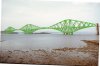
Here's an artists impression (done in all of 5 minutes) of a repainted bridge..
 

Attachments

  • Forth-Bridge6 redone in paint.jpg
    Forth-Bridge6 redone in paint.jpg
    116.9 KB · Views: 84

route101

Veteran Member
Joined
16 May 2010
Messages
12,263
Judging by weather it should be very windy on the Forth Bridge tonight.
 

DaveNewcastle

Established Member
Joined
21 Dec 2007
Messages
7,387
Location
Newcastle (unless I'm out)
Judging by weather it should be very windy on the Forth Bridge tonight.
Surely that pointless post isn't just bait for one of us to make some stupid reply, such as:
'Twas about seven o'clock at night,
And the wind it blew with all its might,
And the rain came pouring down,
And the dark clouds seem'd to frown,
And the Demon of the air seem'd to say-
"I'll blow down the Bridge of Forth."

When the train left Edinburgh
The passengers' hearts were light and felt no sorrow,
But Boreas blew a terrific gale,
Which made their hearts for to quail,
And many of the passengers with fear did say-
"I hope God will send us safe across the Bridge of Forth."

Nah.
I know you wouldn't do that. And even if you did, none of us would be tempted to make such a silly reply, would we?

PS. That light-green rendering of my avatar is really quite offensive to the eye.

- - - - - - E D I T - - - - - - -

PPS. When I refered to the rendering of my avatar, I was, of course, intending to refer to the rendering by 158>185 of a picture of a well known bridge over the river Forth and which is also depicted in my avatar which is also a picture of that Bridge. Geeeez.
 
Last edited:

scotsman

Established Member
Joined
6 Jul 2010
Messages
3,252
I hope they don't change it, it's one of the highlights of the journey. It would be much better to be able to get through Fife quicker rather than the marginal gain by crossing the bridge at 80 mph.

Not only that, but the train would have to slow for the 40mph restriction on Jamestown Viaduct.
 
Status
Not open for further replies.

Top