
Good afternoon I am wondering if someone can help me. I am looking to travel from Paddington to Penzance in 1st class and am wondering what I will get. The website states that light refreshments will be served but what exactly will these entail. Thanks in advance.

-
Our new ticketing site is now live! Using either this or the original site (both powered by TrainSplit) helps support the running of the forum with every ticket purchase! Find out more and ask any questions/give us feedback in this thread!
You are using an out of date browser. It may not display this or other websites correctly.
You should upgrade or use an alternative browser.
You should upgrade or use an alternative browser.
FGW First Class
- Thread starter 47832
- Start date
- Status
- Not open for further replies.
Sponsor Post - registered members do not see these adverts; click here to register, or click here to log in
R
RailUK Forums
Rich McLean
Established Member
- Joined
- 6 Feb 2012
- Messages
- 1,757
Good afternoon I am wondering if someone can help me. I am looking to travel from Paddington to Penzance in 1st class and am wondering what I will get. The website states that light refreshments will be served but what exactly will these entail. Thanks in advance.
What date are you travelling, and what time are you leaving Paddington?
Tea/coffee, I think a cold drink (non-alcoholic) of some manner and biscuits of some sort. Not a lot really is complimentary on FGW. Also there won't be an at-seat service after Plymouth. Depending on the time of day you might be able to take advantage of the Travelling Chef or Pullman Dining.
If there's a Travelling Chef on the train you can buy a choice of meals and hot snacks served at seat on china plate with metal cutlery - a rare treat on modern trains. I try to choose trains with the chef if at all possible.
The four FGW trains with restaurants are even better and first class ticket not usually needed London bound (but standard class tickets may not get restaurant seats on the evening trains from Paddington).
The four FGW trains with restaurants are even better and first class ticket not usually needed London bound (but standard class tickets may not get restaurant seats on the evening trains from Paddington).
Tea/coffee, I think a cold drink (non-alcoholic) of some manner and biscuits of some sort. Not a lot really is complimentary on FGW.
Well, since for health reasons my tea/coffee has to be decaff; my cold drinks have to be sugar-free; and my biscuits also have to be sugar-free I'm not sure I'd get great value from the upgrade!

What date are you travelling, and what time are you leaving Paddington?
Thanks for all the replies, not sure on exact dates but probably leaving Paddington on a friday and coming back on a monday.
Rich McLean
Established Member
- Joined
- 6 Feb 2012
- Messages
- 1,757
Thanks for all the replies, not sure on exact dates but probably leaving Paddington on a friday and coming back on a monday.
Ok, as above, in that case, it is pot luck which catering service will be on your train. However, complimentary items are limited
ChiefPlanner
Established Member
They will certainly do decaf drinks , plus juices and water(s)
Dependant on time of day , there will be some other "food" offers , - mini croissants etc as well as biscuits. Fruit often.
In my experience - largely to and from Sth Wales, the service is very good - and the menu on the Travelling Chef is good - Cumbrian saussge and chips , 3 egg omlettes etc.
Dependant on time of day , there will be some other "food" offers , - mini croissants etc as well as biscuits. Fruit often.
In my experience - largely to and from Sth Wales, the service is very good - and the menu on the Travelling Chef is good - Cumbrian saussge and chips , 3 egg omlettes etc.

Mutant Lemming
Established Member
If the train is crowded then you will have to trek to the buffet car to collect any complimentary items.
If there's a Travelling Chef on the train you can buy a choice of meals and hot snacks served at seat on china plate with metal cutlery - a rare treat on modern trains. I try to choose trains with the chef if at all possible.
The four FGW trains with restaurants are even better and first class ticket not usually needed London bound (but standard class tickets may not get restaurant seats on the evening trains from Paddington).
EMT/VT/EC/GC/HT all have china cups/plates and cutlery in 1st and actually lay them up on the table and serve drinks in proper glasses so its not actually rare at all. FGW are really the only mainline that don't have proper cups etc apart from when the chefs on, even then I think the drinks are still served in paper/plastic.
SephenWorceste
Member
- Joined
- 29 Aug 2012
- Messages
- 467
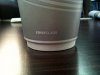
On First Great Western you get a First Class branded paper cup.
Best Wishes, Stephen.
PS. On the Cotswold Line they may well replace your HST with a Sprinter with no catering, service or working toilet. They may also not open the First Class Lounge at Paddington. In which case you get nothing extra for your £150. Not that I am bitter. Don't let them near the West Coast Main Line. Please.
Best Wishes, Stephen.
PS. On the Cotswold Line they may well replace your HST with a Sprinter with no catering, service or working toilet. They may also not open the First Class Lounge at Paddington. In which case you get nothing extra for your £150. Not that I am bitter. Don't let them near the West Coast Main Line. Please.
Attachments
Last edited:

ValleyLines142
Established Member
PS. On the Cotswold Line they may well replace your HST with a Sprinter with no catering, service or working toilet. They may also not open the First Class Lounge at Paddington. In which case you get nothing extra for your £150. Not that I am bitter. Don't let them near the West Coast Main Line. Please.
Would passengers who have bought First Class be entitled to a refund if a Sprinter turned up? I'd be mortified!
thelongestroad
Member
- Joined
- 4 Dec 2011
- Messages
- 591
On First Great Western you get a First Class branded paper cup.
Best Wishes, Stephen.
PS. On the Cotswold Line they may well replace your HST with a Sprinter with no catering, service or working toilet. They may also not open the First Class Lounge at Paddington. In which case you get nothing extra for your £150. Not that I am bitter. Don't let them near the West Coast Main Line. Please.
Fortunately there are no Sprinters on the West Coast. So don't worry.
merlodlliw
Established Member
EMT/VT/EC/GC/HT all have china cups/plates and cutlery in 1st and actually lay them up on the table and serve drinks in proper glasses so its not actually rare at all. FGW are really the only mainline that don't have proper cups etc apart from when the chefs on, even then I think the drinks are still served in paper/plastic.
Plus Gerald Of Wales ATWs flagship uses China.

Would passengers who have bought First Class be entitled to a refund if a Sprinter turned up? I'd be mortified!
Yes, as Sprinters have no First Class they would be entitled to a refund of the difference between Standard and First.
He is talking about Thames Turbo units not Sprinters. These have First Class so no refund due, even though it's completely pointless First Class that is barely any better than standard and miles different to the actually very high quality First Class accomodation on an HST.
It's a bigger difference than on 375s and 377s. It's 2+2 rather than 2+3 seating
BUt most long distance FGW pax already get 2+2 in standard..

MidnightFlyer
Veteran Member
- Joined
- 16 May 2010
- Messages
- 12,856
Don't let them near the West Coast Main Line. Please.
Well, as on the ICWC franchise, the only possible substitution is Voyager for Pendo (and depending on route vice vera), or at longer notice the Pretendoino, I fail to see how First could do any worse from Virgin in that respect - indeed the Turbo vice HST argument is pointless, and, if I'm honest, stinks of the twaddle so many posted on Twitter and Facebook when First got the go ahead for the West Coast franchise. I mean, ScotRail and Hull Trains are First operations too, and they are generally considered two of the best overall TOCs in Britain (as is FGW, compare them now to what was inherited ex-Wessex Trains et al).
SephenWorceste
Member
- Joined
- 29 Aug 2012
- Messages
- 467
My last train from Paddington to Worcester was a 15? 3+2 in standard and 2+2 in first. It was timetabled as a HST service to Hereford. No catering and one toilet (that was out of order from Oxford). Totally unsuitable for three hours plus run to Hereford. According to the Train Manager it costs less to run one of theses rather than an 8+2 HST.
I did get a refund in vouchers of the difference between standard and first. Just under £50. FGW have lost my custom. Since then I have stuck to the West Coast Mainline.
It is a real shame because first class on a FGW HST is so comfortable.
Best wishes, Stephen.
I did get a refund in vouchers of the difference between standard and first. Just under £50. FGW have lost my custom. Since then I have stuck to the West Coast Mainline.
It is a real shame because first class on a FGW HST is so comfortable.
Best wishes, Stephen.

F Great Eastern
Established Member
My last train from Paddington to Worcester was a 15? 3+2 in standard and 2+2 in first. It was timetabled as a HST service to Hereford. No catering and one toilet (that was out of order from Oxford). Totally unsuitable for three hours plus run to Hereford. According to the Train Manager it costs less to run one of theses rather than an 8+2 HST.
I did get a refund in vouchers of the difference between standard and first. Just under £50. FGW have lost my custom. Since then I have stuck to the West Coast Mainline..
Just because this happened on one occasion you are suddenly not going to use them? That is a little bit of an over-reaction if you ask me
Any Full TOC that operates a mix of commuter, intercity and local services will have faced the same at some point. It's better to run different stock than originally booked than no train at all and cancel it.
But of course Virgin won't know about that as they're not interested in running a franchise that has to deal with a large number of different passenger types with aging infrastructure and the consequences of continual government dithering over the IEP and new stock for DMU's.
My last train from Paddington to Worcester was a 15? 3+2 in standard and 2+2 in first.
165/166.
It was timetabled as a HST service to Hereford. No catering and one toilet (that was out of order from Oxford). Totally unsuitable for three hours plus run to Hereford. According to the Train Manager it costs less to run one of theses rather than an 8+2 HST.
This was a stupid thing for the train manager to say. It's true but it will have had no bearing on the reason the 165 turned up instead of the HST.
Captain Chaos
Member
- Joined
- 31 Jan 2011
- Messages
- 840
The reason the 165/166 would have been used would possibly have been due to a HST failure or some other problem. They would therefore most likely scenario is that they use they use the Cotswold HST for the failed service and use a Turbo for the Cotswolds service.
This is the most sensible outcome. They used the stock they have available at the time to ensure both services run. Whilst it is of course disappointing that you have not got the HST as it states in the timetable surely it is better for everyone to have to deviate from it in terms of traction used in order to ensure all services run? Yes, a Turbo to Hereford IS pretty poor. I agree on that. But I'd rather a Turbo than nothing at all.
This is the most sensible outcome. They used the stock they have available at the time to ensure both services run. Whilst it is of course disappointing that you have not got the HST as it states in the timetable surely it is better for everyone to have to deviate from it in terms of traction used in order to ensure all services run? Yes, a Turbo to Hereford IS pretty poor. I agree on that. But I'd rather a Turbo than nothing at all.

musicking1306
Member
My last train from Paddington to Worcester was a 15? 3+2 in standard and 2+2 in first. It was timetabled as a HST service to Hereford. No catering and one toilet (that was out of order from Oxford). Totally unsuitable for three hours plus run to Hereford. According to the Train Manager it costs less to run one of theses rather than an 8+2 HST.
I did get a refund in vouchers of the difference between standard and first. Just under £50. FGW have lost my custom. Since then I have stuck to the West Coast Mainline.
It is a real shame because first class on a FGW HST is so comfortable.
Best wishes, Stephen.
One of the reasons a 165/166 was used on a Hereford diagram might have been the fact of the disruption with flooding in the west of England. It could also have been to do with lack of available HST sets. The only other reason it could be is an earlier 165/166 diagrammed service that required the set at Hereford.
This was a stupid thing for the train manager to say. It's true but it will have had no bearing on the reason the 165 turned up instead of the HST.
Indeed. It is of course the reason most the HST workings to Worcester/Great Malvern were replaced by 166s but it isn't the reason for short term substitutions for HSTs.
I agree on that. But I'd rather a Turbo than nothing at all.
Unless you were travelling on a First Advance and would rather have had the opportunity to catch the next HST rather than use Standard Plus on a Turbo, which you could do if it was cancelled but couldnt do if it was substituted

Indeed. It is of course the reason most the HST workings to Worcester/Great Malvern were replaced by 166s but it isn't the reason for short term substitutions for HSTs.
Let's just get the sequence of events right, as you make it sound as though HSTs reigned supreme on the Cotswold Line for an extended period - it was more like a matter of months.
Until December 2004, soon after FGW took on the former Thames Trains routes, there were just the couple of Hereford-London and return peak HSTs, plus a few weekend HSTs doing the same journey, mostly on Sunday afternoons to take people back to London. Everything else was Turbo-worked
From December 2004, 180s took over most, but not all of the Turbo jobs, just as well given that peak and peak shoulder trains worked by Turbos were often full and standing on parts of their journeys, but growth in traffic meant that 180s soon filled up on some of these trains.
The 180s' reliability issues, plus the availability of HSTs freed from XC and West Coast led FGW to conclude they could get rid of 180s and use more 125s instead, so over the course of 2008-9 the 180s gradually disappeared, despite a degree of scepticism from the locals as to the wisdom of using 500-seat trains on many off-peak trains west of Oxford.
And so it proved, with the costs of carrying lots of empty seats around leading to the gradual removal in 2009-10 of HSTs outside the peaks, except the two Hereford services, and the return of 166s, as the 180s were no longer available to FGW - incidentally also affecting the Reading-Gatwick line, where the 166s had been moved, with their extra luggage space compared with 165s proving useful for the airport traffic.
I don't think senior FGW managers thought the 166s were what they should be using on Worcestershire services but there wasn't anything else more suitable available until East Coast ditched its Lincoln plan, freeing the five 180s that are now back with FGW.
When it comes to substitutions at Paddington, these are usually done at short notice, when an HST on another route has failed. And the crews on most of the Cotswold diagrams are trained on both HSTs and Turbos, so pinching one set off a doubled-up formation of Turbos is the obvious answer - you can't exactly send a 166 to Bristol or Cardiff. Four out of the five 180s are booked to be in traffic anyway, with the other on maintenance, so they can't help in such situations. A Turbo is never ideal but if that's all that's available we just have to put up with it.
SephenWorceste doesn't say when the journey he refers to was made - doesn't sound as though it was recent - so who knows whether it was to do with the flooding. During that period recently (and flooding at Oxford had more of an impact for the Cotswold Line than flooding elsewhere) and the signal problems in west London, the 180s pretty much vanished but with the scale of problems and crews being stepped up at a moment's notice, it made sense, as the crew training programme for 180s is still to be completed and a train without a driver is no use to anyone.
Turbo first class is not up to HST/180 standards but it was never intended for long-distance journeys. It has better seats than standard, made to a proper seat width. The 2+2 standard class section at tables in 166 centre cars just uses the same seats as the rest of standard class, so has a super-wide aisle and more legroom but that's about it.
Goatboy said:Unless you were travelling on a First Advance and would rather have had the opportunity to catch the next HST rather than use Standard Plus on a Turbo, which you could do if it was cancelled but couldnt do if it was substituted
You just try finding an advance fare on the Cotswold Line...
Good point actually, can't say I've ever seen one pop up.
Though to be fair, walk-on fares on the Cotswold Line to London seem really quite reasonable anyway.
Checking the prices has thrown up a question though - from Worcester and Malvern how come the Any Permitted offpeak is cheaper than the Evesham/Stroud one? Given that both are valid on the Cotswold line?
Though to be fair, walk-on fares on the Cotswold Line to London seem really quite reasonable anyway.
Checking the prices has thrown up a question though - from Worcester and Malvern how come the Any Permitted offpeak is cheaper than the Evesham/Stroud one? Given that both are valid on the Cotswold line?
On First Great Western you get a First Class branded paper cup.
Best Wishes, Stephen.
PS. On the Cotswold Line
Since when has Penzance been in the Cotswolds?
Or are you dragging this thread off topic just to make a point?:roll:
- Status
- Not open for further replies.