
• Our new ticketing site is now live! Using either this or the original site (both powered by TrainSplit) helps support the running of the forum with every ticket purchase! Find out more and ask any questions/give us feedback in this thread!

Facing point locks

Status
Not open for further replies.

NoEyeDeer

Member
Joined
14 Sep 2020
Messages
49
Location
Aberdeen
Looking for clarification here

Scenario

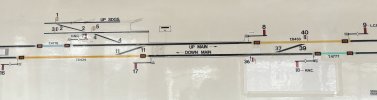
Have a train on the down line and need to make a signalled move over the crossover (36) to get to the up line and then make a wrong direction movement over facing points (39) back into the up platform,

Am I right in saying that as long as the passengers are off the train the move back into the platform can be done WITHOUT securing the points

Obviously if passengers the points would be secured.
 

Attachments

  • IMG_0215.jpeg
    IMG_0215.jpeg
    1.6 MB · Views: 125
Sponsor Post - registered members do not see these adverts; click here to register, or click here to log in
R

RailUK Forums

zwk500

Veteran Member
Joined
20 Jan 2020
Messages
18,489
Location
Northampton
As there's no signal to be routed to on the Up line from Signal 40 wouldn't this count as an unsignalled move? Not sure what the rules are on that at this location as Crossover 11 and the Up Sidings are unsignalled as well from the diagram.

Without greater knowledge, it looks to me like Signal 40 only reads over the crossover, but theres all sorts of oddities around the network that might mean it's fine for the shunt.
 

NoEyeDeer

Member
Joined
14 Sep 2020
Messages
49
Location
Aberdeen
As there's no signal to be routed to on the Up line from Signal 40 wouldn't this count as an unsignalled move? Not sure what the rules are on that at this location as Crossover 11 and the Up Sidings are unsignalled as well from the diagram.

Without greater knowledge, it looks to me like Signal 40 only reads over the crossover, but theres all sorts of oddities around the network that might mean it's fine for the shunt.
Yeah it is an unsignalled move, I was more wondering if trains going over facing points that aren’t secured is ok as long as no passengers, which I believe it is?
 

zwk500

Veteran Member
Joined
20 Jan 2020
Messages
18,489
Location
Northampton
Yeah it is an unsignalled move, I was more wondering if trains going over facing points that aren’t secured is ok as long as no passengers, which I believe it is?
You don't need them to be secured for signalled moves certainly. Somebody who knows the rulebook better than me will need to advise for unsignalled move - it may depend on the local interlocking.
 
Joined
15 Apr 2020
Messages
405
Location
Wakefield
Looking for clarification here

Scenario

Have a train on the down line and need to make a signalled move over the crossover (36) to get to the up line and then make a wrong direction movement over facing points (39) back into the up platform,

Am I right in saying that as long as the passengers are off the train the move back into the platform can be done WITHOUT securing the points

Obviously if passengers the points would be secured.
According to the rule book yes you’re correct, only passenger moves need facing point locks, or the points to be secured - regardless of signalled/shunting/unsignalled.

But as always the box
Special Instructions may differ, and you may also find that the train operator rules are stricter.
 

NoEyeDeer

Member
Joined
14 Sep 2020
Messages
49
Location
Aberdeen
According to the rule book yes you’re correct, only passenger moves need facing point locks, or the points to be secured - regardless of signalled/shunting/unsignalled.

But as always the box
Special Instructions may differ, and you may also find that the train operator rules are stricter.
Cheers
 

Tomnick

Established Member
Joined
10 Jun 2005
Messages
5,933
If the points that become facing are mechanical, and have no electrical detection, how do you know that they've responded to the lever movement and are fitting up correctly if there's no signalled move over them? If there's mechanical detection, then that'll act only on the signal(s) reading over the points in the facing direction and will be no use for unsignalled moves. I was certainly trained to secure points for such movements, and indeed had to do so on a number of occasions.
 
Joined
6 Sep 2011
Messages
989
Location
Blackpool south Shore
Looking at the diagram all points/ crossovers are trailing with mainline running.
If there is locking on those points going opposite direction where they become facing points, there will be one or more blue levers in the frame, next to the black point lever/s.
otherwise perfectly safe with no passengers!
 
Joined
15 Apr 2020
Messages
405
Location
Wakefield
If the points that become facing are mechanical, and have no electrical detection, how do you know that they've responded to the lever movement and are fitting up correctly if there's no signalled move over them? If there's mechanical detection, then that'll act only on the signal(s) reading over the points in the facing direction and will be no use for unsignalled moves. I was certainly trained to secure points for such movements, and indeed had to do so on a number of occasions.
With mechanical interlocking there is never a way of knowing the points have responded to the lever, it is based on the lever itself being in the right place.

A signalled move interlocking checks the right lever is in the right place, not the position of the infrastructure on the ground. An unsignalled move would just require the correct levers in the correct position (which in theory proves the points as they are connected mechanically).

But, as I said before, there are often local instructions to secure points for such moves - the rules though do not dictate it.
 

Tomnick

Established Member
Joined
10 Jun 2005
Messages
5,933
With mechanical interlocking there is never a way of knowing the points have responded to the lever, it is based on the lever itself being in the right place.

A signalled move interlocking checks the right lever is in the right place, not the position of the infrastructure on the ground. An unsignalled move would just require the correct levers in the correct position (which in theory proves the points as they are connected mechanically).

But, as I said before, there are often local instructions to secure points for such moves - the rules though do not dictate it.
This isn't correct – a mechanical set of points will often, if not always, have mechanical detectors in the wire run for any semaphore (main or shunt) signals reading over them in the facing direction, unless they're electrically detected.

It's possible to get the lever controlling a set of mechanical points to complete its travel without the points fitting up correctly, for various reasons – although they are connected mechanically, there's quite a lot that can go wrong with that connection, e.g. loose crank benches in the rodding run (so some of the stroke is lost in rotating the crank bench in the ground!). Been there, done that, including at a box with a mechanically operated and detected set of facing points in a 75mph running line – you certainly wouldn't want to pull off over those with the points not quite fitting up correctly!
 

ikcdab

Member
Joined
3 Feb 2012
Messages
473
Location
Cogload Junction
If the points that become facing are mechanical, and have no electrical detection, how do you know that they've responded to the lever movement and are fitting up correctly if there's no signalled move over them? If there's mechanical detection, then that'll act only on the signal(s) reading over the points in the facing direction and will be no use for unsignalled moves. I was certainly trained to secure points for such movements, and indeed had to do so on a number of occasions.
you dont. All you know is that you've worked the lever. As its unsignalled, you will need to show the driver a green flag. I was always taught that a green flag means to the driver that you have only waggled the lever and its up to the driver to make sure the blades are lying correctly before proceeding. Like you, though, I would be tempted to scotch and clamp before autorising the move.
 

Belperpete

Established Member
Joined
17 Aug 2018
Messages
3,598
With mechanical interlocking there is never a way of knowing the points have responded to the lever, it is based on the lever itself being in the right place.

A signalled move interlocking checks the right lever is in the right place, not the position of the infrastructure on the ground. An unsignalled move would just require the correct levers in the correct position (which in theory proves the points as they are connected mechanically).

The interlocking on the signal lever will indeed ensure that it can't be pulled unless the relevant point and FPL levers are in the correct position. But in addition to this, as Tomnick says, for passenger routes at least, the wire to the signal arm will pass through a detector for each set of facing points. The detector mechanically proves both switch blades are in the correct position and that the FPL is locking those points - if they are not, then it will not be possible to pull the wire through the detector to clear the signal.

It is not usual to mechanically detect trailing points in the route.
 

Tomnick

Established Member
Joined
10 Jun 2005
Messages
5,933
The interlocking on the signal lever will indeed ensure that it can't be pulled unless the relevant point and FPL levers are in the correct position. But in addition to this, as Tomnick says, for passenger routes at least, the wire to the signal arm will pass through a detector for each set of facing points. The detector mechanically proves both switch blades are in the correct position and that the FPL is locking those points - if they are not, then it will not be possible to pull the wire through the detector to clear the signal.

It is not usual to mechanically detect trailing points in the route.
Anywhere that I've ever come across with such an arrangement, it's been provided for all signalled moves – indeed, it's far more common for shunt moves, as passenger routes over mechanical facing points are relatively rare.

Worth adding, perhaps, that it's often possible to fully reverse the lever controlling the signal even if the points aren't detected, but the slide in the detector will be trapped and thus the only effect will be to put a lot of tension into the signal wire, the signal hopefully remaining resolutely 'on'.
 

merry

Member
Joined
19 Oct 2011
Messages
177
And it is worth remembering that in any shunt move, especially one unsignalled, it is the driver's responsibility to observe the actual lie of the points and only proceed if satisfied they are correct.
The signaller is responsible for suitably protecting the move (including use of reminder devices) and clearly communicating the limits and conditions of any movement to the driver. Oh, and to not move points until advised the move is complete, again using reminder devices if needed.
In a signalled shunt move over points where not track circuited, the signal for the move must not be put back until the train is known clear of the points (as the signal being 'off' locks the point lever in position).
 
Status
Not open for further replies.

Top