• Our new ticketing site is now live! Using either this or the original site (both powered by TrainSplit) helps support the running of the forum with every ticket purchase! Find out more and ask any questions/give us feedback in this thread!

Extra rails on Cornish branch lines?

Status
Not open for further replies.

Siimo

Member
Joined
13 Aug 2025
Messages
51
Location
Junction of SW Main and West Coastway
Hi all,
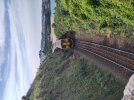
Had a great couple of days in Cornwall last week using mostly trains to get around (if we ignore the fact that I had a delay on literally every single day due to XC staffing or IET breakdowns...). I noticed on both the Newquay and St Ives branches that there were two extra rails mounted between the tracks on significant sections of these lines, and wondered what they were there for. Some kind of derailment protection? Track circuit?
 

Attachments

  • IMG_20250807_162812.jpg
    IMG_20250807_162812.jpg
    5.4 MB · Views: 336
Sponsor Post - registered members do not see these adverts; click here to register, or click here to log in
R

RailUK Forums

swt_passenger

Veteran Member
Joined
7 Apr 2010
Messages
34,256
Hi all,
Had a great couple of days in Cornwall last week using mostly trains to get around (if we ignore the fact that I had a delay on literally every single day due to XC staffing or IET breakdowns...). I noticed on both the Newquay and St Ives branches that there were two extra rails mounted between the tracks on significant sections of these lines, and wondered what they were there for. Some kind of derailment protection? Track circuit?
They’re clipped in place so the most likely reason is ‘guard rails’ for derailment protection, as you’ve worked out. I think in your photo the track extends onto a curved viaduct above a beach. Often you see these extra rails on what are more obviously bridges, but they can appear on the approach to various structures.
 

Siimo

Member
Joined
13 Aug 2025
Messages
51
Location
Junction of SW Main and West Coastway
They’re clipped in place so the most likely reason is ‘guard rails’ for derailment protection, as you’ve worked out. I think in your photo the track extends onto a curved viaduct above a beach. Often you see these extra rails on what are more obviously bridges, but they can appear on the approach to various structures.
Thanks, that was my initial guess. The picture is taken at the approach to St Ives, and I also spotted these on curves through the Luxulyan valley.
 

Wilts Wanderer

Established Member
Joined
21 Nov 2016
Messages
3,199
Thanks, that was my initial guess. The picture is taken at the approach to St Ives, and I also spotted these on curves through the Luxulyan valley.

There‘s definitely something like that between Luxulyan and St Blazey, possibly around Pontsmill Viaduct? IIRC there was a China clay train derailment a few years ago that caused some real damage and the vehicles fell down into a waterway or something like that.

You also commonly get guard rails on viaducts, to trap the flange of a derailed wheel set and prevent it crossing the 4ft which could lead to the vehicle falling from height.
 

Siimo

Member
Joined
13 Aug 2025
Messages
51
Location
Junction of SW Main and West Coastway
There‘s definitely something like that between Luxulyan and St Blazey, possibly around Pontsmill Viaduct? IIRC there was a China clay train derailment a few years ago that caused some real damage and the vehicles fell down into a waterway or something like that.

You also commonly get guard rails on viaducts, to trap the flange of a derailed wheel set and prevent it crossing the 4ft which could lead to the vehicle falling from height.
Yep, where I spotted them was exactly by the viaduct - I'd run over that and back across before descending the bank down to the river level (4x4 trail shoes for the win). Didn't see any freight movement on the line though.
 

I'm here now

Member
Joined
26 Aug 2023
Messages
240
Location
Cornwall
Yep, where I spotted them was exactly by the viaduct - I'd run over that and back across before descending the bank down to the river level (4x4 trail shoes for the win). Didn't see any freight movement on the line though.
It’s not frequent, runs at weird times and, as I understand, shall only get less frequent to/from Fowey Docks.
 

JKF

Established Member
Joined
29 May 2019
Messages
1,287
They have the rails on Pill viaduct. I wonder what the gauge of the inner rails is?

IMG_0552.jpeg
(Photo shows track across Pill viaduct with two rails in the four foot)
 

swt_passenger

Veteran Member
Joined
7 Apr 2010
Messages
34,256
I thought they helped keep the alignment of the curve.
That requirement normally uses a different solution, either vertical plates bolted on the sleeper ends extending down into the ballast, or a newer version fitted to the middle of the sleeper, (lateral restraint plates).
 

AlterEgo

Verified Rep - Wingin' It! Paul Lucas
Joined
30 Dec 2008
Messages
29,307
Location
LBK
Neither of the pictures are guard or check rails. These rails would be closer to the running rail if so.

The rails pictured in the OP and a subsequent post are there to prevent subsidence and slippage of the track on soft or inconsistent ground. They effectively hold the whole structure of the track more rigidly.

Pictured below are guard rails and a check rail.
 

Attachments

  • Shepherdstown_railroad_bridge_WV2.jpg
    Shepherdstown_railroad_bridge_WV2.jpg
    42.9 KB · Views: 101
  • images (1).jpeg
    images (1).jpeg
    14.4 KB · Views: 100

edwin_m

Veteran Member
Joined
21 Apr 2013
Messages
28,617
Location
Nottingham
Neither of the pictures are guard or check rails. These rails would be closer to the running rail if so.

The rails pictured in the OP and a subsequent post are there to prevent subsidence and slippage of the track on soft or inconsistent ground. They effectively hold the whole structure of the track more rigidly.

Pictured below are guard rails and a check rail.
A guard rail is fitted where there is a risk of a train that has been derailed going off the edge of a structure, typically because the parapet is insufficient to contain a derailment. They will usually be between the running rails but can be outside.

Your guard rail picture is American. The position of the guard rails depends on the width of the bridge, and must "catch" a derailed train before the opposite wheel falls off the edge. A British bridge would be wider than this, so the guard rails could be further in from the running rails. The British examples posted earlier may be due to ground conditions, but guard rails on bridges will typically be at a similar spacing.

Check rails are different. They need to be close enough to the running rail to leave only a flangeway gap, and prevent the wheelset moving across enough that the opposite wheel can jump over its rail. This "flange climbing" risk exists on tight curves - in the UK check rails are required on the inner rail of curves less than 200m radius. Short check rails are also fitted to points, opposite the crossing to prevent a wheel taking the wrong path through the flange gap.
 

D6130

Established Member
Joined
12 Jan 2021
Messages
9,000
Location
West Yorkshire/Tuscany
Guard rails are also fitted on much of the reopened Leven branch in Scotland. Presumably this is due to the tight reverse curvature.
 

edwin_m

Veteran Member
Joined
21 Apr 2013
Messages
28,617
Location
Nottingham
Guard rails are also fitted on much of the reopened Leven branch in Scotland. Presumably this is due to the tight reverse curvature.
Are these guard rails or check rails (photos above)? Curvature on its own is not usually a reason to provide guard rails.
 

D6130

Established Member
Joined
12 Jan 2021
Messages
9,000
Location
West Yorkshire/Tuscany
Are these guard rails or check rails (photos above)? Curvature on its own is not usually a reason to provide guard rails.
They're definitely not check rails as they are positioning close to the centre of the four foot, as per the photo in post #8. They may be strengtheners to hold the track together in an area of unstable ground conditions due to mining subsidence. They could also serve to keep the track formation rigid on the sharp reserve curves. Sorry, I can't provide a photo....but there must be at least one somewhere on line.
 

ac6000cw

Established Member
Joined
10 May 2014
Messages
3,909
Location
Cambridge, UK
They're definitely not check rails as they are positioning close to the centre of the four foot, as per the photo in post #8. They may be strengtheners to hold the track together in an area of unstable ground conditions due to mining subsidence. They could also serve to keep the track formation rigid on the sharp reserve curves. Sorry, I can't provide a photo....but there must be at least one somewhere on line.
Hopefully this might help - a screen capture from Google Streetview, looking west from Station Road overbridge in Cameron Bridge:

1755188996482.png
 

mcmad

Member
Joined
11 Mar 2015
Messages
1,073
They are used for both purposes, to guard against derailment risk or where tight curvature requires additional lateral resistance. The later historically has only been on steel sleepers which cannot take the bolt on ones but laterally on concrete sleepers as above as they are a quicker and cheaper solution.
 
Status
Not open for further replies.

Top