• Our new ticketing site is now live! Using either this or the original site (both powered by TrainSplit) helps support the running of the forum with every ticket purchase! Find out more and ask any questions/give us feedback in this thread!

'Extra' Rails in the Fourfoot

Status
Not open for further replies.

BestWestern

Established Member
Joined
6 Feb 2011
Messages
6,736
Evening All,

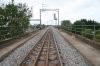
Arriving at Newport today for the first time in a while, I notice the NR boys have finished off the shiny new trackwork at the London end approach with a pair of 'extra' rails mounted in the fourfoot of the Up Main and Down Relief lines. Of course this isn't the only location we see this, but here the length of these rails in quite extensive, extending pretty much from Maindee Jcn's to the station throat. They're not spare or P-way junk, they're properly fixed and clipped, with breaks for the AWS magnets etc. I don't recall this arrangement having been in place before. Anybody enlighted us as to their purpose here?
 
Sponsor Post - registered members do not see these adverts; click here to register, or click here to log in
R

RailUK Forums

a good off

Member
Joined
2 Jul 2010
Messages
372
Location
Control Room
They are provided across the length of the river Usk viaduct. The idea is to try keep a derailed train upright as it traverses the viaduct as the wheel flanges would be guided in a straight line and minimise overall destruction. In an ideal world anyway...
 
Last edited:

es373

Member
Joined
19 May 2011
Messages
468
Location
London
I don't think so....

They are called Check Rails. Usually found in lower speed areas.

The idea is at high speed, the flange doesnt "steer" the train, the conicity on the active surface does. As we all know, when you turn a corner in a car, the inner wheel spins faster than the outer wheel, this is called a differential.
Train wheelsets are fixed to the axle there fore it is impossible to get an outer wheel spin faster.
As the train corners at high speed, the cant in the rail makes all wheelsets slightly shift left or right, making it corner fine.

At lower speeds, the flanges do steer the train as effectively they pull the train in the desired direction. The only supposed risk is the flange climbing over the railhead derailing the train - so - check rails are placed there to guide the flange and stop it climbing the rail head.

Hope this clears it up...


Or the spare rails could be ones left in the 4 foot in placement for track replacement.
 

ralphchadkirk

Established Member
Joined
20 Oct 2008
Messages
5,754
Location
Essex
es373 - there is a reason why you get rails fixed down the centre (i.e. not check rails), but I can't remember what for!
 

BestWestern

Established Member
Joined
6 Feb 2011
Messages
6,736
I don't think so....

They are called Check Rails. Usually found in lower speed areas.

The idea is at high speed, the flange doesnt "steer" the train, the conicity on the active surface does. As we all know, when you turn a corner in a car, the inner wheel spins faster than the outer wheel, this is called a differential.
Train wheelsets are fixed to the axle there fore it is impossible to get an outer wheel spin faster.
As the train corners at high speed, the cant in the rail makes all wheelsets slightly shift left or right, making it corner fine.

At lower speeds, the flanges do steer the train as effectively they pull the train in the desired direction. The only supposed risk is the flange climbing over the railhead derailing the train - so - check rails are placed there to guide the flange and stop it climbing the rail head.

Hope this clears it up...


Or the spare rails could be ones left in the 4 foot in placement for track replacement.

These are certainly not check rails, as they're in towards the centre of the sleepers, and they're not spare lengths of rail as they properly fitted and in neat parallel formation. Hmm.....
 

Yank 119

Member
Joined
29 Jul 2008
Messages
97
Location
Florence, South Carolina, USA
First response is likely correct. Check rails are used on points to guide the flanges in the manner described by the second response.

I would call the rails you describe as "guard rails" to keep a derailed train upright on a bridge. They do not guide the flanges in any way during normal operations.
 

BestWestern

Established Member
Joined
6 Feb 2011
Messages
6,736
They are provided across the length of the river Usk viaduct. The idea is to try keep a derailed train upright as it traverses the viaduct as the wheel flanges would be guided in a straight line and minimise overall destruction. In an ideal world anyway...

Sounds plausible!
 

Yank 119

Member
Joined
29 Jul 2008
Messages
97
Location
Florence, South Carolina, USA
So are the extra rails in the OP actually located on a bridge or viaduct?

From what I understand, yes.

Should look something like this example, which is in Canada:

CNRbridgeat20MileCreek5.jpg
 

GB

Established Member
Joined
16 Nov 2008
Messages
6,553
Location
Somewhere
That makes sense for bridges but the OP stated (after I re read it) they are on normal lines. Perhaps to aid support?
 

Ploughman

Established Member
Joined
15 Jan 2010
Messages
3,099
Location
Near where the 3 ridings meet
Technical term is Guard Rails.
Another poster did state that they were installed over a bridge so this would be the correct type of installation for that site.
They are, as stated, to keep any derailed vehicles in line across the structure in an attempt to prevent anything falling off the bridge etc. No mention about what happens when it reaches the embankment beyond the bridge though.

Check rails are installed on pointwork and on tight curves to keep the wheels from climbing the high rail or find a gap in the flangeway in pointwork
 

es373

Member
Joined
19 May 2011
Messages
468
Location
London
Technical term is Guard Rails.
Another poster did state that they were installed over a bridge so this would be the correct type of installation for that site.
They are, as stated, to keep any derailed vehicles in line across the structure in an attempt to prevent anything falling off the bridge etc. No mention about what happens when it reaches the embankment beyond the bridge though.

Check rails are installed on pointwork and on tight curves to keep the wheels from climbing the high rail or find a gap in the flangeway in pointwork


So why are there tonnes of check rails away from point work mainly on LUL (lower speeds) and in depots... Again at lower speeds. Never heard of Guard Rail.... Take a picture and upload it to here.
 

Hydro

Established Member
Joined
5 Mar 2007
Messages
2,204


So why are there tonnes of check rails away from point work mainly on LUL (lower speeds) and in depots... Again at lower speeds. Never heard of Guard Rail.... Take a picture and upload it to here.


Just because you've not heard of them, doesn't make it incorrect. Guard rails is absolutely correct.

Check rails are mounted on curves under a certain radius, and opposite the crossing noses on pointwork to ensure any potential excessive lateral movement on traverse is arrested, keeping the train on the correct route. LUL would probably have lots of check rails as I doubt that a great deal of cant can be applied to a curve due to the loading gauge, meaning that more flange contact will be inevitable raising the risk of flange climb.
 

es373

Member
Joined
19 May 2011
Messages
468
Location
London
Just because you've not heard of them, doesn't make it incorrect. Guard rails is absolutely correct.

Check rails are mounted on curves under a certain radius, and opposite the crossing noses on pointwork to ensure any potential excessive lateral movement on traverse is arrested, keeping the train on the correct route. LUL would probably have lots of check rails as I doubt that a great deal of cant can be applied to a curve due to the loading gauge, meaning that more flange contact will be inevitable raising the risk of flange climb.


At which point did I insinuate it was wrong because I've never heard of it?
 

Yank 119

Member
Joined
29 Jul 2008
Messages
97
Location
Florence, South Carolina, USA

At which point did I insinuate it was wrong because I've never heard of it?

Maybe it's because you said:

Never heard of Guard Rail.... Take a picture and upload it to here.

I read it as defensive in tone. To me, you were basically saying "I don't believe you, you're wrong unless you provide photos." Speaking of photos, I'd like to see some of your photos of those check rails on LUL. I am genuinely interested.

Also, a photo of this specific case at Newport would be nice.
 

a good off

Member
Joined
2 Jul 2010
Messages
372
Location
Control Room
At lower speeds, the flanges do steer the train as effectively they pull the train in the desired direction. The only supposed risk is the flange climbing over the railhead derailing the train - so - check rails are placed there to guide the flange and stop it climbing the rail head.

Hope this clears it up...


Or the spare rails could be ones left in the 4 foot in placement for track replacement.[/QUOTE]

Check rails are what you describe and these are not check rails. I stand by my first statement.

Thanks.
 

es373

Member
Joined
19 May 2011
Messages
468
Location
London
I cannot help the way you percieve written material on here and for your advice, I was being nothing of the sort. 'I don't think so' was purely me saying exactly that.
So I learned something new, that's what I'm here for. As reguards to the picture of the Guard Rail- just wanted to see what it looks like.
I shall get photos of check rails if you so wish, it may take a while as I do not plan on travelling on LU this week as I walk to my depot.
Sorry if you took my input the wrong way, again that's something I cannot help.
 
Last edited:

The Crab

Member
Joined
7 Apr 2011
Messages
271
I wonder whether there is any connexion with a thread posted some time ago, titled something like "Stones in the 4 foot at Newport". It had crossed my mind that they could be something to do with track stabilisation.
 

es373

Member
Joined
19 May 2011
Messages
468
Location
London
Hmm I was thinking maybe its also another way to keep sleepers rigid. As I presume you cannot have a Tamper go over viaduct - therefore if sleepers don't wiggle about as a train passes, no 'voids' or gaps can be created reducing the risk of premature track failure.

Just a thought though.
 

BestWestern

Established Member
Joined
6 Feb 2011
Messages
6,736
Just to confirm, they are indeed rails of the 'check' variety judging by the pics of identical set-ups elsewhere. My initial post was a little misleading since I suggessted that the rails extended right up into the station, which I now accept they probably don't - apologies to all, I only caught a quick glance in the middle of doing 20 things at once etc; my bad!
 

Ploughman

Established Member
Joined
15 Jan 2010
Messages
3,099
Location
Near where the 3 ridings meet

Never heard of Guard Rail.... Take a picture and upload it to here.
Don't need to.
There is a perfectly good photo just above your post.
--- old post above --- --- new post below ---
A picture of guard rail in situ.

Do I recognise that location as being Skelton bridge north of York?

If yes I was on the crew that installed the new layout there over Christmas a number of years back.
 

Old Timer

Established Member
Joined
24 Aug 2009
Messages
3,702
Location
On a plane somewhere at 35,000
...As I presume you cannot have a Tamper go over viaduct.
There is no restriction on a tamper working on a viaduct on the main line railway.

Tamping is not allowed where there is insufficient ballast depth or the track ballast is glued.

Guards rails will give very little rigidity to the track as they are intended purely to contain a wheel moving sideways, not to provide any means of track support.

The track failure conditions you describe can (and do) occur where there are guard rails.
 

es373

Member
Joined
19 May 2011
Messages
468
Location
London
Again, it was just a thought... one of the things I thought it may have been when I saw the picture a few hours after my first post.
Thanks anyway though.
 

Old Timer

Established Member
Joined
24 Aug 2009
Messages
3,702
Location
On a plane somewhere at 35,000
Again, it was just a thought... one of the things I thought it may have been when I saw the picture a few hours after my first post.
Thanks anyway though.
No worries old chap !

Please do feel free to ask anything else, all the Infrastructure chaps on here are more than happy to pass on information.

We dont bite - honestly ! :D
 

es373

Member
Joined
19 May 2011
Messages
468
Location
London
I shall learn it in time! Busy doing stock training at the moment....... :/
 

Trog

Established Member
Joined
30 Oct 2009
Messages
1,546
Location
In Retirement.
You can also find guard rail fitted steel sleepers on sharp curves, that are not on bridges.

The extra rails being used purely to add to the tracks lateral stiffness, to help prevent misalignment due to heat expansion.

OT Do I recognise the Up Birmingham at Rugby?
 
Status
Not open for further replies.

Top