Ivo
Established Member
Imagine the following scenario...
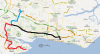
Two buses run along the same road for a substantial stretch of their respective journeys. In this specific case however, the two buses have differing extensions at one end; one takes 15 minutes and the other takes 40 minutes, with both having layovers of about eight minutes.
Seems quite straightforward right? If you don't understand it, look at the following diagram, in which each dot is equal to approximately three minutes' journey time in both unique and shared sections.
(This isn't a perfect diagram, but it's roughly correct. Also, there are eastern extensions to both routes as well.)
Now, in this same situation, assume that traffic levels are normal, to the point that all other services in the same area - both on the shared and unique stretches of route - are running normally. Therefore, these two routes should also be running normally, and as such if the two buses split up simultaneously then the northern one should rejoin the shared stretch when the southern one is waiting at its terminus.
So...
Could someone explain to me how exactly the same two buses could run on these routes pretty much together, on one return trip (i.e. outbound then inbound) in both directions?
This is exactly what happened to me on Thursday and I am not happy about it. My mother and I travelled on the northern one and in both directions I changed to the southern one (a short distance behind) and both times it overtook the northern one.
And this is not exactly a rare phenomenon either. Since then I have kept a record of every journey I have made with this operator and they have averaged delays of eight minutes which is three more than permitted. They have also been known for such delays for a long time. In fact, last Summer I tried recording running data for Traffic Commissioner consideration - but they just happened to go through a purple patch of reliability :roll:
I am now considering doing so again.
Anyhow, what reasonable excuses are there? The only one that could apply - traffic problems - is negated by (a) other routes running correctly and (b) the northern route running slower than the southern one on the shared stretch as well as its unique stretch.
I have kept the operators' names and routes under wraps to prevent any possible arguments about why each operator is good/bad. However, some of you will be able to identify the operators in question - and no, neither of them is named "First Somerset & Avon".
EDIT: See Post #29 for answers...
Two buses run along the same road for a substantial stretch of their respective journeys. In this specific case however, the two buses have differing extensions at one end; one takes 15 minutes and the other takes 40 minutes, with both having layovers of about eight minutes.
Seems quite straightforward right? If you don't understand it, look at the following diagram, in which each dot is equal to approximately three minutes' journey time in both unique and shared sections.
Code:
  .
  .
  .
  .
  .
. . . . . . . . . . . . . . . . . .
.
.
.
.
.
. . . . . . . .
(This isn't a perfect diagram, but it's roughly correct. Also, there are eastern extensions to both routes as well.)
Now, in this same situation, assume that traffic levels are normal, to the point that all other services in the same area - both on the shared and unique stretches of route - are running normally. Therefore, these two routes should also be running normally, and as such if the two buses split up simultaneously then the northern one should rejoin the shared stretch when the southern one is waiting at its terminus.
So...
Could someone explain to me how exactly the same two buses could run on these routes pretty much together, on one return trip (i.e. outbound then inbound) in both directions?
This is exactly what happened to me on Thursday and I am not happy about it. My mother and I travelled on the northern one and in both directions I changed to the southern one (a short distance behind) and both times it overtook the northern one.
And this is not exactly a rare phenomenon either. Since then I have kept a record of every journey I have made with this operator and they have averaged delays of eight minutes which is three more than permitted. They have also been known for such delays for a long time. In fact, last Summer I tried recording running data for Traffic Commissioner consideration - but they just happened to go through a purple patch of reliability :roll:
I am now considering doing so again.
Anyhow, what reasonable excuses are there? The only one that could apply - traffic problems - is negated by (a) other routes running correctly and (b) the northern route running slower than the southern one on the shared stretch as well as its unique stretch.
I have kept the operators' names and routes under wraps to prevent any possible arguments about why each operator is good/bad. However, some of you will be able to identify the operators in question - and no, neither of them is named "First Somerset & Avon".
EDIT: See Post #29 for answers...
Last edited:


 ), but that stretch of route is not applicable to this matter, except to say that I could tell that this 1 would be unusually slow even by 1 standards.