

• Our new ticketing site is now live! Using either this or the original site (both powered by TrainSplit) helps support the running of the forum with every ticket purchase! Find out more and ask any questions/give us feedback in this thread!

ETCS Roll-Out on ECML South Confirmed

Status
Not open for further replies.

snowball

Established Member
Joined
4 Mar 2013
Messages
8,144
Location
Leeds
Press release


Over the August Bank Holiday, Network Rail delivered a package of improvements worth over £2.8m to bring better, more reliable journeys for passengers between Hitchin and London terminals.


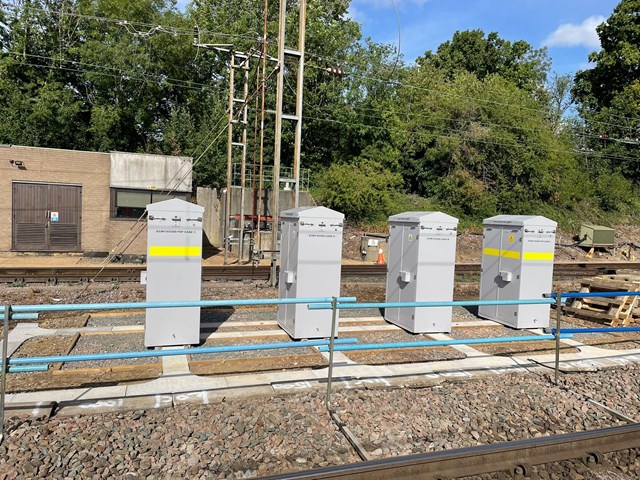
Progress was made on the East Coast Digital Programme, with 56 new cabinets installed to house the equipment needed to support a digital railway in the future. The once-in-a-generation programme will eventually see traditional signals removed from the side of the track and replaced with innovative digital signalling technology.

Installing this important infrastructure now will set the route up for an advanced new operating system, which will allow for continuous in-cab communication with train drivers by 2025 on the East Coast Main Line.
 
Sponsor Post - registered members do not see these adverts; click here to register, or click here to log in
R

RailUK Forums

LAX54

Established Member
Joined
15 Jan 2008
Messages
3,906
AIUI ETCS level 2 gets rid of the "lights on sticks", but there will still be a need for train detection equipment, and baileses to communicate with the trains.

Level 3 would get rid of much of the lineside kit but I think it's still largely theretical at this point.
and if, no sorry, when it all goes wrong, will ETCS prove better or worse than real signals ?
 

stuu

Established Member
Joined
2 Sep 2011
Messages
3,772
and if, no sorry, when it all goes wrong, will ETCS prove better or worse than real signals ?
There is much less to go wrong in the first place, especially much less equipment exposed to the elements. That is one of the major selling points of the whole design
 

najaB

Veteran Member
Joined
28 Aug 2011
Messages
33,719
Location
Scotland
There is much less to go wrong in the first place, especially much less equipment exposed to the elements. That is one of the major selling points of the whole design
Yeah, but it's new = different = bad.
 

zwk500

Veteran Member
Joined
20 Jan 2020
Messages
18,625
Location
Northampton
and if, no sorry, when it all goes wrong, will ETCS prove better or worse than real signals ?
It really depends on what parts of the system go wrong. There are less things to fail, and much of it will be computerised so should be quicker to fault-find and replace/reset. In addition it's easier (or more cost-effective) to build redundancy into the system, so the chances of a Movement Authority failing to be transmitted should be very low indeed.
There will still be track circuits, axle counters and points that can fail. The Train's DMI will also be a particular risk but then that's no different to a brake failure or traction motor problem. The block markers though will be simple reflectorised signs so unless the post gets clobbered it can't really fail. All the routing information will be on the driver's desk so no more bushes or sunlight obscuring signals.
 

MarkyT

Established Member
Joined
20 May 2012
Messages
7,595
Location
Torbay
The block markers though will be simple reflectorised signs so unless the post gets clobbered it can't really fail. All the routing information will be on the driver's desk so no more bushes or sunlight obscuring signals.
Block marker boards will still need to be 'sighted' and maintained so they are visible to drivers on final approach, but long-range visibility is not necessary so the inevitable costs and compromises in conventional signal positioning will be much less onerous. The passive markers should be able to be placed almost universally on short poles beside the track, or attached to adjacent structures provided for other purposes. Hopefully, vast dedicated structures just for signalling, crossing many tracks in complex areas should be avoidable.
 
Joined
12 Dec 2018
Messages
41
Block marker boards will still need to be 'sighted' and maintained so they are visible to drivers on final approach, but long-range visibility is not necessary so the inevitable costs and compromises in conventional signal positioning will be much less onerous. The passive markers should be able to be placed almost universally on short poles beside the track, or attached to adjacent structures provided for other purposes. Hopefully, vast dedicated structures just for signalling, crossing many tracks in complex areas should be avoidable.
So my understanding (as a signalling engineer not too familiar with etcs trting to remember this being previously explained to me by one who is) is that the end of authority distance on the dmi is what should be driven to, and that markerboards only really exist for degraded working. In fact etcs can have movement authorities ending at locations without marker boards in theory. (How much that idea will be reflected in what actualy gets implemented, never mind what goes into training/instructions to drivers is of course an entire other question which we won't know until after it's all done)
 

Wyrleybart

Established Member
Joined
29 Mar 2020
Messages
2,633
Location
South Staffordshire
ETCS Level 2 and up require on track balises but almost all will be "passive" balises that merely tell the train that it is now passing a certain point.

As for Level 3 being theoretical, sort of, at least as Level 3 was originally conceived.
But something approaching Level 3 appears ready for deployment - if you can have train integrity proving on all your trains. This is "Level 2/3 Hybrid" which has numerous other names.
From what I am interpreting, it is intended to be level 3 KGX-PBO, then level 2 PBO-Stoke. This means that a driver working KGX-LDS will be on Level 3 to Peterborough theoretically not seeing any signals, then level 2 with the in cab DMI and signals, then traditional MAS Stoke Tunnel - Leeds.

I get the impression DfT will be wanting a new brand of driver for this route.
 

The Planner

Veteran Member
Joined
15 Apr 2008
Messages
19,721
From what I am interpreting, it is intended to be level 3 KGX-PBO, then level 2 PBO-Stoke. This means that a driver working KGX-LDS will be on Level 3 to Peterborough theoretically not seeing any signals, then level 2 with the in cab DMI and signals, then traditional MAS Stoke Tunnel - Leeds.

I get the impression DfT will be wanting a new brand of driver for this route.
Clearly the descriptions are altering, level 3 was always considered moving block I thought? ECML isnt going to be that.
 

LAX54

Established Member
Joined
15 Jan 2008
Messages
3,906
Yeah, but it's new = different = bad.
We had , new, different in our PSB when it was brought into the 21st Century, almost indestructable, 3 computers run the system, plus a back up system :) when it works which is 90% of the time, its good, when it fails, as its all digital and computer controlled, it was a nightmare, well just job stopped until the S&T attended
 

Wyrleybart

Established Member
Joined
29 Mar 2020
Messages
2,633
Location
South Staffordshire
Clearly the descriptions are altering, level 3 was always considered moving block I thought? ECML isnt going to be that.
Beg your pardon.
I was under the impression that level 3 was no signals and translated to moving block, but you are very likely to be right. thought level 2 was with signals and level 3 was without so maybe level 1 is with signals, level 2 is without signals and level 3 is no signals and moving block.

I guess that the move from no signals to moving block is lots and lots of software ands upgrades
 

Railsigns

Established Member
Joined
15 Feb 2010
Messages
2,754
ETCS Level 2 can be designed either with or without lineside signals.
 

zwk500

Veteran Member
Joined
20 Jan 2020
Messages
18,625
Location
Northampton
Beg your pardon.
I was under the impression that level 3 was no signals and translated to moving block, but you are very likely to be right. thought level 2 was with signals and level 3 was without so maybe level 1 is with signals, level 2 is without signals and level 3 is no signals and moving block.

I guess that the move from no signals to moving block is lots and lots of software ands upgrades
Level 1 is linside signals with on-train PTC, Level 2 is in-cab signals but fixed block, level 3 is moving block. (Although lots of sub levels keep being crested by various national railways, like L2 overlay to maintain lineside signals)
 
Joined
12 Dec 2018
Messages
41
Clearly the descriptions are altering, level 3 was always considered moving block I thought? ECML isnt going to be that.
Yes, ECML etcs is all level 2.
Level 2 traditionally means no signals, but peterborough northwards will (like thameslink) have signals as an overlay for non etcs trains.
Level 3 isn't necessarily moving block; the level mainly is about the use of position report messages from trains rather than traditional trackside train detection (track circuits or axle counters) to work out what track sections are clear. You can do this and still keep long fixed blocks (though yes it is likely you'd have blocks short enough to look almost like moving block in busier areas)
 

Wyrleybart

Established Member
Joined
29 Mar 2020
Messages
2,633
Location
South Staffordshire
Yes, ECML etcs is all level 2.
Level 2 traditionally means no signals, but peterborough northwards will (like thameslink) have signals as an overlay for non etcs trains.
Level 3 isn't necessarily moving block; the level mainly is about the use of position report messages from trains rather than traditional trackside train detection (track circuits or axle counters) to work out what track sections are clear. You can do this and still keep long fixed blocks (though yes it is likely you'd have blocks short enough to look almost like moving block in busier areas)
So how does the level 2 signal overlay work for the person sat at the front. Do they have to observe all the signals and driver "conventionally" or do they driver to the DMI (if they have it) and ignore the signals outside ?

Hmmmm
 
Joined
12 Dec 2018
Messages
41
So how does the level 2 signal overlay work for the person sat at the front. Do they have to observe all the signals and driver "conventionally" or do they driver to the DMI (if they have it) and ignore the signals outside ?

Hmmmm
In theory probbably just to the dmi. I would expect that where signals exist, that they have cleared first might be proved before giving a (normal) movement authority past them to prevent misleading indications as you do quite rightly question. (I would similarly expect etcs to be able to offer a some form of degraded mode movement authority if the signal lamp proving fails, though that really is just me guessing on how I would resolve that issue so reality might be a little different )
I do know that in the thameslink core, signals will show a yellow aspect when an etcs route past it to an intemediate marker board is set (even when there is another train before the next actual signal)
 

XAM2175

Established Member
Joined
8 Jun 2016
Messages
3,471
Location
Glasgow
So how does the level 2 signal overlay work for the person sat at the front. Do they have to observe all the signals and driver "conventionally" or do they driver to the DMI (if they have it) and ignore the signals outside ?
In theory probbably just to the dmi. I would expect that where signals exist, that they have cleared first might be proved before giving a (normal) movement authority past them to prevent misleading indications as you do quite rightly question.
If a train is equipped with ETCS that's working properly, the driver will drive according to the Movement Authority shown on the DMI. A train running on the same line without ETCS, or with an inoperable or degraded installation, will be driven in the "conventional" manner according to the lineside signals.

The ETCS Radio Block Control system (RBC), which is attached to the signalling interlocking, knows whether a given train is running under ETCS or conventional control and ensures that trains under ETCS control are not shown a lineside aspect that conflicts with their Movement Authority. As noted a similar function exists in many CBTC installations and a number of other in-cab-plus-lineside systems.

There is some further discussion of the overlay concept in this paper from the IRSE's 2012 conference.
 

kevin_roche

Member
Joined
26 Feb 2019
Messages
997
If a train is equipped with ETCS that's working properly, the driver will drive according to the Movement Authority shown on the DMI. A train running on the same line without ETCS, or with an inoperable or degraded installation, will be driven in the "conventional" manner according to the lineside signals.

The ETCS Radio Block Control system (RBC), which is attached to the signalling interlocking, knows whether a given train is running under ETCS or conventional control and ensures that trains under ETCS control are not shown a lineside aspect that conflicts with their Movement Authority. As noted a similar function exists in many CBTC installations and a number of other in-cab-plus-lineside systems.

There is some further discussion of the overlay concept in this paper from the IRSE's 2012 conference.
I was interested to learn recently that on the ETCS L2 overlay installation between Paddington and Heathrow a driver of an ETCS-equipped train will not be shown a yellow aspect on a lineside signal when the next signal is a red. The DMI will show the driver when to start braking which means trains can continue at full speed for longer and thus capacity can be increased.
 

The Planner

Veteran Member
Joined
15 Apr 2008
Messages
19,721
I was interested to learn recently that on the ETCS L2 overlay installation between Paddington and Heathrow a driver of an ETCS-equipped train will not be shown a yellow aspect on a lineside signal when the next signal is a red. The DMI will show the driver when to start braking which means trains can continue at full speed for longer and thus capacity can be increased.
Its increased a bit, whether its enough to make a difference in a timetable I would suggest the jury is still out on.
 

D365

Veteran Member
Joined
29 Jun 2012
Messages
13,194
There is much less to go wrong in the first place, especially much less equipment exposed to the elements. That is one of the major selling points of the whole design
Also worth noting that a majority of the failures will be borne by the on-train equipment. Therefore, recovering from the majority of ETCS failures may well become quicker - drag the vehicle out of the way, or box in the cab.
 

zwk500

Veteran Member
Joined
20 Jan 2020
Messages
18,625
Location
Northampton
Its increased a bit, whether its enough to make a difference in a timetable I would suggest the jury is still out on.
I suspect one the Heathrow branch the impact will barely be felt as the line was never going to carry freight or loco hauled traffic so the signals will be at the optimum spacing for EMUs anyway.
It may well be a very different story when Azumas can use their proper braking curve instead of signal spacing designed for Intercity 225s at 125/140mph.
 

43066

Veteran Member
Joined
24 Nov 2019
Messages
12,089
Location
London
I was interested to learn recently that on the ETCS L2 overlay installation between Paddington and Heathrow a driver of an ETCS-equipped train will not be shown a yellow aspect on a lineside signal when the next signal is a red. The DMI will show the driver when to start braking which means trains can continue at full speed for longer and thus capacity can be increased.

Not sure that can be correct? The signals in the ETCS fitted TL core seem to follow the same sequence for all trains.
 

zwk500

Veteran Member
Joined
20 Jan 2020
Messages
18,625
Location
Northampton
Not sure that can be correct? The signals in the ETCS fitted TL core seem to follow the same sequence for all trains.
The TLncore has additional ETCS-only blocks between the normal signal berths though, its a slightly different setup
 

Annetts key

Established Member
Joined
13 Feb 2021
Messages
3,821
Location
West is best
Err, a couple of points…
Mechanical, electro-mechanical, and electrical interlocking/signalling systems are digital systems. A signal section is either occupied or not. A signal is either showing a defined indication/aspect or it’s not. A point is either free to move or locked (as far as the interlocking is concerned) and it’s position is either normal, reverse or out of correspondence.

Of course, by digital, the marketing people actually mean computer controlled. But this is nothing new in itself (SSI is now rather old…).

On the subject of failures, it’s never easy to compare different technologies. But the types of failures are both different and the same. The devil is in the detail. The so called modern digital systems will have failure modes that can still cause massive disruption.

Indeed, the current generation of Westlock Interlocking or Smartlock Interlocking can, and do have spectacular failure modes, as do the axle counter systems they often use for train detection.

And in actual fact, Route Relay Interlocking systems actually have a ridiculously high reliability figure.

The primary advantage is that level 3 ERTMS/ETCS has far less lineside cables, which are the most vulnerable part of any electrical/computer based signalling system.
 
Status
Not open for further replies.

Top