• Our new ticketing site is now live! Using either this or the original site (both powered by TrainSplit) helps support the running of the forum with every ticket purchase! Find out more and ask any questions/give us feedback in this thread!

Elmers End Down Bay Platform usage?

Status
Not open for further replies.

frankmoh

On Moderation
Joined
7 May 2025
Messages
817
Location
London
1755443012106.png

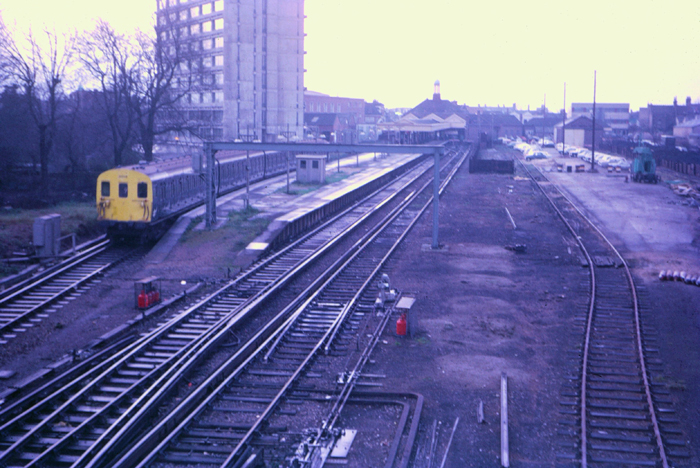
Surprisingly this is one of the only pictures I can find of Elmers End's down bay platform in use. What was it used for and how on earth did it stay open until 1975?

(Also when did it get removed?)
 
Sponsor Post - registered members do not see these adverts; click here to register, or click here to log in
R

RailUK Forums

Taunton

Veteran Member
Joined
1 Aug 2013
Messages
12,224
The line ran, certainly after the 1960s, just as a main London to Hayes service. There were 2-EPB shuttles from Elmers End to Addiscombe, and separately (in peak hours) to Sanderstead, which used the bays and the crossovers in varying combinations. At the end of each peak some trains ran through from London to Addiscombe, purely because the car shed was there..
 

Ashley Hill

Established Member
Joined
8 Dec 2019
Messages
5,572
Location
The West Country
View attachment 186514

Surprisingly this is one of the only pictures I can find of Elmers End's down bay platform in use. What was it used for and how on earth did it stay open until 1975?

(Also when did it get removed?)
Targets,Totems,semaphores and a box. What’s not to like! Lovely photo.
 

30907

Veteran Member
Joined
30 Sep 2012
Messages
21,922
Location
Airedale
The bay was very little used (apart for stabling, possibly - I'd have to check an old Carriage Working Notice later) from the 30s onwards because the growth of suburban housing turned the one-time Hayes branch into the main line.
In the 1963 timetable (selected at random online, but typical pre 1967) there is just one return trip at 4.56am from Hayes to Elmers End which must have used it (I suspect that was discontinued in 1967 but can't check).
It was retained when the layout was altered in the mid 50s as the vogue for rationalisation had not yet started; it was taken out when the line was transferred to the new London Bridge box around 1976.
 

frankmoh

On Moderation
Joined
7 May 2025
Messages
817
Location
London
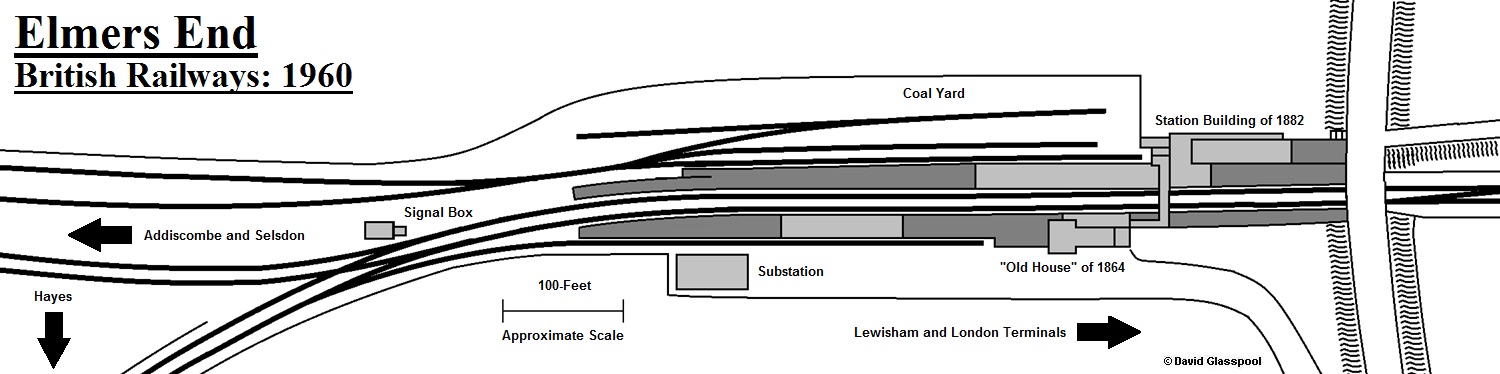
I also wonder why the coal yard stayed at the station up to at least 1960, even though the line was electrified in 1926? Also where did the Old House go? Presumably gone before the big Tesco or Bollom fire?

elmers_end_1960_final.jpg

Source: https://www.kentrail.org.uk/elmers_end_1960.htm
 

Bishopstone

Established Member
Joined
24 Jun 2010
Messages
1,685
Location
Seaford
Could Addiscombe and Sanderstead be reached from the down bay? The track layout isn’t quite clear enough to tell, in this photo.

Given the flow of London commuter traffic, an Up bay would be most useful in the morning peak, and a Down bay in the evening.
 

Gloster

Veteran Member
Joined
4 Sep 2020
Messages
12,942
Location
Up the creek
Looking at the 1957 diagram it appears that the Down Bay only served trains to and from Hayes, while the Up Bay only served those to the Woodside line. Both seem capable of handling both arrivals and departures.
 

Bodiam

Member
Joined
8 Jul 2025
Messages
105
Location
Kent, UK
I think that the main service pre - electrification would have been from London to Addiscombe, with most Hayes branch trains being shuttles to/from Elmer's End.
 

frankmoh

On Moderation
Joined
7 May 2025
Messages
817
Location
London
I think that the main service pre - electrification would have been from London to Addiscombe, with most Hayes branch trains being shuttles to/from Elmer's End.
Funny how after the war it swapped around and Addiscombe was the less important line.
 

Taunton

Veteran Member
Joined
1 Aug 2013
Messages
12,224
I also wonder why the coal yard stayed at the station up to at least 1960, even though the line was electrified in 1926?


Source: https://www.kentrail.org.uk/elmers_end_1960.htm
Nothing to do with coal for locomotives; it was for coal delivered by the wagonload for local coal merchants, as up to around 1955 the vast majority of houses heated by coal fires. After the considerable winter smogs of the 1950s in London coal fires were restricted, and then banned, people had to change to alternative heating, and the coal merchants lost their business, as did the once-daily local freights that brought it to many London suburban stations, commonly after the morning peak. Coal for domestic use often came from the East Midlands, and was a key freight traffic lost to the railway.
 

Chrius56000

Member
Joined
18 Aug 2010
Messages
262
Location
Walsall
View attachment 186514

Surprisingly this is one of the only pictures I can find of Elmers End's down bay platform in use. What was it used for and how on earth did it stay open until 1975?

(Also when did it get removed?)
. . .Which brings me to the inevitable question – Elmers End certainly DID get B.R. Southern Region Green Totem Signs (any colour pics of Elmers End from this Era?), but how come B.R. left at least one Ex–S.R. "Target" sign on the platform lamp–posts?

. . .(I believe there were quite a number of S. Region stations where B.R. only made a half–hearted job of converting stations to full B.R./Totem signage!)

Chris Williams
 

The exile

Established Member
Joined
31 Mar 2010
Messages
9,310
Location
Somerset
Nothing to do with coal for locomotives; it was for coal delivered by the wagonload for local coal merchants, as up to around 1955 the vast majority of houses heated by coal fires. After the considerable winter smogs of the 1950s in London coal fires were restricted, and then banned, people had to change to alternative heating, and the coal merchants lost their business, as did the once-daily local freights that brought it to many London suburban stations, commonly after the morning peak. Coal for domestic use often came from the East Midlands, and was a key freight traffic lost to the railway.
Though coal traffic to Tolworth (?) on the Chessington branch continued until relatively recently (compared with the photo, that is)

== Doublepost prevention - post automatically merged: ==

. . .Which brings me to the inevitable question – Elmers End certainly DID get B.R. Southern Region Green Totem Signs (any colour pics of Elmers End from this Era?), but how come B.R. left at least one Ex–S.R. "Target" sign on the platform lamp–posts?

. . .(I believe there were quite a number of S. Region stations where B.R. only made a half–hearted job of converting stations to full B.R./Totem signage!)

Chris Williams
At a guess “we’ve been told to exchange these signs. No one’s said anything to do with the extra ones, so we’ll leave them” ( assuming fewer new ones supplied than old ones fitted)
 

yorksrob

Veteran Member
Joined
6 Aug 2009
Messages
44,263
Location
Yorks
I see the new signs are on the new concrete lamp posts on the platform extension, where as the old one is on a traditional SER lamp post, so I assume they hadn't got round to changing the pre existing ones.
 

ChiefPlanner

Established Member
Joined
6 Sep 2011
Messages
8,311
Location
Herts
Nothing to do with coal for locomotives; it was for coal delivered by the wagonload for local coal merchants, as up to around 1955 the vast majority of houses heated by coal fires. After the considerable winter smogs of the 1950s in London coal fires were restricted, and then banned, people had to change to alternative heating, and the coal merchants lost their business, as did the once-daily local freights that brought it to many London suburban stations, commonly after the morning peak. Coal for domestic use often came from the East Midlands, and was a key freight traffic lost to the railway.

Alan A Jackson covered these lines in commendable detail in "Londons Local Railways" - with regard to Elemers End , (home of a station manager into the 1980's - which looked after Hayes to Catford Bridge plus branches) , freight was largely driven by the needs of Lower Sydenham gasworks with up 4 workings a day (from North End sidings Erith) , but there was a bespoke at 0300 Bricklayers Arms to Addiscombe calling at Catford Bridge and Clock House , plus an 0407 Bricklayers Arms to Hayes calling at Catford
Bridge and Elmers End as required , followed by a late evening return to the "Brick" ...

These terminals ceased in 1963 to 1964 , as demand for both gas coal and domestic coal declined , though in the late 1960's I recall decent numbers of HTV's (branded "House Coal Concentration" being despatched via Acton Yard to Beckenham Junction CCD. Best quality Gwaun Cae Gurwen beans and stovesse for the acres of 1930's housing and their boilers.
 

Taunton

Veteran Member
Joined
1 Aug 2013
Messages
12,224
Coal Concentration Depots were a 1950s-60s initiative of the railway to move on from local stations each having their own siding with resident coal merchant hand-shovelling from wagon to coal bag, to a centralised, mechanised high volume area depot, some large enough to have their own diesel shunter. Unfortunately the investment coincided with the rapid (very, in the case of London) elimination of household coal, and likewise the changeover of gas supply from gasworks to natural gas.
 

30907

Veteran Member
Joined
30 Sep 2012
Messages
21,922
Location
Airedale
Coal Concentration Depots were a 1950s-60s initiative of the railway to move on from local stations each having their own siding with resident coal merchant hand-shovelling from wagon to coal bag, to a centralised, mechanised high volume area depot, some large enough to have their own diesel shunter. Unfortunately the investment coincided with the rapid (very, in the case of London) elimination of household coal, and likewise the changeover of gas supply from gasworks to natural gas.
IIRC Beckenham Jn opened in 1965, diesel shunter and all. Now Waitrose :)
 

frankmoh

On Moderation
Joined
7 May 2025
Messages
817
Location
London
That's gentrification for you !
Given that Elmers End's former coal yard is a now the station's car park, I think it's inevitable. I think having South Norwood Country Park instead of a sewage farm is more desirable. Hopefully someone who lived in the area at the time could tell me what it smelt like.

Also, even little old Bromley North used to have a good yard! Nowadays it's a car park for offices.

Source: https://www.kentrail.org.uk/bromley north 2.htm
bromley_north_1970_12_12.jpg
 
Status
Not open for further replies.

Top