
-
Our new ticketing site is now live! Using either this or the original site (both powered by TrainSplit) helps support the running of the forum with every ticket purchase! Find out more and ask any questions/give us feedback in this thread!
You are using an out of date browser. It may not display this or other websites correctly.
You should upgrade or use an alternative browser.
You should upgrade or use an alternative browser.
Electrification fencing requirements??
- Thread starter Meerkat
- Start date
- Status
- Not open for further replies.
Sponsor Post - registered members do not see these adverts; click here to register, or click here to log in
R
RailUK Forums

High Dyke
Established Member
Not sure of specific requirements, but new installation are usually of the metal palisade type fencing.
That would sure look pretty on the sea wall!!Not sure of specific requirements, but new installation are usually of the metal palisade type fencing.

GRALISTAIR
Established Member
With heavy HDG - really thick zinc coating and very regular organic coating too. I cant think of a more corrosive environment.That would sure look pretty on the sea wall!!
(HDG = hot dip galvanized)
Last edited:

Philip Phlopp
Established Member
- Joined
- 31 May 2015
- Messages
- 3,003
There's no single answer, but for Dawlish, it won't be palisade fencing if/when the time comes.
At track level and for track access, fencing is determined by a risk assessment matrix - that's why 125mph 25kV electrified track in open country will get a robust wire fence with wooden posts, as you move into more populated areas with a higher risk of trespassing, welded mesh fencing will be acceptable and then around stations or in areas with trespass problems, it's palisade fences or similar. Third rail will raise the risk factor and may well see palisade fencing rather than welded mesh for an otherwise similar section of track, since trespass with DC is more likely to be life ending than trespass with AC.
Palisade fencing is the usual culprit but there are plenty of other options available to ensure the track access prevention fits in with surroundings.
In cuttings and in many other situations, fencing will be deployed to ensure there's no way to get too close to the OLE itself - and given the risk there, palisade fencing can be more prevalent based on risk assessments.
The sea wall at Dawlish is getting a shiny new wall in sections, which meets the current requirements for keeping the public away from the track and will probably be fine if/when the line is electrified at 25kV AC. I'd certainly be much more concerned with kite flying on the beach getting an electric shock, than I am about a trespasser getting into a position of danger with regards to the OLE.
At track level and for track access, fencing is determined by a risk assessment matrix - that's why 125mph 25kV electrified track in open country will get a robust wire fence with wooden posts, as you move into more populated areas with a higher risk of trespassing, welded mesh fencing will be acceptable and then around stations or in areas with trespass problems, it's palisade fences or similar. Third rail will raise the risk factor and may well see palisade fencing rather than welded mesh for an otherwise similar section of track, since trespass with DC is more likely to be life ending than trespass with AC.
Palisade fencing is the usual culprit but there are plenty of other options available to ensure the track access prevention fits in with surroundings.
In cuttings and in many other situations, fencing will be deployed to ensure there's no way to get too close to the OLE itself - and given the risk there, palisade fencing can be more prevalent based on risk assessments.
The sea wall at Dawlish is getting a shiny new wall in sections, which meets the current requirements for keeping the public away from the track and will probably be fine if/when the line is electrified at 25kV AC. I'd certainly be much more concerned with kite flying on the beach getting an electric shock, than I am about a trespasser getting into a position of danger with regards to the OLE.
GRALISTAIR
Established Member
Absolute no doubt in my mind that flying a kite or similar on the beach would be my greatest concern.
That’s scary - I guess a kite ban on the beach would be the only real mitigation.Absolute no doubt in my mind that flying a kite or similar on the beach would be my greatest concern.
Do you get folks wandering along the wall with fishing gear?
Thanks for the responses

themiller
Established Member
I doubt that there'd be a danger to the kite flyer as kites generally have nylon control lines which aren't conductive. On the other hand, would the kite and/or strings be a problem to a pantograph?Absolute no doubt in my mind that flying a kite or similar on the beach would be my greatest concern.
I doubt that there'd be a danger to the kite flyer as kites generally have nylon control lines which aren't conductive. On the other hand, would the kite and/or strings be a problem to a pantograph?
They are conductive if they are wet.
And yes. See this link
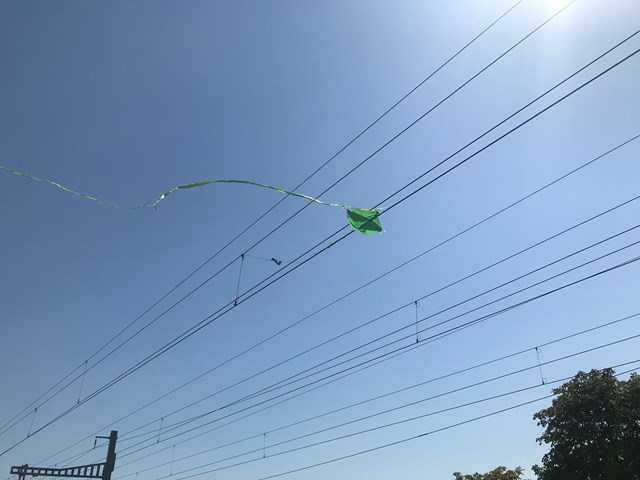
Overhead electric wires warning after kite flyers risk their lives
Network Rail has issued a warning about the dangers of overhead electric wires after kite flyers in Buckinghamshire risked their lives and caused delays for passengers because they were flying too close to the railway.
 www.networkrailmediacentre.co.uk
themiller
Established Member
I don’t believe that wet strings are a problem otherwise wet insulators would bring the railway to a stand!They are conductive if they are wet.
And yes. See this link
Overhead electric wires warning after kite flyers risk their lives
Network Rail has issued a warning about the dangers of overhead electric wires after kite flyers in Buckinghamshire risked their lives and caused delays for passengers because they were flying too close to the railway.

I don’t believe that wet strings are a problem otherwise wet insulators would bring the railway to a stand!
The difference between a wet string and a wet insulator however is that the string gets soggy (and remains conductive) whilst the insulator sheds the water off!
I don’t believe that wet strings are a problem otherwise wet insulators would bring the railway to a stand!
They do, frequently!
They are conductive if they are wet.
And yes. See this link
Overhead electric wires warning after kite flyers risk their lives
Network Rail has issued a warning about the dangers of overhead electric wires after kite flyers in Buckinghamshire risked their lives and caused delays for passengers because they were flying too close to the railway.
I'll wait with bated breath for the 3rd rail fanbois to come along and tell us that if only we electrified the network with 3rd rail, kites wouldn't be a problem......
I'll wait with bated breath for the 3rd rail fanbois to come along and tell us that if only we electrified the network with 3rd rail, kites wouldn't be a problem......
Right up to when the kite lands on the con rail!

Midnight Sun
Member
- Joined
- 16 Sep 2018
- Messages
- 310
I don’t believe that wet strings are a problem otherwise wet insulators would bring the railway to a stand!
On June 10, 1752
Benjamin Franklin flies a kite during a thunderstorm and collects ambient electrical charge in a Leyden jar(primitive capacitor) , enabling him to demonstrate the connection between lightning and electricity. Fly a kite string close to a high voltage line you collect the ambient electrical charge given off the line.
Had Franklin's kite been hit by lightning, just as if a wet kite string touching a overhead power line. Will result in a high risk of electrocution and in some case death.
Old Rugelian
New Member
We are going off topic but there is doubt the American carried out the experiment although he did propose it: https://www.mentalfloss.com/article/66551/true-story-behind-ben-franklins-lightning-experimentOn June 10, 1752
Benjamin Franklin flies a kite during a thunderstorm and collects ambient electrical charge in a Leyden jar....
Midnight Sun
Member
- Joined
- 16 Sep 2018
- Messages
- 310
That is just one view of the story, In the modern retelling of the story, Ben Franklin’s kite is struck by lightning and the electrical current travels down the hemp rope to the metal key. When Franklin touched the key, he received an electrical shock. That’s probably not how it happened, though. Most scientists today believe that if Franklin’s kite had, indeed, been struck by lightning, Franklin would have been instantly killed. Instead, they theorize, the kite picked up the ambient electrical charges from the thunderstorm which was enough to give the key a mild zing when touched. Which was point I made. As to what happen on day in question we only have Joseph Priestley account and Franklin statement in the Pennsylvania Gazette of October 19, 1752, .We are going off topic but there is doubt the American carried out the experiment although he did propose it: https://www.mentalfloss.com/article/66551/true-story-behind-ben-franklins-lightning-experiment
https://founders.archives.gov/documents/Franklin/01-04-02-0135
It is a fact that people have been killed flying kites into power lines.
Last edited:
Philip Phlopp
Established Member
- Joined
- 31 May 2015
- Messages
- 3,003
It is a fact that people have been killed flying kites into power lines.
Absolutely.
We need to be clear that flying kites around 25kV AC OLE is a highly dangerous activity which should always be discouraged and where possible prohibited by relevant local authority bye-laws.
- Status
- Not open for further replies.