• Our new ticketing site is now live! Using either this or the original site (both powered by TrainSplit) helps support the running of the forum with every ticket purchase! Find out more and ask any questions/give us feedback in this thread!

Double headed locos.

Status
Not open for further replies.

BoroAndy

Member
Joined
11 Jan 2020
Messages
272
Location
Scarborough
I also wonder what the control system is like on a double or triple header train. Even if the two locos have the engine revs perfectly synchronisef and gears identical, it is impossible for two machines to be identical, so the power to the wheels has to be slightly different across the locos, so some wheel slippage must be occuring resulting in excess wear and tear, and loss of power and efficiency.
 
Sponsor Post - registered members do not see these adverts; click here to register, or click here to log in
R

RailUK Forums

Joined
28 Oct 2017
Messages
251
it is impossible for two machines to be identical, so the power to the wheels has to be slightly different across the locos
So far, so good

so the power to the wheels has to be slightly different across the locos, so some wheel slippage must be occuring
No, that doesn't follow at all.

A locomotive doesn't operate at a fixed speed, it operates at a fixed power (as you said). Power is the product of torque and speed. The more torque the locomotive has to provide (the more pulling force), then the slower it moves. Whichever locomotive is higher geared will do more work (marginally), but neither set of wheels slides. You never quite get double the power like you hoped for. but it works.

Two people pushing a car, one of them stronger than the other, neither slides, the car moves faster than either could move it alone.
 

Ken H

Established Member
Joined
11 Nov 2018
Messages
6,718
Location
N Yorks
With all the BR classes with blue star coupling code some ecclectic mixes were possible. Cl20+Cl45 for instance. It must have been quite clever to make locos with such diverse characteristics work together.
This link to wiki has some stuff about multiple operation and also lists classes by coupling code.

(Locos had a code, actually a coloured skape, painted close to the jumpers so the shunter knew if compatible.)
 

norbitonflyer

Established Member
Joined
24 Mar 2020
Messages
5,660
Location
SW London
I also wonder what the control system is like on a double or triple header train. Even if the two locos have the engine revs perfectly synchronisef and gears identical, it is impossible for two machines to be identical, so the power to the wheels has to be slightly different across the locos, so some wheel slippage must be occuring resulting in excess wear and tear, and loss of power and efficiency.
That would only be the case if the engine revs were synchronised and they had mechanical transmissions. With an electric or hydraulic transmission the wheel speed is not fixed with relation to engine revs (that's why you don't need a gear lever in an electric car).

In practice, even with a mechanical transmission such as a dmu or a steam locomotive, the engine revs will adjust to the road speed - the power output will thus be a compromise between the two engines. (this is true even for the individual cylinders in an single engine)
 

Western 52

Established Member
Joined
19 Jun 2020
Messages
1,672
Location
Burry Port
Many years ago, a friend of my father's, who was a design engineer for the Ford motor company, asked me a question. If two locos are double heading, and they are not well matched, surely one is either pushing or pulling the other? I was young at the time and it gave me something to think about!
 

Basher

Member
Joined
6 Oct 2017
Messages
343
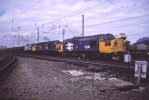
This question brings back memories of watching the iron oar trains going into Ravenscraig Steel Plant. They usually had 3 class 37s pulling. What a site and atmospheric sensation
 

Attachments

  • IMG_0008.jpg
    IMG_0008.jpg
    1.3 MB · Views: 77

hexagon789

Veteran Member
Joined
2 Sep 2016
Messages
18,285
Location
Glasgow
With all the BR classes with blue star coupling code some ecclectic mixes were possible. Cl20+Cl45 for instance. It must have been quite clever to make locos with such diverse characteristics work together.
It was actually very simple, most locos of the period used a control air system to control the engine speed. The Blue Star system used control air pipes to link locos and the multiple working was thus afforded through air pressure (hence the E&G Cl. 27 push-pull Mk2 coaches having through control air pipes fitted). It varied class to class but as an example 5psi might represent the 'On' position, and 45psi 'Full'.
 

y3j

Member
Joined
29 Nov 2019
Messages
21
I also wonder what the control system is like on a double or triple header train. Even if the two locos have the engine revs perfectly synchronisef and gears identical, it is impossible for two machines to be identical, so the power to the wheels has to be slightly different across the locos, so some wheel slippage must be occuring resulting in excess wear and tear, and loss of power and efficiency.
If what you say was true then that does make the 45+ year old HST a bit of a dead duck, doesn't it?
 

zwk500

Veteran Member
Joined
20 Jan 2020
Messages
18,401
Location
Northampton
Am I right in thinking that there is a distinction between double- or triple-heading where each loco is crewed individually, and Multiple working where all locos are under the control of the same driver? Or are both terms used interchangably?
 

popeter45

Established Member
Joined
7 Dec 2019
Messages
1,477
Location
london
I wonder what could be done these days with modern network based Machine to Machine controls?, could run everything from shunters to high speed multible units under the same core system allowing a load of flexability (e.g. control a shunter pushing a EMU around a depo from the EMU's cab or even remote control of 2 trains coupling up from a platform view all as a standardised system)
 

norbitonflyer

Established Member
Joined
24 Mar 2020
Messages
5,660
Location
SW London
Am I right in thinking that there is a distinction between double- or triple-heading where each loco is crewed individually, and Multiple working where all locos are under the control of the same driver? Or are both terms used interchangably?
Yes. As I understand it if they are all under control of one driver that is multiple working (the original "meaning of multiple-unit") whereas if the engines are being controlled by different drivers but the continuous brake is under the control of the driver in the leading cab that is "tandem" working. (Just as on a tandem bicycle!)
 

Pigeon

Member
Joined
8 Apr 2015
Messages
1,123
Many years ago, a friend of my father's, who was a design engineer for the Ford motor company, asked me a question. If two locos are double heading, and they are not well matched, surely one is either pushing or pulling the other? I was young at the time and it gave me something to think about!

No, but the tension in the front coupling will be slightly more or less than half that in the rear one, instead of exactly half in the ideal case.
 

norbitonflyer

Established Member
Joined
24 Mar 2020
Messages
5,660
Location
SW London
With all the BR classes with blue star coupling code some ecclectic mixes were possible. Cl20+Cl45 for instance. It must have been quite clever to make locos with such diverse characteristics work together.

Did the driver have to sign both classes?
 

Taunton

Veteran Member
Joined
1 Aug 2013
Messages
12,220
It's no different to a multiple unit set with multiple power cars, or even a Western Region Hydraulic with two engines, which drove the two bogies independently. They never match perfectly, but each just contributes power to the whole formation, with little differences in how the couplers are in tension or compression.

Interesting article in the USA Trains magazine by a mechanical engineer. The US loco multiple unit control system is highly standardised, with groups of locos from different builders, ages and powers all able to be run together from the front cab. It showed some combinations, such as adding a 1200hp switcher to the consist, would have no impact on speed at all, but if placed at the back it did. And so on. Increasingly nowadays in the US instead of huge loco combinations at the front (four was common, I have seen up to eight), the locos are distributed along the train, controlled remotely by radio from the front.

 

ac6000cw

Established Member
Joined
10 May 2014
Messages
3,888
Location
Cambridge, UK
It's no different to a multiple unit set with multiple power cars, or even a Western Region Hydraulic with two engines, which drove the two bogies independently. They never match perfectly, but each just contributes power to the whole formation, with little differences in how the couplers are in tension or compression.
Exactly - it's like people on a tug-of-war rope, each one adds it's own force and unless they slip they all progress over the ground at the same rate. In the railway context - if you have a direct mechanical coupling between wheels and the 'engine' (be that steam, diesel or electric motor) - it's the rotation rate of the wheels that determines the rotational speed of the 'engine', not the other way round. The steam pressure/diesel fuel combustion/electric current just provides the force to make things move. The only time that doesn't apply is when the force applied exceeds the available adhesion and the wheel slips (rotates faster).

The US loco multiple unit control system is highly standardised, with groups of locos from different builders, ages and powers all able to be run together from the front cab. It showed some combinations, such as adding a 1200hp switcher to the consist, would have no impact on speed at all, but if placed at the back it did. And so on. Increasingly nowadays in the US instead of huge loco combinations at the front (four was common, I have seen up to eight), the locos are distributed along the train, controlled remotely by radio from the front.
Yes - Canadian Pacific make very extensive use of 'distributed power' in the western mountains, partly because they found it reduced rail wear in curves (due to reduced lateral forces as a function of reduced longitudinal forces within the train) and partly to allow longer & heavier trains over that sort of steeply graded and twisty route.

I assume the experiments with adding the 'switcher' at the rear worked better for the same reason - reduced lateral forces so reduced rolling resistance overall (= faster speeds with the same power).

Interesting article in the USA Trains magazine by a mechanical engineer.
Do you know which issue that was in?
 

plarailfan

Member
Joined
6 Feb 2013
Messages
172
Location
56D
This youtube clip shows what can happen when double heading. The train is being hauled by some SD40-2's which our class 59 / 66 locomotives were based on, here in the UK.
The train is climbing a gradient and the wheelslip system is not performing 100% - perhaps due to the challenging environment. The rails may be slippery or damp ?
The caption mentions, that Knuckle couplers have been broken in the past, at this location
 

Whistler40145

Established Member
Joined
30 Apr 2010
Messages
6,149
Location
Lancashire
With all the BR classes with blue star coupling code some ecclectic mixes were possible. Cl20+Cl45 for instance. It must have been quite clever to make locos with such diverse characteristics work together.
This link to wiki has some stuff about multiple operation and also lists classes by coupling code.

(Locos had a code, actually a coloured skape, painted close to the jumpers so the shunter knew if compatible.)
Plus Blue Star fitted locos had control air pipes, which were necessary when locos were working in multiple
 

Taunton

Veteran Member
Joined
1 Aug 2013
Messages
12,220
Do you know which issue that was in?
Sorry, only when I was in the USA, probably 30-40 years ago.

== Doublepost prevention - post automatically merged: ==

The caption mentions, that Knuckle couplers have been broken in the past, at this location
The USA does seem to get far more coupler breaks than here, having trains of such a weight and length that it can be on downhill, uphill, and downhill again, all at the same time, and you get a surging "slack action" through the train.

Those wonderful stories by David L Smith about the Glasgow & South Western Railway 100 years ago likewise describe challenging runs with unbraked wagons and very regular breakaways, with a notable comic element.
 
Last edited:

ac6000cw

Established Member
Joined
10 May 2014
Messages
3,888
Location
Cambridge, UK
This youtube clip shows what can happen when double heading. The train is being hauled by some SD40-2's which our class 59 / 66 locomotives were based on, here in the UK.
The train is climbing a gradient and the wheelslip system is not performing 100% - perhaps due to the challenging environment. The rails may be slippery or damp ?
As the description by 'Hotspots Southeast' on YouTube says (with my bolding):

On this day the train was very long and one of the units was having problems with the anti-slip system. This section of track is on a hill and long trains often have trouble with it. 154 for example has broken knuckles several times on this hill. If you walk down the track at Suwanee you will find several broken knuckles left rusting by the side of the tracks. Sand is used to help the wheels get traction but in this case the problem was not sand. Once the wheels start to slip the anti-slip system should have stopped the wheels from spinning but it didn't. The crew was aware of the problem, the noise was intense and the sparks could be seen from the front of the train. The proper course of action would have been to stop and ask dispatch for assistance. Additional power could have been added the the front or another train could have pushed on the rear to get them over the hill. Once the train was over the hill it was able to move properly again. The track in this section was severely damaged by the grinding wheels and had to be torn out and replaced.

SD40-2's are (for their design age) very good at wheelslip control. If you want a contrast between more modern DC-drive locos in controlled wheelslip/wheelcreep (screaming loudly on wet rails) at the head of a train and a set of SD40-2 shoving hard on the rear, just slipping a little, have a look at this (my video - the SD40-2 are at about the 1:30 point):

 
Status
Not open for further replies.

Top