• Our new ticketing site is now live! Using either this or the original site (both powered by TrainSplit) helps support the running of the forum with every ticket purchase! Find out more and ask any questions/give us feedback in this thread!

Do direct London services actually matter?

Status
Not open for further replies.

Bletchleyite

Veteran Member
Joined
20 Oct 2014
Messages
113,234
Location
"Marston Vale mafia"
It generally isn't a problem in Switzerland because they have a lot more slack/padding in their timetabling, meaning that it's relatively rare for those kinds of delays of develop in the first place. If we adopted that same practice on our much more intensively used network then it would mean significantly reduced capacity and extended journey times (at least until we upgraded the network to counter that. So for a very long time...), which would hardly be a good way to attract and retain passengers.

It's possible and has been done in some places (albeit to a bit of whining). The south WCML post COVID timetable is slightly less frequent than before, based on a 2tph pattern (though rather than upping to 12 car for the peaks it's mostly done by peak extras, probably because 8 is easier to platform at Euston and avoiding splitting/joining increases resilience). Similarly the Cross City has been reduced to 4tph from 6 but running everything as double units so capacity isn't lost.
 
Sponsor Post - registered members do not see these adverts; click here to register, or click here to log in
R

RailUK Forums

yorkie

Forum Staff
Staff Member
Administrator
Joined
6 Jun 2005
Messages
78,335
Location
Yorkshire
It generally isn't a problem in Switzerland because they have a lot more slack/padding in their timetabling, meaning that it's relatively rare for those kinds of delays of develop in the first place. If we adopted that same practice on our much more intensively used network then it would mean significantly reduced capacity and extended journey times (at least until we upgraded the network to counter that. So for a very long time...), which would hardly be a good way to attract and retain passengers.
I was expecting these myth to be mentioned, and was prepared for them
;):D

I refer you to these posts from someone who is originally from the UK but now resident in Switzerland:
... I'm currently in Switzerland where railway infrastructure is used more intensively than anywhere else in Europe and almost every train I've been on has had 1-5 minutes' delay at some point in the journey.
...but I don't think that the timetables otherwise have significantly more slack that anywhere else. SBB's figures show that their infrastructure is the most intensively used in Europe. A lot of the secondary lines (and even some main lines in places) are single track, the movements around major stations are very dense.
 

Bletchleyite

Veteran Member
Joined
20 Oct 2014
Messages
113,234
Location
"Marston Vale mafia"
It's perhaps of note that the slack, where it exists, is usually at the interchange stations rather than all at the end.

The practice of Avanti timing Euston-MKC at 30 minutes and almost every single train reaching there a couple of minutes late would not occur in Switzerland, for instance, because it would make a mess of connections. Indeed, I get rather a lot of 15 minute Delay Repay claims due to exactly that kind of sloppiness breaking fairly short connections there southbound. But the Avanti that breaks that connection would likely be on time at Euston.

(I might not live in CH now but I effectively did in 2010-2011, albeit on a weekly-commute basis and still legally UK resident).

CH might use the infrastructure fairly heavily but the key is that it's designed for the service.
 

Ghostbus

On Moderation
Joined
17 Sep 2024
Messages
331
Location
England
It seems that most towns and cities across the UK seem to desire a direct London service. Wouldn’t better connecting services to London trains be better for places like Cleethopes and Sunderland which aren’t very big in themselves and could do with better local services anyway?
Sunderland (ranked 60th) has a bigger population than York (97) and Darlington (221), their near neighbours on the ECML in terms of London chains.

Darlington and York are relatively isolated and self contained barring their onward rail connections compared to Sunderland. They perhaps depend on their London trains in particular and the ECML in general to support their populations and businesses far more than Sunderland, which has neither.

So I guess Sunderland has a desire, but not necessarily coming from need. Not that the railway should be inhibiting aspiration. But it should be clear that's what it's trying to do in such cases, fulfilling an aspiration not an unmet need.

Note that Sunderland, York and Darlington are all pretty close to the long distance road network, specifically the road to London.
 

etr221

Established Member
Joined
10 Mar 2018
Messages
1,589
2m59 sec, every cancelled train counts as one that is late, with more detail available here

My guess would be around 85%, but really not sure

Looking at the SBB stats on the link given by Trainbike46, apart from an overall 93% train punctuality (Definition from site: Percentage share of all punctual trains. A train is considered punctual if it arrives at its stops with fewer than three minutes’ delay. The measurement is based on the commercial timetables for trains from Monday to Sunday, and takes into account all stops. Trains cancelled at short notice are considered late), there is a figure of 98.7% (steady over the last three years) for 'Connection punctuality in Passenger Services' (Definition: Percentage share of all connections reached. A connection is considered to have been reached if the fixed interchange time between two trains at the transfer station is provided. The directions of the arriving and departing trains are not taken into account. Trains for which the interchange time exceeds 30 minutes are no longer considered connections.)

Is there a GB network equivalent figure for 'Connection punctuality'? (If so, what is it?)
 

The Ham

Veteran Member
Joined
6 Jul 2012
Messages
12,036
I was expecting these myth to be mentioned, and was prepared for them
;):D

I refer you to these posts from someone who is originally from the UK but now resident in Switzerland:

TL: DR - the answer is the UK vs Switzerland is close and complicated but there's an argument that is close enough that on key routes the UK probably is more intensively used.

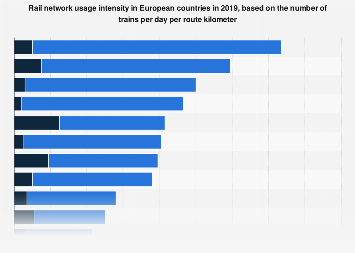
There's few things I would say, actually they are incorrect about Switzerland being the highest, the Netherlands is more intensively used (2019 data):


Secondly, the UK isn't that far behind (100 vs 119) however that's UK wide, and I wonder how much closer it would be if you were to look at England only.

As whilst (as I understand it) there's lots of rural branch lines in Switzerland there's some very long fairly lightly used lines in places like Scotland and Wales.

Also, it's not clear from that link if the UK includes London underground (I think it does exclude it) as if it doesn't then that's going to affect the result. I'm not saying it should, but if you exclude a chunk of the London metro services but include all of those from Switzerland that's going to alter the outcome.

An interesting fact (looking at the 2021 data) for those countries which split it out the UK had both the highest usage (train km per network km) of their railways when split between Electric railways and Diesel railways.

The UK elected railways at 126 then actually beats the Swiss network (which is famously nearly entirely electric),

Figures 8 & 9:

Bottom line is fairly close, and so on key routes there's an argument that the UK is more intensively used and so anything which interacts with those routes are going to be risky to inject by adding delays.
 

The exile

Established Member
Joined
31 Mar 2010
Messages
9,361
Location
Somerset
It's rare because there's generally enough slack to avoid knock-on. The phenomenon was perhaps a bit more visible in Germany in the 90s on a Saturday when people were making cheap connectional long distance journeys on the Wochenendticket. These days of course DB is just a mess generally.
Echoing my initial reaction to experiencing travel in countries then renowned for the ability to set your watch by the running times of trains:”It’s fairly easy to run a punctual railway when even IC trains run at 50mph with 10 minute stops at stations”. Bit of an exaggeration, but one with a lot of truth in it. Timetable slack is a Good Thing.

== Doublepost prevention - post automatically merged: ==

Any concept of regaining time when late would appear to imply that the train schedule was padded in the first place. Most trains already run to line
Which is a major contribution to the problem- they shouldn’t.
 

cle

Established Member
Joined
17 Nov 2010
Messages
5,633
Sunderland (ranked 60th) has a bigger population than York (97) and Darlington (221), their near neighbours on the ECML in terms of London chains.

Darlington and York are relatively isolated and self contained barring their onward rail connections compared to Sunderland. They perhaps depend on their London trains in particular and the ECML in general to support their populations and businesses far more than Sunderland, which has neither.

So I guess Sunderland has a desire, but not necessarily coming from need. Not that the railway should be inhibiting aspiration. But it should be clear that's what it's trying to do in such cases, fulfilling an aspiration not an unmet need.

Note that Sunderland, York and Darlington are all pretty close to the long distance road network, specifically the road to London.
Not to be too reductive - and being on main lines has a HUGE impact here (both for faster/more directs, and hubs/railheadding) - but also not all places are equal. Population does not really determine rail demand. Those factors of the extant rail network I mentioned do, as do basic economics.

Sunderland is a post-industrial, fairly depressed place - high population but not high performing. Not much inbound visiting, tourism, business demand etc. York has all of the makings (traditionally important, attractive city, lots of tourist appeal - history, shopping, rail, races, and business travel) - plus a star location on the ECML with sub-2 hour trains to London.

You can't compare the likes of Sunderland and Bradford which are oversized regional towns but economically 'small' in practice. Highly suburbanized too which means leak to the bigger centres - ie Newcastle and Leeds dominate. Imagine what Crewe or Doncaster would be like without their rail gifts... I'd probably add Preston to that too. It's a huge huge factor.
 

Indigo Soup

Established Member
Joined
17 May 2018
Messages
1,485
The LNER services from Inverness and Aberdeen to London are phenomenally useful - not just because they go to London, but because they also go to the stations south of Edinburgh and north of London. That eliminates the change in Edinburgh, and the potential for cascading missed connections if travelling to somewhere off the ECML.

It's a pity there aren't equivalent WCML services, though understandable as there's no sensible way to route them.
 

Bletchleyite

Veteran Member
Joined
20 Oct 2014
Messages
113,234
Location
"Marston Vale mafia"
The LNER services from Inverness and Aberdeen to London are phenomenally useful - not just because they go to London, but because they also go to the stations south of Edinburgh and north of London. That eliminates the change in Edinburgh, and the potential for cascading missed connections if travelling to somewhere off the ECML.

It's a pity there aren't equivalent WCML services, though understandable as there's no sensible way to route them.

In BR days there was a daily direct Aberdeen CrossCountry that ran via the WCML, though I forget where it originated down south, it was possibly the Wessex or Sussex Scot? I've been on it when I was a kid. Curiously it was at the time the only train that stopped at Barry Links and Golf Street. Possibly more use than a service from Euston (as after all people from Milton Keynes can pop down to Kings Cross if they prefer boring themselves to tears at the drab ECML scenery/getting a sore backside over a change at Glasgow Central/Queen St). It was HST worked.
 

stevieinselby

Established Member
Joined
6 Jan 2013
Messages
1,690
Location
Selby
Not to be too reductive - and being on main lines has a HUGE impact here (both for faster/more directs, and hubs/railheadding) - but also not all places are equal. Population does not really determine rail demand. Those factors of the extant rail network I mentioned do, as do basic economics.

Sunderland is a post-industrial, fairly depressed place - high population but not high performing. Not much inbound visiting, tourism, business demand etc. York has all of the makings (traditionally important, attractive city, lots of tourist appeal - history, shopping, rail, races, and business travel) - plus a star location on the ECML with sub-2 hour trains to London.

You can't compare the likes of Sunderland and Bradford which are oversized regional towns but economically 'small' in practice. Highly suburbanized too which means leak to the bigger centres - ie Newcastle and Leeds dominate. Imagine what Crewe or Doncaster would be like without their rail gifts... I'd probably add Preston to that too. It's a huge huge factor.
There's a large element of chicken-and-egg there – towns and cities that developed because they had good rail connections are now more economically successful and so demand better rail connections. If the government is serious about any form of levelling up for the more economically depressed parts of the country then better rail connections can be a key driver to that.

One aspect that has been slightly glossed over in this is the role that being a region's second city can play. Bradford, Sunderland and Bolton are all big enough to merit a decent intercity service in their own right, but because they very much play second fiddle to Leeds, Newcastle and Manchester respectively, those cities' main stations act as a railhead for the surrounding area, and so as long as they have decent local connections to a main hub that has often been seen as adequate for those second cities. (I'm not saying that it is necessarily right or appropriate, but it's definitely a consideration). In that light, it's a little bit surprising that Wolverhampton does get an extension beyond Birmingham on all the ICWC services, but that may be more down to historical service patterns and being on a through line to the north.
 

dk1

Veteran Member
Joined
2 Oct 2009
Messages
19,863
Location
East Anglia
The LNER services from Inverness and Aberdeen to London are phenomenally useful - not just because they go to London, but because they also go to the stations south of Edinburgh and north of London. That eliminates the change in Edinburgh, and the potential for cascading missed connections if travelling to somewhere off the ECML.

It's a pity there aren't equivalent WCML services, though understandable as there's no sensible way to route them.

Yes the trouble is those that did run like ‘The Clansman’ avoided Glasgow which was a major traffic and revenue generator.
 

AndrewE

Established Member
Joined
9 Nov 2015
Messages
7,335
Yes the trouble is those that did run like ‘The Clansman’ avoided Glasgow which was a major traffic and revenue generator.
but nowadays with the dramatically improved central belt rail network there might be more scope for somewhere like Motherwell to serve as a hub - in addition to the destination further north.

On the original topic, as I hardly ever go to London these days I would say that (for me) a far better express or semi-fast service from Brum to the NW and Scotland would be far preferable to yet more London services. (and better inter-Regional services across N England are needed too.)
 

Bald Rick

Veteran Member
Joined
28 Sep 2010
Messages
35,771
In that light, it's a little bit surprising that Wolverhampton does get an extension beyond Birmingham on all the ICWC services, but that may be more down to historical service patterns and being on a through line to the north.

Partly historic, Partly to provide capacity on the corridor, but mostly because the rolling stock depot, Drivers‘ depot and catering depot are all at Wolverhampton.
 

dk1

Veteran Member
Joined
2 Oct 2009
Messages
19,863
Location
East Anglia
Partly historic, Partly to provide capacity on the corridor, but mostly because the rolling stock depot, Drivers‘ depot and catering depot are all at Wolverhampton.

I was just about to post ‘Oxley’ but you beat me to it.

== Doublepost prevention - post automatically merged: ==

Operational convenience will always rule.
 

cactustwirly

Established Member
Joined
10 Apr 2013
Messages
8,409
Location
UK
From my perspective, my local station has both options.
Direct service London or a train to Reading and change.

Although there are plenty of trains to Reading from London, there is a wait for the connection and it's not especially pleasant if it's cold outside, there is also a 10 minute time penalty for doing so. For this sort of station with a relatively large flow to London it should have direct services.

However stations like Cleethorpes it makes sense to have a connection as the flow isn't big enough to justify it, plus the time penalty as a %of the overall journey time is much smaller
 

Palmerston

Member
Joined
4 Oct 2024
Messages
210
Location
Hampshire
Yes the trouble is those that did run like ‘The Clansman’ avoided Glasgow which was a major traffic and revenue generator.
Are the services from Euston to Stirling due to begin this year? Were they missing Glasgow?
 

The Ham

Veteran Member
Joined
6 Jul 2012
Messages
12,036
Interesting to see UK rail passenger miles ahead of France, given the standard press comment would usually talk one up and the other down.

The numbers in figure 7 are how intensively the railways are used based on numbers of trains per km of network per day which would imply that France could run double the number of trains and be on a par with the UK (although if rail use increased accordingly the French would average four times the British, as they already travel an average of 1,447km per inhabitant vs the UK's 775km).

The numbers in figure 27 are billions of passenger km's which shows that (2021, so a fairly low point in train travel due to COVID) France is at 70.3bn passenger km whilst the UK is at 30.8bn passenger km.

Although the 2019 data shows a much closer set of numbers with France at 93.5bn and the UK at 71.8bn (difference of 22.7bn vs 39.5).


johntea

Established Member
Joined
29 Dec 2010
Messages
3,034
Grand Central and Pontefract Monkhill is an interesting case (presumably due to Open Access and pathing and various other considerations)

All services to London Monday - Saturday call there, but Sunday all services bypass it

Then returning from London you need to be on the first 2 departures out if you want the direct call as the other 2 departures bypass it - presuming there isn't a major delay however all it means in reality is alight P3 at Wakefield Kirkgate, and there is a Northern service to Knottingley scheduled just behind on the same platform

On Saturday however the first 3 departures skip it and the last departure does make a call! (again tough luck on Sunday)

It is quite an 'odd' feeling in some ways spending a day in London then alighting in good old Pontefract :D
 

Harpo

Established Member
Joined
21 Aug 2024
Messages
3,831
Location
Newport
In that light, it's a little bit surprising that Wolverhampton does get an extension beyond Birmingham on all the ICWC services, but that may be more down to historical service patterns and being on a through line to the north.
Wolves is a shocking example of London connectivity with one train per hour each way off peak and journey times of 1hr 50+. So awful in fact that it’s faster via Stafford.

By comparison, in 1h 55 the fast Euston to Glasgow gets to Wigan.
 

Trainbike46

Established Member
Joined
18 Sep 2021
Messages
4,371
Location
belfast
Wolves is a shocking example of London connectivity with one train per hour each way off peak and journey times of 1hr 50+. So awful in fact that it’s faster via Stafford.

By comparison, in 1h 55 the fast Euston to Glasgow gets to Wigan.
curious - I thought all Avanti Birmingham trains served Wolverhampton - either as Euston-Wolverhampton via Birmingham or as Euston-Scotland via West Mids. Has that changed?
 

Bletchleyite

Veteran Member
Joined
20 Oct 2014
Messages
113,234
Location
"Marston Vale mafia"
curious - I thought all Avanti Birmingham trains served Wolverhampton - either as Euston-Wolverhampton via Birmingham or as Euston-Scotland via West Mids. Has that changed?

The semifast (which presently doesn't run in every hour) doesn't go past New St. Nor does the second fast. It was only ever one an hour (peaks aside) to Wolves.

Wolves and Cov are similar places, but Cov gets all three. This however is just because of where it is - I'm sure if the cities were the other way round the service would be too.

The Wolves origin Pendolinos (there are a few odd ones) are generally very quiet north of New St, demonstrating low demand for this service.
 

Harpo

Established Member
Joined
21 Aug 2024
Messages
3,831
Location
Newport
curious - I thought all Avanti Birmingham trains served Wolverhampton - either as Euston-Wolverhampton via Birmingham or as Euston-Scotland via West Mids. Has that changed?
No. Off peak, Wolves only gets the Euston - Somewhere North Of Brum once an hour. Other Birminghams turn at New Street.
 

dk1

Veteran Member
Joined
2 Oct 2009
Messages
19,863
Location
East Anglia
curious - I thought all Avanti Birmingham trains served Wolverhampton - either as Euston-Wolverhampton via Birmingham or as Euston-Scotland via West Mids. Has that changed?

No, that’s only really the case with up services first thing and down services last thing for operational reasons. During the day it’s only ever been hourly.
 

43096

On Moderation
Joined
23 Nov 2015
Messages
18,785
No, that’s only really the case with up services first thing and down services last thing for operational reasons. During the day it’s only ever been hourly.
Indeed, back in BR days the EBW service was hourly with a Euston-Birmingham in the opposite half hour. Even the extension of the Wolves service northwards has precedent: from memory the old Clansman service to Inverness ran via Wolverhampton.
 

Krokodil

Established Member
Joined
23 Jan 2023
Messages
6,558
Location
Wales
I'm sorry but i massively disagree with a lot of this. Poor timetabling? Just not true, our timetabling is generally very good.
Define "poor timetabling". The timetable can be very robust from an operational point of view, but are poor from the passengers' point of view. Or vice versa. So it depends which aspect you are considering. I would say that the GB timetable frequently falls short in respect of integration between services.

The Swiss respectfully disagree.
They'll hold for a few minutes which can sometimes be a struggle in the UK (I've frequently been in the position of having to request holds of northbound Avantis at Warrington. "Three minutes max" or just "no". They can make up three minutes, and it would help if the signaller routed us onto the main (which was clear at the time) rather than having us cross over at 10mph from the Helsby lines. The fragmentation between operators really doesn't help with cooperation.

Too many trains, not enough platforms. That isnt poor timetabling, that is poor specification and rinsing as much revenue as possible.
In many places that is the case. I can also point to specific examples where the only reason that a potential connection doesn‘t line up is that no one considered the question.

Bottom line is fairly close, and so on key routes there's an argument that the UK is more intensively used and so anything which interacts with those routes are going to be risky to inject by adding delays.
Doesn't the southern WCML hold some sort of European record for being busy?

The numbers in figure 7 are how intensively the railways are used based on numbers of trains per km of network per day
Route km or track km? Yorkie might claim that the Swiss railways are more intensively used than ours but I've a feeling that if you looked at the occupancy rate of a given track circuit in the throat of a major station, the British one is occupied more, simply because of the lack of grade separation and the use of ladders or even sections of single track to save money when BR "rationalised" in the 1980s.
 

dk1

Veteran Member
Joined
2 Oct 2009
Messages
19,863
Location
East Anglia
Indeed, back in BR days the EBW service was hourly with a Euston-Birmingham in the opposite half hour. Even the extension of the Wolves service northwards has precedent: from memory the old Clansman service to Inverness ran via Wolverhampton.

Yes I’m sure it did. Got an few old GBTTs in the attic.
 
Status
Not open for further replies.

Top