• Our new ticketing site is now live! Using either this or the original site (both powered by TrainSplit) helps support the running of the forum with every ticket purchase! Find out more and ask any questions/give us feedback in this thread!

DMU basic questions

Status
Not open for further replies.

hexagon789

Veteran Member
Joined
2 Sep 2016
Messages
18,361
Location
Glasgow
Pullman was an American company. So no surprised it brought 'Car' for sleeping car, to Europe.
I'm not convinced that it's definitely American in origin, though it remains possible, because the first sleeping car was on the London and Birmingham in 1838 and it was referred to as a 'bed-carriage'.

Is it beyond possibity that the 'carriage' in 'bed-carriage' was the original contraction to 'car'?

== Doublepost prevention - post automatically merged: ==

Yes, AFAIK 'car' is an abbreviation of 'carriage', and in general use is probably now the dominant form of the term.

As others have said it got imported into the UK railway lexicon from North America where most rail vehicles that carry things are 'cars' of one sort or another - passenger car, MU car, freight car (box car/flat car/well car/tank car/lumber car/hopper car - 'gondola' is the odd one out, their name for an open box vehicle). They used to have rail 'motor cars' which were basically motorised maintenance trolleys, like our 'Wickham trolleys' of old - now essentially extinct, replaced with road-rail vehicles.
I'm not convinced that it's definitely American in origin, though it remains possible, because the first sleeping car was on the London and Birmingham in 1838 and it was referred to as a 'bed-carriage'.

Is it beyond possibity that the 'carriage' in 'bed-carriage' was the original contraction to 'car'?


EDIT - apologies for the split reply, but I can't seem to merge it properly to reply to both members as one.
 
Sponsor Post - registered members do not see these adverts; click here to register, or click here to log in
R

RailUK Forums

Fleetwood Boy

Member
Joined
11 Oct 2017
Messages
244
The 124 Trans-Pennine had the only non-driving motor cars of all the First Gen units.

As introduced and until the buffet cars were removed the units were formed:

DMC
MBSK
TSL
TFKRB
MBSK
DMC

This gave 1,840hp from eight 230bhp Leyland Albion engines for the demanding gradients of the Liverpool-Hull route. In later years the units were progressively reduced to 4-car and often mixed with 123 vehicles on transfer. Some of the MBSK having the engines removed.


They were originally on the ScR formed as effectively two 3-car sets with the intermediate Driving Motors in the middle coupled cab-to-cab. However there was little need to separate units in normal service, as they pretty much always worked as a 6-car formation on the E&G service, and it was decided it was more logical and practical to form the trailers in the middle with all the first class together and the power cars to the outside. This also gave the advantage that if a leading motor car developed a control air defect, it could be removed and it would reveal a usable driving cab on the next vehicle in. I have seen a photo of a set with two intermediate motors leading.

The 79xxx sets actually started out on the WR and they formed their sets as two divisible 9-car formations.

These being formed:

DMBSL-TFK-DMBSL*/DMBSL*-TFKRB-DMBSL*/DMBSL*-TFK-DMBSL

(* denotes intermediate driving motor)

The Class 126 which were based directly on the 79xxx cars were always formed as 3-car units in the conventional manner with two motors sandwiching a trailer. As continues today on Strathclyde, 6-car sets would be formed at peak times and split into 3-car units for off-peak working. Though certainly in earlier years the 126s sometimes worked as 9-car formations at particularly busy times.
Two things have just occurred to me reading these fascinating replies. Firstly, that the first class accommodation in the longer-distance "express" DMUs was all compartments, so the ability of first class passengers to partake of anything from the buffet/restaurant would have meant balancing it on your knee back in your compartment - no first open accommodation available for dining/drinking?

And secondly, why on earth did the Scottish Region order the Class 126s? If they wanted "up market" stock for the longer-distance services to Girvan, why not just standardise on the 120s which they took anyway? The two white circle fleets never met each other, so no need for routine compatibility until in later years a few white circle trailers were transferred to Ayrshire (when surely they could have been converted to blue star - the two white circle sets of stock weren't routinely compatible and the cascaded 79xxx cars had to be modified anyway)?
 

hexagon789

Veteran Member
Joined
2 Sep 2016
Messages
18,361
Location
Glasgow
Two things have just occurred to me reading these fascinating replies. Firstly, that the first class accommodation in the longer-distance "express" DMUs was all compartments, so the ability of first class passengers to partake of anything from the buffet/restaurant would have meant balancing it on your knee back in your compartment - no first open accommodation available for dining/drinking?

And secondly, why on earth did the Scottish Region order the Class 126s? If they wanted "up market" stock for the longer-distance services to Girvan, why not just standardise on the 120s which they took anyway? The two white circle fleets never met each other, so no need for routine compatibility until in later years a few white circle trailers were transferred to Ayrshire (when surely they could have been converted to blue star - the two white circle sets of stock weren't routinely compatible and the cascaded 79xxx cars had to be modified anyway)?
The 124s had open seating in both classes.

In the 124s TransPennine units the DMC were all open seating - 2+1 in First Class. In the TFKRB, there were two tables of four for dining by the buffet counter, additionally meals could be served in the three compartments by use of folding tables.

The 79xxx cars had the exact same arrangement in their TFKRB except they had three tables of 4 instead if only two.

The 79xxx and later 126 did work together. Originally wiring restrictions meant they could not but a modification was performed to allow the two batches to multi. There are records of mixed sets on Edinburgh-Dundee, on various specials, the two Ayrshire batch buffet cars were transferred to the E&G after only a few years as the facility was not well patronised on Stranraer runs. Also for many years there was a long standing mixed early morning diagram into Glasgow St Enoch from Ayr formed of 8 coaches, two intermediate E&G DMBS leading two Ayrshire 3-car sets. On arrival at St Enoch they split. The rear three-car returning to Ayr via Dalry the 5-car with its 4 power cars then formed a diagram working over the gradients of the North Johnstone loop line.

There are also records of ex-WR cars worked mixed sets to Girvan in 1960 shortly after the rewiring was completed alomg all the cars. I understand the ex-WR cars were done last.
 
Last edited:

matchmaker

Established Member
Joined
8 Mar 2009
Messages
1,890
Location
Central Scotland
When the Swindon Inter City units were introduced between Edinburgh and Glasgow in 1956, the by then closed Leith Central Station was converted into a depot for servicing and stabling them.
 

Fleetwood Boy

Member
Joined
11 Oct 2017
Messages
244
The 124s had open seating in both classes.

In the 124s TransPennine units the DMC were all open seating - 2+1 in First Class. In the TFKRB, there were two tables of four for dining by the buffet counter, additionally meals could be served in the three compartments by use of folding tables.

The 79xxx cars had the exact same arrangement in their TFKRB except they had three tables of 4 instead if only two.

The 79xxx and later 126 did work together. Originally wiring restrictions meant they could not but a modification was performed to allow the two batches to multi. There are records of mixed sets on Edinburgh-Dundee, on various specials, the two Ayrshire batch buffet cars were transferred to the E&G after only a few years as the facility was not well patronised on Stranraer runs. Also for many years there was a long standing mixed early morning diagram into Glasgow St Enoch from Ayr formed of 8 coaches, two intermediate E&G DMBS leading two Ayrshire 3-car sets. On arrival at St Enoch they split. The rear three-car returning to Ayr via Dalry the 5-car with its 4 power cars then formed a diagram working over the gradients of the North Johnstone loop line.

There are also records of ex-WR cars worked mixed sets to Girvan in 1960 shortly after the rewiring was completed alomg all the cars. I understand the ex-WR cars were done last.
Fascinating insights thanks. And I’d forgotten the DMCs in the Trans Pennine sets.
I still the ScR could have just gone with blue star 120s rather than the 126s. Would have made it easier to make up mixed sets like the one you describe for the North Johnstone loop. You may have unintentionally also answered another question I’ve long pondered, which was why on earth the line via Lochwinnoch and Kilbirnie closed in favour of one which doesn’t serve anywhere significant en route to Dalry, especially before Howwood reopened (and bearing in mind there’s still no station at Beth).
Thanks.
 

hexagon789

Veteran Member
Joined
2 Sep 2016
Messages
18,361
Location
Glasgow
And I’d forgotten the DMCs in the Trans Pennine sets.
I can put up the official diagrams if you wish a glance, might be if interest.

They are freely available and I've put up others before so I don't see an issue.


You may have unintentionally also answered another question I’ve long pondered, which was why on earth the line via Lochwinnoch and Kilbirnie closed in favour of one which doesn’t serve anywhere significant en route to Dalry, especially before Howwood reopened (and bearing in mind there’s still no station at Beth).
Gradients as mentioned?

Higher speeds sustainable? (The current line allowed 75mph continuously from Paisley to just past Irvine, which nowadays is 90mph throughout from Johnstone).

4 track section layer reduced to goods loops? (Ie needed for the level or traffic that still existed until, quite simply, it didn't - the alternative route to Dalry lasted until 1973).

I don't really know, that's just some of the things that came to mind.
 

randyrippley

Established Member
Joined
21 Feb 2016
Messages
5,382
Wasn't one of the problems with Diesels being maintained in steam sheds was the amount of dirt in the old buildings causing issues with delicate diesel parts. Only later did they discover that maintaining diesels in a clean environment increased reliability.
Definitely reported as a problem on the WR with soot getting into the hydraulic fluid
 

Taunton

Veteran Member
Joined
1 Aug 2013
Messages
12,352
Fascinating insights thanks. And I’d forgotten the DMCs in the Trans Pennine sets.
I still the ScR could have just gone with blue star 120s rather than the 126s. Would have made it easier to make up mixed sets like the one you describe for the North Johnstone loop. You may have unintentionally also answered another question I’ve long pondered, which was why on earth the line via Lochwinnoch and Kilbirnie closed in favour of one which doesn’t serve anywhere significant en route to Dalry, especially before Howwood reopened (and bearing in mind there’s still no station at Beth).
Thanks.
I guess the intention was to have the 126s as a common fleet with the E&G units, although ending up being different. It is strange however; the later conventional 120s for Aberdeen-Inverness, despite the car numbers being widely separated, followed the Ayrshire units out of Swindon works only a couple of months later - both types entered service in the latter half of 1959.

Also strange is why the Scottish Region went for the White Circle E&G units in the first place, as when they were built in 1957 Blue Square units were also coming into use, which overcame the issues with the original Yellow Diamond controls.
 
Last edited:

Fleetwood Boy

Member
Joined
11 Oct 2017
Messages
244
I can put up the official diagrams if you wish a glance, might be if interest.

They are freely available and I've put up others before so I don't see an issue.


Gradients as mentioned?

Higher speeds sustainable? (The current line allowed 75mph continuously from Paisley to just past Irvine, which nowadays is 90mph throughout from Johnstone).

4 track section layer reduced to goods loops? (Ie needed for the level or traffic that still existed until, quite simply, it didn't - the alternative route to Dalry lasted until 1973).

I don't really know, that's just some of the things that came to mind.
That’s interesting thanks. I’ll need to check Timetable World sometime again, but I seem to remember running times for stoppers via either route were about the same and as I said the loop had better located stations. My theory has always been that they simply kept the line that was perceived as the main line rather than looking at the actual places served. We’ll probably never know.
 

Ken H

Established Member
Joined
11 Nov 2018
Messages
6,718
Location
N Yorks
Also of note was the use of screw couplings and vacuum brake hoses. So joining/separating units needed a shunter to go between the units and do the necessary. No buckeye couplers or high level brake hoses.
When separating units how did the driver compress the buffers to make the screw coupling less tight. With hauled stock the loco would just gently reverse into the train a few inches.
 

hexagon789

Veteran Member
Joined
2 Sep 2016
Messages
18,361
Location
Glasgow
We’ll probably never know.
A little more digging produced one piece of information that is essentially one of the suggestions I gave above but this confirms it - 'the topography of the route with its multiple curves precluded any high-speed running'.
 

ac6000cw

Established Member
Joined
10 May 2014
Messages
3,919
Location
Cambridge, UK
Also of note was the use of screw couplings and vacuum brake hoses. So joining/separating units needed a shunter to go between the units and do the necessary. No buckeye couplers or high level brake hoses.
When separating units how did the driver compress the buffers to make the screw coupling less tight. With hauled stock the loco would just gently reverse into the train a few inches.
It's been a very long time since I last saw it being done, so this is an educated guess, but assuming the brakes are applied on both units - disconnect the MU cables and hoses, which you have to anyway at some point, then push one unit (after releasing the brakes!) against the other unit (with brakes still on) to compress the buffers, then put the brakes on and uncouple.
 

hexagon789

Veteran Member
Joined
2 Sep 2016
Messages
18,361
Location
Glasgow
Also of note was the use of screw couplings and vacuum brake hoses. So joining/separating units needed a shunter to go between the units and do the necessary. No buckeye couplers or high level brake hoses.
When separating units how did the driver compress the buffers to make the screw coupling less tight. With hauled stock the loco would just gently reverse into the train a few inches.
Depends on the class but the 79xxx and TOPS 126 units had buckeye throughout - indeed the conventional drawgear and buffers were only lightweight in design and were intended purely for shunting purposes. I believe the 123 and 124s also had buckeye couplers throughout - 119/120 I'm not sure of.
 

delt1c

Established Member
Joined
4 Apr 2008
Messages
2,182
Never understood why Aberdeen to Inverness didn’t get 126’s as was often 6 cars and if you didn’t get in the correct portion you had no access to the buffet. This also meant reduced revenue for the buffet. Add to this the stock was used solely on this service the white circle coupling code would not have been a problem
 

hexagon789

Veteran Member
Joined
2 Sep 2016
Messages
18,361
Location
Glasgow
Never understood why Aberdeen to Inverness didn’t get 126’s as was often 6 cars and if you didn’t get in the correct portion you had no access to the buffet. This also meant reduced revenue for the buffet. Add to this the stock was used solely on this service the white circle coupling code would not have been a problem
Presumably the powers that be felt the Swindon Cross-Country design better suited the route and its traffic than the Swindon Inter-City design. The former having a smaller buffet and far less First Class seating.
 

matchmaker

Established Member
Joined
8 Mar 2009
Messages
1,890
Location
Central Scotland
Depends on the class but the 79xxx and TOPS 126 units had buckeye throughout - indeed the conventional drawgear and buffers were only lightweight in design and were intended purely for shunting purposes. I believe the 123 and 124s also had buckeye couplers throughout - 119/120 I'm not sure of.
The 120s had conventional drawgear and scissors gangways. The other unique feature on the Aberdeen - Inverness units was the Mansons Token Exchange Apparatus operated by the guard.
 

Taunton

Veteran Member
Joined
1 Aug 2013
Messages
12,352
Never understood why Aberdeen to Inverness didn’t get 126’s as was often 6 cars and if you didn’t get in the correct portion you had no access to the buffet. This also meant reduced revenue for the buffet. Add to this the stock was used solely on this service the white circle coupling code would not have been a problem
These cars were originally allocated to Aberdeen, which at the time had an allocation of about half the Scottish Region's Cravens units, for routes to Ballater, Peterhead/Fraserburgh, Elgin locals, Speyside line, etc. It was only some years later that they became the only dmus in the area.

You are correct it was a bit of a nonsense that the Inverness line, with buffets, had no communication between units, whereas the Ayrshire lines, with their cumbersome end gangways and squashed driving compartment, had got rid of any buffets, not many anyway, at an early stage.
 

hexagon789

Veteran Member
Joined
2 Sep 2016
Messages
18,361
Location
Glasgow
The 120s had conventional drawgear and scissors gangways. The other unique feature on the Aberdeen - Inverness units was the Mansons Token Exchange Apparatus operated by the guard.
I knew of the tablet apparatus, I've seen a photo on either Flickr or railcar or another forum showing it - the drawgear/gangway situation I wasn't sure of given that the other Swindon units all had buckeyes and Pullman gangways.


These cars were originally allocated to Aberdeen, which at the time had an allocation of about half the Scottish Region's Cravens units, for routes to Ballater, Peterhead/Fraserburgh, Elgin locals, Speyside line, etc. It was only some years later that they became the only dmus in the area.
The Cravens were also sometimes used in multiple with a Swindon XC unit on both local and Inverness workings from Aberdeen. There's at least one picture of such a formation on railcar.
 

Taunton

Veteran Member
Joined
1 Aug 2013
Messages
12,352
I knew of the tablet apparatus, I've seen a photo on either Flickr or railcar or another forum showing it
I came across one of these in Scotland in the 1970s. Looking in the guards' van, just inside the door was a decal with a series of special buzzer codes for exchange between guard and driver, which included "exchange correct", and various "exchange failed" codes, for which driver had to stop forthwith. This was always what seemed to me to be a hole in token safety, that with exchange at speed the train would be into the next single line section before it could be stopped, for example, because a token for the wrong section had been put in.
 

Gloster

Veteran Member
Joined
4 Sep 2020
Messages
13,067
Location
Up the creek
I came across one of these in Scotland in the 1970s. Looking in the guards' van, just inside the door was a decal with a series of special buzzer codes for exchange between guard and driver, which included "exchange correct", and various "exchange failed" codes, for which driver had to stop forthwith. This was always what seemed to me to be a hole in token safety, that with exchange at speed the train would be into the next single line section before it could be stopped, for example, because a token for the wrong section had been put in.
It would be a bit difficult. If you are at a crossing loop the token for the previous section will be dropped off at the same time: with a speeding train there is no chance of a second already being out of the instrument or of handing the same one back to the driver (as at Abermule). If there is double-track in one direction, there isn’t even a second token to get confused with. The only possibility would be if there is a junction, in which case a token for one line could be given to a train on the other, but it would require quite a series of errors by several signalmen. And of course you have to have the correct token out in order to clear the Starting signal and without that cleared the Distant will be at Caution.
 

Springs Branch

Established Member
Joined
7 Nov 2013
Messages
1,683
Location
Where my keyboard has no £ key
This thread has branched off in various directions on 1st Generation DMU topics. A different tangent towards another minor quirk is this one:-

When TOPS renumbering was introduced in the early 1970s, DMU driving trailers and non-driving intermediate cars were assigned to TOPS classes of their own.

This numbering scheme didn't persist for long (trailers were subsumed into the TOPS Class for the relevant motor cars), and some of the original classifications were re-used for subsequent, completely different BR and post-privatisation DMUs.

For example, in the case of the Derby Class 108, this link, which was posted by @jfollows includes:-
TOPS Numbering
In 1973 the introduction of TOPS gave the vehicles the following classifications:

DMBS vehicles became Class 108/2
DMC(L) vehicles became Class 108/1
DTC(L) vehicles became Class 142
TBS(L) vehicles became Class 167
TS(L) vehicles became Class 161

Later all cars became simply Class 108.
Some other of today's familar DMU classes which were originally applied to 1st Gen trailer cars include:-
  • Class 144: DTC(L) for Metro-Cammell 2-car Class 101.
  • Class 150: DTS built by Gloucester RCW for use with Class 121 & 122 single-car units (to make a 2-car formation with three cabs)
  • Class 165: TSBuffet(L) for Metro-Cammell 4-car Class 101/111
  • Class 171: TC(L) for Metro-Cammell 3-car & 4-car Class 101
  • Class 172: TS for Derby 3-car Suburban Class 116
  • Class 175: TC for Derby 3-car Suburban Class 116
  • Class 185: TS for Derby 3-car Suburban Class 125 (Lea Valley diesel-hydraulic sets)
There's a cheat-sheet here on Wiki.
 

Andy873

Established Member
Joined
23 Mar 2017
Messages
1,424
Hi,

Another very basic question about DMUs:

The passenger WTT from 1963 I have shows empty DMUs either going to Accrington CS (presume carriage shed?) late at night / from Accrington CS early in the mornings, but it never mentions (as far as I can see) them going to an MPD (engine shed).

So was this the place the DMUs would be topped up with fuel? i.e. at a carriage shed, or did BR have fuelling depots etc?

The WTT seems to be very detailed regarding any movements of trains / ECS / LEs etc but I can't see any of them being fuelled with diesel.

Thanks,
Andy.
 

Ken H

Established Member
Joined
11 Nov 2018
Messages
6,718
Location
N Yorks
Hi,

Another very basic question about DMUs:

The passenger WTT from 1963 I have shows empty DMUs either going to Accrington CS (presume carriage shed?) late at night / from Accrington CS early in the mornings, but it never mentions (as far as I can see) them going to an MPD (engine shed).

So was this the place the DMUs would be topped up with fuel? i.e. at a carriage shed, or did BR have fuelling depots etc?

The WTT seems to be very detailed regarding any movements of trains / ECS / LEs etc but I can't see any of them being fuelled with diesel.

Thanks,
Andy.
More to the point, did they need filling every night?
 

Revaulx

Member
Joined
17 Sep 2019
Messages
530
Location
Saddleworth
Hi,

Another very basic question about DMUs:

The passenger WTT from 1963 I have shows empty DMUs either going to Accrington CS (presume carriage shed?) late at night / from Accrington CS early in the mornings, but it never mentions (as far as I can see) them going to an MPD (engine shed).

So was this the place the DMUs would be topped up with fuel? i.e. at a carriage shed, or did BR have fuelling depots etc?

The WTT seems to be very detailed regarding any movements of trains / ECS / LEs etc but I can't see any of them being fuelled with diesel.

Thanks,
Andy.
Accrington was closed to steam in 1961 and converted to a specialist all-DMU depot. Its (steam) freight work was transferred to Rose Grove; hence the latter’s importance in steam’s final years.
 

ac6000cw

Established Member
Joined
10 May 2014
Messages
3,919
Location
Cambridge, UK
More to the point, did they need filling every night?
Given the number of DMUs that were stabled overnight at places without fueling and servicing facilities - no, they didn't. I assume the diagrams for the units were arranged so that they visited a depot/fueling point as required.

Back in the 1970s I well remember the number of DMUs that were stabled overnight in the Birmingham area at places like Stourbridge Junction and Four Oaks, including leaving the engines running all night in cold weather. I think Tyseley was the only place in the area with DMU fuelling facilities (Saltley and Bescot were loco-only depots, AFAIK).
 

Springs Branch

Established Member
Joined
7 Nov 2013
Messages
1,683
Location
Where my keyboard has no £ key
The WTT seems to be very detailed regarding any movements of trains / ECS / LEs etc but I can't see any of them being fuelled with diesel.

Some of the more intriguing specimens in the old WTT eco-system were the "central area" timetables, issued for large stations.

These were compendiums of several WTT for lines in the immediate vicinity of a busy station such as Manchester Victoria and included more information about the empty stock and locomotives scuttling between nearby sidings and depots, which did not appear in the "main line" WTTs.

Manchester Victoria had the "Section S" book, covering everything between Windsor Bridge Jn to Newton Heath, while Manchester Piccadilly had "Section P" covering Cornbrook Jn - Oxford Rd - Piccadilly - Ardwick and Slade Lane Jn.

Some of the notes for short-distance moves of empty stock included intricate and devilish details about different operation on different days of the week, shunting between platforms, previous service and next service to be worked etc. - all in the familiar WTT layout.

Amongst all this could be found instructions for DMU moves "to fuel" and "after fuelling".

I've attached a couple of extracts from the Manchester Victoria book of 1972. You'll notice that the notes at the bottom of columns for some of the 5Jxx empty DMUs have instructions regarding fuelling (at Newton Heath D.D, which was a locomotive MPD at that time).

NH-WB_72_1.jpg NH-WB_72_2.jpg NH-WB_72_3.jpg
 
Last edited:

Andy873

Established Member
Joined
23 Mar 2017
Messages
1,424
Thank you every one for the replies.

The Manchester Victoria one clearly shows fuelling notes in there, it still amazes me just how much detail was placed in theses WTT.

Thanks,
Andy.
 

norbitonflyer

Established Member
Joined
24 Mar 2020
Messages
5,863
Location
SW London
Just come across this thread. It was certainly possible to operate a single-ended motor coach on its own, and I saw it done at Lincoln - presumably to turn it on the Boultham triangle. Not in passenger service of course.

I also remember tail loads on the Grantham to Lincoln run - that must have been before 1966 when the line closed. As I recall, the load was always a four wheel covered van. The Class 114s had more powerful engines than most DMUs, so although a twin unit only had one power car it was quite capableof hauling a tail load.

I don't recall passenger carriages being hauled as tail loads, but three Gloucester Cross Country units (later class 119) were delivered without trailers, with ex-GWR hauled stock being adapted to run between the two power cars. The same arrangement had been used with a pair of the original GWR railcars
 

hexagon789

Veteran Member
Joined
2 Sep 2016
Messages
18,361
Location
Glasgow
The Class 114s had more powerful engines than most DMUs, so although a twin unit only had one power car it was quite capableof hauling a tail load.
Originally they had the usual 150hp engines, but they were rather heavy built units and performance was found lacking, so they were soon re-engined with 230bhp Leyland Albion engines.

These engines suffered from coolant issues, so all were derated to 200bhp after a few years.

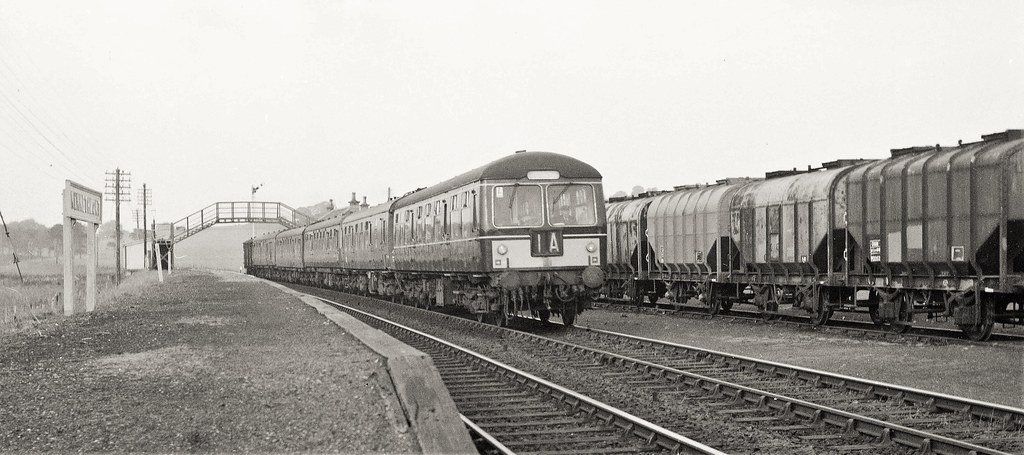
As an example of tail loads, here is a period photo which I like which demonstrates the flexibility of DMU design - a Cravens two-car (105) leads a 3-car Swindon Cross-Country (120), trailing a four-wheel van on the 1800 Aberdeen-Inverness on 7/8/67 past Kennethmont:
(Copyright Kevin Lane)
 
Status
Not open for further replies.

Top