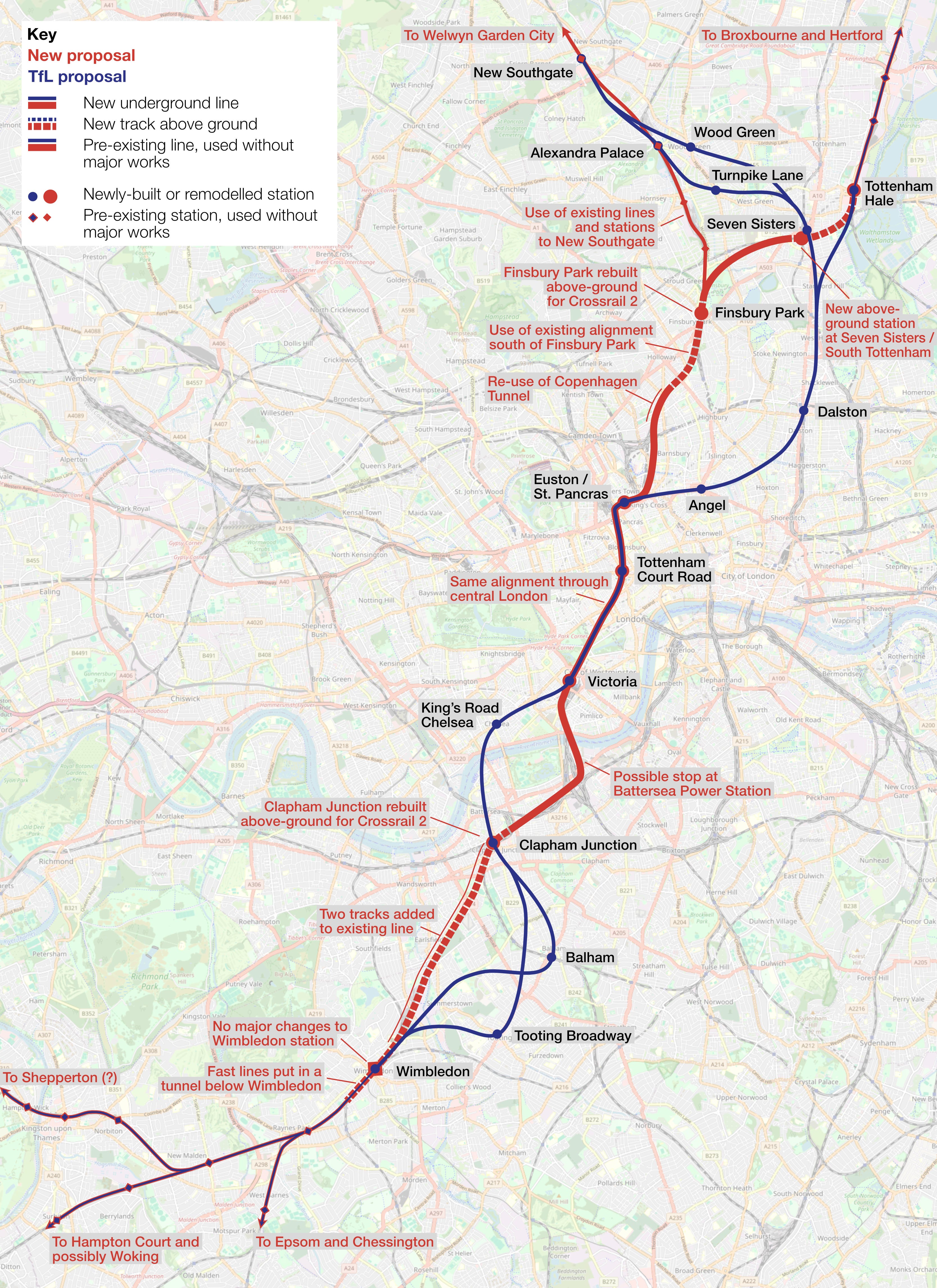
Author here! I've written two blogposts about this already,
here and
here that go into more detail about my crayon. Very happy to receive constructive feedback!
Responding to a few specific points:
I can't see how this is going to be any cheaper than the proposed route.
The disruption and other costs from trying to rebuild Clapham Junction is going blow this scheme up by itself.
Plus the desire to permanently cripple the line through reuse of legacy infrastructure.
There are four choices:
- Don't build Crossrail 2, which is what we're currently doing.
- Build Crossrail 2 but don't stop at Clapham Junction.
- Build an underground station at Clapham Junction.
- Use the existing above-ground platforms at Clapham Junction. This would entail severing the Croydon – Watford service that uses platforms 16 and 17. The five island platforms on the southern side of the station (7–16) would then have two tracks for each of: SWML fast; SWML slow; XR 2; BML fast; BML slow. Platform 17 would be put out of service. The tunnel portal to go to Victoria would probably be where the Parkfield Industrial Estate is.
I think we can agree that (1) and (2) are undesirable. So the question is, (3) or (4). In my view we should simply go with the cheaper. I suspect that redesigning the throat of CLJ is likely to be cheaper than a full-fat underground station, but very happy to be proven wrong!
Second, "legacy infrastructure" is a misnomer. I'm proposing re-using legacy alignments – when you've replaced all the track and all the signals the line is a bit of a Ship of Theseus. Today's SWML shares only the alignment in common with the line built in the 1800s!
In other words, if we can fit in extra tracks next to existing alignments, or in disused alignments, then we should do so unless tunnelling genuinely would be cheaper.
I don't see how Finsbury Park needs a forth (or fifth counting canal tunnels) connection to the area around St Pancras. I don't think another overlapping route would have a favourable CBR compared to upgrading the Piccadilly line. The Dalston plan would likely also alleviate Finsbury Park, as the Victoria line loses its Tottenham Hale/Seven Sisters monopoly on non-Liverpool Street central London destinations, as well as a TFL takeover likely resulting in ECML stopper improvements. However, XR2 is certainly not the cheapest way of getting more than 2tph to certain stations.
I strongly disagree that Finsbury Park is better for connectivity. Every new connection is just a duplicate (South Tottenham does not need XR2 to be rebuilt). Dalston would provide NEW useful connections. This would actually improve connectivity. Linked is a video roughly about this topic.
The reason to go by Finsbury Park rather than Dalston is simple: cost. This allows us to re-use the formerly six-track alignment north of the Copenhagen Tunnel. Rebuilding Finsbury Park (which has a disused platform on the western side) will obviously be disruptive and time-consuming, but it should be cheaper than building an underground station.
Going via Finsbury Park also makes it easier to relieve the Piccadilly Line without building underground stations at Wood Green / Turnpike Lane + Ally Pally. As long as London spends £800 mn on building a single Crossrail station, we need to be tight-fisted about doing
anything underground.
There are, somewhere, hundreds of pages of research into why the route is the best. As every suggestion here, including the blogpost, are near the route, I suspect they were considered and turned down for good reasons.
If our institutions of government were competent, we would have
Nordic infrastructure costs (or lower-than-Nordic costs, Denmark and Sweden's costs have been inching upwards in the last decade).
Less flippantly, everybody can agree on one thing: TfL have failed to get Crossrail 2 built, largely because it is so expensive. It's as much of a line on a map as my proposal.
I don't think that TfL were explicitly optimising for low costs, whereas I am. They might have been optimising for BCR, but that's conceptually very different: if a project costs £45 bn then it will have a BCR > 1 so long as it produces benefits greater than £45 bn. But that doesn't mean the Treasury will be willing to
spend £45 bn, whatever the BCR.
In my view, costs are the correct thing to be optimising for. Given the political and institutional environment we're operating in, we won't get anything built unless we can bring construction costs down. We can't just blame "Treasury Brain" for blocking big rail infrastructure projects: yes, the Treasury's rules probably probably should be reformed, but we have to operate in the Britain we actually live in.
Again, happy to be corrected. If a TfL insider tells me that the decision-making process actually was optimising for low cost above all else, then I will of course believe them. But I would be
astounded, and would have to rethink a lot of my prior beliefs about railways, given some of the choices made in respect of the current XR 2 route.