• Our new ticketing site is now live! Using either this or the original site (both powered by TrainSplit) helps support the running of the forum with every ticket purchase! Find out more and ask any questions/give us feedback in this thread!

Could steam engines provide steam heating for rail tours?

Status
Not open for further replies.

infobleep

On Moderation
Joined
27 Feb 2011
Messages
13,453
I appreciate why diesel locomotives are added to the back of rail tours. They provide steam heating and also additional power for the trains when going up gradients. Also when the train needs to go in the opposite direction without being turned they can be used.

Ignoring, gradient issues, the could the heating be provided by the steam engine?

Would it be possible to provide one steam engine at the front and one at the rear instead of a diesel at the back?

I'm not advocating for this. Just wondering if any of this is technically possible.
 
Sponsor Post - registered members do not see these adverts; click here to register, or click here to log in
R

RailUK Forums

matt

Forum Staff
Staff Member
Global Moderator
Joined
30 Jun 2005
Messages
8,875
Location
Rugby
The diesel is providing electric heating not steam heating. I think 37025 is the only loco capable of steam heating on the mainline.

Some coaches are dual heated such as the Vintage Trains and SRPS coaches and the steam loco at the front also provides the heat.
 

andyjhatton

Member
Joined
8 Apr 2023
Messages
114
Location
Dartford
Slightly related, I remeber a bit of a furore breaking out when the SVR had a Pannier providing steam heating for one of the more modern diesels at this year's diesel gala.
 

12LDA28C

Established Member
Joined
14 Oct 2022
Messages
5,058
I appreciate why diesel locomotives are added to the back of rail tours. They provide steam heating and also additional power for the trains when going up gradients. Also when the train needs to go in the opposite direction without being turned they can be used.

Ignoring, gradient issues, the could the heating be provided by the steam engine?

Would it be possible to provide one steam engine at the front and one at the rear instead of a diesel at the back?

I'm not advocating for this. Just wondering if any of this is technically possible.

It's perfectly possible for a steam loco to provide heat to a rake of stock on a railtour if that stock is compatible. Vintage Trains certainly have a rake that can be steam-heated and indeed that rake is used on the 'Polar Express' trains that operate out of Birmingham Moor St in the run-up to Christmas.
 

Taunton

Veteran Member
Joined
1 Aug 2013
Messages
12,321
Steam heating is a particular nuisance for owners of old, commonly Mk1 and early Mk2 stock. Quite apart from whether the steam equipment on the carriages is in place, or in order, steam heat was the No 1 source of corrosion, from leaks from the low pressure steam equipment, notably in the inside lower areas inside the bodywork. The transition to electric heat made vehicles notably longer lasting. In the USA they long used steam 12 months a year, for heating and steam air conditioning, and it was one of the reasons there for moving to stainless steel construction.

There were some electric heat vehicles which also had poor corrosion records, the Hastings dmus for example, but if you look at their main maintenance depot, on the beachfront at St Leonards and pounded by English Channel spray, it's understandable.
 

infobleep

On Moderation
Joined
27 Feb 2011
Messages
13,453
The diesel is providing electric heating not steam heating. I think 37025 is the only loco capable of steam heating on the mainline.

Some coaches are dual heated such as the Vintage Trains and SRPS coaches and the steam loco at the front also provides the heat.
That makes sense now. I was under the misapprehension the diesel provided steam heating. Probably because there was a time when some diesels did, I believe.

== Doublepost prevention - post automatically merged: ==

Steam heating is a particular nuisance for owners of old, commonly Mk1 and early Mk2 stock. Quite apart from whether the steam equipment on the carriages is in place, or in order, steam heat was the No 1 source of corrosion, from leaks from the low pressure steam equipment, notably in the inside lower areas inside the bodywork. The transition to electric heat made vehicles notably longer lasting. In the USA they long used steam 12 months a year, for heating and steam air conditioning, and it was one of the reasons there for moving to stainless steel construction.

There were some electric heat vehicles which also had poor corrosion records, the Hastings dmus for example, but if you look at their main maintenance depot, on the beachfront at St Leonards and pounded by English Channel spray, it's understandable.
Interesting. Thanks for that.
 

zwk500

Veteran Member
Joined
20 Jan 2020
Messages
18,631
Location
Northampton
That makes sense now. I was under the misapprehension the diesel provided steam heating. Probably because there was a time when some diesels did, I believe.
For a period of time there was a crossover when Diesels were fitted with internal boilers to work steam-heat only stock. However once steam locos had been withdrawn BR transitioned to Electric heating, and the boilers were removed.
 

D365

Veteran Member
Joined
29 Jun 2012
Messages
13,195
The diesel is providing electric heating not steam heating. I think 37025 is the only loco capable of steam heating on the mainline.
37099 still has a boiler fitted and could be recommissioned if/when Colas [or 099’s future owner] sees fit.
 

The exile

Established Member
Joined
31 Mar 2010
Messages
9,455
Location
Somerset
For a period of time there was a crossover when Diesels were fitted with internal boilers to work steam-heat only stock. However once steam locos had been withdrawn BR transitioned to Electric heating, and the boilers were removed.
That transition took the best part of 25 years, though.
 

Taunton

Veteran Member
Joined
1 Aug 2013
Messages
12,321
For a period of time there was a crossover when Diesels were fitted with internal boilers to work steam-heat only stock. However once steam locos had been withdrawn BR transitioned to Electric heating, and the boilers were removed.
It was a long transition. Steam locomotives finished in 1968, before this in many areas, but there were still steam-heating diesels and stock 30 and more years later, and in fact an ongoing shortage of diesels which could provide electric train supply. The Southern Region was an outlier in this, and as soon as their steam locomotives were finished in 1967 they moved very rapidly to electric-only heating; their inter-regional services continued otherwise, but with both locos and coaches from other regions.
 
Last edited:

12LDA28C

Established Member
Joined
14 Oct 2022
Messages
5,058
It was a long transition. Steam locomotives finished in 1968, before this in many areas, but there were still steam-heating diesels and stock 30 and more years later, and in fact an ongoing shortage of diesels which could provide electric train supply. The Southern Region was an outlier in this, and as soon as their steam locomotives were finished in 1967 they moved very rapidly to electric-only heating; their inter-regional services continued otherwise, but with both locos and coaches from other regions.

It seems you're suggesting that there were still service trains being steam-heated at the turn of the millenium however as far as I am aware the Scottish Region was the last bastion of steam-heating of timetabled main-line passenger trains and this ceased in 1987.
 

MarkyT

Established Member
Joined
20 May 2012
Messages
7,598
Location
Torbay
For a period of time there was a crossover when Diesels were fitted with internal boilers to work steam-heat only stock. However once steam locos had been withdrawn BR transitioned to Electric heating, and the boilers were removed.
Some diesels had scoops for picking up water for the steam heat boiler on the move from troughs. On the ECML the troughs survived a few years after the end of steam haulage (until early 70s?) for deltics and class 40s working longer distance limited stop trains. Eventually there was enough electric heated stock to eliminate this.
 

Taunton

Veteran Member
Joined
1 Aug 2013
Messages
12,321
It seems you're suggesting that there were still service trains being steam-heated at the turn of the millenium however as far as I am aware the Scottish Region was the last bastion of steam-heating of timetabled main-line passenger trains and this ceased in 1987.
Someone will have the details, but I understand Mk1 charter stock could be, and was, steam heated after timetabled services ceased. Enthusiast specials, particularly those using steam locomotives on other legs, were among the last. In those times such stock used was BR mainstream, and not independently owned.
 

12LDA28C

Established Member
Joined
14 Oct 2022
Messages
5,058
Someone will have the details, but I understand Mk1 charter stock could be, and was, steam heated after timetabled services ceased. Enthusiast specials, particularly those using steam locomotives on other legs, were among the last. In those times such stock used was BR mainstream, and not independently owned.

I'm sure this is true however any steam heat on those specials you describe would have been provided by the steam loco, not by the diesel. I'm 99% certain no diesels provided steam heat on BR after 1987. Any locomotives that previously had the capability of doing so would have had the boiler removed, or at the very least isolated.
 

D365

Veteran Member
Joined
29 Jun 2012
Messages
13,195
It was a long transition. Steam locomotives finished in 1968, before this in many areas, but there were still steam-heating diesels and stock 30 and more years later, and in fact an ongoing shortage of diesels which could provide electric train supply.
DRS found this out for themselves ~10 years ago - the 37/4s are precious commodities!
 

Bill57p9

Member
Joined
1 Dec 2019
Messages
900
Location
Ayrshire
WCRC ran steam heating on the Jacobite, I believe right up until they were required to run CDL stock.

Another reason to have a second loco on the rear of railtours is minimise delay (and subsequent charges) if the main loco fails.
 

xotGD

Established Member
Joined
4 Feb 2017
Messages
7,894
Let's not forget that we also had electric locomotives with steam heat boilers.
 

Vespa

Established Member
Joined
20 Dec 2019
Messages
1,733
Location
Merseyside
In my experience steam heating is not that warm or particularly impressive, in the 90s Irish Rail was still using steam heating on some lines, I saw large steam vapours coming out of their diesel loco presumably in the same way as steam trains would.
 

randyrippley

Established Member
Joined
21 Feb 2016
Messages
5,382
In my experience steam heating is not that warm or particularly impressive, in the 90s Irish Rail was still using steam heating on some lines, I saw large steam vapours coming out of their diesel loco presumably in the same way as steam trains would.
I don't think so......AFAIK they used coaches fitted with steam generators
 

MarkyT

Established Member
Joined
20 May 2012
Messages
7,598
Location
Torbay
I don't think so......AFAIK they used coaches fitted with steam generators
Definitely 2 and 3 axle fixed wheelbase vans at first in the 1950s, then bogie vehicles for higher speed later. I don't think any of their diesel locos ever had steam heat built in.
 

Vespa

Established Member
Joined
20 Dec 2019
Messages
1,733
Location
Merseyside
I don't think so......AFAIK they used coaches fitted with steam generators
Probably, I was a young lad and not so into the minutae of trains then, I saw what looked like a loco type or similar with steam coming out of it, I was aware it was steam heated when I asked about the heating in the carriage as it wasn't warm.
 

infobleep

On Moderation
Joined
27 Feb 2011
Messages
13,453
WCRC ran steam heating on the Jacobite, I believe right up until they were required to run CDL stock.
I went on the Jacobite in 1990 but it would have been in August.
Another reason to have a second loco on the rear of railtours is minimise delay (and subsequent charges) if the main loco fails.
That could in theory be provided by a second steam engine. I'm not saying anyone would want to do it in practice.
Let's not forget that we also had electric locomotives with steam heat boilers.
I didn't know this but I do now. How interesting.
 

RGM654

Member
Joined
19 Jul 2022
Messages
244
Location
Harrow
I was on a Vintage Trains trip a few years ago when the steam heat connections on a newly acquired coach hadn't been sorted out. On the outward run the whole train was without heat. During the layover they connected up the electric train heating from the diesel at the other end -- and on the return journey we were cooked.
 

sprinterguy

Veteran Member
Joined
4 Mar 2010
Messages
11,575
Location
Macclesfield
WCRC ran steam heating on the Jacobite, I believe right up until they were required to run CDL stock.
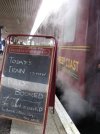
That's a good point, there was definitely steam leaking from between the carriages towards the rear of the train when I encountered The Jacobite in Fort William in September 2009.
I went on the Jacobite in 1990 but it would have been in August.
WCRC took over the West Highland steam operation from BR for the 1995 season, with their own stock: That said, the BR mark 1 rake in 1990 (was the service called 'The West Highlander' by that point?) would have been steam heat capable, but as you suggest probably not needed in August.
 

Attachments

  • FB_IMG_1722541177147.jpg
    FB_IMG_1722541177147.jpg
    29.8 KB · Views: 14

AndrewE

Established Member
Joined
9 Nov 2015
Messages
7,356
What hasn't been mentioned yet is the enormous amount of highly skilled work a) maintaining a main line steam loco in working order (we'll overlook industrial pugs creeping round sidings with almost no maintenance ) and b) the man-hours it takes to get all the motion oiled up and the fire raised.

Nowadays the heritage lines benefit from dedicated volunteers preparing their engines at 5am, old-time steam sheds had an entire corps of steam-raisers on duty round the clock.

There's no way that you could justify using a steam engine nowadays if it wasn't actually hauling a train! Keeping the motion oiled is critical to it surviving the job... even when (valuable) steam engines were moved by diesels they were in "light steam," so were crewed and fired so that the lubrication reliant on steam still got to the cylinders etc.
 

infobleep

On Moderation
Joined
27 Feb 2011
Messages
13,453
That's a good point, there was definitely steam leaking from between the carriages towards the rear of the train when I encountered The Jacobite in Fort William in September 2009.

WCRC took over the West Highland steam operation from BR for the 1995 season, with their own stock: That said, the BR mark 1 rake in 1990 (was the service called 'The West Highlander' by that point?) would have been steam heat capable, but as you suggest probably not needed in August.
I was only almost 13 at the time and have no idea of the service name.

Lovely photo of the steam leaking.
 
Status
Not open for further replies.

Top