• Our new ticketing site is now live! Using either this or the original site (both powered by TrainSplit) helps support the running of the forum with every ticket purchase! Find out more and ask any questions/give us feedback in this thread!

Controller's mistake leaves IC-Berlin stranded in front of buffers

Status
Not open for further replies.

DanielB

Established Member
Joined
27 Feb 2020
Messages
1,456
Location
Amersfoort, NL
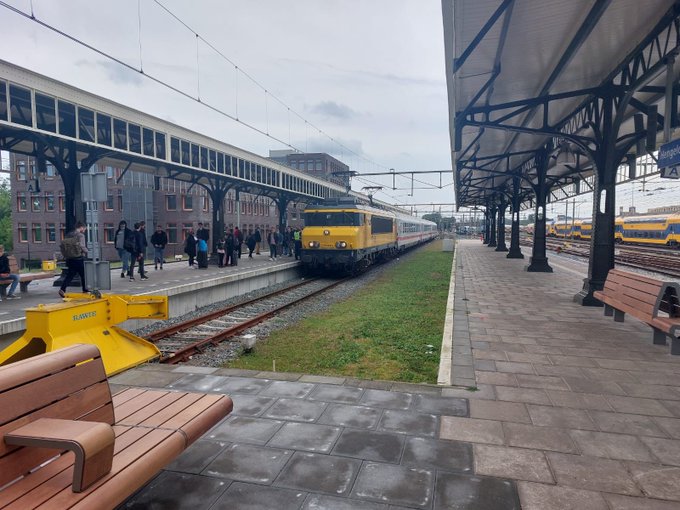
Intercity 146 Berlin-Amsterdam which crossed the border with a 20 minute delay was mistaken for the RB61 (which usually arrives about 20 minutes after the IC) by the controller in charge of Hengelo station this afternoon. Thus, the incoming train was sent to platform 11 instead of 2.
And that... was just a very slight problem as can be seen on images appearing on social media ;) ...

FATUjeFVgAEYwUY

Source

The train was eventually reversed out of the station and continued towards Amsterdam with a 45 minute delay.
 
Sponsor Post - registered members do not see these adverts; click here to register, or click here to log in
R

RailUK Forums

Bertie the bus

Established Member
Joined
15 Aug 2014
Messages
3,216
Could have been worse. If it had happened in Britain the driver probably wouldn't have signed the bay and it would have just been left there.
 

DanielB

Established Member
Joined
27 Feb 2020
Messages
1,456
Location
Amersfoort, NL
And what about the driver for accepting the route!
Almost impossible for the driver to notice this mistake in time having a look at the track diagrams. Hengelo station is all 40 km/h points, so the entry signal will always show yellow arriving from Bad Bentheim with a route set to any platform (a yellow signal in the Dutch system means "reduce speed to 40 km/h or less, expect next signal to be at danger")

As some explanation of the track diagram linked above: IC 146 will have arrived into Hengelo (Hgl) from Germany using track OH, then passed signal 222 showing the usual yellow, then pass through the points 217B/A. Switch 215 is the one that would had been wrongly set today, but there are only 19 metres between the two sets of points and according to a quick online calculation tool the braking distance would have been about 30 metres.
 

biko

Member
Joined
8 Mar 2020
Messages
512
Location
Overijssel, the Netherlands
And what about the driver for accepting the route!
I believe it doesn’t work that way over here. Because speed signalling is used, the route is only visible from the points or derived from a specific speed which only occurs on the diverging route. In this case the previous signal would have been yellow, which is also possible on the normal route into the regular platform. The speed into both platforms is the same. So the driver could only see where they went at the points.
 

popeter45

Established Member
Joined
7 Dec 2019
Messages
1,495
Location
london
I guess when he saw where he was heading it was too late to stop.
yea by the looks of it
the junction that misrouted them is aprox 100m before the station and with how short pl11 is compared to pl2 they where prob going at a speed where to stop that quickly they prob had to foucus on the emergency break before anything else
 

biko

Member
Joined
8 Mar 2020
Messages
512
Location
Overijssel, the Netherlands
yea by the looks of it
the junction that misrouted them is aprox 100m before the station and with how short pl11 is compared to pl2 they where prob going at a speed where to stop that quickly they prob had to foucus on the emergency break before anything else
Platform 2 has a signal in the middle, which is not that much further from the previous signal than the end of platform 11.
 

popeter45

Established Member
Joined
7 Dec 2019
Messages
1,495
Location
london
Platform 2 has a signal in the middle, which is not that much further from the previous signal than the end of platform 11.
i belive IC146 is a ~200m long train so would need more than the ~120m that stopping in the middle would give
 

DanielB

Established Member
Joined
27 Feb 2020
Messages
1,456
Location
Amersfoort, NL
i belive IC146 is a ~200m long train so would need more than the ~120m that stopping in the middle would give
Indeed, the longer IC trains usually use the entire platform 2 in Hengelo. But that won't make a difference in entry speed: that's always 40 km/h as the train has to pass through points (which are all max 40 km/h there) to end up at any platform.
There are only two ways the signal can enforce that speed limit: either by being yellow or by being blinking green. In this case probably yellow as the driver has to expect a follow up signal at danger. (Blinking green is only displaying a speed limit of 40 km/h, but not "expect next signal at danger")
 
Last edited:

biko

Member
Joined
8 Mar 2020
Messages
512
Location
Overijssel, the Netherlands
Yes, and because the speed is always 40 km/h, the signal spacing is such that a train can stop before the next signal. That signal can be in the middle of platform 2 or the end of platform 11 (the buffer is regarded as a red signal).
 

peteb

Established Member
Joined
30 Mar 2011
Messages
1,698
That's a great photo if you know the back story!! Thanks for cheering up my evening!
 

30907

Veteran Member
Joined
30 Sep 2012
Messages
21,973
Location
Airedale
It's a disadvantage of speed-based rather than route-based signalling - but it must be quite rare for a bay line and the through route to have the same speed.
 

Bletchleyite

Veteran Member
Joined
20 Oct 2014
Messages
113,722
Location
"Marston Vale mafia"
It's a disadvantage of speed-based rather than route-based signalling - but it must be quite rare for a bay line and the through route to have the same speed.

Given the way "positive braking" is still used in mainland Europe it's not that surprising. In the UK bays would have a very slow approach speed, but in the Netherlands and Germany it feels more like "full speed until the last minute then hard on the anchors".
 

Fragezeichnen

Member
Joined
14 Jun 2021
Messages
437
Location
Somewhere
It's a disadvantage of speed-based rather than route-based signalling - but it must be quite rare for a bay line and the through route to have the same speed.
If desired a direction indicator can be fitted to show which route has been set, however in this case there wasn't one.
Given the way "positive braking" is still used in mainland Europe it's not that surprising. In the UK bays would have a very slow approach speed, but in the Netherlands and Germany it feels more like "full speed until the last minute then hard on the anchors".
In Germany there is typically no extra train protection fitment to terminus platforms beyond whatever is required for the approach pointwork, so the driver can approach at any speed they consider safe.
 

XAM2175

Established Member
Joined
8 Jun 2016
Messages
3,471
Location
Glasgow
In Germany there is typically no extra train protection fitment to terminus platforms beyond whatever is required for the approach pointwork, so the driver can approach at any speed they consider safe.
They're fitted with PZB magnets the same as a signal showing halt, are they not?
 

Fragezeichnen

Member
Joined
14 Jun 2021
Messages
437
Location
Somewhere
No, as far as I am aware they are not.

However, having checked, it seems there is always a speed restriction of 40 km/h or less applied to terminus platforms even if the approach pointwork does not require it.
 

biko

Member
Joined
8 Mar 2020
Messages
512
Location
Overijssel, the Netherlands
In the Netherlands, there can be ATB-VV on terminus platforms, which would stop the train as if a signal is red and if the approach speed is too high. No idea if that's present in Hengelo.
 

DanielB

Established Member
Joined
27 Feb 2020
Messages
1,456
Location
Amersfoort, NL
In the Netherlands, there can be ATB-VV on terminus platforms, which would stop the train as if a signal is red and if the approach speed is too high. No idea if that's present in Hengelo.
There's an ATB-VV beacon clearly visible besides track 311 on Google sattelite view.
But in this case the speed limit is already limited by the first set of points required to arrive at platform 2, so there wouldn't be a seperate speed restriction by the bay (and there's no good place to put a direction indicator)

Given the way "positive braking" is still used in mainland Europe it's not that surprising. In the UK bays would have a very slow approach speed, but in the Netherlands and Germany it feels more like "full speed until the last minute then hard on the anchors".
Well... Not really full speed as a buffer stop is seen as a red signal in the Netherlands, so it will be preceded by yellow one (and thus max 40 km/h).
Although even 40 km/h may cause a lot of damage: a Plan V trainset once got separated from it's bogies after it failed to stop in time (photos). And the famous Sprinter which ended inside a chocolates shop on the concourse of The Hague Central also was an example of failing to stop in a 40 zone.
 

biko

Member
Joined
8 Mar 2020
Messages
512
Location
Overijssel, the Netherlands
But in this case the speed limit is already limited by the first set of points required to arrive at platform 2, so there wouldn't be a seperate speed restriction by the bay (and there's no good place to put a direction indicator)
Indeed is the speed limit 40 km/h anyway, but ATB-VV will apply the emergency brake when passing over the beacon at a high speed. So effectively there is a limit on the approach speed of such a short platform.
 

Fragezeichnen

Member
Joined
14 Jun 2021
Messages
437
Location
Somewhere
True it is not really "full speed", however compared to the UK, where there is typically a train protection beacon shortly before the buffers enforcing no more than 15 km/h speed, and some train operators even require their drivers to have already reduced to 15 km/h by the start of the terminus platform, no matter how long it is, it's still a quite noticeable difference.
 

TheEdge

Established Member
Joined
29 Nov 2012
Messages
4,498
Location
Norwich
It's a disadvantage of speed-based rather than route-based signalling - but it must be quite rare for a bay line and the through route to have the same speed.

It something I always struggle to get my head round as a British driver to have signals tell you speed limits (and even be able to change them) but give you nothing about route. I presume drivers just expect they get routed properly.
 

DanielB

Established Member
Joined
27 Feb 2020
Messages
1,456
Location
Amersfoort, NL
It something I always struggle to get my head round as a British driver to have signals tell you speed limits (and even be able to change them) but give you nothing about route. I presume drivers just expect they get routed properly.
Drivers in the Netherlands need to have route knowledge. There's even an exam to test how well new drivers know the routes and drivers also have to maintain this knowledge. When not having driven a certain route for a while, they'll need a refresher prior to being allowed to use that route again.
Part of this knowledge is to know what paths to expect based on what the signals display. And to know where to expect signals (and things like platforms)
 

TheEdge

Established Member
Joined
29 Nov 2012
Messages
4,498
Location
Norwich
Drivers in the Netherlands need to have route knowledge. There's even an exam to test how well new drivers know the routes and drivers also have to maintain this knowledge. When not having driven a certain route for a while, they'll need a refresher prior to being allowed to use that route again.
Part of this knowledge is to know what paths to expect based on what the signals display. And to know where to expect signals (and things like platforms)

No I get that but is situations like this that knowledge doesn't help.

For example I can think of a few signals I pass which under speed signalling would (probably) show the same aspect but have plenty opportunities to wrong route. Under the UK directional signalling I get plenty of indication of route and my route knowledge tells me the speed. But under continental signalling you'd only know you'd been wrong routed when it was too late.
 

biko

Member
Joined
8 Mar 2020
Messages
512
Location
Overijssel, the Netherlands
So basically, signals in the UK show the route from which the driver can derive the speed based on their knowledge while on the continent (at least in the Netherlands) the signals show the speed and the driver can derive the route.

Indeed in Hengelo all routes are the same speed but on main lines a driver would notice a wrong route because there are speed differences between routes. In a station the consequences are not that big so I don’t think it is a huge problem. It does make the signalling simpler as all signals can be just normal signals
 

MarcVD

Established Member
Joined
23 Aug 2016
Messages
1,245
When Belgium introduced color light signals around 1950 (there were prototypes before that but 1950ish is when the final version came out) there were both speed and direction indications on the signal boards. After some 10 years the direction information was deemed superfluous and was abandoned. Only the indication about right/wrong main remained. Wrong routings do happen but are quite rare and even more so since all signaling in Belgium is now under computer control.
 
Status
Not open for further replies.

Top