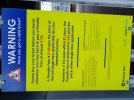
In terms of the wording, the requirement is set out in paragraph 1(1)(c) of Part 1 of
Schedule 1 of the Railways (Penalty Fares) Regulations 2018 (emphasis added):
1. A standard notice must contain—
...
(c) the wording “Please buy your ticket before you travel otherwise you may be charged a Penalty Fare”;
The sign does not contain that wording. A
similar wording appears, but the Regulations use quotation marks for this wording - this makes it clear that the exact specified wording must be present. This is to be contrasted against paragraph 1(1)(e), for example (emphasis added), which requires the notice to contain:
(e) wording which indicates where information about the circumstances in which a person may be charged a penalty fare in relation to travel by, presence on or leaving a train is published or may be obtained;
If there were any further doubt, paragraph 2 makes clear even a minor procedural error can (partially or otherwise) invalidate the notice, and that this is entirely intentional:
(2) The absence of a logo or name, as required by sub-paragraph (1)(f), on a notice only invalidates the notice in relation to the operator whose logo or name is missing.
Therefore, aside from anything else, the signage is non-compliant on the basis of not containing the specified wording. The same issue applies to any other station where Southeastern or GTR have used a sign without the specified wording.
As for the placement of signage, the requirement is set out in regulations 8(2) and (4):
(2) Where any entrance onto a platform at the station is not the entrance to, or situated within, a compulsory ticket area, a notice complying with the requirements of paragraph 1 of Part 1 of Schedule 1 (“a standard notice”) must be displayed at that entrance.
...
(4) Standard notices and compulsory ticket area notices must also be displayed at sufficient locations around the station so that at least one notice is readily visible to passengers prior to boarding a train at the station, including passengers changing from one train to another train.
So
every entrance must have a notice, and there must be sufficient notices that at least one notice is readily visible to passengers prior to boarding. You've told us that there is no sign you'd see when the ticket office is shut, unless you happened to enter via the car park - if that's the case then the station is further non-compliant on the basis of insufficient signage.
Regulation 6 is clear that a failure to comply with the signage requirements - in any respect - means a Penalty Fare must not be issued to passengers who have boarded at a non-compliant station:
6.—(1) Subject to paragraph (6), a person travelling by, present on, or leaving a train (in this regulation “the passenger”) must not be charged a penalty fare where either paragraph (2) or (3) applies.
...
(2) This paragraph applies if, at the time when, and at the station where, the passenger boarded the train—
...
(b) the requirements for the display of notices specified in regulation 8 were not satisfied;
Never having got on or off at Crayford, it's a little difficult for me to understand the context of what your first photo shows - is the blue gate the entrance used when the ticket office shut? If so, there appears to be a Penalty Fare sign perhaps 1.5 metres to its left, albeit it isn't immediately next to the gate so it might be argued that it isn't "displayed at that entrance" or alternatively that it's not "readily visible ... prior to boarding". But that is a matter of judgment and we can't be certain that an appeals panel would necessarily agree.
I'd have said it's much more clear-cut relying on the failure to have compliant wording, as this is possible to prove beyond doubt - simply by including a picture of the non-compliant wording.
But overall, this analysis goes to show that even at a station where the signage may superficially appear sufficient, it may not comply with the requirements that the Regulation imposes. This is what I (and others) have been saying is widespread for a long time. There are certainly few stations where I'd have said the requirement for "readily visible" signage is met, as a minimum. In many cases Penalty Fare signage is rather hidden away, or in such minute font that it's barely readable. There are therefore a lot of Penalty Fares that - even if issued in the correct manner or in 'legitimate' circumstances - are simply not validly issued.
I would hesitate to say whether that makes issuing those Penalty Fares illegal, but as a minimum Penalty Fares should not be being issued under such circumstances and any that are issued, should be appealed (hopefully successfully).