
• Our new ticketing site is now live! Using either this or the original site (both powered by TrainSplit) helps support the running of the forum with every ticket purchase! Find out more and ask any questions/give us feedback in this thread!

Commuting from Ongar

Status
Not open for further replies.

David Burrows

Member
Joined
1 Feb 2013
Messages
116
Rhyme with -banger unless one was taking the p...s when it was pronounced very poshly with 'ar' version.

== Doublepost prevention - post automatically merged: ==

Re service levels, here is a copy of an item I wrote years ago for the 'Abandoned Tube Stations' website.

"The use of the line declined immediately it was electrified, presumably so that London Transport no longer had to pay the Eastern Region to provide engines, stock and crews which enabled Epping engine shed to be closed. The wonderful new electric service started on a cold, foggy November day in 1957, when the passengers, formerly used to a delightfully warm (steam-heated) train, which being a push-pull set had the engine attached and providing heat all day, found that the replacement underground train had absolutely abysmal heating, made worse by the fact that the train stood for some time at the end of each journey with ALL the doors open. Not only that but the minimal heat produced between stations promptly left as soon as all the doors opened at each stop. Winter was not the best time to introduce such 'improvements'. The riding of the electric trains was very poor when compared to the steam-worked stock, the motion being akin to a small boat in a storm, bouncing up and down and from side to side. There was much adverse comment in the local newspaper 'Express & Independent' at the time.

"Since the line was electrified 'on the cheap' only single units could be used as there was insufficient electricity available beyond Epping to run 8 car (two unit) trains through to London. There were allegedly sometimes even problems when two trains passing at North Weald tried to set off simultaneously, each attempting to draw maximum power. At such times accelerations was less than rapid! Thus all passengers had to transfer at Epping via the footbridge for London trains, and with car ownership increasing at that time, many former passengers chose to drive to Epping to catch trains to London.

"There was also the London Transport operated 339 bus route, every 30 mins for most of the day between Epping station and Ongar via North Weald village (and passing Ongar station), although this took rather longer than the train. Alternate journeys continued to Warley, passing Brentwood station with its electrified regular suburban service to London. With this bus service being operated by LT there was obviously not a great incentive for them to encourage use of the train service.

"The decline in train passengers was used as an excuse to remove the passing loop at North Weald as an economy measure, thus only one train could shuttle between Epping and Ongar, giving a maximum service of every 40-48 minutes even in the peak periods, approximately half that which previously operated. This led to even more people using alternative transport as, unless they managed to catch the right train from London to connect, they could have a long wait at Epping for a cold train forward. It was soon time for the service to be reduced to peak hours only, with LT claiming that at other times there was the 339 bus! There was a brief period when trains were restored between the peaks but by then enough passengers had found alternative transport so it did not last long."​

Prior to the electrification from Epping to Onger that line was effectively operated as a self contained branch line, with quite frequent service during morning and evening peaks, using three push-pull sets based at Epping. On leaving Epping, one set would be passed at North Weald, and on arrival at Ongar the incoming train would run via the loop to the country end of the station, passing the third set which would be waiting to depart from the London end of the platform. Once that one had left, the incoming set would move to the London end and the performance was repeated. It was thus one of the most intensively used single track 'branch lines'.
 
Last edited:
Sponsor Post - registered members do not see these adverts; click here to register, or click here to log in
R

RailUK Forums

Beebman

Member
Joined
17 Feb 2011
Messages
962
Location
Twyford
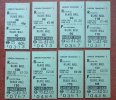
Blake Hall closed 2 November 1981, presumably to the dismay of the seventeen daily passengers (Sundays Excepted).
Just after Blake Hall closed I was at a transport collectors' event in London where someone was selling sets of unused tickets from the station. I still have the set I bought as shown in the attached photo:
 

Attachments

  • IMG_8589.jpeg
    IMG_8589.jpeg
    516.7 KB · Views: 90

frodshamfella

Established Member
Joined
25 Sep 2010
Messages
2,029
Location
Frodsham
Rhyme with -banger unless one was taking the p...s when it was pronounced very poshly with 'ar' version.

== Doublepost prevention - post automatically merged: ==

Re service levels, here is a copy of an item I wrote years ago for the 'Abandoned Tube Stations' website.

"The use of the line declined immediately it was electrified, presumably so that London Transport no longer had to pay the Eastern Region to provide engines, stock and crews which enabled Epping engine shed to be closed. The wonderful new electric service started on a cold, foggy November day in 1957, when the passengers, formerly used to a delightfully warm (steam-heated) train, which being a push-pull set had the engine attached and providing heat all day, found that the replacement underground train had absolutely abysmal heating, made worse by the fact that the train stood for some time at the end of each journey with ALL the doors open. Not only that but the minimal heat produced between stations promptly left as soon as all the doors opened at each stop. Winter was not the best time to introduce such 'improvements'. The riding of the electric trains was very poor when compared to the steam-worked stock, the motion being akin to a small boat in a storm, bouncing up and down and from side to side. There was much adverse comment in the local newspaper 'Express & Independent' at the time.

"Since the line was electrified 'on the cheap' only single units could be used as there was insufficient electricity available beyond Epping to run 8 car (two unit) trains through to London. There were allegedly sometimes even problems when two trains passing at North Weald tried to set off simultaneously, each attempting to draw maximum power. At such times accelerations was less than rapid! Thus all passengers had to transfer at Epping via the footbridge for London trains, and with car ownership increasing at that time, many former passengers chose to drive to Epping to catch trains to London.

"There was also the London Transport operated 339 bus route, every 30 mins for most of the day between Epping station and Ongar via North Weald village (and passing Ongar station), although this took rather longer than the train. Alternate journeys continued to Warley, passing Brentwood station with its electrified regular suburban service to London. With this bus service being operated by LT there was obviously not a great incentive for them to encourage use of the train service.

"The decline in train passengers was used as an excuse to remove the passing loop at North Weald as an economy measure, thus only one train could shuttle between Epping and Ongar, giving a maximum service of every 40-48 minutes even in the peak periods, approximately half that which previously operated. This led to even more people using alternative transport as, unless they managed to catch the right train from London to connect, they could have a long wait at Epping for a cold train forward. It was soon time for the service to be reduced to peak hours only, with LT claiming that at other times there was the 339 bus! There was a brief period when trains were restored between the peaks but by then enough passengers had found alternative transport so it did not last long."​

Prior to the electrification from Epping to Onger that line was effectively operated as a self contained branch line, with quite frequent service during morning and evening peaks, using three push-pull sets based at Epping. On leaving Epping, one set would be passed at North Weald, and on arrival at Ongar the incoming train would run via the loop to the country end of the station, passing the third set which would be waiting to depart from the London end of the platform. Once that one had left, the incoming set would move to the London end and the performance was repeated. It was thus one of the most intensively used single track 'branch lines'.
I can understand how unpleasant a journey it would have been on the Epping-Ongar during damp / cold winters having had the doors left open on the platform for a period to chill the carriages nicely .
 

richardderby

Member
Joined
20 Nov 2010
Messages
411
Rhyme with -banger unless one was taking the p...s when it was pronounced very poshly with 'ar' version.

== Doublepost prevention - post automatically merged: ==

Re service levels, here is a copy of an item I wrote years ago for the 'Abandoned Tube Stations' website.

"The use of the line declined immediately it was electrified, presumably so that London Transport no longer had to pay the Eastern Region to provide engines, stock and crews which enabled Epping engine shed to be closed. The wonderful new electric service started on a cold, foggy November day in 1957, when the passengers, formerly used to a delightfully warm (steam-heated) train, which being a push-pull set had the engine attached and providing heat all day, found that the replacement underground train had absolutely abysmal heating, made worse by the fact that the train stood for some time at the end of each journey with ALL the doors open. Not only that but the minimal heat produced between stations promptly left as soon as all the doors opened at each stop. Winter was not the best time to introduce such 'improvements'. The riding of the electric trains was very poor when compared to the steam-worked stock, the motion being akin to a small boat in a storm, bouncing up and down and from side to side. There was much adverse comment in the local newspaper 'Express & Independent' at the time.

"Since the line was electrified 'on the cheap' only single units could be used as there was insufficient electricity available beyond Epping to run 8 car (two unit) trains through to London. There were allegedly sometimes even problems when two trains passing at North Weald tried to set off simultaneously, each attempting to draw maximum power. At such times accelerations was less than rapid! Thus all passengers had to transfer at Epping via the footbridge for London trains, and with car ownership increasing at that time, many former passengers chose to drive to Epping to catch trains to London.

"There was also the London Transport operated 339 bus route, every 30 mins for most of the day between Epping station and Ongar via North Weald village (and passing Ongar station), although this took rather longer than the train. Alternate journeys continued to Warley, passing Brentwood station with its electrified regular suburban service to London. With this bus service being operated by LT there was obviously not a great incentive for them to encourage use of the train service.

"The decline in train passengers was used as an excuse to remove the passing loop at North Weald as an economy measure, thus only one train could shuttle between Epping and Ongar, giving a maximum service of every 40-48 minutes even in the peak periods, approximately half that which previously operated. This led to even more people using alternative transport as, unless they managed to catch the right train from London to connect, they could have a long wait at Epping for a cold train forward. It was soon time for the service to be reduced to peak hours only, with LT claiming that at other times there was the 339 bus! There was a brief period when trains were restored between the peaks but by then enough passengers had found alternative transport so it did not last long."​

Prior to the electrification from Epping to Onger that line was effectively operated as a self contained branch line, with quite frequent service during morning and evening peaks, using three push-pull sets based at Epping. On leaving Epping, one set would be passed at North Weald, and on arrival at Ongar the incoming train would run via the loop to the country end of the station, passing the third set which would be waiting to depart from the London end of the platform. Once that one had left, the incoming set would move to the London end and the performance was repeated. It was thus one of the most intensively used single track 'branch lines'.
I think part of the later problem was also Essex council not wanting to fund/ subsidise the line, and the GLC reluctant to pay for a service outside of London. shame it went, I had a few rides just after I started work on LUL.
 

Recessio

Established Member
Joined
4 Aug 2019
Messages
1,491
Location
London
I think part of the later problem was also Essex council not wanting to fund/ subsidise the line, and the GLC reluctant to pay for a service outside of London. shame it went, I had a few rides just after I started work on LUL.
Towards the end it would have been run by London Regional Transport, as the GLC was abolished in 1986, but the line to Ongar didn't close until 1994. (Funnily enough, apparently one of the last acts of the GLC was to pay for repairs/renewals of two bridges on the Chesham branch, outside of Greater London...)

Essex County Council don't even subsidise the remaining parts of the Central line that are within Essex though, so it certainly doesn't surprise me that they wouldn't have wanted to subsidise the Ongar-Epping stretch either.
 
Last edited:

frodshamfella

Established Member
Joined
25 Sep 2010
Messages
2,029
Location
Frodsham
Is it possible if the line was still be operating and was upgraded to take direct services from Central London, or even a better connecting service , it would be more patronized now ? I think I read there had been more housing built in the Ongar area.
 

AM9

Veteran Member
Joined
13 May 2014
Messages
16,015
Location
St Albans
Is it possible if the line was still be operating and was upgraded to take direct services from Central London, or even a better connecting service , it would be more patronized now ? I think I read there had been more housing built in the Ongar area.
I doubt that the population of Ongar and it's environs would justify upgrading from a single line with end-fed LV DC to a full-service capacity commuter line. Maybe if the GEML service from Chelmsford couldn't cope and Beaulieu Park station hadn't been sanctioned, some of the Writtle development may have extended further west on the A414 towards Ongar.
 

Bishopstone

Established Member
Joined
24 Jun 2010
Messages
1,685
Location
Seaford
Is it possible if the line was still be operating and was upgraded to take direct services from Central London, or even a better connecting service , it would be more patronized now ? I think I read there had been more housing built in the Ongar area.

On your assumptions, then yes, I’m sure it would see more use than in 1994, though that’s a low bar.

But it would still be very quiet between the peaks, and require a large subsidy from other TfL operations or the taxpayer. In respect of leisure travel, spending 75 minutes sat on the Central Line (Ongar to the middle of zone 1) is a prospect many would avoid, if National Rail from Harlow or Chelmsford was an alternative.
 

ian1944

Member
Joined
13 Dec 2012
Messages
691
Location
North Berwick
During my all-too-long residence in London (1965/6) I covered the full length of all the undergroung lines, but went to Ongar only once. I remember the length of the journey and the uncomfortable ride, and to me the underwhelming Essex landscape. I'm afraid that I got the same train back, so can't comment on the town/village as I felt no desire to linger.
 

alex397

Established Member
Joined
6 Oct 2017
Messages
2,028
Location
UK
On your assumptions, then yes, I’m sure it would see more use than in 1994, though that’s a low bar.

But it would still be very quiet between the peaks, and require a large subsidy from other TfL operations or the taxpayer. In respect of leisure travel, spending 75 minutes sat on the Central Line (Ongar to the middle of zone 1) is a prospect many would avoid, if National Rail from Harlow or Chelmsford was an alternative.
If the service was reintroduced, it would struggle to compete off-peak for any local traffic with the bus service. Route 20 runs every half an hour through Ongar, North Weald to Epping, and until late. The bus is probably more convienient for most as well, reaching further into the towns, and using the bus would avoid walking the steep hill from Epping Station to the high street. Many passengers would also have a free concessionary pass.

I think a peak service would be busy though. Epping Station seems to have a large catchment area of car drivers, meaning the large car park gets full.
 

yorksrob

Veteran Member
Joined
6 Aug 2009
Messages
44,258
Location
Yorks
I remember Ongar came up in a previous thread.

Never been that way but I understand the atmosphere at some of the intermediate stations was deeply rural and quite eerie in a way with one of them (Blake Hall, I think?) close to some kind of Cold War radio station situated on top of a small hill.

Ongar is itself quite near to the Kelveden Hatch nuclear bunker, which would have been the regional seat of government in the event of a nuclear conflagration.
 
Status
Not open for further replies.

Top