• Our new ticketing site is now live! Using either this or the original site (both powered by TrainSplit) helps support the running of the forum with every ticket purchase! Find out more and ask any questions/give us feedback in this thread!

Class 501 tail light

Status
Not open for further replies.

Regeff

Member
Joined
23 Feb 2014
Messages
53
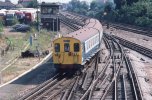
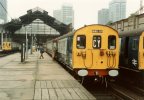
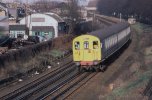
I recently found a photograph of Class 501 unit that I took in September 1983. The unit appears not to have the red electric marker light that other members of the class carried.

The unit in the photo is travelling towards the camera so no problem arises, but how would this unit have displayed a red tail light? Would a portable (oil?) lamp have been carried?
 
Sponsor Post - registered members do not see these adverts; click here to register, or click here to log in
R

RailUK Forums

Roger1973

Member
Joined
5 Jul 2020
Messages
852
Location
Berkshire
It's possible but seems unlikely that a unit would have had its rear marker light removed requiring a separate tail lamp.

I have vague memories (possibly reinforced by photos I've seen since) of southern region 4 SUB units and the CO/CP stock on the District Line carrying a separate (oil? battery?) tail lamp, but the EPB generation of southern region units didn't carry separate tail lamps as far as I can remember. Presume they (unlike the 4 SUB units) had a battery backup to the lights in the headcode displays.

North London wasn't really my patch - I have vague memories of travelling on class 501's from Euston and Broad Street on occasional days out, but it wasn't a regular thing and I can't remember a lot about them other than the bars on the windows and them seeming generally grottier than the southern region units.

The photos I've seen suggest that they showed the headcode at front and rear, but is it possible that a few units were adapted so they could show red blanks in the rear headcode box, southern region style?

Could you post the photo? There may be a clue somewhere.
 

D6130

Established Member
Joined
12 Jan 2021
Messages
8,924
Location
West Yorkshire/Tuscany
IIRC, the 501s had a separate single red electric tail lamp incorporated in the cab end bodywork below and off-set from the headcode indicator window.
 

Springs Branch

Established Member
Joined
7 Nov 2013
Messages
1,680
Location
Where my keyboard has no £ key
The unit in the photo is travelling towards the camera so no problem arises, but how would this unit have displayed a red tail light? Would a portable (oil?) lamp have been carried?
The question of paraffin tail lamps carried on electric and diesel multiple units is one of those topics which piques the interest of those fascinated by the minutiae of 'old railway' operations.

I remember reading somewhere (can't remember the source) that traditional red-coloured paraffin lamps were mandatory on the backs of EMUs and DMUs up until a certain point in time, after which these were dispensed with in favour of red electric marker lights (or red route number blinds on the SR).

The rationale was along the lines of train batteries historically not being reliable enough to guarantee that, if the train was halted on a running line due to failure of power from the OHLE, third rail or diesel engine, the red tail lamp would stay illuminated brightly enough and for a long enough period of time to protect the rear of the train. There may have been also some consideration of the lifetime and failure rates of higher powered (brighter) electric bulbs back in the day.

Presumably with time, filament bulbs became brighter and more reliable, as did backup batteries (still lead-acid type of course), and the routine use of separate tail lamps could be dispensed with. I wonder if a paraffin lamp was still required to be carried in multiple unit guard's vans 'just in case'?

Regarding the OP's point - close-up photos of the Class 501's front end seem to show a single lamp iron fixed centrally below the headcode panel, with the electric tail light red lens offset to the right of this - presumably the bracket was available for use with an old school oil lamp if and when necessary.

Class-501-train-B2-headcode.jpg

Image shows close up of front end of a Class 501 EMU during the 'Rail Blue' era.
Source: Public Domain at Wikipedia
 
Last edited:

Snow1964

Established Member
Joined
7 Oct 2019
Messages
11,015
Location
West Wiltshire
I have read in a book (long time ago, can't remember where) that the red lamp location was to satisfy London Underground on the shared section of the Bakerloo.

Tube stock red lights are positioned low so that the light reflects off the top surfaces of the rails so that they can be seen from further away where track curves or dips etc.

I am guessing it would have been visible from a tube cab, logically would have been better on other side of the central lamp bracket, so that it was facing oncoming cab, but there is a risk of the jumper cable dangling in front if it was there. I would also guess its position was determined where a hole for a lamp housing could be made (nothing on other side like part of steel frame).
 

edwin_m

Veteran Member
Joined
21 Apr 2013
Messages
28,586
Location
Nottingham
Another reason to put a lamp on the bracket might have been that the early built-in tail lamps were very feeble, and in some daylight conditions a signalman in an Absolute Block box might have had difficulty confirming the train was complete.
 

Regeff

Member
Joined
23 Feb 2014
Messages
53
It's possible but seems unlikely that a unit would have had its rear marker light removed requiring a separate tail lamp.

I have vague memories (possibly reinforced by photos I've seen since) of southern region 4 SUB units and the CO/CP stock on the District Line carrying a separate (oil? battery?) tail lamp, but the EPB generation of southern region units didn't carry separate tail lamps as far as I can remember. Presume they (unlike the 4 SUB units) had a battery backup to the lights in the headcode displays.

North London wasn't really my patch - I have vague memories of travelling on class 501's from Euston and Broad Street on occasional days out, but it wasn't a regular thing and I can't remember a lot about them other than the bars on the windows and them seeming generally grottier than the southern region units.

The photos I've seen suggest that they showed the headcode at front and rear, but is it possible that a few units were adapted so they could show red blanks in the rear headcode box, southern region style?

Could you post the photo? There may be a clue somewhere.
Thanks. I'll post the photo (and one showing the marker light for compaison purposes later).
 

Regeff

Member
Joined
23 Feb 2014
Messages
53
Here's the one without the tail lamp (only taken me 40 years to notice). And one showing the tail lamp. The 501s normally ran with the headcode showing at both ends. They definitely had white blank blinds, but I never saw red blanks. If there was only one 501 without an electric tail lamp, I wonder how many drivers or guards remembered to check? Surely running without a tail lamp was not permitted (although I can remember very occasionally seeing SR emus running with the rear of the train showing a headcode instead of red blanks because someone had forgotten to wind things on to red blanks). It might be the same unit, but there's another picture I took showing no tail lamp too (on a different day), so I have added that.
 

Attachments

  • 6147473494_949c7e5a65_o (1).jpg
    6147473494_949c7e5a65_o (1).jpg
    531.1 KB · Views: 73
  • 7473036300_703b0f7bd7_o.jpg
    7473036300_703b0f7bd7_o.jpg
    258.9 KB · Views: 73
  • 6155410633_0f30a94b33_o.jpg
    6155410633_0f30a94b33_o.jpg
    437 KB · Views: 73

Rescars

Established Member
Joined
25 May 2021
Messages
2,516
Location
Surrey
It's possible but seems unlikely that a unit would have had its rear marker light removed requiring a separate tail lamp.

I have vague memories (possibly reinforced by photos I've seen since) of southern region 4 SUB units and the CO/CP stock on the District Line carrying a separate (oil? battery?) tail lamp, but the EPB generation of southern region units didn't carry separate tail lamps as far as I can remember. Presume they (unlike the 4 SUB units) had a battery backup to the lights in the headcode displays.

North London wasn't really my patch - I have vague memories of travelling on class 501's from Euston and Broad Street on occasional days out, but it wasn't a regular thing and I can't remember a lot about them other than the bars on the windows and them seeming generally grottier than the southern region units.

The photos I've seen suggest that they showed the headcode at front and rear, but is it possible that a few units were adapted so they could show red blanks in the rear headcode box, southern region style?

Could you post the photo? There may be a clue somewhere.
I too recall the 4-SUBs carrying oil tail lamps, and the area behind the buffers on platform 9 at Victoria where the lamps were stored and trimmed. IIRC the 4-SUB light boxes illuminated metal stencil headcode markers. There weren't roller blinds, at least not until very late on in their lives, so no possibility of displaying a red blind. As noted by edwin_m, in bright light the visible presence of tail lamps would have helped assure signalman that trains were complete.
 

Taunton

Veteran Member
Joined
1 Aug 2013
Messages
12,218
If I am not mistaken the Southern's 4-SUB units had no low voltage circuits at all, so always needed an oil tail lamp. No starting bells, so they were still being green flagged away by the guard from each station in the mid-1980s, which astounded me when I first came across it then, as the 1938 LMS Wirral units I knew, recently withdrawn then, had always had this since new. Saloon lighting at full 650V DC. Surprising that after the EPB stock came into use with all of this there was no major overhaul rebuild to make these compatible with current standards.

The 4-SUB stencil headcodes were taken from a box of number slides in the cab, there was only one set of numbers 0-9, so double digit numbers like '44' were not possible. They were lit from behind at night, provided the current was on. A couple of red slides could have been provided, but weren't, and would not have been fail-safe anyway.

The 501s must surely have had something better than an oil lamp, as the Euston-Watford signalling included the 'pass red signal, reset trainstop, and stop short if train ahead' procedure, and were mixed in with Bakerloo trains, which had no compatible buffers or similar.
 
Last edited:

Rescars

Established Member
Joined
25 May 2021
Messages
2,516
Location
Surrey
If I am not mistaken the Southern's 4-SUB units had no low voltage circuits at all, so always needed an oil tail lamp. No starting bells, so they were still being green flagged away from each station in the mid-1980s, which astounded me when I first came across it then, as the 1938 LMS Wirral units I knew, recently withdrawn then, had always had this since new. Saloon lighting at full 650x DC. Surprising that after the EPB stock came into use with all of this there was no major overhaul rebuild to make these compatible with current standards.

The 501s must surely have had something better than an oil lamp, as the Euston-Watford signalling included the 'pass red signal, reset trainstop, and stop short if train ahead' procedure, and were mixed in with Bakerloo trains, which had no compatible buffers or similar.
Oil lamps, green flags, iffy saloon lighting and a decidedly bouncy ride were all part of the charm! They had air whistles rather than horns in their original form too.
 

Regeff

Member
Joined
23 Feb 2014
Messages
53
If I am not mistaken the Southern's 4-SUB units had no low voltage circuits at all, so always needed an oil tail lamp. No starting bells, so they were still being green flagged away by the guard from each station in the mid-1980s, which astounded me when I first came across it then, as the 1938 LMS Wirral units I knew, recently withdrawn then, had always had this since new. Saloon lighting at full 650V DC. Surprising that after the EPB stock came into use with all of this there was no major overhaul rebuild to make these compatible with current standards.

The 4-SUB stencil headcodes were taken from a box of number slides in the cab, there was only one set of numbers 0-9, so double digit numbers like '44' were not possible. They were lit from behind at night, provided the current was on. A couple of red slides could have been provided, but weren't, and would not have been fail-safe anyway.

The 501s must surely have had something better than an oil lamp, as the Euston-Watford signalling included the 'pass red signal, reset trainstop, and stop short if train ahead' procedure, and were mixed in with Bakerloo trains, which had no compatible buffers or similar.
Yes, it seems incredible now that the SUBs were flagged away in the 1980s.

There was at least one incident of a collision between a 501 and a Bakerloo train. I read somewhere the other day that some 501 drivers were a bit quick away from signals they had been stopped at on the Watford DC line.
 

Peter Mugridge

Veteran Member
Joined
8 Apr 2010
Messages
17,790
Location
Epsom
It might be the same unit, but there's another picture I took showing no tail lamp too (on a different day), so I have added that.
The three pictures are of three different units; left image to right image they are 501 151, 501 180 and 501 135.
 

Springs Branch

Established Member
Joined
7 Nov 2013
Messages
1,680
Location
Where my keyboard has no £ key
One last hurrah on the topic of vintage EMUs carrying oil lamps. This time Class 502s rather than 501s & 4-SUBs . . .

I was looking for any photos of the historic Southport - Crossens local electric service.
I came across these two pics, taken in the line's twilight year before closure in 1964:-


My first thought was that both EMUs seemed to be running with a paraffin tail lamp on the front.
I did speculate whether the crews (the photos are two different trains) had neglected to change them over during the reversal in Meols Cop station.
(This must have been a chore on such a short branch - half-a-dozen shortly-spaced stations, including termini, with a reversal part way along the route)

On further investigation, it seems the LMS 'Southport' units routinely ran with oil lamps on both front and rear - up until the post-Beeching 'Rail Blue' era, when photos seem to suggest the old lamps were done away with in favour of the EMU's electric marker lamps.

For example, this train at Town Green on the Ormskirk line


This train departing Southport for Liverpool Exchange with an oil lamp mounted on the front right-hand lamp bracket.

. . . and the 'going away' shot with a paraffin tail lamp on the left-hand lamp iron.

These nighttime shots at Liverpool Exchange, proving the lamps were showing white rather than red - and the unit's electric marker lights were illuminated too.

How odd that rolling stock fitted with quite adequate electric marker lights should run routinely with an archaic oil lamp on the front.

Perhaps the idea was that if a unit had to be rescued by a loco running wrong direction following traction current failure, the approaching engine could still see the front of the stranded EMU?

 
Last edited:

Taunton

Veteran Member
Joined
1 Aug 2013
Messages
12,218
How odd that rolling stock fitted with quite adequate electric marker lights should run routinely with an archaic oil lamp on the front.
The issue, as with the SUB units, is they had no (or inadequate) low voltage circuits from batteries, which would carry on working if the main 650V DC supply, which did the front marker lights and the saloon lighting, failed. I find this a bit surprising because I seem to recall the Southport units did have starting bells, and did at the ends of their lives run in the new tunnels under Liverpool where emergency lighting would have been compulsory.
 

Springs Branch

Established Member
Joined
7 Nov 2013
Messages
1,680
Location
Where my keyboard has no £ key
The issue, as with the SUB units, is they had no (or inadequate) low voltage circuits from batteries, which would carry on working if the main 650V DC supply, which did the front marker lights and the saloon lighting, failed. I find this a bit surprising because I seem to recall the Southport units did have starting bells, and did at the ends of their lives run in the new tunnels under Liverpool where emergency lighting would have been compulsory.
Yes, it's a bit incongruous that the LMS Southport units / Class 502s, which otherwise had a modern design and 'all mod cons' for a 1930s train (e.g. air-operated sliding doors controlled by the guard, rear-view mirrors for the driver, . . .) still needed to carry paraffin lamps front and back. More akin to a tank engine operation than a state-of-the-art electric train.

Photos of their slightly older LMS siblings (Wirral Class 503s) in more original condition* seem harder to locate online than those of Southport 502s - but the ones I've seen from the 1960s strongly suggest the Wirral units managed without routinely carrying any oil lamps on the back & front. Maybe the Wirral trains were equipped with dependable batteries and low-voltage circuitry for emergency lighting etc. right from the start, since they spent a high proportion of every journey in tunnel?


* Prior to fitting of emergency end doors and pre-Rail Blue / yellow ends livery.
 

markindurham

Member
Joined
1 Nov 2011
Messages
390
The issue, as with the SUB units, is they had no (or inadequate) low voltage circuits from batteries, which would carry on working if the main 650V DC supply, which did the front marker lights and the saloon lighting, failed. I find this a bit surprising because I seem to recall the Southport units did have starting bells, and did at the ends of their lives run in the new tunnels under Liverpool where emergency lighting would have been compulsory.
The 502s certainly did have starting bells. What wonderful sets they were too...
 

AY1975

Established Member
Joined
14 Dec 2016
Messages
2,175
The question of paraffin tail lamps carried on electric and diesel multiple units is one of those topics which piques the interest of those fascinated by the minutiae of 'old railway' operations.

I remember reading somewhere (can't remember the source) that traditional red-coloured paraffin lamps were mandatory on the backs of EMUs and DMUs up until a certain point in time, after which these were dispensed with in favour of red electric marker lights (or red route number blinds on the SR).
Yes, until about the late 1970s or early '80s for most classes of DMU and EMU, I believe, although obviously even after the rules were changed some units didn't have their own in-built red electric marker lights and so still needed a tail lamp. This also meant that until that time, London Underground trains that ran on BR metals, such as between East Putney and Wimbledon or between Gunnersbury and Richmond on the District Line, had to carry a tail lamp for that leg of their journey even though they had their own in-built red marker lights. As I recall this applied to the CO/CP and R Stock until withdrawal but C69/C77 and D78 Stock never had to carry tail lamps.
 

Ianigsy

Established Member
Joined
12 May 2015
Messages
1,345
Photos of their slightly older LMS siblings (Wirral Class 503s) in more original condition* seem harder to locate online than those of Southport 502s


* Prior to fitting of emergency end doors and pre-Rail Blue / yellow ends livery.
There are probably more of the 502s from the 1960s because photographers were out catching the last decade of steam in the Preston/Liverpool/Southport area and would have taken a couple of shots of the units out of curiosity.

Until the closure of Woodside in 1968 and the opening of the Loop in the 1970s, the Wirral system was more of a self-contained oddity which didn’t really interact very much with the non-electrified network, a bit like the DC lines out of Euston or the Northern City. The main photographic interest would have been the Bidston Dock iron ore trains.
 

Taunton

Veteran Member
Joined
1 Aug 2013
Messages
12,218
Yes, it's a bit incongruous that the LMS Southport units / Class 502s, which otherwise had a modern design and 'all mod cons' for a 1930s train (e.g. air-operated sliding doors controlled by the guard, rear-view mirrors for the driver, . . .) still needed to carry paraffin lamps front and back. More akin to a tank engine operation than a state-of-the-art electric train.

Photos of their slightly older LMS siblings (Wirral Class 503s) in more original condition* seem harder to locate online than those of Southport 502s - but the ones I've seen from the 1960s strongly suggest the Wirral units managed without routinely carrying any oil lamps on the back & front. Maybe the Wirral trains were equipped with dependable batteries and low-voltage circuitry for emergency lighting etc. right from the start, since they spent a high proportion of every journey in tunnel?
We actually moved from Somerset to the Wirral in the later 1960s, and these became my local trains.

The key issue I believe was that the 1938 Wirral units were designed and built for the LMS externally, by Met-Cam and BRCW together, just as the contemporary Underground O/P Stock, and the 1938 Tube units. They thus came with all the more advanced features of their builders for London Transport and for their export markets. I think they were also the first air door stock on the national network.

The Southport units came a couple of years later, 1939/40, and the LMS designed and built them themselves, at Derby. True, they were an advance on the all-compartment sets the LMS got for their other DC electrified lines 10 years before, but they just didn't seem to have the detail of the Wirral units. Significantly heavier and more powerful, in acceleration in the motor cars there was considerable vibration. Unlike the Wirral units, which had buckeye couplers, the Southports had decidedly heavy-looking buffers and link couplers. They just seemed rougher and coarser, despite both being overhauled at Horwich and using the same paint scheme and upholstery inside. Towards the end, they looked decidedly run down, rippled bodysides and big rusted patches of paint peeling off. Meanwhile, the Wirral units, which I last saw on the dockside at Birkenhead where they were actually broken up, managed to remain in perfect condition to the end. It looked a real shame to see them being dismantled.

It was curious how the much higher powered Southport units (940hp), having spent their lives on the dead-flat runs across the sandy shores to Southport and Ormskirk, got into difficulties on the gradient up from the new Liverpool tunnels to Sandhills in their final years. The Wirral units (just 540hp) spent their lives on the steepest passenger gradient on BR, the 1 in 27 climb both ways from the bottom of the tunnel under the Mersey, including restarting from any signal stop approaching the next station without difficulty.
 
Status
Not open for further replies.

Top