• Our new ticketing site is now live! Using either this or the original site (both powered by TrainSplit) helps support the running of the forum with every ticket purchase! Find out more and ask any questions/give us feedback in this thread!

Class 455 Mishap - Battersea Park (07/10)

Status
Not open for further replies.

BestWestern

Established Member
Joined
6 Feb 2011
Messages
6,736
As I speculated. Often a weaker link than the four bolts at the centre of the bar.

So the inner end of the coupling is secured only by one (presumably very substantial) fixing? That seems to offer a rather glaring lack of redundancy given the known issue of metal fatigue and such?
 
Sponsor Post - registered members do not see these adverts; click here to register, or click here to log in
R

RailUK Forums

talldave

Established Member
Joined
24 Jan 2013
Messages
2,687
As a curious layman I'm intrigued as to what the driver would have known or realised about the split? Did they stop because of no power in their half? Would brakes immediately kick in? Etc etc.
 

richa2002

Established Member
Joined
8 Jun 2005
Messages
2,298
Brakes automatically apply on all trains when they split. Except unfitted ones of course but they're a thing of the past.
 

furnessvale

Established Member
Joined
14 Jul 2015
Messages
4,914
So the inner end of the coupling is secured only by one (presumably very substantial) fixing? That seems to offer a rather glaring lack of redundancy given the known issue of metal fatigue and such?

Yes, it is a complete lack of redundancy compared to the 4 bolts at the centre but presumably it is something they have looked at and found they couldn't design redundancy into the system. In such cases, over engineering to reduce stresses can be used.

Many things in engineering in general have that problem. For example, if the single axle in a wheelset were to break, the result could be catastrophic.
 
Last edited:

A-driver

Established Member
Joined
9 May 2011
Messages
4,482
As a curious layman I'm intrigued as to what the driver would have known or realised about the split? Did they stop because of no power in their half? Would brakes immediately kick in? Etc etc.


The driver would "loose everything". The emergancy brake would apply and he would loose traction interlock. This is due to wires which run through the entire train ensuring all safety systems are ok. So a passcom being pulled, the air pressure dropping dangerously low, doors being opened on the move, a train splitting etc would all break the wire and cause the emergancy brake to apply and in some instances like a train splitting, also cause interlock to be lost.

A driver has to make certain checks after an unsolicited brake application such as checking the air gauge, TPWS indicator, interlock light and also looking out the window. If the driver can't confirm by looking that he can see the entire train to be complete then the worst has to be assumed and the alarm is raised as it could be blocking another running line.

After the potters bar crash, the first the driver knew something was up was when he lost brakes and interlock and looked out the window to see if the train was complete...

 

455driver

Veteran Member
Joined
10 May 2010
Messages
11,329
So the inner end of the coupling is secured only by one (presumably very substantial) fixing? That seems to offer a rather glaring lack of redundancy given the known issue of metal fatigue and such?

As it has to work as a pivot for the bar coupling how would you have more than one (very large) fixing?
 

talltim

Established Member
Joined
17 Jan 2010
Messages
2,454
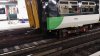
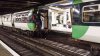
Some pics after it was moved to the platform
 

Attachments

  • image1.jpg
    image1.jpg
    145.3 KB · Views: 450
  • image2.jpg
    image2.jpg
    166.4 KB · Views: 438

387star

On Moderation
Joined
16 Nov 2009
Messages
6,665
I remember during my guard training we were shown how the uncoupling rod works on a 15x do these trains have a different coupling between coaches?
 

455driver

Veteran Member
Joined
10 May 2010
Messages
11,329
I remember during my guard training we were shown how the uncoupling rod works on a 15x do these trains have a different coupling between coaches?

It is very similar.
Please ignore this.
The uncoupling bar is used on the cab end Tightlock coupler and not the between coaches bar coupling.
 
Last edited:

IrishDave

Member
Joined
30 Jun 2009
Messages
471
Location
Brighton
Those pictures seem to show both portions at Victoria. I thought it was only the front three that were taken there?

One of the signallers at Victoria Central described the sequence of events as follows:

5E64, formed of two 4-car 455 units, became divided between the third and fourth coach just after passing Battersea Park on the Up Brighton Slow at about 14:35. After examination and discussion by both NR and GTR/Southern staff, the following moves took place (all at no more than 5mph):
  • Another 455 unit was sent "wrong road" onto the London end to assist the front 3 coaches into platform 10 at Victoria (about 18:30).
  • The rear 5 coaches were moved under their own power, being driven from the front of the rear unit with no visibility, with a staff member standing in the front of the train with a radio to guide the driver into platform 10 at Victoria (about 19:00).
  • With both portions in platform 10, platforms 10 and 11 were blocked and the 3rd rail isolated, in order that repairs could be undertaken, including joining the two halves back together.
  • At about 00:15, both portions (now reunited) were moved into Stewart's Lane depot.
 

Surreytraveller

On Moderation
Joined
21 Oct 2009
Messages
3,905
it must be difficult to plan movements on the reversible that won't affect workings out of Battersea Pier Carriage Sidings.

I know. All one of the movements! But the driver travelling to Battersea Pier would have had plenty of trains to get there on! I think a train can leave the sidings straight onto the Brighton Fast, and doesn't need to use the Brighton Reversible?
 

Domh245

Established Member
Joined
6 Apr 2013
Messages
8,426
Location
nowhere
As it has to work as a pivot for the bar coupling how would you have more than one (very large) fixing?

Perhaps with a concentric style thing:

( : (-+- ) : )

It is (unsurprisingly) not a perfect illustration, given it's done with ASCII, but essentially what you have is 2 pins running between the bracket pairs, which are milled out arcs in the coupling. But it isn't an ideal solution.
 

FordFocus

Member
Joined
15 Apr 2015
Messages
918
Don't 455s have to be a complete unit to move with traction motors, compressors and other control equipment all been on the same coach so it couldn't split and be moved?

If a bar coupler had split on a DMU (except certain modern units like 185s) then you can isolate virtually every electrical safety system to get the brakes released, isolate the end main res air cocks to prevent air escaping and away you go with a single car. Regularly happens on depots.
 
Last edited:

gtr driver

Member
Joined
24 Apr 2015
Messages
144
Don't 455s have to be a complete unit to move with traction motors, compressors and other control equipment all been on the same coach so it couldn't split and be moved?

If a bar coupler had split on a DMU (except certain modern units like 185s) then you can isolate virtually every electrical safety system to get the brakes released, isolate the end main res air cocks to prevent air escaping and away you go with a single car. Regularly happens on depots.

Two compressors and the front portion contained the motor coach so no.
 

RichardKing

Member
Joined
25 Jul 2015
Messages
565
I know. All one of the movements! But the driver travelling to Battersea Pier would have had plenty of trains to get there on! I think a train can leave the sidings straight onto the Brighton Fast, and doesn't need to use the Brighton Reversible?

A train leaving Battersea Pier Sidings does have a brief encounter with the reversible line before having the option of continuing using the aforementioned line or crossing onto the Up Brighton Fast.
In my experience of movements from the Sidings to Victoria, the signaller tends to hold the ECS in the sidings if there is a train already occupying the reversible (unless there is a problem with it and it will not be moving for a while) as opposed to sending it straight onto the Up Fast.
 

hairyhandedfool

Established Member
Joined
14 Apr 2008
Messages
8,837
I remember during my guard training we were shown how the uncoupling rod works on a 15x do these trains have a different coupling between coaches?

It is very similar.

Some 150s have a bar coupling....

http://www.railforums.co.uk/picture.php?albumid=399&pictureid=2442

Whilst some have a BSI....

http://www.mcrua.org.uk/chairmansblog/wp-content/uploads/2014/10/Newton-Heath-TMD-003.jpg

But I believe all Mk3 based EMUs have bar couplings between coaches.
 

SpacePhoenix

Established Member
Joined
18 Mar 2014
Messages
5,491
Will the affected ends of the coaches have the coupler, "pipe jumpers" and electrical jumpers replaced as a precaution?
 

cyclebytrain

Member
Joined
11 Jul 2009
Messages
311
As it has to work as a pivot for the bar coupling how would you have more than one (very large) fixing?

You'd split it vertically rather than horizontally; so you'd have a top bar and a bottom bar on top and bottom pins on the same axis of rotation (note that I'm not suggesting doing this would be a good idea).
 

today

New Member
Joined
2 Oct 2015
Messages
1
Don't 455s have to be a complete unit to move with traction motors, compressors and other control equipment all been on the same coach so it couldn't split and be moved?

s.

If you think about it, you do not need any of this. The front portion was hauled out by a unit from Victoria; the rear portion consisted of one car then a self contained four car unit which was not damaged. This unit then pushed the single car into Victoria.
 

455driver

Veteran Member
Joined
10 May 2010
Messages
11,329
You'd split it vertically rather than horizontally; so you'd have a top bar and a bottom bar on top and bottom pins on the same axis of rotation (note that I'm not suggesting doing this would be a good idea).

Would that allow free movement in 2 axis (horizontal and vertical) and absorb compression forces when being pushed?
 

swt_passenger

Veteran Member
Joined
7 Apr 2010
Messages
34,303
Would that allow free movement in 2 axis (horizontal and vertical) and absorb compression forces when being pushed?

With vehicles able to 'roll' independently (or twist) you'd actually need three axes of movement? It isn't a simple problem at all.
 

cyclebytrain

Member
Joined
11 Jul 2009
Messages
311
The more degrees of freedom a joint has, the more complex it becomes (this is true with the single bar too of course).

But the point is that while you could design and manufacture a dual bar coupler without too much difficulty it would be horrible from a maintenance inspection point of view and in my personal opinion would probably result in a net reduction in safety because you've both doubled the number of parts to be inspected. That's the sort of situation that leads to crack growth getting missed, far better to just life the parts more conservatively.
 

TDK

Established Member
Joined
19 Apr 2008
Messages
4,164
Location
Crewe
Given the rule book allows some concessions with regards to isolated, unbraked vehicles provided it's a bar coupler then I definitely think the industry will look at the event in greater detail.

They may do but since they were introduced I have never heard of a class 455 separating mid train so when a risk assessment is carried out the risk will be low however if it happens once it could in reality happen again. We will have to wait for the official report to ascertain the reasons why the train divided.
--- old post above --- --- new post below ---
Don't 455s have to be a complete unit to move with traction motors, compressors and other control equipment all been on the same coach so it couldn't split and be moved?

If a bar coupler had split on a DMU (except certain modern units like 185s) then you can isolate virtually every electrical safety system to get the brakes released, isolate the end main res air cocks to prevent air escaping and away you go with a single car. Regularly happens on depots.

Class 455's have 2 compressors one either end fed by 750v DC I believe or it may be 415V, control equipment is either end in the cabs.
 

455driver

Veteran Member
Joined
10 May 2010
Messages
11,329
With vehicles able to 'roll' independently (or twist) you'd actually need three axes of movement? It isn't a simple problem at all.

Oh yeah, I forgot about that one! :oops: :lol:

Also remember the compression, extension forces it needs to cope with!
--- old post above --- --- new post below ---
The more degrees of freedom a joint has, the more complex it becomes (this is true with the single bar too of course).

But the point is that while you could design and manufacture a dual bar coupler without too much difficulty it would be horrible from a maintenance inspection point of view and in my personal opinion would probably result in a net reduction in safety because you've both doubled the number of parts to be inspected. That's the sort of situation that leads to crack growth getting missed, far better to just life the parts more conservatively.

455s have been in service since 1983(ish) and this is the first I have heard of one letting go, it isn't exactly common!

Your last statement is basically a knee jerk reaction which does not have any merit.
 

najaB

Veteran Member
Joined
28 Aug 2011
Messages
33,718
Location
Scotland
Your last statement is basically a knee jerk reaction which does not have any merit.
I disagree - what he's saying is that it makes sense to continue to use the current coupling design, but impose an "inspect after x hours use" requirement. Seems sensible to me as long as there's a suitably large value for x.
 

455driver

Veteran Member
Joined
10 May 2010
Messages
11,329
I disagree - what he's saying is that it makes sense to continue to use the current coupling design, but impose an "inspect after x hours use" requirement. Seems sensible to me as long as there's a suitably large value for x.
These things are already inspected periodically, just like every other component.
 

najaB

Veteran Member
Joined
28 Aug 2011
Messages
33,718
Location
Scotland
These things are already inspected periodically, just like every other component.
I understand that units are inspected regularly, but are these types of couplings inspected on a cycle or on need? If (and I stress if) the investigation into this incident indicates there was fatigue cracking then it may be necessary to treat them as damage tolerant rather than safe life components.
 

ChiefPlanner

Established Member
Joined
6 Sep 2011
Messages
8,333
Location
Herts
Not much different to the bar couplings on the older Freightliner 5 sets - apart from having electrical through connections - relatively easy to check and a normal part of the exam process.

Very rare to see one split in service - and you can be assured that this will be looked at diligently as part of the inevitable enquiry.(I believe some 46x vehicles had a few issues around the early 1990's in service. - never reoccured)
 
Status
Not open for further replies.

Top