• Our new ticketing site is now live! Using either this or the original site (both powered by TrainSplit) helps support the running of the forum with every ticket purchase! Find out more and ask any questions/give us feedback in this thread!

Class 40 & 55 Deltic

Status
Not open for further replies.

camperdown9

Member
Joined
2 Nov 2011
Messages
97
Location
Chestfield, Kent & Chatillon Sur-Seine, Burgundy
Hi All

What is a Deltic? Lots of people even non rail enthusiasts seam to know what a Deltic looks like. But whats the difference between a class 40 and a class 55?

Are there other locomotives that look similar to class 40's and 55's?

From a photo how can you tell the difference between a class 40 and 55?

Does the term Deltic just refer to a class 55?

Please go easy on me..I know next to nothing about trains and am here to learn :oops:

Thanks

Alex
 
Sponsor Post - registered members do not see these adverts; click here to register, or click here to log in
R

RailUK Forums

Western Lord

Member
Joined
17 Mar 2014
Messages
1,062
The difference between a Class 40 and a Deltic is about 30 tons and 1,300 bhp.
The class 40 was heavy eight axled machine with a 2,000 bhp V-16 engine. The Deltic was named after its engine, the Napier Deltic eighteen cylinder two stroke with three banks of opposed pistons with a crankshaft at each of the three corners. It was light and compact having been developed as a marine engine for patrol boats. The locomotive it powered had two of these engines each producing 1,650bhp, ran on two six axle bogies and was much lighter than a class 40 as well as being faster (100mph vs. 90mph). Class 55 refers to the 22 production machines introduced in 1961. There was an earlier prototype which is now in the NRM. In addition there was a smaller Type 2 locomotive with a single nine cylinder Deltic engine which were referred to as the Baby Deltics. Unlike their big brothers they were not a success.
The Deltic engine was expensive to maintain and saw no further use in rail applications. Deltic engines continue in service in the Royal Navy's Hunt class mine countermeasures boats.
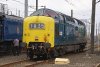
All early English Electric diesels had a prominent nose end which is a feature of Class 40, Class 37 and the Deltics. The Class 40 can be distinguished by its heavy plate frame four axle 1Co-Co1 bogies. The class 37 is shorter and runs on six axle Co-Co bogies of the same design as the Deltics. Both the Class 40 and the Class 37 have three cab windscreens (as did the Baby Deltics), whereas the big Deltics have two cab windscreens and more rounded nose ends.
 
Last edited:

dgl

Established Member
Joined
5 Oct 2014
Messages
3,056
Deltic refers to the Napier Deltic engine used.
 

Cowley

Forum Staff
Staff Member
Global Moderator
Joined
15 Apr 2016
Messages
18,913
Location
Devon
To the uninitiated a lot of diesel and electric locomotives look like boxes on wheels, although obviously some have noses, some are flat fronted, some are streamlined etc. But there are many differences under the skin. A bit like cars I suppose.
The older diesels all sound very distinctive too and I should imagine many people on here including myself could identify quite a few locomotives when they're pulling away just from the sound they make even if they couldn't see them.
I don't know where you're based but a good way to understand this would be to go along to a diesel gala on a preserved railway and have a look and listen to some of them and maybe a few rides behind them.
On preserved railways the line speed is low (meant to be about 25mph) but you can still hear the locomotives working at times, back when the older machines were running at fast speeds on the mainline it could be pretty exhilarating if you like the sound of a big engine working hard.
 

daikilo

Established Member
Joined
2 Feb 2010
Messages
1,623
The Deltics 18 cylinders are arranged in a triangular arrngement with 3 banks of 6 at 120 degrees to each other. They were high-speed diesels whereas the class 40s were medium speed. If you can find and compare recordings on youtube you will hear the difference. Personally, I like both and especially 40145 accelerating.
 

daikilo

Established Member
Joined
2 Feb 2010
Messages
1,623
The Deltics 18 cylinders are arranged in a triangular arrngement with 3 banks of 6 at 120 degrees to each other. They were high-speed diesels whereas the class 40s were medium speed. If you can find and compare recordings on youtube you will hear the difference. Personally, I like both and especially 40145 accelerating.

And the 55s had two engine banks whilst the 23s had one, but the high-speed sound was the same.
 

randyrippley

Established Member
Joined
21 Feb 2016
Messages
5,382
The "Deltic" is really the diesel engine which powered the locomotive, not the locomotive. It was an unusual lightweight high powered opposed-piston design with technology directly ripped off - and extrapolated from - that of the opposed piston diesels used in German Ju88 bombers during WWII
There are plenty of overviews of the design, here's one example.
http://www.dieselarmy.com/engine-te...n-history-how-the-napier-deltic-diesel-works/

The class 55 "Deltic" locomotives used two 18-cylinder Deltic engines, in a lightweight bodyshell which took styling cues from the earlier Victorian Railways L class electric locomotives, which were also built by English Electric from 1952 onwards. Both the L class and the Deltics used relatively lightweight three-axle bogie designs, unlike the class 40s which used a massively overweight 4-axle bogie.
The class 40 design was the epitome of what was wrong in British Rail locomotive design in the 1950s - a heavy, underpowered low technology machine using massively overengineered structural components whose design philosophy dated from steam engine construction. The Deltic design was a lightweight, high technology (for its time) concept optimised for maximum performance.
Its telling that the engineers at the two main English Electric production plants refused to build the prototype Deltic as they didn't accept its design principles, so it had to be knocked up as a one-off at the Dick, Kerr site at Preston
 

Taunton

Veteran Member
Joined
1 Aug 2013
Messages
12,273
Both Class 40 and Deltic were designed by English Electric, who favoured having nose ends on their locos. I've seen observers say this was wasteful, not really so as the nose did contain a variety of auxiliary items. But English Electric had a long pioneering history of supplying export diesels to Africa, Asia, etc, where railways were unfenced and trains regularly struck vehicles at unguarded level crossings and various other hazards. In these cases crews would be most grateful for a nose (which has a substantial girder frame inside) in front of them (as I'm sure the crew of the EE prototype DP2 were when it was destroyed colliding with a cement train, but the crew walked away).

In the USA, where they have an enormous and continuing issue with level crossing collisions, nose ends on locos were always standard, and continue to be so.

Both Class 40 and Deltic were designed by English Electric at their Preston works, and built by Vulcan, an EE subsidiary, in Warrington, where both were under construction simultaneously. The original blue pioneer Deltic prototype, now in York museum, was hand built at Preston.
 
Last edited:

MarlowDonkey

Established Member
Joined
4 Apr 2013
Messages
1,861
Both Class 40 and Deltic were designed by English Electric at their Preston works, and built by Vulcan, an EE subsidiary, in Warrington, where both were under construction simultaneously.

Are not the bodyshells of the class 37 and class 55 next to identical? Like cars, same body, different engines and styling.

Class 40 and Class 55/37 can easily be differentiated. The former has 8 axles and the latter just 6.
 

Cowley

Forum Staff
Staff Member
Global Moderator
Joined
15 Apr 2016
Messages
18,913
Location
Devon
Are not the bodyshells of the class 37 and class 55 next to identical? Like cars, same body, different engines and styling.

Class 40 and Class 55/37 can easily be differentiated. The former has 8 axles and the latter just 6.

I would say that 37s and 55s look different in almost every area. I'm struggling to think of any part of the body that's identical, from the grilles to the windows, to the roof, they shared similar bogies but a Deltic is much longer and I think the construction was different too. A 37 if anything looks more similar to a 40 in my eyes although longer and with more wheels etc.
 

randyrippley

Established Member
Joined
21 Feb 2016
Messages
5,382
Are not the bodyshells of the class 37 and class 55 next to identical? Like cars, same body, different engines and styling.

Class 40 and Class 55/37 can easily be differentiated. The former has 8 axles and the latter just 6.

A class 50 bodyshell is basically a class 55 bodyshell with a new flat nose, and internal redesign to allow for the single motor.
The class 37 is a completely different design, and is more like a re-engineered lightweight version of a class 40
 

Taunton

Veteran Member
Joined
1 Aug 2013
Messages
12,273
The Class 50 was fundamentally a production version of DP2, which had the single large EE diesel installed in a Deltic bodyshell. It suffered because a significant number of the auxiliaries were changed from the prototype, and it was these that gave the initial unreliability of the Class 50.
 

gimmea50anyday

Established Member
Joined
8 Jan 2013
Messages
3,456
Location
Back Cab
In short a 40 has big cumbersome and chunky 1 co co 1 bogies which the drawbar and buffers are attached to with the body plonked on top and the front end has 3 windows.

A deltic has only 2 windows at the cab front, bigger more curvy noses which the bufferbeam is attached to and smaller co co bogies tucked in neatly underneath the loco
 

MK Tom

Established Member
Joined
31 Aug 2011
Messages
2,458
Location
Milton Keynes
Classes with noses:

Class 23 - 'Baby Deltic', 4+4 (bo-bo) wheel arrangement, Napier Deltic engine
Class 37 - 6+6 (co-co) wheel arrangement, English Electric engine
Class 40 - 8+8 (1-co-co-1) wheel arrangement, English Electric engine
Class 44/45/46 'Peak' - 8+8 (1-co-co-1) wheel arrangement, Sulzer engine
Class 55 'Deltic' - 6+6 (co-co) wheel arrangement, Napier Deltic engine x2

55s are the only ones with American-style two-window cabs. All the others have three.
 

RichmondCommu

Established Member
Joined
23 Feb 2010
Messages
6,906
Location
Richmond, London
Uk
Classes with noses:

Class 23 - 'Baby Deltic', 4+4 (bo-bo) wheel arrangement, Napier Deltic engine
Class 37 - 6+6 (co-co) wheel arrangement, English Electric engine
Class 40 - 8+8 (1-co-co-1) wheel arrangement, English Electric engine
Class 44/45/46 'Peak' - 8+8 (1-co-co-1) wheel arrangement, Sulzer engine
Class 55 'Deltic' - 6+6 (co-co) wheel arrangement, Napier Deltic engine x2

55s are the only ones with American-style two-window cabs. All the others have three.

It could also perhaps be suggested that the class 20 has a nose, albeit a very long one!
 

Cowley

Forum Staff
Staff Member
Global Moderator
Joined
15 Apr 2016
Messages
18,913
Location
Devon
Separated at birth.
 

Attachments

  • IMG_0845.JPG
    IMG_0845.JPG
    100.1 KB · Views: 17
  • IMG_0847.JPG
    IMG_0847.JPG
    171.9 KB · Views: 21
Status
Not open for further replies.

Top