Ashley Hill
Established Member
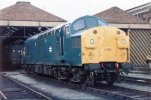
Probably an easy question for those that know but why was the lower part of the noses modified around the buffer beam?


Photos John Woolley.
Photos John Woolley.


Primarily to make ot easier for a shunter to couple and also make it easier to fit ploughs.Probably an easy question for those that know but why was the lower part of the noses modified around the buffer beam?
View attachment 141956View attachment 141957
Photos John Woolley.

Thanks for your replyPrimarily to make ot easier for a shunter to couple and also make it easier to fit ploughs.
Locos were modified beginning in 1979 I understand, the work generally (but not always) coinciding with the headcode box bring plated over. Though, the last to be so modified - 37116, only had its cowling done as late as 1996.

I had always thought, probably incorrectly, that it been done to make it easier to replace buffers.Thanks for your reply
Could be another thing made easier by the alteration?I had always thought, probably incorrectly, that it been done to make it easier to replace buffers.
37's did have steam heat boiler which was fitted in the nose, and this was accessed via the front panels (doors) on the nose, once the steam boilers became redundant, the doors were not required and the nose was plated over when the steam heat boilers were removed, and a standard headcode box fitted. as regards modification to the lower panels was likely to assist the replacement of the buffers

Yes you are right,never worked a 37 with a boiler in the nose end.Really?!?
I thought the boiler was in the main part of the body, with the water tank underneath. Also, not sure how your logic applies to the later build which had central panels rather than split boxes (and therefore no nose doors) but still provided steam heat

The boilers were in the main body of the loco and the two different front end designs were from new. Locos of both types had steam heat boilers.37's did have steam heat boiler which was fitted in the nose, and this was accessed via the front panels (doors) on the nose, once the steam boilers became redundant, the doors were not required and the nose was plated over when the steam heat boilers were removed, and a standard headcode box fitted. as regards modification to the lower panels was likely to assist the replacement of the buffers
I really think you may have misunderstood something there37's did have steam heat boiler which was fitted in the nose, and this was accessed via the front panels (doors) on the nose, once the steam boilers became redundant, the doors were not required and the nose was plated over when the steam heat boilers were removed, and a standard headcode box fitted. as regards modification to the lower panels was likely to assist the replacement of the buffers
The nose doors were nothing to do with the boiler placement. The doors were originally installed to allow the crew to pass between locomotives when double headed but were a source of drafts and were rarely used so deleted on later locos.37's did have steam heat boiler which was fitted in the nose, and this was accessed via the front panels (doors) on the nose, once the steam boilers became redundant, the doors were not required and the nose was plated over when the steam heat boilers were removed, and a standard headcode box fitted. as regards modification to the lower panels was likely to assist the replacement of the buffers

As per all the other posts, what you've posted is not correct at all. The boiler in a 37 was located at the number 2 end of the engine room, between the generator and the control cubicle opposite the battery box. The nose ends contain the traction motor blowers, compressor and exhauster (at opposite ends).37's did have steam heat boiler which was fitted in the nose, and this was accessed via the front panels (doors) on the nose, once the steam boilers became redundant, the doors were not required and the nose was plated over when the steam heat boilers were removed, and a standard headcode box fitted.

Have any preserved examples had the original style refitted?