• Our new ticketing site is now live! Using either this or the original site (both powered by TrainSplit) helps support the running of the forum with every ticket purchase! Find out more and ask any questions/give us feedback in this thread!

Class 25 cab ends

Status
Not open for further replies.

Masbroughlad

Established Member
Joined
2 Mar 2011
Messages
1,838
Location
Midlands
Just out of curiosity......

When class 25s were built, why did they have 2 designs? There were those with a smaller middle windows and those with three front windows of similar size.

Were they built at the same place? Were they a sub-class intended for different duties?

Wondered if it was just a railway oddity or a planned design feature?
 
Last edited:
Sponsor Post - registered members do not see these adverts; click here to register, or click here to log in
R

RailUK Forums

Cowley

Forum Staff
Staff Member
Global Moderator
Joined
15 Apr 2016
Messages
18,893
Location
Devon
The class 25 design followed on from the class 24 in that below the smaller centre window there were a set of doors with a gangway connection that enabled crew to pass from one loco to another if working in multiple. Many different types of loco had this but in practice it was rarely used so on the later built 25s it was dispensed with and the opportunity was taken to tidy up the front end.
Classes fitted with front end doors that I can think of off the top of my head were at least 22,24,25,26,27,28,30,31,37,40,41 (original Warship),44 and 45.
You can tell which 37s had them because these are the ones with split headcodes.
On most classes the doors were eventually welded shut or plated over to stop draughts in the cabs, although some preserved locos still have opening doors I'm not sure if any still have the gangway equipment still fitted.
 

randyrippley

Established Member
Joined
21 Feb 2016
Messages
5,383
Don't forget that the 25's went through a number of body redesigns based on who built them - and which works fettled them....most of those with the full-depth front windows also had the cleaned-up body sides with the louvres and grilles relocated to the roof.
My understanding is these were built by Beyer-Peacock who objected to the difficulty and costs of assembling the original design, and came up with their own more efficient version - which also reduced the amount of crud being drawn into the air intakes. They cleaned up the cabs at the same time. The ones built at BR shops retained the original body panels.
The whole history of the 24/25 design in quite complex - best to read a decent source such as the Derbysulzers site
http://www.derbysulzers.com/cabs.html
http://www.derbysulzers.com/changes.html
 

DarloRich

Veteran Member
Joined
12 Oct 2010
Messages
32,893
Location
Fenny Stratford
Just out of curiosity......

When class 25s were built, why did they have 2 designs? There were those with a smaller middle windows and those with three front windows of similar size.

Were they built at the same place? Were they a sub-class intended for different duties?

Wondered if it was just a railway oddity or a planned design feature?

They were built:

  • Class 25/0 -Darlington
  • Class 25/1 - Darlington & Derby
  • Class 25/2 - Darlington & Derby ( mostly the latter)
  • Class 25/3 - Derby & Beyer Peacock at Gorton

It is clear where the good ones came from ;)
 

Ash Bridge

Established Member
Joined
17 Mar 2014
Messages
4,214
Location
Stockport
As a kid living in Leicester, I watched some of these, slowly disappear at Vic Berry's...

Engines generators and other heavy bits removed, then body shell lifted off its bogies and stacked 3/4 high, don't think anywhere else did it in quite the same manner did they?
 

Taunton

Veteran Member
Joined
1 Aug 2013
Messages
12,245
The gangway doors were hardly ever used, and were a significant source of draughts into the cab, and also into the auxiliary equipment that was mounted in the nose. In actual fact multiple-unit operation of diesels overall was decidedly uncommon on BR, maybe with the exception of the Class 20s (which inevitably didn't have the doors).

The concept came from the USA, where not only is multiple-unit operation universal, but the first diesels in the 1930s, the GM F-types and their equivalents, did not have automatic operation of radiator shutters and thus the fireman had to make their way through all the units periodically to reset them, and also check other equipment which was not remotely indicated in the front cab. These USA units had proper Pullman-type gangways between units rather than the hands-and-knees crawl required on the BR units.

The decidedly open-ventilated engine rooms of the US units, even though they looked to have carbody type bodies, led to substantial draughts through them at speed, and the prospect of having to walk to and fro through a 4-unit FT diesel running at 60mph through -20C weather conditions in northern/eastern USA in the winter, resetting the shutters before the coolant froze, was a notable downside of the early diesels compared to the fireman's position in a steam loco cab.
 

ac6000cw

Established Member
Joined
10 May 2014
Messages
3,909
Location
Cambridge, UK
Pairs of 25s used to turn up reasonably often around the Birmingham area in the 1970s (even occasionally on passenger trains if no Type-4 was available, especially in the summer - aural delights for the enthusiast in the front coach...). I've never seen the nose doors in use on any BR loco though.
 

Harbornite

Established Member
Joined
7 May 2016
Messages
3,627
Some shots of 25s in the Birmingham area. Not a class I really associate with Birmingham, I'm not saying that they didn't show up here because that would be just wrong.


750201_25075_BhamNS.jpg


25075 waiting for the signal to leave Birmingham New Street with a north bound van train.

That platform still looks roughly the same today, it's now often used by London Midland Shrewsbury services.

http://www.class25.info/photograph_pages/individual_photos/750201_25075_BirminghamNS.htm


25313birminghamint.jpg


hotograph courtesy Ian Hammond & Nick Ross
25313 & 25249 wait to be uncoupled from their train at Birmingham International whilst working the final Class 25 hauled railtour, see below.
Four Class 25's took part in the very last Class 25 railtour, Hertfordshire Railtours ‘Mersey Ratcatcher’ (1Z30) of September 28, 1986. The tour started in Euston behind 25313 & 25249 running as far as Birmingham International where 86237 took over for the trip to Birmingham New Street. This odd move was created due to construction at New Street closing the west end of the station making run rounds difficult. 25313 & 25249 came back on the train heading off to Leicester, Derby, and over the Hope Valley line to Manchester and Liverpool Lime Street. Here 25904 & 25910 made the short run down to Crewe, via Chester, where the original pair took up the final run to Euston via the Trent Valley line, completing a day of 490 miles of 25 haulage. Both 25313 & 25249 would continue in service into 1987, both reached Vic Berry’s during the summer of 1987, for 25249 it was the end, the more fortunate 25313 would reach preservation.

http://www.derbysulzers.com/25313.html


25038_25073_BNS_290380.jpg


Double-headed Class 25's 25 038 & 25 073 enter Birmingham New Street on the 29th March 1980.

http://www.railblue.com/pages/Class 25/25038_25073_BNS_290380.htm
 

Cowley

Forum Staff
Staff Member
Global Moderator
Joined
15 Apr 2016
Messages
18,893
Location
Devon
Excellent photos! Especially love the black and white one. Remember seeing one at Bideford once on a China clay train. Only time I definitely saw one working. Pretty sure they were often around Bescot in the 80s, saw them in Toton scrapline too. Cabbed 25080 there. Didn't pairs of them do the summer Saturday Cambrian coast trains with intercity stock in the mid 80s too?
 
Last edited:

Harbornite

Established Member
Joined
7 May 2016
Messages
3,627
Excellent photos! Especially love the black and white one. Remember seeing one at Bideford once on a China clay train. Only time I definitely saw one working. Pretty sure they were often around Bescot in the 80s, saw them in Toton scrapline too. Cabbed 25080 there. Didn't pairs of them do the summer Saturday Cambrian coast trains with intercity stock in the mid 80s too?

How did I forget about those? Class 24s in pairs were used on the CCE when it was reinstated in the 1970s, they were replaced by class 25 pairs which in turn were replaced by railfreight and then intercity 37s. I wasn't alive when any of this was happening but I do wish the Cambrian still had loco hauled passenger trains.

This is one of my favourite websites about Welsh railways and includes some nice pictures or 24s and 25s on the Cambrian.

www.2d53.co.uk/CambrianML/general.htm
www.2d53.co.uk/cambriancoast/Barmouth.htm

s1089.jpg


Another Welsh site that I recommend is this.

www.penmorfa.com/Archive/eleven.htm

Regarding Bideford, it's a shame that the North Cornwall line to Meeth managed to survive the Beeching cuts, only to close in the 1980s. At lwast the stations are preserved.
 
Last edited:

Cowley

Forum Staff
Staff Member
Global Moderator
Joined
15 Apr 2016
Messages
18,893
Location
Devon
How did I forget about those? Class 24s in pairs were used on the CCE when it was reinstated in the 1970s, they were replaced by class 25 pairs which in turn were replaced by railfreight and then intercity 37s. I wasn't alive when any of this was happening but I do wish the Cambrian still had loco hauled passenger trains.

31s did a stint too I seem to remember after the 37s, and I think even the occasional 40 in the 1980s to Aberystwyth?
One of my few bashing regrets is not doing a loco hauled trip to Pwllheli or Aberystwyth when I had the chance, but there you go.
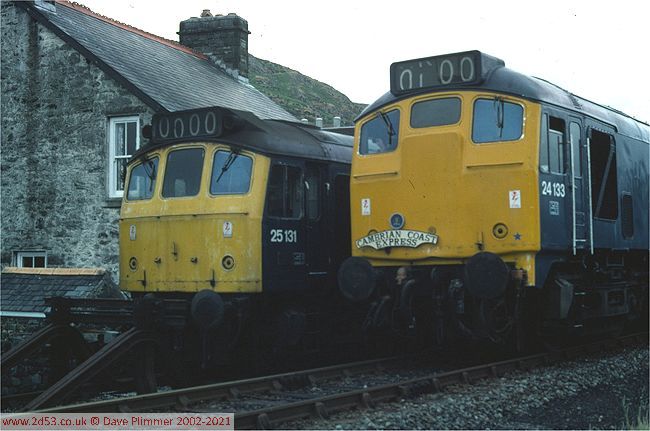
Interesting photo of the 24 with headcodes next the 25 with the three large windows, that picture illustrates the difference in cab fronts really well.
Also reading on those sites about the 25s that were the last ones left in traffic in March 1987 there were a few quite early ones (notably 25035) that clung on, I remembered that 035 worked the last normal passenger train by its type after rescuing a 47 at Chester.
A few of the 25s had unofficial names too near the end.
Of course back then you had to wait a month for one of the railway magazines to tell you all this!
 
Last edited:

Ash Bridge

Established Member
Joined
17 Mar 2014
Messages
4,214
Location
Stockport
31s did a stint too I seem to remember after the 37s, and I think even the occasional 40 in the 1980s to Aberystwyth?
One of my few bashing regrets is not doing a loco hauled trip to Pwllheli or Aberystwyth when I had the chance, but there you go.
Interesting photo of the 24 with headcodes next the 25 with the three large windows, that picture illustrates the difference in cab fronts really well.
Also reading on those sites about the 25s that were the last ones left in traffic in March 1987 there were a few quite early ones (notably 25035) that clung on, I remembered that 035 worked the last normal passenger train by its type after rescuing a 47 at Chester.
A few of the 25s had unofficial names too near the end.
Of course back then you had to wait a month for one of the railway magazines to tell you all this!

I fortunately made a couple of trips from Shrewsbury to Barmouth around 1990/91, what a contrast it was between the then regular RR/Centro Class 150s one way compared to the luxury of an ex. Transpennine mk2 FK or indeed NSE mk1 SO or SK behind a 37 in the other direction, that shot of the 24 with the headcode panel got me thinking, how many of these were so fitted? I recall the early version 25s in this style, but always remember the 24s without the boxes, was this perhaps a one-off due to a replacement cab being fitted at some point?
 

Cowley

Forum Staff
Staff Member
Global Moderator
Joined
15 Apr 2016
Messages
18,893
Location
Devon
I fortunately made a couple of trips from Shrewsbury to Barmouth around 1990/91, what a contrast it was between the then regular RR/Centro Class 150s one way compared to the luxury of an ex. Transpennine mk2 FK or indeed NSE mk1 SO or SK behind a 37 in the other direction, that shot of the 24 with the headcode panel got me thinking, how many of these were so fitted? I recall the early version 25s in this style, but always remember the 24s without the boxes, was this perhaps a one-off due to a replacement cab being fitted at some point?

Wish I'd done that.
I think there were quite a lot of 24s with headcodes, definitely the last thirty or so looked pretty much the same as the first batch of 25s with top headcodes and no horns on the side of the boxes.
 

Saltleyman

Member
Joined
2 Aug 2009
Messages
179
Location
West Midlands
in the mid 1960's right up to their scrapping most of the local trippers worked by Saltley were usually class 25's,we also worked passenger trains with 25's mainly the B'ham to Norwich trains if a 31 wasn't available, we also worked parcel and newspaper trains with them.A regular Saltley turn with two 25's in multiple was from York to Landor Street and Landor Street to Bristol(a 2nd crew)with the Newcastle to Newton Abbot car sleeper.Also we quite often had a 25 on the Carlisle lodging jobs if a 45 was not available.
 
Last edited:

Ash Bridge

Established Member
Joined
17 Mar 2014
Messages
4,214
Location
Stockport
Wish I'd done that.
I think there were quite a lot of 24s with headcodes, definitely the last thirty or so looked pretty much the same as the first batch of 25s with top headcodes and no horns on the side of the boxes.
Ah, thanks for that, I guess it's my memory that must be fading somewhat.
in the mid 1960's right up to their scrapping most of the local trippers worked by Saltley were usually class 25's,we also worked passenger trains with 25's mainly the B'ham to Norwich trains if a 31 wasn't available, we also worked parcel and newspaper trains with them.A regular Saltley turn with two 25's in multiple was from York to Landor Street and Landor Street to Bristol(a 2nd crew)with the Newcastle to Newton Abbot car sleeper.

Generally speaking, how would a Saltley driver have rated a 25 opposed to a 31, not just in terms of performance but in cab environment terms and comfort etc. Also would 2x25 roughly match a 45/46 in performance on an express passenger working?
 

Saltleyman

Member
Joined
2 Aug 2009
Messages
179
Location
West Midlands
25's were a useful workhorse although very noisy in the cab,they rode roughly at speed and you felt every rail joint,howver they didn't "bounce" like a 31.The 31's always seemed a "weak" loco compared to a 25, but the 31's were far heavier in weight.Out of all the early diesels we worked on at Saltley the B'Ham C&W built class D53xx series(later class 26)were by far the most comfortable locos for crews.
 

Cowley

Forum Staff
Staff Member
Global Moderator
Joined
15 Apr 2016
Messages
18,893
Location
Devon
25's were a useful workhorse although very noisy in the cab,they rode roughly at speed and you felt every rail joint,howver they didn't "bounce" like a 31.The 31's always seemed a "weak" loco compared to a 25, but the 31's were far heavier in weight.Out of all the early diesels we worked on at Saltley the B'Ham C&W built class D53xx series(later class 26)were by far the most comfortable locos for crews.

When I volunteered at the Mid Hants in the early 90s we had 25067 and 27007 based there and we used them a lot to move stock from Alresford to Ropley for servicing and from what I remember the 27 was definitely more comfortable.
I loved the 25 though, it was a bit battered by then which made it feel more like the real thing to me.
I remember reading somewhere that a 25 could take quite a bit of punishment compared to other types. Was that true?
 

Taunton

Veteran Member
Joined
1 Aug 2013
Messages
12,245
I remember reading somewhere that a 25 could take quite a bit of punishment compared to other types. Was that true?
A 27 even more so, but being all up in Scotland they didn't get noticed much elsewhere. The overnight goods from Glasgow to Fort William forcing through a foot or two of snow, then the next day slamming back and forth on the Glasgow-Edinburgh High Speed shuttle, in both cases with the ammeter needle on the limit for sustained periods, year after year, gave them a good reputation with Eastfield crews - possibly the hardest taskmasters to please on the system!
 

Harbornite

Established Member
Joined
7 May 2016
Messages
3,627
25's were a useful workhorse although very noisy in the cab,they rode roughly at speed and you felt every rail joint,howver they didn't "bounce" like a 31.The 31's always seemed a "weak" loco compared to a 25, but the 31's were far heavier in weight.Out of all the early diesels we worked on at Saltley the B'Ham C&W built class D53xx series(later class 26)were by far the most comfortable locos for crews.

I can't remember where (it could well have been you), but I heard someone criticise 31s and praise 25s, I think it was due to the cabs and lack of power.
--- old post above --- --- new post below ---
31s did a stint too I seem to remember after the 37s, and I think even the occasional 40 in the 1980s to Aberystwyth?
One of my few bashing regrets is not doing a loco hauled trip to Pwllheli or Aberystwyth when I had the chance, but there you go.
Interesting photo of the 24 with headcodes next the 25 with the three large windows, that picture illustrates the difference in cab fronts really well.
Also reading on those sites about the 25s that were the last ones left in traffic in March 1987 there were a few quite early ones (notably 25035) that clung on, I remembered that 035 worked the last normal passenger train by its type after rescuing a 47 at Chester.
A few of the 25s had unofficial names too near the end.
Of course back then you had to wait a month for one of the railway magazines to tell you all this!

31s were only used after a derailment in 1990 or 1991. They didn't last long, unfortunately, because BR decided in their infinite wisdom to axe the Cambrian coast express. Possibly because of the number of loco changes required en route.

I also wish I could have done a loco hauled trip up there, the current crop of 158s are a bit dull in comparison.
 

Harbornite

Established Member
Joined
7 May 2016
Messages
3,627
Although far superior to what went before i.e. 150/153

The 150s appeared in 1987 I think and were displaced by 156s. Central used these and 158s until eventually the fleet had been standardised to 158s, although for a brief while before the franchise changed, 170s were used. How often did 153s appear, pics of them on the Cam are scarce.
 

Saltleyman

Member
Joined
2 Aug 2009
Messages
179
Location
West Midlands
When I volunteered at the Mid Hants in the early 90s we had 25067 and 27007 based there and we used them a lot to move stock from Alresford to Ropley for servicing and from what I remember the 27 was definitely more comfortable.
I loved the 25 though, it was a bit battered by then which made it feel more like the real thing to me.
I remember reading somewhere that a 25 could take quite a bit of punishment compared to other types. Was that true?

I can't remember the exact date but I relieved a "special" at Gloucester on a Sunday in the 1960's to work back to B'Ham New St. the train arrived with a class 25 and load of ten coaches (330 tons trailing)and I was advised that there wouldn't be a banker at Bromsgrove for the Lickey bank.I contacted the control to find out the allowed load between Bromsgrove and Blackwell for a single class 25 only to find that there was no laid down load in the Appendix for a 25 !
I had a word with Gloucester panel and asked for a guaranteed clear road from Stoke Works and on to Blackwell this assurance I was given.
I eventually passed Bromsgrove station under clear signals at 61 mph and topped the bank at Blackwell (with fingers and everything else crossed) at 10 mph.
In my opinion don't think that a 31 would have managed that !Good job it wasn't raining !!
 
Last edited:

Ash Bridge

Established Member
Joined
17 Mar 2014
Messages
4,214
Location
Stockport
The 150s appeared in 1987 I think and were displaced by 156s. Central used these and 158s until eventually the fleet had been standardised to 158s, although for a brief while before the franchise changed, 170s were used. How often did 153s appear, pics of them on the Cam are scarce.

I think it was August 1994 when I last travelled on one from Penhelig to Machynlleth to connect with a mainline service to Shrewsbury, I do have some slides of them on the Cambrian Coast around Aberdovey during this period but I've yet to scan them, I don't recall seeing the 150s much after 1991, like you say the 156s & 158s seemed to take over from this point although I'm sure the 153s lingered until the mid nineties at least on the coast services.
 

Cowley

Forum Staff
Staff Member
Global Moderator
Joined
15 Apr 2016
Messages
18,893
Location
Devon
I can't remember the exact date but I relieved a "special" at Gloucester on a Sunday in the 1960's to work back to B'Ham New St. the train arrived with a class 25 and load of ten coaches (330 tons trailing)and I was advised that there wouldn't be a banker at Bromsgrove for the Lickey bank.I contacted the control to find out the allowed load between Bromsgrove and Blackwell for a single class 25 only to find that there was no laid down load in the Appendix for a 25 !
I had a word with Gloucester panel and asked for a guaranteed clear road from Stoke Works and on to Blackwell this assurance I was given.
I eventually passed Bromsgrove station under clear signals at 61 mph and topped the bank at Blackwell (with fingers and everything else crossed) at 10 mph.
In my opinion don't think that a 31 would have managed that !Good job it wasn't raining !!

What a post. Excellent. :)
--- old post above --- --- new post below ---
A 27 even more so, but being all up in Scotland they didn't get noticed much elsewhere. The overnight goods from Glasgow to Fort William forcing through a foot or two of snow, then the next day slamming back and forth on the Glasgow-Edinburgh High Speed shuttle, in both cases with the ammeter needle on the limit for sustained periods, year after year, gave them a good reputation with Eastfield crews - possibly the hardest taskmasters to please on the system!

Very true, the 27s on the Edinburgh-Glasgow push pulls were given a very hard workout. I always wondered why the 26s outlasted the 27s despite being older and lower powered. Were they just worn out?
 
Last edited:

edwin_m

Veteran Member
Joined
21 Apr 2013
Messages
28,617
Location
Nottingham
I recall a trip from Birmingham to Machynlleth in 1992 in early Mk2s behind two 31s in Dutch. I think it was all 158s by then except for summer Saturday extras like that one, and due to hay fever I was very glad when a 158 rolled in for the journey home. 150s were running to Aber in summer 1987.
 

Ash Bridge

Established Member
Joined
17 Mar 2014
Messages
4,214
Location
Stockport
I can't remember the exact date but I relieved a "special" at Gloucester on a Sunday in the 1960's to work back to B'Ham New St. the train arrived with a class 25 and load of ten coaches (330 tons trailing)and I was advised that there wouldn't be a banker at Bromsgrove for the Lickey bank.I contacted the control to find out the allowed load between Bromsgrove and Blackwell for a single class 25 only to find that there was no laid down load in the Appendix for a 25 !
I had a word with Gloucester panel and asked for a guaranteed clear road from Stoke Works and on to Blackwell this assurance I was given.
I eventually passed Bromsgrove station under clear signals at 61 mph and topped the bank at Blackwell (with fingers and everything else crossed) at 10 mph.
In my opinion don't think that a 31 would have managed that !Good job it wasn't raining !!

As Cowley said above, super post and many thanks for sharing, I can never tire from reading about drivers experiences such as yours.
I recall a trip from Birmingham to Machynlleth in 1992 in early Mk2s behind two 31s in Dutch. I think it was all 158s by then except for summer Saturday extras like that one, and due to hay fever I was very glad when a 158 rolled in for the journey home. 150s were running to Aber in summer 1987.

I definitely recall that Central 156s were still working to Pwllheli from Birmingham during 2000 as I travelled out and back on one during the summer of that year.
 

randyrippley

Established Member
Joined
21 Feb 2016
Messages
5,383
Very true, the 27s on the Edinburgh-Glasgow push pulls were given a very hard workout. I always wondered why the 26s outlasted the 27s despite being older and lower powered. Were they just worn out?

Many of the 26 fleet got an engine transplant from 25s that were scrapped early due to asbestos. Despite being newer units they were downrated to match the power output of the originals to prevent any risk to the old traction motors. Thats why the lasted longer - the 27s never got a transplant
 
Status
Not open for further replies.

Top