

ABB125
Established Member
I recently spent some time in Italy, and travelled on Circumvesuviana (for th video, click my signature and look for 'Circumvesuviana trains in Italy').
I have some questions:
The track gauge is around 950mm. Why was this chosen? I don’t think it was to save on tunnelling costs, because the trains are just as wide as standard gauge.
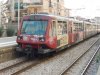
Most of the trains were covered in at least some graffiti. Is this normal in Italy?
The line from Pompeii to Sorrento is predominately single track. There are lots of stations with passing places. However, some have two platforms, some have three platforms, and some have four platforms (with only one seemingly in use). Why is there so much variation?
On one journey, the train stopped outside a station with two platforms, just before the points. The driver got out of the cab, and unlocked a door so the guard could get out. I couldn’t see what was happening, but after about a minute, the guard got back in, and the train proceeded to the station. The guard then got out again, and walked along the track to the next set of points. He unlocked a trackside cabinet, removed an object (hammer?), and fiddled with the points, but didn’t change the direction they were set in. he then locked the cabinet. The train moved forward, stopped, collected the guard, and then proceeded on its journey. What was happening?
I also have some observations:
Acceleration: this was very quick, possibly the best I’ve experience (not that I travel much).
Braking: on approach to the stations, the train would arrive quite quickly, and then brake sharply.
Doors: these were opened by the driver about one second before the train stopped moving. People go on/off. The guard then closed the doors. Would this practice work in the UK?
Overgrown track: quite a lot of the track was overgrown. Is this normal?
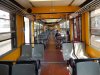
Seats: these were moulded plastic, and surprisingly comfortable. Would British train operators adopt this type of seat?
Articulation: the trains were articulated. Is this common in Italy/rest of Europe?
See the attached images.
I have some questions:
The track gauge is around 950mm. Why was this chosen? I don’t think it was to save on tunnelling costs, because the trains are just as wide as standard gauge.
Most of the trains were covered in at least some graffiti. Is this normal in Italy?
The line from Pompeii to Sorrento is predominately single track. There are lots of stations with passing places. However, some have two platforms, some have three platforms, and some have four platforms (with only one seemingly in use). Why is there so much variation?
On one journey, the train stopped outside a station with two platforms, just before the points. The driver got out of the cab, and unlocked a door so the guard could get out. I couldn’t see what was happening, but after about a minute, the guard got back in, and the train proceeded to the station. The guard then got out again, and walked along the track to the next set of points. He unlocked a trackside cabinet, removed an object (hammer?), and fiddled with the points, but didn’t change the direction they were set in. he then locked the cabinet. The train moved forward, stopped, collected the guard, and then proceeded on its journey. What was happening?
I also have some observations:
Acceleration: this was very quick, possibly the best I’ve experience (not that I travel much).
Braking: on approach to the stations, the train would arrive quite quickly, and then brake sharply.
Doors: these were opened by the driver about one second before the train stopped moving. People go on/off. The guard then closed the doors. Would this practice work in the UK?
Overgrown track: quite a lot of the track was overgrown. Is this normal?
Seats: these were moulded plastic, and surprisingly comfortable. Would British train operators adopt this type of seat?
Articulation: the trains were articulated. Is this common in Italy/rest of Europe?
See the attached images.


 ) and the guard or driver can retrive it (it could also be taken out from the signal box, although this is getting more and more rare as most boxes are closed in favour of CTC). It is then inserted into the point, and can't be returned until the point is replaced to its normal position. This also prevents all signals from being set to a clear aspect. Simple, but safe and means you can run two trains without having a staffed signal box where they will meet. The only downside is when someone remembers to return the points, but forgets to actually returning the key, leading to the signals being stuck at danger, with no way of getting the point back in control (without locating the key, of course). That is when things start to get embarrassing...