We go in with every good intention of getting odds in one direction and evens in the other and it works well after a recast when you redo the headcodes but then loses its way a few years in. Trying ti put discipline back into it. Plus the fifth and sixth character used by planning which has really lost its way over the years.

-
Our new ticketing site is now live! Using either this or the original site (both powered by TrainSplit) helps support the running of the forum with every ticket purchase! Find out more and ask any questions/give us feedback in this thread!
You are using an out of date browser. It may not display this or other websites correctly.
You should upgrade or use an alternative browser.
You should upgrade or use an alternative browser.
Changes to 4-Character Headcode Conventions in recent years
- Thread starter GordonT
- Start date
- Status
- Not open for further replies.
Sponsor Post - registered members do not see these adverts; click here to register, or click here to log in
R
RailUK Forums
I was told by a signaller in York ROC the TPE class 9’s are trains they aren’t allowed to delay.Headcodes starting with "9" also apply to TPE Liverpool-York-Newcastle-Edinburgh trains.
Probably to distinguish TPE trains heading west to Liverpool rather than south to Manchester Airport, at the Ordsall Chord junction.
(Actually it can't be that because there are some "9" trains to/from the Airport too...).
There's no reason to retain the inter-regional codes now the regions don't exist, but they still seem to be used like that in places.
There are some odd ones like on the Marches line, it's V southbound but W northbound (not M).
On the other axis through Shrewsbury it's I towards Birmingham, and J towards Cambrian/Chester (you'd think they would avoid using I and O).
NR route/region boundaries keep changing too, as signalling areas expand.
The Midland main line south of Chesterfield is now in LNE territory, for instance (where trains to Corby use code M!).
With Eurostar there was some complicated reason why train numbers starting "9" also worked for Eurotunnel and SNCF/SNCB control systems.
Presumably it also works in the Netherlands too.
== Doublepost prevention - post automatically merged: ==
I was told by a signaller in York ROC the TPE class 9’s are trains they aren’t allowed to delay.Headcodes starting with "9" also apply to TPE Liverpool-York-Newcastle-Edinburgh trains.
Probably to distinguish TPE trains heading west to Liverpool rather than south to Manchester Airport, at the Ordsall Chord junction.
(Actually it can't be that because there are some "9" trains to/from the Airport too...).
There's no reason to retain the inter-regional codes now the regions don't exist, but they still seem to be used like that in places.
There are some odd ones like on the Marches line, it's V southbound but W northbound (not M).
On the other axis through Shrewsbury it's I towards Birmingham, and J towards Cambrian/Chester (you'd think they would avoid using I and O).
NR route/region boundaries keep changing too, as signalling areas expand.
The Midland main line south of Chesterfield is now in LNE territory, for instance (where trains to Corby use code M!).
With Eurostar there was some complicated reason why train numbers starting "9" also worked for Eurotunnel and SNCF/SNCB control systems.
Presumably it also works in the Netherlands too.
Cricketer8for9
Member
- Joined
- 11 Jan 2015
- Messages
- 974
Some variations exist, e.g. through London Bridge Southeastern use odd numbers for Cannon Street services and even numbers for Charing Cross services.
Which very conveniently replicates the old Southern convention that Charing Cross got even numbered headcodes and Cannon Street the odd ones.
Which very conveniently replicates the old Southern convention that Charing Cross got even numbered headcodes and Cannon Street the odd ones.
The second letter sometimes indicates which route it's booked to take - B for Maidstone East, C for Redhill, D for Orpington. There are some E/L/M/V and O for those that go further afield.Was there a reason why CT rail traffic was a B head code to/from Wembley?
Any traffic onto the Southern was a O head code.

SargeNpton
Established Member
- Joined
- 19 Nov 2018
- Messages
- 1,755
I can only half-remember the details now, but I think that looking at Virgin/Avanti trains on Open Train Times there were some apparently duplicated schedules, one with a '1Z--' headcode. I was given to understand that two schedules were entered for 'double' Voyagers, for reservation reasons, but can anyone confirm or explain further?
That is correct. Each Voyager set requires its own digital download of the reservations manifest but the reservations systems could only produce one per train. The dummy trains were created just so that a second manifest could be created.

Western 52
Established Member
I remember some of the first generation DMU sets had 2 rather than 4 character headcodes below the cab windows. Some of the class 116 sets at Cardiff had these and they would display a letter and a number, for example C2. I assumed these were local arrangements in some areas, but was that the case or were they meant to show the first 2 of 4 character headcode?

LNW-GW Joint
Veteran Member
I remember some of the first generation DMU sets had 2 rather than 4 character headcodes below the cab windows. Some of the class 116 sets at Cardiff had these and they would display a letter and a number, for example C2. I assumed these were local arrangements in some areas, but was that the case or were they meant to show the first 2 of 4 character headcode?
I think that was an attempt by the WR to use route numbers as on the SR, and didn't last long.
There was also the recent period when BR Thames & Chiltern and its successors showed route numbers on their Turbos, don't know if that still applies.
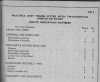
On the London Midland Region (south Manchester) in 1977, the first character was the "former classification letter (A, B or C)" and the second per the attached tableI remember some of the first generation DMU sets had 2 rather than 4 character headcodes below the cab windows. Some of the class 116 sets at Cardiff had these and they would display a letter and a number, for example C2. I assumed these were local arrangements in some areas, but was that the case or were they meant to show the first 2 of 4 character headcode?
EDIT - the "former classification letter" roughly mapped A, B & C to train classes 1, 2 & 5. So for most services with two character indicators in that area the first indicator was usually "B" for a class 2 passenger train, "C" for empty stock. Hence "B3" for Manchester Piccadilly - Buxton line trains.
MULTIPLE UNIT TRAINS FITTED WITH TWO-POSITION INDICATOR BOXES
ROUTE INDICATION NUMBERS
For trains between CREWE AND DERBY LIVERPOOL LIME STREET AND Warrington Central Manchester Piccadilly MANCHESTER OXFORD ROAD AND Chester Warrington Central Manchester Piccadilly Crewe line via Stockport Buxton MANCHESTER PICCADILLY AND Chester Buxton Derby via Belle Vue STOCKPORT AND STALYBRIDGE
Attachments
Last edited:
the old SR headcodes were revived for class 455 on SWD and still appear on many of their destination blinds (eg 24 for Shepperton via Kingston). Up trains simply show Waterloo and do not reveal their origin.I think that was an attempt by the WR to use route numbers as on the SR, and didn't last long.
There was also the recent period when BR Thames & Chiltern and its successors showed route numbers on their Turbos, don't know if that still applies.
- Status
- Not open for further replies.