• Our new ticketing site is now live! Using either this or the original site (both powered by TrainSplit) helps support the running of the forum with every ticket purchase! Find out more and ask any questions/give us feedback in this thread!

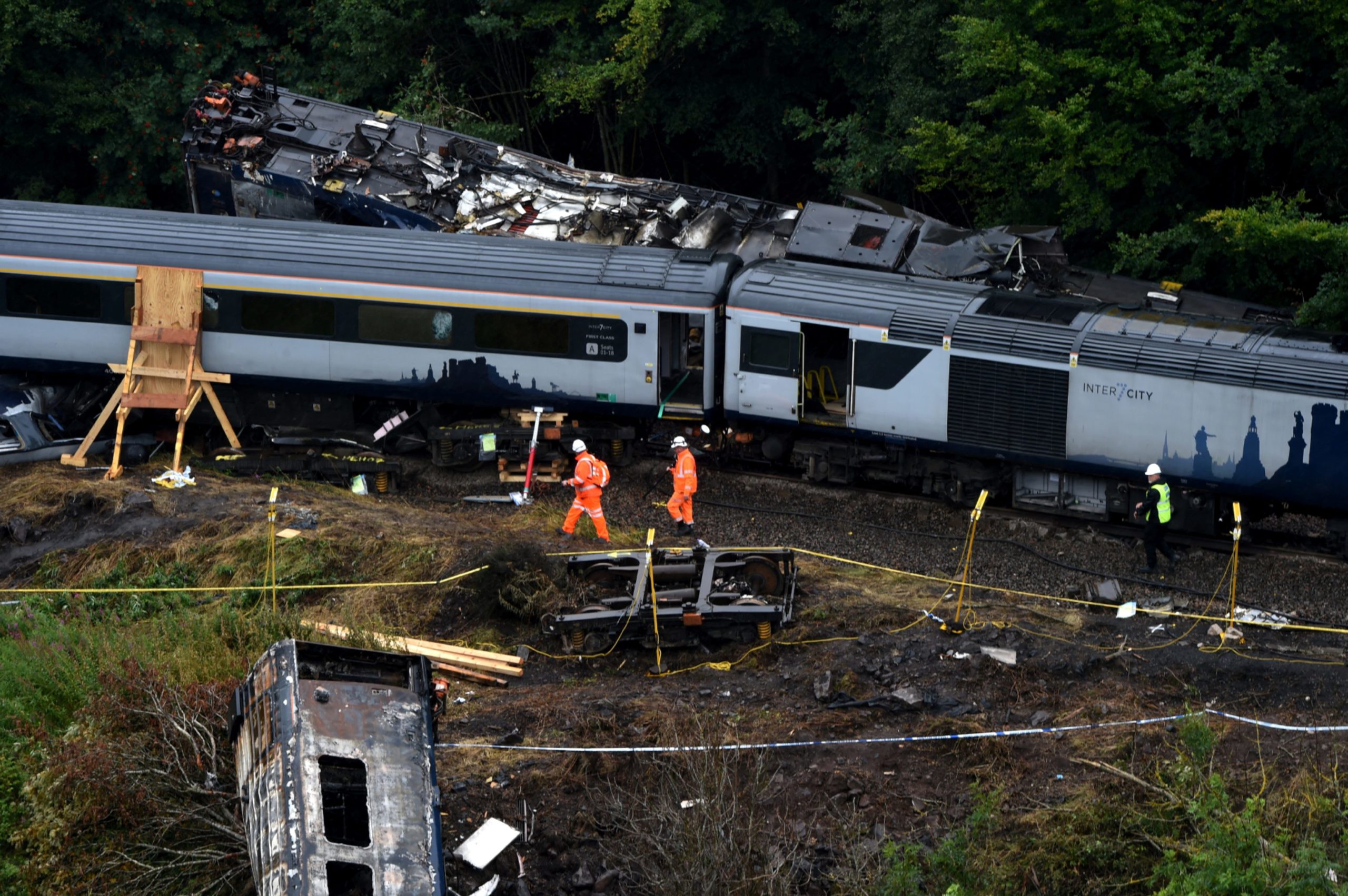
Carmont (near Stonehaven) derailment - 12 August 2020

Status
Not open for further replies.

Bletchleyite

Veteran Member
Joined
20 Oct 2014
Messages
113,554
Location
"Marston Vale mafia"
The reason for not having seatbelts, AIUI, is that there are far more incidents where being able to get out of the seat quickly saves a driver's life than there are where being belted in would. This is because, unlike road vehicles, trains only very rarely hit either other trains or immovable objects, whereas they quite frequently hit trees and the likes, and these quite commonly breach the windscreen.

However, an investigation into what could be done with airbags would seem worthwhile.
 
Sponsor Post - registered members do not see these adverts; click here to register, or click here to log in
R

RailUK Forums

Swanny200

Member
Joined
18 Sep 2010
Messages
680
The reason for not having seatbelts, AIUI, is that there are far more incidents where being able to get out of the seat quickly saves a driver's life than there are where being belted in would. This is because, unlike road vehicles, trains only very rarely hit either other trains or immovable objects, whereas they quite frequently hit trees and the likes, and these quite commonly breach the windscreen.

However, an investigation into what could be done with airbags would seem worthwhile.
From my limited knowledge, Airbags would only work in conjunction with seatbelts as being thrown towards an exploding airbag unrestrained would just be as bad as hitting a tree at 70mph
 

Taunton

Veteran Member
Joined
1 Aug 2013
Messages
12,297
In terms of the controllers, what do they have to go on? how would they know how bad it was at the crash site other than what they have been told by other drivers, they knew the landslip at Laurencekirk was bad but as stated previously, other trains had gone past the crash site with no issue, the affected service had been through some time before and had the driver seen something,
It wasn't just the one at Laurencekirk, there were three other serious blockages in hand, locally on this very line. Described in the report. And by definition, in the time preceding the accident it's apparent that there was at each one of these a last train had gone through without issue, and then a washout occurred and the next one along found the line blocked.

I would have liked the report to describe just how it was at each of these other blockages that it was discovered that the washout had happened, given there was no apparent checking in hand and trains at line speed are not normally able to stop on sight. Did the train just manage to plough through it? Was the driver proceeding more cautiously than normal because of the conditions ...?
 
Last edited:

BRX

Established Member
Joined
20 Oct 2008
Messages
4,516
There was a ScotRail HST thread with hundreds of pages arguing about whether they are a better passenger experience than a 170 or 158. From my limited experience of them so far, they absolutely are. And that's before you consider capacity. It's clear that many people don't agree - although I wonder how many of them are actually familiar with the routes they've been introduced onto.

At least on Inverness to Central belt journeys I personally know people who do it by car because of past bad experiences they've had with overcrowded trains.

And car accidents happen much much more frequently than rail accidents. Was it not the case that until this accident, not a single passenger (or driver?) had died in a UK train crash for over 10 years?
 

northernbelle

Member
Joined
10 Oct 2018
Messages
770
I would suggest that if you’re thrown out of your seat in a cab at around 70mph having come off a bridge and hit your head on the windscreen or cab interior then it will be fatal regardless of train type. To suggest otherwise has no logic.
This is exactly what happened to the driver of the Grayrigg Pendolino. He was seriously injured but not fatally.

I believe cabs can be designed with this eventuality in mind - the HST cab separating from the power car was frankly shocking and I do believe other types of rolling stock would have fared better in this regard.
 

Ex-controller

Member
Joined
29 Nov 2021
Messages
252
Location
Glasgow
As an ex-Controller I will refrain from commenting on the above statement, other than to say that I was surprised, no utterly shocked, by the way a local newspaper, the Press and Journal, chose to report on the RAIB's findings;

The paper's headline:

Stonehaven rail crash: Staff failed to impose speed limit despite knowing of hazards on network ​


And the first paragraph of their article:
Rail control room staff failed to limit the speed of a train that then crashed – despite knowing about hazards nearby, a new report has said.

Additional comment:
They concluded there were multiple concerns, including a failure of Glasgow control room staff to impose a speed limit due to four obstacles within 11 miles of the crash scene.

Somehow this has become the lead feature of their coverage of the RAIB report, rather than the extreme weather and defective drainage resulting in the landslip.
However, further down the article goes on to say;

The RAIB report said: “Although aware of multiple safety-related events caused by heavy rain, route control staff were not required to, and did not, restrict the speed of the train.” (my highlighting).

Agreed. Any requirement or decision to impose a blanket speed restriction is based on hindsight. Outrageously inaccurate article.
 

Nicholas Lewis

Established Member
Joined
9 Aug 2019
Messages
8,012
Location
Surrey
So which rule was being followed at Glanrhyd but had somehow been withdrawn by Carmont?
Read that report which was an RI led investigation and what stands out is how much more locally the railway is run then with the control not being responsible for deciding they needed to check the line but local Operations and P.Way staff.

It was Regulation 9 but where that is in which module of the Rule Book ive no idea. However, regulation 9 was invoked because of the reports of flooding which had incurred onto the running lines so was instigated by general regulations when water was above sleeper level. Thus still driven by Rules.

So put Carmont in the same era and i guess there would have been an Area Managers organisation at Aberdeen that would have been concerning itself with the state of the nation in its operating patch who may have been more circumspect but we will never know. What is for sure in my 40 years in the industry every accident/incident generally involves another layer of bureaucracy being imposed in attempt to prevent a future reoccurrence and i do wonder if at times things have become over complicated.
 

Mcr Warrior

Veteran Member
Joined
8 Jan 2009
Messages
17,263
Any requirement or decision to impose a blanket speed restriction is based on hindsight. Outrageously inaccurate article.
Completely disagree. Entirely foreseeable that when there are multiple weather-related issues in a particular area, which in this instance had blocked the Aberdeen -> Dundee line and had stopped services from operating Southbound, this ought then to have then resulted in speed restrictions being imposed for anything still operating Northbound, rather than trains still being allowed to run at almost full line speed. Naive to think that this was ever going to end well, and sadly it didn't.
 

millemille

Member
Joined
28 Jul 2011
Messages
407
Location
Derbyshire
From my limited knowledge, Airbags would only work in conjunction with seatbelts as being thrown towards an exploding airbag unrestrained would just be as bad as hitting a tree at 70mph
Nope, many country have design and use regulations, or their equivalent, for motor vehicles where the air bag system is to function on the assumption that the occupants are not wearing seat belts. Air bags work by actually starting to deflate as the are impacted by the person in the vehicle so that the reduction in velocity of the person striking the airbag is gradual - relatively - so it is simply a matter of inflating the air bag more quickly as soon as the vehicle experiences the impact.
 

Nicholas Lewis

Established Member
Joined
9 Aug 2019
Messages
8,012
Location
Surrey
Completely disagree. Entirely foreseeable that when there are multiple weather-related issues in a particular area, which in this instance had blocked the Aberdeen -> Dundee line and had stopped services from operating Southbound, this ought then to have then resulted in speed restrictions being imposed for anything still operating Northbound, rather than trains still being allowed to run at almost full line speed. Naive to think that this was ever going to end well, and sadly it didn't.
On the balance of probability it would have been perfectly safe to run at the permitted speed. Was it wise with the benefit of hindsight no.
 

Bikeman78

Established Member
Joined
26 Apr 2018
Messages
6,185
There was a ScotRail HST thread with hundreds of pages arguing about whether they are a better passenger experience than a 170 or 158. From my limited experience of them so far, they absolutely are. And that's before you consider capacity. It's clear that many people don't agree - although I wonder how many of them are actually familiar with the routes they've been introduced onto.

At least on Inverness to Central belt journeys I personally know people who do it by car because of past bad experiences they've had with overcrowded trains.

And car accidents happen much much more frequently than rail accidents. Was it not the case that until this accident, not a single passenger (or driver?) had died in a UK train crash for over 10 years?
The perception amongst people that don't use trains is that they are too expensive and not very reliable. Those are the reasons that most of my non railway friends have flagged up. No one ever mentions safety as a reason not to travel by train. Indeed I have discussed the topic with people and they readily accept that driving is less safe.
 

Horizon22

Established Member
Associate Staff
Jobs & Careers
Joined
8 Sep 2019
Messages
11,005
Location
London
I spoke to someone the other day about this, him having zero knowledge of the railways, his response about the driver hitting his head was, "do they not have seatbelts?" to which I flippantly replied, "no, they don't have airbags either!", I doubt even with that, the poor guy would have survived the impact, also neither would travelling in a Pendo or many other stock, the other people you could argue, may have survived.

In terms of the controllers, what do they have to go on? how would they know how bad it was at the crash site other than what they have been told by other drivers, they knew the landslip at Laurencekirk was bad but as stated previously, other trains had gone past the crash site with no issue, the affected service had been through some time before and had the driver seen something, would have obviously reported it, I haven't had time to properly look but how long before the HST was turned back was it that another service had gone along that same bit of track?

They don't, but there were other various events in a 10-15 mile area that had stopped the railway. This is why blanket restrictions are common in severe weather now, because in remote areas, it simply cannot be known exactly when a tree/ landslip/ flood might be encountered, even if certain areas are known to be of a higher risk. It is therefore advisable to be safe than sorry and take the performance / disruption penalty.
 
Joined
31 Jan 2020
Messages
395
Location
Inverness
The perception amongst people that don't use trains is that they are too expensive and not very reliable. Those are the reasons that most of my non railway friends have flagged up. No one ever mentions safety as a reason not to travel by train. Indeed I have discussed the topic with people and they readily accept that driving is less safe.
Yep, for a while after their introduction reservations were either very unreliable or unavailable. Trains were subject to replacement with shorter units with no notice.

The flagship first class wasn't used because there was no guarantee that the unit would even have a first section.
 

edwin_m

Veteran Member
Joined
21 Apr 2013
Messages
28,680
Location
Nottingham
And 170's certainly don't seem to fare particularly great in accidents of late either, the Ally body opening up like a can or the fibreglass cabs getting crunched at a Bird or Vegetation strike. Thankfully, we haven't had anything as serious to compare to and frankly I hope we don't.
Which accidents are you referring to here? I don't believe there has been any accident with that degree of structural damage to a 170. If you're thinking of Ladbroke Grove that was a 16x unit - also aluminium but welded together where the 170 is bolted.

Agree various 170s have had end impacts and the fibreglass gets severely damaged, but as someone pointed out way back upthread there's a metal structure behind it that takes the actual load.
This is exactly what happened to the driver of the Grayrigg Pendolino. He was seriously injured but not fatally.
I come back to the deceleration at Grayrigg being more gradual over a longer distance. That's a critical difference considering that the fatal injuries were caused by hitting the desk or windscreen.
 

Nicholas Lewis

Established Member
Joined
9 Aug 2019
Messages
8,012
Location
Surrey
They don't, but there were other various events in a 10-15 mile area that had stopped the railway. This is why blanket restrictions are common in severe weather now, because in remote areas, it simply cannot be known exactly when a tree/ landslip/ flood might be encountered, even if certain areas are known to be of a higher risk. It is therefore advisable to be safe than sorry and take the performance / disruption penalty.
For sure that is the most appropriate response now when the infrastructure hasn't been designed for worst case weather conditions. I look forward to seeing how HS2 will respond to such conditions.
 

O L Leigh

Established Member
Joined
20 Jan 2006
Messages
5,609
Location
In the cab with the paper
I understand that without HSTs the service would be less frequent and therefore people would be resorting to cars to fill the gap.

That may be true. But people will decide to take their cars for many reasons, many of which will have nothing to do with this or any other incident. I'm sure that the total number of people travelling between, say, Dundee and Aberdeen is far higher than the total number using the rail service because many have already eschewed the train.

I think that now might be a good time to register a protest against this line of argument because it gets trotted out on a semi-regular basis, usually to justify why the industry should/shouldn't be doing this or that. Comparing the risks of rail and road is like comparing chalk and cheese. That there are different standards of safety and, therefore, different levels of risk is not the fault of the rail industry. Rail, like road, is responsible for it's own safety culture and has no say on what the other does.

If something on the rail network is considered unsafe and requires remedial action (e.g. the fallout from the Hatfield derailment) then the rail industry is legally bound to keep it's own house in order. That it may mean an increase in road usage and a commensurate increase in road casualties is a sad and regrettable side-effect, but not actually the responsibility of the rail network. Consquently, statements along the lines of "if you support the withdrawal of HSTs on the basis of their safety record you must also support the withdrawal of road vehicles" on the basis of the different levels of casualty incidence between road and rail is nonsensical.

@yorkie is correct to say that there is a double-standard at play in this but fails to see where that double-standard applies. Because the safety cultures are so different it would be illogical to compare the two directly, hence why I suggested that @yorkie's attempts at doing so were a non-sequitur.

Do you think everything they say is always accurate?

Maybe, maybe not. However, what I think is that I can say with some confidence that neither you nor I are adequately expert in the matter to gainsay the RAIB's professional opinion.

Word it how you want but the post deserved to be challenged

See above.

And 170's certainly don't seem to fare particularly great in accidents of late either, the Ally body opening up like a can or the fibreglass cabs getting crunched at a Bird or Vegetation strike.

I think that needs a little substantiation. I know of no such accidents involving Cl170s and can assure you that the cabs are a lot more robust than perhaps you think.

We can also add that bogie retention at Grayrigg is not something from the whim of the designer, but because being tilting stock it is inevitable that the bogies are attached to the body - by the powered tilting mechanism.

It's neither the whim of the designer nor a consequence of having tilt. It is required by Group Standards for rolling stock.

 

bramling

Veteran Member
Joined
5 Mar 2012
Messages
20,397
Location
Hertfordshire / Teesdale
I think that needs a little substantiation. I know of no such accidents involving Cl170s and can assure you that the cabs are a lot more robust than perhaps you think.

ISTR that during one of the recent storms, a Scotrail 170 hit a tree, and from the photos it *appears* that the bodyshell split open at cantrail level behind the driver's door. There was a photo on here somewhere.

It is worth remembering that with the exception of Grayrigg, the current generation of rolling stock hasn't really been tested in a very serious incident. In particular we haven't seen bolted bodyshells, such as widely used on Electrostars and Turbostars, tested in practice. The only other accident involving modern stock has been Potters Bar, where I think it's fair to say the bodyshell held up fairly well in a 100 mph derailment.
 

Horizon22

Established Member
Associate Staff
Jobs & Careers
Joined
8 Sep 2019
Messages
11,005
Location
London
For sure that is the most appropriate response now when the infrastructure hasn't been designed for worst case weather conditions. I look forward to seeing how HS2 will respond to such conditions.

Well HS2 is a brand new line, so will be no doubt built to a specification that takes into account climate change and the environment with in-built protections for embankments / cuttings / tunnels etc.
 

Nicholas Lewis

Established Member
Joined
9 Aug 2019
Messages
8,012
Location
Surrey
Well HS2 is a brand new line, so will be no doubt built to a specification that takes into account climate change and the environment with in-built protections for embankments / cuttings / tunnels etc.
Lets hope so but will be a while before we know how it will respond to weather events
 

Horizon22

Established Member
Associate Staff
Jobs & Careers
Joined
8 Sep 2019
Messages
11,005
Location
London
Lets hope so but will be a while before we know how it will respond to weather events

This is true. I suppose you only need to look at HS1 though to look at the general landscape around the track and the vast difference to classic lines to get an idea as to what HS2 will look like. Also the lack of any external enviromental disruption (floods / trees / landslips etc.) on HS1 generally.
 

Taunton

Veteran Member
Joined
1 Aug 2013
Messages
12,297
ISTR that during one of the recent storms, a Scotrail 170 hit a tree, and from the photos it *appears* that the bodyshell split open at cantrail level behind the driver's door. There was a photo on here somewhere.

It is worth remembering that with the exception of Grayrigg, the current generation of rolling stock hasn't really been tested in a very serious incident. In particular we haven't seen bolted bodyshells, such as widely used on Electrostars and Turbostars, tested in practice. The only other accident involving modern stock has been Potters Bar, where I think it's fair to say the bodyshell held up fairly well in a 100 mph derailment.
The 365 bodyshell at Potters Bar was of course the same Networker design as the 165 at Ladbroke Grove, head on into an HST, where, as I described above, the leading passenger car of the 165, almost new at the time, completely disintegrated full length down to the underframe, far worse destruction than any of the HST cars involved. But fortunately, almost empty.
 

O L Leigh

Established Member
Joined
20 Jan 2006
Messages
5,609
Location
In the cab with the paper
The 365 bodyshell at Potters Bar was of course the same Networker design as the 165 at Ladbroke Grove, head on into an HST, where, as I described above, the leading passenger car of the 165, almost new at the time, completely disintegrated full length down to the underframe, far worse destruction than any of the HST cars involved. But fortunately, almost empty.

But to be entirely fair, no train would survive a head-on collision at a combined speed in the region of 130mph.
 

Taunton

Veteran Member
Joined
1 Aug 2013
Messages
12,297
But to be entirely fair, no train would survive a head-on collision at a combined speed in the region of 130mph.
I do agree. However, the HST design, with a power car without passengers on the front, provided far more sacrificial protection to passengers behind at both Ladbroke Grove and Carmont than any design of multiple unit carriage. One day someone will say "surely it's safer to have something like a locomotive at the front".
 

tomuk

Established Member
Joined
15 May 2010
Messages
2,009
"surely it's safer to have something like a locomotive at the front".
Well isn't that the case with a 'ban' on passengers in the front half of the leading cars 125mph stock. This space being taken up with van space\kitchens on Voyagers, Pendos and 80x.
 

O L Leigh

Established Member
Joined
20 Jan 2006
Messages
5,609
Location
In the cab with the paper
I do agree. However, the HST design, with a power car without passengers on the front, provided far more sacrificial protection to passengers behind at both Ladbroke Grove and Carmont than any design of multiple unit carriage. One day someone will say "surely it's safer to have something like a locomotive at the front".

@tomuk has already outlined the restrictions on passengers in the front part of high speed trains, although in this instance it is quite possible that some other MU could have operated this service.

I still defer to the RAIB's opinions on the matter of relative crashworthiness.

While the RAIB cannot determine whether or not stronger lifeguards would have prevented the derailment in the first place (para 529), they do believe that there was a chance that stronger couplers, anti-climbers and bogie retention would have prevented overriding and may even have resulted in the lead vehicle being sufficiently stabilised to have traversed the bridge before jack-knifing (para 531-534) rather than pitching over the side. As such, "sacrificial protection" (this driver notes the term and it's meaning and makes no further comment upon it o_O) would have been superfluous.
 
Last edited:

43096

On Moderation
Joined
23 Nov 2015
Messages
18,845
Doesn't matter. It's 125mph stock, which is why the front car of Voyagers, Pendolinos, Meridians and IETs are given over to staff and/or storage areas.
None of those designs have the front car given over to staff or storage areas. If you look at a Class 180 and IET in particular, it's not even half the leading car.
 

InOban

On Moderation
Joined
12 Mar 2017
Messages
4,537
The reason for not having seatbelts, AIUI, is that there are far more incidents where being able to get out of the seat quickly saves a driver's life than there are where being belted in would. This is because, unlike road vehicles, trains only very rarely hit either other trains or immovable objects, whereas they quite frequently hit trees and the likes, and these quite commonly breach the windscreen.

However, an investigation into what could be done with airbags would seem worthwhile.
Is this conclusion the result of expert analysis of numerous incidents? It sounds very like the arguments used against the compulsory wearing of belts in cars. Obviously there will be some incidents which may be made worse, some which will be made survivable, and (probably the vast majority ) where it would make no difference.
 

IanXC

Emeritus Moderator
Joined
18 Dec 2009
Messages
6,614
Two things stand out to me that haven't yet been discussed:

Why was the conductor doing local door only at Stonehaven? Surely the full train would have been platformed?

The business about not applying a speed restriction to the movement seems to me to be tied up in the lack of a proper set of procedures for Route Proving trains, and indeed even when they should be used.
 
Status
Not open for further replies.

Top