
• Our new ticketing site is now live! Using either this or the original site (both powered by TrainSplit) helps support the running of the forum with every ticket purchase! Find out more and ask any questions/give us feedback in this thread!

Bus restoration is not for the faint-hearted...

jp4712

Member
Joined
1 May 2009
Messages
568
Location
Lichfield
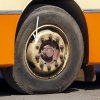
My current restoration project has a broken front wheel stud - instant fail, so the whole wheel drum had to come off so the stud can be accessed and a replacement sought. Getting the wheel drum off a 60 year old bus is, to say the least, not for those who lack experience or perseverance. But eventually (a couple of hours) it started to come off. But hang on, why is one of the OTHER wheel studs coming off with the drum? The answer is that it has corroded and snapped off.

The area of the fixing where that stud should be attached to the drum is a mess of built-up weld and general corruption. So the wheel centre will have to be removed (a full day’s task) so it can all be ground off and cleaned up. And now I have two wheel studs to find, not one.

But at least now I can see the brake linings - and of course, they’re worn down! Not illegal, and fine for a while, but it seems logical to replace them while everything is off. Thankfully after measuring up, I find that I have a spare set - but that’s all for another day.
 

Attachments

  • IMG_7044 copy - Copy.jpg
    IMG_7044 copy - Copy.jpg
    619.2 KB · Views: 95
  • IMG_6571.JPG
    4.2 MB · Views: 102
  • IMG_6571.JPG
    4.2 MB · Views: 70
  • IMG_6569.JPG
    5.5 MB · Views: 75
Sponsor Post - registered members do not see these adverts; click here to register, or click here to log in
R

RailUK Forums

BULLSAREMAGIC

Member
Joined
2 Dec 2025
Messages
73
Location
DERBYSHIRE
My current restoration project has a broken front wheel stud - instant fail, so the whole wheel drum had to come off so the stud can be accessed and a replacement sought. Getting the wheel drum off a 60 year old bus is, to say the least, not for those who lack experience or perseverance. But eventually (a couple of hours) it started to come off. But hang on, why is one of the OTHER wheel studs coming off with the drum? The answer is that it has corroded and snapped off.

The area of the fixing where that stud should be attached to the drum is a mess of built-up weld and general corruption. So the wheel centre will have to be removed (a full day’s task) so it can all be ground off and cleaned up. And now I have two wheel studs to find, not one.

But at least now I can see the brake linings - and of course, they’re worn down! Not illegal, and fine for a while, but it seems logical to replace them while everything is off. Thankfully after measuring up, I find that I have a spare set - but that’s all for another day.
I have long been (and still am) in awe of the skill and hard work of preservationist. I spent several years driving for Yorkshire Heritage Bus and the man hours spent by Tony and staff to turn the vehicles out for a one day week on wedding jobs was a labour of love
 

XFeed

Member
Joined
25 Nov 2025
Messages
367
Location
Chester
Hi, what vehicle is it please as I don't recognise the hub and hub cap ?

Looking at picture of the brake lining there looks plenty of meat on the liners judging by the depth of the rivet holes.

If you are going to reline the front brakes don't just do one side only otherwise you asking for brakes pulling over problems, but I suspect that you already know this.
 

jp4712

Member
Joined
1 May 2009
Messages
568
Location
Lichfield
It’s a 1965 AEC Reliance with Harrington body. Like I said there’s a reasonable amount of life left in the shoes, but doing them now means they’ll outlast me…
 

XFeed

Member
Joined
25 Nov 2025
Messages
367
Location
Chester
It’s a 1965 AEC Reliance with Harrington body. Like I said there’s a reasonable amount of life left in the shoes, but doing them now means they’ll outlast me…

I`ve never worked on an AEC so I`m totally in the dark about them. I've Googled you bus but don't recall them either sorry.

If you are going to reline both front brakes and when you do the other side and if you are feeling strong you could remove the wheel, drum and hub assembly as one complete unit to gain access to the brake shoes, it saves the hassle of removing the wheel individually then trying to remove the brake drum off the hub and wheel studs.
 

Wyrleybart

Established Member
Joined
29 Mar 2020
Messages
2,643
Location
South Staffordshire
My current restoration project has a broken front wheel stud - instant fail, so the whole wheel drum had to come off so the stud can be accessed and a replacement sought. Getting the wheel drum off a 60 year old bus is, to say the least, not for those who lack experience or perseverance. But eventually (a couple of hours) it started to come off. But hang on, why is one of the OTHER wheel studs coming off with the drum? The answer is that it has corroded and snapped off.

The area of the fixing where that stud should be attached to the drum is a mess of built-up weld and general corruption. So the wheel centre will have to be removed (a full day’s task) so it can all be ground off and cleaned up. And now I have two wheel studs to find, not one.

But at least now I can see the brake linings - and of course, they’re worn down! Not illegal, and fine for a while, but it seems logical to replace them while everything is off. Thankfully after measuring up, I find that I have a spare set - but that’s all for another day.
This takes me back to 1988 when I was led into buying my first car an old Mini 850. Obviously a Friday afternoon vehicle anyway, but when I came to change one of the front wheels I discovered that one of the four studs had been superglued on - presumably after a fracture.
 
Joined
2 Oct 2024
Messages
29
Location
South Yorkshire
Had four Reliance's over the years. Can still remember the head torque sequence as 470s were prone to popping them (and a couple of 590s).
As for brakes, they are fun to set up. Get the drum back on with new shoes (if needed) then wind the adjuster up until the drum doesn't rotate. Then hit the end of the adjuster with a big hammer. Then wind it back up until until the drum doesn't rotate and repeat. When it no longer needs this, wind the adjuster back a quarter of a turn. Should stop on a sixpence after that (do them all!!).
 

XFeed

Member
Joined
25 Nov 2025
Messages
367
Location
Chester
Had four Reliance's over the years. Can still remember the head torque sequence as 470s were prone to popping them (and a couple of 590s).
As for brakes, they are fun to set up. Get the drum back on with new shoes (if needed) then wind the adjuster up until the drum doesn't rotate. Then hit the end of the adjuster with a big hammer. Then wind it back up until until the drum doesn't rotate and repeat. When it no longer needs this, wind the adjuster back a quarter of a turn. Should stop on a sixpence after that (do them all!!).

Never worked on an AEC, was there one particular reason or was it one of many that they were prone to head gasket failure ?

Novel way to adjust the brakes but hey if it worked why change it :smile:
 

jp4712

Member
Joined
1 May 2009
Messages
568
Location
Lichfield
Never worked on an AEC, was there one particular reason or was it one of many that they were prone to head gasket failure ?

Novel way to adjust the brakes but hey if it worked why change it :smile:
The 470 was an awful engine for head gaskets, they blow just for fun. Their reputation at the time wasn’t helped by the fact that the motorways were just opening up, and the sustained high speed runs really showed that the 470 (only about seven and a half litres) wasn’t really built to haul eight or nine tons of coach, passengers and luggage at 70 mph for hours on end. The 590 was much better in that respect, the 505 is better still. Yes, the traditional way to adjust up brakes is to screw ’em till the wheel seizes, then wind them back a bit. If you get it right, AECs have legendarily good brakes.

My Bristol RE also has excellent brakes, but they’re a swine to adjust up - one adjusting cam per shoe, not per wheel, so you have eight to do altogether.
 

XFeed

Member
Joined
25 Nov 2025
Messages
367
Location
Chester
The 470 was an awful engine for head gaskets, they blow just for fun. Their reputation at the time wasn’t helped by the fact that the motorways were just opening up, and the sustained high speed runs really showed that the 470 (only about seven and a half litres) wasn’t really built to haul eight or nine tons of coach, passengers and luggage at 70 mph for hours on end. The 590 was much better in that respect, the 505 is better still. Yes, the traditional way to adjust up brakes is to screw ’em till the wheel seizes, then wind them back a bit. If you get it right, AECs have legendarily good brakes.

My Bristol RE also has excellent brakes, but they’re a swine to adjust up - one adjusting cam per shoe, not per wheel, so you have eight to do altogether.

Thanks for the reply and information around the AECs.

REs now there's something I used to know a lot about :D Our traditional brake adjusting method was to adjust each of the wheels 2 brake adjusters separately by adjusting each adjuster up until the wheel locked and back off adjuster 4 full turns I think it was. With the rear brake actuators remote from each rear wheel and acting on the brake cross shaft we found it critical that the brake rods were balanced together.
 

Top