
One of the cheap chain hotels near my mum's house is mostly full for months now because there's a civil engineering project going on nearby and some people have booked into it for some long stints. Never seen so many Ford Rangers in one hotel car park.

-
Our new ticketing site is now live! Using either this or the original site (both powered by TrainSplit) helps support the running of the forum with every ticket purchase! Find out more and ask any questions/give us feedback in this thread!
You are using an out of date browser. It may not display this or other websites correctly.
You should upgrade or use an alternative browser.
You should upgrade or use an alternative browser.
Budget hotels discussion
- Thread starter dorsetdesiro
- Start date
Sponsor Post - registered members do not see these adverts; click here to register, or click here to log in
R
RailUK Forums
eyebrook1961
Member
My son and I wanted to book at a particular hotel for a saturday in October, stated rate was £126 which is quite a bit more than the "usual" - couldn't find out anything particular happening locally so had a conversation with the manager when we were up there recently and they promised to look into it - have come back saying they can do the room for £80
Brilliant and much appreciated customer service.
Brilliant and much appreciated customer service.

317 forever
Established Member
One consolation in terms of the 28 day rule is that, if you book a cheaper night, they will refund you the difference. Or, if it's a 2nd or subsequent amendment, they will reduce the balance owing.l had a Friday booking for Premier lnn at the ExCeL for an early morning flight out of City the following day. lt was a £50 ‘Advance’ rate which allows free cancellation 28 days out or a date change up to the day of arrival.
My flight ended up getting cancelled with the airline giving notification about 6 hours too late for the free refund!
ld tried to change the booking to a date in Oct and the room is over £200 on that night! No idea why as lve looked and there doesn’t seem to be any events at the ExCeL or anywhere nearby! Luckily managed to find a room for just £5 extra in January next year instead.
When a purpose for a stay in December fell through, I kicked it back until April to keep the booking live. By then, I found July the optimum time for going, and I saw my balance owing amended accordingly.
In other news, I saw the post here dated May 14th about the PI free breakfast flexibility. I don't remember seeing it at the time, unless it was for dates inconvenient to book anywhere for at this stage.

Baxenden Bank
Established Member
- Joined
- 23 Oct 2013
- Messages
- 4,770
Having been on a walk in the Peak District on the Bank Holiday (over 30 degrees), it was very nice indeed to walk into a Premier Inn room ready air-conditioned down to 21 degrees.
On the other side it was far from nice, on a January day 2025, with outside temperature at -4C, to walk into an IBIS room where ythe heating had not been turned on!!!Having been on a walk in the Peak District on the Bank Holiday (over 30 degrees), it was very nice indeed to walk into a Premier Inn room ready air-conditioned down to 21 degrees.

Jamesrob637
Established Member
- Joined
- 12 Aug 2016
- Messages
- 6,087
Having been on a walk in the Peak District on the Bank Holiday (over 30 degrees), it was very nice indeed to walk into a Premier Inn room ready air-conditioned down to 21 degrees.
I'd have wanted things a bit lower than 21 upon entering the room, even if I had to crank it back up a notch a bit later.
Baxenden Bank
Established Member
- Joined
- 23 Oct 2013
- Messages
- 4,770
31 to 21 was quite enough for me. On a normal day 21 would have been just a bit too cold. As the evening went on, 21 did become too cold but I wasn't able to adjust the settings so had to turn it off completely.I'd have wanted things a bit lower than 21 upon entering the room, even if I had to crank it back up a notch a bit later.
I have stayed in a Premier Inn (Shrewsbury, mentioned up thread as needing improvement) where I couldn't get the heat to come on even though the conditioning unit was 'live' doing something. Had to get under the duvet for a while until it was time to go out for the evening.On the other side it was far from nice, on a January day 2025, with outside temperature at -4C, to walk into an IBIS room where ythe heating had not been turned on!!!

It still is there (https://maps.app.goo.gl/kMwBak78YJP1PJX68) - it has however been rebranded as "Acom Hotels" which is a brand owned by Premier Inn (Germany.)Looking at booking a hotel near to Wien Hbf and noticed there is or was a Premier Inn. It must of just shut down as there has been reviews left today. I wonder what happened.
I can't really tell, but I think it might be a way to appear more upmarket looking at their website? https://www.acomhotels.com/en/ however that hotel doesn't appear on the website...
Grr at people staying on business midweek knocking up prices quite significantly (probably via expenses too compared to the fleas from my bank account!)
Sun 26th Jul 26 £60.99
Mon 27th Jul 26 £54.99
Tue 28th Jul 26 £101.99
Wed 29th Jul 26 £74.99
Thu 30th Jul 26 £54.99
Sun 26th Jul 26 £60.99
Mon 27th Jul 26 £54.99
Tue 28th Jul 26 £101.99
Wed 29th Jul 26 £74.99
Thu 30th Jul 26 £54.99
Bletchleyite
Veteran Member
Sunday and Thursday are always the cheapest nights as they have lowest demand. Surprised Monday is cheap!
eyebrook1961
Member
We stayed in the Travelodge at York Monks Cross in early June - then subsequently received a parking charge from Horizon. Previously we had found that the Travelodge were not using their countertop car register, but were using a photocopied sheet upon which you put your registration, duration of stay and your name/signature. Turns out that the Travelodge were fed up with people parking up, popping in and registering their car for parking, then going across to the McDonalds (whose car park was, i assume, full). So they'd adopted the manual approach and made people sign in with a member of staff present.
Not a problem the first time this happened - so they must have entered our car into the horizon system themselves. However, this time they must have neglected to do this.
After providing the booking details Horizon have graciously (as a gesture of goodwill) cancelled the charge - but then proceeded to tell us that WE didn't register out car correctly. Cheeky sods. It's the hotel at fault and all because they are peed off with McDonalds!
I'd have had a go back but there's no email address to use . . . .
Not a problem the first time this happened - so they must have entered our car into the horizon system themselves. However, this time they must have neglected to do this.
After providing the booking details Horizon have graciously (as a gesture of goodwill) cancelled the charge - but then proceeded to tell us that WE didn't register out car correctly. Cheeky sods. It's the hotel at fault and all because they are peed off with McDonalds!
I'd have had a go back but there's no email address to use . . . .
Jamesrob637
Established Member
- Joined
- 12 Aug 2016
- Messages
- 6,087
We stayed in the Travelodge at York Monks Cross in early June - then subsequently received a parking charge from Horizon. Previously we had found that the Travelodge were not using their countertop car register, but were using a photocopied sheet upon which you put your registration, duration of stay and your name/signature. Turns out that the Travelodge were fed up with people parking up, popping in and registering their car for parking, then going across to the McDonalds (whose car park was, i assume, full). So they'd adopted the manual approach and made people sign in with a member of staff present.
Not a problem the first time this happened - so they must have entered our car into the horizon system themselves. However, this time they must have neglected to do this.
After providing the booking details Horizon have graciously (as a gesture of goodwill) cancelled the charge - but then proceeded to tell us that WE didn't register out car correctly. Cheeky sods. It's the hotel at fault and all because they are peed off with McDonalds!
I'd have had a go back but there's no email address to use . . . .
Don't pay it. It's not the council. Just ignore any letters you receive and they'll stop pestering you.
Bletchleyite
Veteran Member
Don't pay it. It's not the council. Just ignore any letters you receive and they'll stop pestering you.
This is no longer true, they can take legal action and often do.
IANAL but it sounds like Travelodge offered you free parking, assumed all responsibility for the admin, and they completely failed to administer it properly. Sounds entirely like their fine to payIt's the hotel at fault and all because they are peed off with McDonalds!
I'd have had a go back but there's no email address to use . . . .

cactustwirly
Established Member
They don't have the legal powers to issue fines and legal action has so many holes that you can argue againstThis is no longer true, they can take legal action and often do.
An actual fine issued by a local authority is a completely different kettle of fish
Bletchleyite
Veteran Member
They don't have the legal powers to issue fines and legal action has so many holes that you can argue against
If you engage with the legal process. If you just ignore it, the likely outcome is a CCJ*.
* County Court Judgement.
It's not a fine, but it is a breach of contract. It establishes a debt, which is a civil matter, but it is enforceable.They don't have the legal powers to issue fines and legal action has so many holes that you can argue against
An actual fine issued by a local authority is a completely different kettle of fish
It used to be the case in England & Wales (and still is the case in Scotland and Northern Ireland) that liability couldn't be automatically transferred to the registered keeper. So while they could get the RK details from DVLA, you could largely ignore them because they wouldn't be able to easily prove who was driving to breach the contract, so it wasn't worthwhile them chasing it. Since the Protection of Freedoms Act was introduced though, they are now able to transfer the liability to the registered keeper. It varies by parking company but many of them do follow through with this and it'll end up being a CCJ as @Bletchleyite says, with the additional fees to boot.
In Scotland and NI you can, for now, fairly safely ignore them. The debt still exists but it's difficult to enforce unless someone admits who was driving. For repeat/persistent offenders, they do still sometimes go through the effort of trying to identify the driver though. Scotland is "in the process" of changing this to have RK liability like England & Wales but they've been "in the process" of doing this for years now.

Transport Scotland Act 2019 keeper liability query: FOI release
Information request and response under the Freedom of Information (Scotland) Act 2002.
 www.gov.scot
Worth noting that airport property is often statutory land covered by byelaws in England & Wales, which stops it being "relevant land" for the purposes of the RK liability legislation, so you can also get away without paying airport parking charges, though again, the higher the total charges, the greater chance the parking company will make efforts to identify the driver(s).I can confirm that Section 8 of the Transport (Scotland) Act 2019 has not yet been commenced.
To provide some background on private parking, a number of changes to the parking industry were introduced by the UK Government in the Parking (Code of Practice) Act 2019. However, in June 2022 this Code of Practice was temporarily withdrawn following legal challenges from a number of parking firms. The UK Government is currently undertaking consultation to bring an amended Code of Practice into force, however we do not have a set timescale at present.
It is important that the amended Code of Practice is implemented to ensure that standards are set for the private parking industry around parking charges and debt recovery fees, before any secondary legislation to support Section 8 of the above mentioned Act is brought into force in Scotland.
Goes without saying that ignore the letters isn't qualified legal advice!

DelW
Established Member
- Joined
- 15 Jan 2015
- Messages
- 6,055
I realise that some of the posts above are making a wider point, but note that post #1213 actually says:
So advice about how to avoid paying is not relevant to this particular case.After providing the booking details Horizon have graciously (as a gesture of goodwill) cancelled the charge

Willie Bee
Member
My wife and I often go away for Sunday to Wednesday breaks but finding now Tuesday seems very expensive. Sometimes the Tuesday night alone is dearer than the Sunday plus the MondayGrr at people staying on business midweek knocking up prices quite significantly (probably via expenses too compared to the fleas from my bank account!)
Sun 26th Jul 26 £60.99
Mon 27th Jul 26 £54.99
Tue 28th Jul 26 £101.99
Wed 29th Jul 26 £74.99
Thu 30th Jul 26 £54.99
Bletchleyite
Veteran Member
My wife and I often go away for Sunday to Wednesday breaks but finding now Tuesday seems very expensive. Sometimes the Tuesday night alone is dearer than the Sunday plus the Monday
Tuesday is the busiest day - "in the office"/business travel days are increasingly Tuesday Wednesday and Thursday, meaning Tuesday and Wednesday are the busiest hotel nights in business areas (Friday and Saturday in touristy areas, obviously).
Least busy are usually Thursday (business travellers gone home, tourists not arrived yet) and Sunday (tourists gone home, business travellers not arrived yet) though that Monday above is surprisingly cheap I'd expect it to be cheaper than Tuesday.
ChrisC
Established Member
I completely agree. Since I retired I do quite a lot of 4 or 5 night stays and these random midweek highly priced nights can really put the total cost up. Recently I have found that staying in independently owned hotels where they have fixed prices can work out less for a longer stay than the big chains. Often they are much better quality than the budget chains but I always do lots of research and review reading before I book.My wife and I often go away for Sunday to Wednesday breaks but finding now Tuesday seems very expensive. Sometimes the Tuesday night alone is dearer than the Sunday plus the Monday
TravelDream
Member
- Joined
- 7 Aug 2016
- Messages
- 1,164
My wife and I often go away for Sunday to Wednesday breaks but finding now Tuesday seems very expensive. Sometimes the Tuesday night alone is dearer than the Sunday plus the Monday
It really depends on the location.
For touristy areas, Friday and Saturday tend to be the most expensive nights at hotels.
For more business focused areas, midweek - especially Tuesday and Wednesday nights - tends to be the most expensive.
Most British cities have a mix of both meaning Sunday and Thursday nights tend to be the cheapest of the week. Obviously that's just on average. Special events can have a huge affect in pricing.
ChrisC
Established Member
I also find the prices in large cities are often lower during the school summer holidays. Perhaps it's because lots of business people who use them for work purposes are also on Holiday. I've booked 5 nights in Manchester at the end of this month and 4 nights in Hull next month and prices are far lower than they have been in recent weeks. Prices of course go up during school holidays in tourist destinations especially those which attract families.It really depends on the location.
For touristy areas, Friday and Saturday tend to be the most expensive nights at hotels.
For more business focused areas, midweek - especially Tuesday and Wednesday nights - tends to be the most expensive.
Most British cities have a mix of both meaning Sunday and Thursday nights tend to be the cheapest of the week. Obviously that's just on average. Special events can have a huge affect in pricing.
It is a crap spot, but I stayed there for a night last December and the saving on somewhere more central easily justified a taxi to town and back.Cardiff is a city that commands high prices. The Premier Inn Zip being a cheaper option, altough I think the location is poor.
TravelDream
Member
- Joined
- 7 Aug 2016
- Messages
- 1,164
Cardiff is a city that commands high prices. The Premier Inn Zip being a cheaper option, altough I think the location is poor.
I would actually say the opposite. Cardiff is a city that has lower prices than comparable cities like Bristol. But Cardiff is hugely susceptible to event prices when there's a big concert/ sports match in the city as the city/ hotel market is relatively small for the events it hosts (Let's face it, if Cardiff were a random English city, it would never get megastars/ huge sports matches as they rely on it being the capital on Wales).
I also find the prices in large cities are often lower during the school summer holidays. Perhaps it's because lots of business people who use them for work purposes are also on Holiday. I've booked 5 nights in Manchester at the end of this month and 4 nights in Hull next month and prices are far lower than they have been in recent weeks. Prices of course go up during school holidays in tourist destinations especially those which attract families.
You're right it depends on the type of hotel and location. Though I'd say most locations see prices rise in summer rather than go down.
I think you're looking for those locations which are not at all attractive to visitors (with all due respect to Hull!) to see prices go down in summer.
But you can always be surprised. I have a family member who cleaned the Premier Inn in Merthyr Tydfil. I remember checking prices and being shocked at how high they were (Merthyr Tydfil after all). A quick check on Google shows it's over £100 every night this August apart from on Sunday nights (Tuesday/ Wednesday/ Saturday clearly being more expensive as we discussed above).
She said it would be at or almost at full capacity all summer as people used it as a gateway to the Brecon Beacons which I wouldn't have considered even though it is probably only a 15-20 minute drive to Story Arms which is the starting point for the climb of the tallest mountain in South Wales Pen Y Fan.
Willie Bee
Member
Butlins .. off peak
A friend from overseas has just had a short 4-night break in Butlins with his young family.
He was staying at Bognor Regis and paid about £140, although of course the same accommodation, in peak season could be as high as £600.
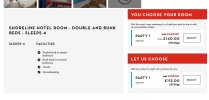
Even better, in September it could be as low as £115 for 4 nights in an apartment (see image)
I wonder whether this would be suitable for a couple .. just to spend the nights there .. cheaper than the Prermier Inn I guess .. much cheaper in fact
A friend from overseas has just had a short 4-night break in Butlins with his young family.
He was staying at Bognor Regis and paid about £140, although of course the same accommodation, in peak season could be as high as £600.
Even better, in September it could be as low as £115 for 4 nights in an apartment (see image)
I wonder whether this would be suitable for a couple .. just to spend the nights there .. cheaper than the Prermier Inn I guess .. much cheaper in fact
Attachments
Amos
Member
I quite agree, both about the location and the price. We stayed for a Friday and Saturday night at the end of February for £63, and whilst it wasn’t the greatest hotel I have ever stayed in I could put up with it for 2 nights.It is a crap spot, but I stayed there for a night last December and the saving on somewhere more central easily justified a taxi to town and back.
There are quite a few buses which go past the end of the road, and we got a good value day ticket for £5.20.
eyebrook1961
Member
Hi. Interesting reading the responses to my post but, as others have said, there was no problem at the end of the day. Horizon capitulated after being given the relevant booking references for our stay but still managed to blame us for not registering our car details properly . . . . when in fact it is the Hotel going off doing their own thing which, whilst understanding the reasons for doing it, ends up causing issues because the staff have (probably) not then gone on to enter the details themselves . . .
One thing I have been wondering is if there are quite a few people being caught out by this but have then just coughed up assuming that they've actually done sonthing wrong.
One thing I have been wondering is if there are quite a few people being caught out by this but have then just coughed up assuming that they've actually done sonthing wrong.