
• Our new ticketing site is now live! Using either this or the original site (both powered by TrainSplit) helps support the running of the forum with every ticket purchase! Find out more and ask any questions/give us feedback in this thread!

British rail class 506s

Status
Not open for further replies.

317663

Member
Joined
30 Sep 2013
Messages
98
Location
Weymouth
I was just looking at a page of the british rail 506s that went in service in the late 40s and out of service in 1980 something.

1. are there any units left over
2. why they went out of service
3. what traction motors did the trains use

if anyone can give some more information about the 506s... not forgetting their cousins the 306s#, thanks.

#what lines did the 306s go on?
 
Sponsor Post - registered members do not see these adverts; click here to register, or click here to log in
R

RailUK Forums

fowler9

Established Member
Joined
29 Oct 2013
Messages
8,380
Location
Liverpool
They were withdrawn due to the conversion of the routes they operated to the more standard AC electrification. Someone more knowledgeable than me will probably answer your other questions.

They ran from Manchester to Glossop & Hadfield. Further info below:-

http://en.wikipedia.org/wiki/British_Rail_Class_506
 
Last edited:

507 001

Established Member
Joined
3 Dec 2008
Messages
2,173
Location
Huyton
1. are there any units left over
2. why they went out of service
3. what traction motors did the trains use

if anyone can give some more information about the 506s... not forgetting their cousins the 306s#, thanks.

1) not sure, think there might be a cab somewhere.

2) they were non-standard being powered by 1500v DC, BR closed its last major 1500v line in iirc 1985 (the wood head route) and the surviving short section of it around manchester was re-electrified at british standard 25kv AC.

3) not sure.
 

electra27000

Member
Joined
17 Jun 2011
Messages
111
Location
Low Moor
1) not sure, think there might be a cab somewhere.
There was a cab at Barrow Hill until last year, when it was taken away by someone who has, apparently, bought a few cabs for restoration.

2) they were non-standard being powered by 1500v DC, BR closed its last major 1500v line in iirc 1985 (the wood head route) and the surviving short section of it around manchester was re-electrified at british standard 25kv AC.
They were non-standard and regarded as being too old for conversion to AC - as per their Great Eastern cousins (aka class 306). BR closed Woodhead in July 1981 and the remaining stub - Manchester-Glossop/Hadfield - was converted to 25kV AC in December 1984.

3) not sure.
I'm not sure on this one, either, but I think the Manchester 8 were broadly similar to the 92 sets built for Shenfield, so I wouldn't be surprised if they carried the same motors - that 306017 will still have.
 

306024

Established Member
Joined
23 Jan 2013
Messages
3,974
Location
East Anglia
.......what lines did the 306s go on?
Ah now we're talking. :)

Basically Liverpool Street to Shenfield, with odd trips usually at night to Southend Victoria. Also Shenfield - Chelmsford shuttles. I have a set of 1967 class 306 diagrams that make interesting reading - to me anyway.

Towards the end of their life pre-Christmas parcels traffic used to see them work to Ipswich but not in passenger service.

The 506s were younger but very similar.
 

table38

Established Member
Joined
12 Oct 2010
Messages
1,812
Location
Stalybridge
3. what traction motors did the trains use
The Glossop stock used GEC electrical equipment and traction motors, in contrast to the Shenfield stock's English Electric equipment and Crompton Parkinson motors.

Did the class 506's ever run east of Hadfield?
The only passenger-carrying exception was in June 1954, when they operated a shuttle service between Woodhead and Dunford Bridge for visitors to the new Woodhead tunnel.
from http://www.lner.info/locos/Electric/glossop.shtml
 
Last edited:

colchesterken

Member
Joined
12 Oct 2010
Messages
768
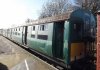
my favorite train 306 017 is parked up at the East Anglian Railway museum.
on loan from NRM it has not been touched for at least 2 yrs I would like to see it running again
I think it belongs there 1 mile from overhead at Marks Tey I would love to see it running specials Colchester-Walton on bank holidays
 

MK Tom

Established Member
Joined
31 Aug 2011
Messages
2,457
Location
Milton Keynes
my favorite train 306 017 is parked up at the East Anglian Railway museum.
on loan from NRM it has not been touched for at least 2 yrs I would like to see it running again
I think it belongs there 1 mile from overhead at Marks Tey I would love to see it running specials Colchester-Walton on bank holidays

I touched it when I slid the door open to have a look inside! It's in a rather poor state I must say.
 

Attachments

  • DSCF5109.jpg
    DSCF5109.jpg
    204.1 KB · Views: 104

317663

Member
Joined
30 Sep 2013
Messages
98
Location
Weymouth
I touched it when I slid the door open to have a look inside! It's in a rather poor state I must say.
Those sliding doors (if I'm right) must have taken at least 5 seconds to open fully!

*Also about doors, does anyone know what the first stock was to have sliding doors, such ass 455's and 313's?
 

RobShipway

Established Member
Joined
20 Sep 2009
Messages
3,337
Those sliding doors (if I'm right) must have taken at least 5 seconds to open fully!

*Also about doors, does anyone know what the first stock was to have sliding doors, such ass 455's and 313's?

I will probably be corrected but I believe the Class 306 trains which where in service from 1949 onwards as per http://en.wikipedia.org/wiki/British_Rail_Class_306 where the first sliding door trains.
 

Taunton

Veteran Member
Joined
1 Aug 2013
Messages
12,238
*Also about doors, does anyone know what the first stock was to have sliding doors, such ass 455's and 313's?
The first trains on the national network with power-operated sliding doors were the LMS Wirral units built in 1938 (later BR class 503). They were built by the same builders (BRCW and Met-Cam) who were building the London Underground O and P Stocks at the same time with the same door equipment. They lasted until 1984-5 on the Wirral lines. They were regarded as pioneers of this equipment.

Several trains had sliding doors before this (including some steam stock) but the doors were hand-worked. The units designed for the LNER Tyneside lines in 1937, just one year before and also built by Met-Cam, had hand-operated sliding doors

The London Underground lines were somewhat earlier in adopting power doors, operated by compressed air actuated by electric controls, the first came I believe in 1923. Again, there were earlier trains with hand-operated sliding doors.

Regarding the class 306 (Liverpool Street) and 506 (Manchester-Hadfield), the LNER ordered, in its last years, 100 1500 volt 3-car units, from the same two builders who did the class 503 described above. 92 of them were allocated to Liverpool Street and the other 8 to Hadfield. Initially they were very similar although the Hadfield units were delayed in building until a few years after the London units. The Liverpool Street units were extensively rebuilt after a few years when the line changed from 1500 volt to 25 Kv, not just the equipment but the actual arrangement of the cars was substantially changed. The Hadfield units remained as built.
 
Last edited:

Springs Branch

Established Member
Joined
7 Nov 2013
Messages
1,681
Location
Where my keyboard has no £ key
. . . . . The Liverpool Street units were extensively rebuilt after a few years when the line changed from 1500 volt to 25 Kv, not just the equipment but the actual arrangement of the cars was substantially changed. The Hadfield units remained as built.
I remember the Hadfield units running around Manchester, back in the day. I always thought there was something slightly odd-looking about the 506s, compared to other overhead EMUs on BR, but couldn't put my finger on exactly what.

Eventually the penny dropped - the pantograph was positioned right at one end of the train - above the driving cab of the motor coach. This made the Hadfield units look a bit "unbalanced", more like a loco and coaches than other EMUs, where the panto is somewhere towards the middle of the train.
But I doubt any of the normal punters would notice this aesthetic!
 

O L Leigh

Established Member
Joined
20 Jan 2006
Messages
5,609
Location
In the cab with the paper
306017 is not in operational state. Irrespective of whether or not it has all the necessary on-train equipment necessary for mainline operation these days, it requires a new HT lead (the cable that connects the pantograph to the transformer). Also it has been stored out of use for many years and almost certainly requires more parts and attention than just the HT lead.

It used to be Ilford's "pet" unit for some years and maintained on a voluntary basis by the staff and stabled inside the New Shed. However, the capacity for keeping the unit, together with the space, disappeared almost ten years ago and the unit went into storage, initially at MOD Kineton (or so I'm lead to believe). Storage of the unit out in the open together with the lack of ongoing maintenance will only see it's condition deteriorate. Sad really, given that it is probably the only complete AC EMU in preservation. It really should be at Shildon if not at York.

O L Leigh
 

Oldrowley

Member
Joined
14 Oct 2010
Messages
32
Quote from Wikipedia
In 1981 the Woodhead line was closed east of Hadfield. In December 1984 the remaining section was converted to the standard 25 kV AC overhead system and the Class 506 EMUs were withdrawn following the last run on 7 December. Following withdrawal, unit 59404-59504-59604 was set aside for preservation, but the rest were all sent to Vic Berry in Leicester for scrap, being cut up in April 1985. They were replaced by Class 303s transferred from Glasgow (themselves since withdrawn). The Manchester-Hadfield line is now operated by Class 323 EMUs.

While one complete unit was scheduled for preservation by West Yorkshire Transport Museum - being originally based at Dinting Railway Museum, then moved to the former BR depot at Bradford (Hammerton Street), and finally to Butterley - it deteriorated severely; two cars, and most of the third, were scrapped in August 1995 by Booth, Rotherham. All that remains is a severed driving end of a motor open brake second, M59404, which is preserved at the Electric Railway Museum, Warwickshire"
 

colchesterken

Member
Joined
12 Oct 2010
Messages
768
Its a great shame I went to EARM to give it a pat the weekend after it arrived. The inside was complete but the seats had been chucked about by Knights removing the asbastos from the heaters they had some spares for the moden safety equipment
I know it needed an HT lead I was told it cost £10 000 does not seem too much in restoration terms. It clearly needed a rub down and a coat of paint The roof was the worst part..I was sad to see the pic here of it now, as someone said it is the only AC unit runable, shame no one saved a complete 302-308 set...Does anyone remember LTS did not refurb 217 I rode it to Southend in about 1985 and it had been restored to original condition with wood panels etc,and painted green,I dont know why it was allowed to go to scrap.
 

zn1

Member
Joined
3 Sep 2011
Messages
435
agreed, the shenfielder the last of the LNER units complete, it should be in york, sat next to the oerlikon, not rusting away in the open - dear old Mr Birchler the ilford DE (the man who saved her) must be very sad to see her in this condition...he made sure and went to great lengths to make sure this was preserved....
 

colchesterken

Member
Joined
12 Oct 2010
Messages
768
How about getting a petition together and trying to get some publicity to pressure NRM to take proper care of it,, myabe taking it up with railway mags.
When you think of the number of Deltics & Cl 50 s preserved ( dont get me wrong I love both classes) it is a shame they cannot paint it to stop further rot
It is a unique unit which risks being lost!!
 
Status
Not open for further replies.

Top