Hi I see that price (anytime day return) for Bristol parkway - Cardiff central is £19.40 and Bristol temple meads - Cardiff central is £24. But my friend told me he can scan the Cardiff - parkway ticket at Temple meads and Staff on board will also agree so no fine given to my friend. Wondering is that legal if I buy parkway ticket but travelling to/from temple meads?

-
Our new ticketing site is now live! Using either this or the original site (both powered by TrainSplit) helps support the running of the forum with every ticket purchase! Find out more and ask any questions/give us feedback in this thread!
You are using an out of date browser. It may not display this or other websites correctly.
You should upgrade or use an alternative browser.
You should upgrade or use an alternative browser.
Bristol - Cardiff Fare Enquiry
- Thread starter rubin
- Start date
- Status
- Not open for further replies.
Sponsor Post - registered members do not see these adverts; click here to register, or click here to log in
R
RailUK Forums
Nicholas43
Member
Er, hang on: an anytime day return from Bristol Parkway to Cardiff Central should not be accepted at Temple Meads station, and should be challenged as short-faring if inspected on the train. OTOH, an anytime day return from Bristol Temple Meads to Cardiff is valid via Bristol Parkway.
Why?Er, hang on: an anytime day return from Bristol Parkway to Cardiff Central should not be accepted at Temple Meads station, and should be challenged as short-faring if inspected on the train.

yes it shouldEr, hang on: an anytime day return from Bristol Parkway to Cardiff Central should not be accepted at Temple Meads station
no it shouldn'tshould be challenged as short-faring if inspected on the train.
It's valid
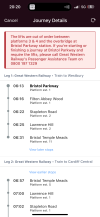
Journey planners will sell through tickets BPW-BRI-CDF including the relatively short double back near BRI
== Doublepost prevention - post automatically merged: ==
This is correctThat appears valid to me – you cannot of course travel via Bristol Parkway however.
Attachments
contrex
Established Member
The situation seems very similar to my trips from Stapleton Road to Cardiff and back. I have the choice of changing at Filton Abbey Wood or Temple Meads, and if I do the latter I could leave the station instead.
Nicholas43
Member
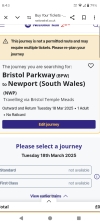
The journey is to Cardiff Central. You have searched to Newport.NRE says no. But maybe you might get away with it because routing guide uses Bristol group?
I believe journey planners permit this on some journeys purely due to a potentially erroneous easement by GWR.
Easement 700885 states:
One of the electronic easement records, however, is written as follows:
Journey planners will interpret this as meaning that if one of the trains you take between Bristol Temple Meads and Bristol Parkway or Bristol Temple Meads and Filton Abbey Wood calls at Stapleton Road, it will permit the double-back into Bristol Temple Meads and back out to Parkway. However, if you take services that go non-stop through Stapleton Road, the double-back will not be permitted as the station is not a mandatory timing point for services that do not call at the station, thus the train does not "pass" the station in any way interpretable by online journey planners.
I would imagine this easement is not supposed to apply to this journey, but may be doing so erroneously and could be corrected in the future.
Easement 700885 states:
My understanding is that this is intended to allow passengers travelling to or from these local stations to travel into Bristol and back out to Bristol Parkway for long distance services.From 15 December 2019 customers travelling from Lawrence Hill, Filton Abbeywood, Ashley Down, Stapleton Road and via Stapleton Road to Bristol Parkway or via Bristol Parkway may doubleback at Bristol Temple Meads. This doubleback easement will apply in both directions.
One of the electronic easement records, however, is written as follows:
If all of the below apply to the journey:
then the journey may double-back through { Ashley Down [ASD], Filton Abbey Wood [FIT], Lawrence Hill [LWH], Stapleton Road [SRD] }
- passes through at least one of { Ashley Down [ASD], Filton Abbey Wood [FIT], Lawrence Hill [LWH], Stapleton Road [SRD] }
- passes through all of { Bristol Parkway [BPW], Stapleton Road [SRD] }
Journey planners will interpret this as meaning that if one of the trains you take between Bristol Temple Meads and Bristol Parkway or Bristol Temple Meads and Filton Abbey Wood calls at Stapleton Road, it will permit the double-back into Bristol Temple Meads and back out to Parkway. However, if you take services that go non-stop through Stapleton Road, the double-back will not be permitted as the station is not a mandatory timing point for services that do not call at the station, thus the train does not "pass" the station in any way interpretable by online journey planners.
I would imagine this easement is not supposed to apply to this journey, but may be doing so erroneously and could be corrected in the future.
Nicholas43
Member
Sorry, my mistake. However, NRE gives the same No for Cardiff Central.The journey is to Cardiff Central. You have searched to Newport.
Thanks, Mr Jeeves, for explaining why some journey planners are misled into offering a mad fare for some times.

kieron
Established Member
When I try it, NRE behaves exactly as MrJeeves describes for journeys to Cardiff or Newport.
- Status
- Not open for further replies.