• Our new ticketing site is now live! Using either this or the original site (both powered by TrainSplit) helps support the running of the forum with every ticket purchase! Find out more and ask any questions/give us feedback in this thread!

BR Livery

Status
Not open for further replies.

rdlover777

Member
Joined
4 Feb 2014
Messages
461
Location
Kent
Note: I'm sorry if this is in the wrong place.


Hello, In the late 60s and early 70s, what livery did BR use, was it brunswick green or Blue & Grey or both?


Thanks in advanced.

rdlover777~
 
Sponsor Post - registered members do not see these adverts; click here to register, or click here to log in
R

RailUK Forums

DasLunatic

Member
Joined
11 May 2015
Messages
696
If memory serves, they used this livery:
1982_Cravens-2-car-DMU-still-as-delivered-in-BR-Blue-at-Williton-in-1982._WSR.jpg
.
 

sprinterguy

Veteran Member
Joined
4 Mar 2010
Messages
11,571
Location
Macclesfield
British Rails' corporate image, utilising BR rail blue and the double arrow logo, was launched in 1965.

Brunswick green livery and the lion holding wheel emblem survived on steam locos until withdrawal, and lingered on in decreasing numbers on diesel locos and multiple units into the early seventies. In fact, the last class 20 didn't lose BR green livery until 1980.

The following page provides detailed information on the final members of various classes to retain BR green livery during the rail blue era:
http://www.railblue.com/rail_blue_history_2.htm
 
Last edited:

GRALISTAIR

Established Member
Joined
11 Apr 2012
Messages
10,492
Location
Preston Lancs
Note: I'm sorry if this is in the wrong place.

Hello, In the late 60s and early 70s, what livery did BR use, was it brunswick green or Blue & Grey or both?

Thanks in advanced. rdlover777~

Immingham and similar sheds had theirs painted in two tone green - not BR Blue (what a boring livery that was!)
 

rdlover777

Member
Joined
4 Feb 2014
Messages
461
Location
Kent
British Rails' corporate image, utilising BR rail blue and the double arrow logo, was launched in 1965.

Brunswick green livery and the lion holding wheel emblem survived on steam locos until withdrawal, and lingered on in decreasing numbers on diesel locos and multiple units into the early seventies.

Thanks, i didn't know when the green and late crest was fazed out for BR blue
 

Harbornite

Established Member
Joined
7 May 2016
Messages
3,627
Blue and grey was applied to loco hauled coaching stock from 1965 onwards, marroj was finally eradicated in the early 1970s. As mentioned above, some locos remained in dark green but the majority gained BR blue livery.
--- old post above --- --- new post below ---
Thanks, i didn't know when the green and late crest was fazed out for BR blue

An experimental livery called XP64 was applied to a rake of mark 1 coaches and a class 47 in 1964.
 

Phil.

Established Member
Joined
10 Oct 2015
Messages
1,323
Location
Penzance
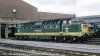
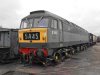
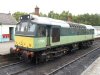
The green 50s/60s livery for diesel locomotives was generally all over Brunswick green but some locomotives had a two tone green livery to disguise their length or bulk. The 47s and 55s were two tone green and - oddly enough - so were the later 25s.

These aren't my pictures.
 

Attachments

  • 001-bill-wright-deltic-gateshead-b.jpg
    001-bill-wright-deltic-gateshead-b.jpg
    88.6 KB · Views: 36
  • D 1842 _Class 47_ in BR Two Tone Green.JPG
    D 1842 _Class 47_ in BR Two Tone Green.JPG
    87.6 KB · Views: 33
  • P9160756.jpg
    P9160756.jpg
    72.3 KB · Views: 30

70014IronDuke

Established Member
Joined
13 Jun 2015
Messages
4,068
Thanks, i didn't know when the green and late crest was fazed out for BR blue

Sprinterguy is 99% correct - but BR Blue was 'phased in' to the three VoR steam locos.
This certainly fazed out GWR fans.
:)
--- old post above --- --- new post below ---
Immingham and similar sheds had theirs painted in two tone green - not BR Blue (what a boring livery that was!)

When kept clean and lustrous, the blue was fine. I remember seeing a sparkling blue Hymek just ex shops for the first time - it looked superb.

BR green, when worn or unkempt, was equally depressing. I think this is true for whatever livery is applied.
--- old post above --- --- new post below ---
The green 50s/60s livery for diesel locomotives was generally all over Brunswick green but some locomotives had a two tone green livery to disguise their length or bulk. The 47s and 55s were two tone green and - oddly enough - so were the later 25s.

These aren't my pictures.

Do you know that as fact, or is it just conjecture? I've never seen any reasoning given for the two-tone green myself.
 

Phil.

Established Member
Joined
10 Oct 2015
Messages
1,323
Location
Penzance
Sprinterguy is 99% correct - but BR Blue was 'phased in' to the three VoR steam locos.
This certainly fazed out GWR fans.
:)
--- old post above --- --- new post below ---


When kept clean and lustrous, the blue was fine. I remember seeing a sparkling blue Hymek just ex shops for the first time - it looked superb.

BR green, when worn or unkempt, was equally depressing. I think this is true for whatever livery is applied.
--- old post above --- --- new post below ---


Do you know that as fact, or is it just conjecture? I've never seen any reasoning given for the two-tone green myself.

Page 40 (chapter 5, Deltic aesthetics) "The Deltic Locomotives of British Rail" Brian Webb 1982.
"The colour break on the Deltics was visually important in reducing the apparent height of the bodysides, by leading the eye lengthways along the locomotive".
I do know that this was the same for the expanse of plain bodywork on the 47s too. This is why the 50s in rail blue looked like big boxes on wheels. I've no idea what the thinking was behind the two-tone green on the later 25s though.
 

sprinterguy

Veteran Member
Joined
4 Mar 2010
Messages
11,571
Location
Macclesfield
It was the CEP's rather than the VEP's that it went on down in Kent, but I agree it did look very smart and modern.
It wasn't a bad livery for its' era, but compared to NSE (which admittedly was updated over the years) which followed I think that it would have become dated very quickly.
--- old post above --- --- new post below ---
When kept clean and lustrous, the blue was fine. I remember seeing a sparkling blue Hymek just ex shops for the first time - it looked superb.

BR green, when worn or unkempt, was equally depressing. I think this is true for whatever livery is applied.
The Hymeks were one of the classes that benefited from some attempt at styling in the way that the cab window surrounds were picked out in warning yellow (although my favourite was those class members that retained white window surrounds with a small yellow warning panel). Without such styling features, the unrelieved expanse of BR blue looked very drab in my opinion, whether clean or otherwise (consider the handful of Hymeks that had the cab window surrounds painted in rail blue along with everything else, for comparison). I would agree, though, that brunswick green was just as uninspiring, particularly when unkempt.
 

Nic Robinson

Member
Joined
15 Jun 2016
Messages
48
Page 40 (chapter 5, Deltic aesthetics) "The Deltic Locomotives of British Rail" Brian Webb 1982.
"The colour break on the Deltics was visually important in reducing the apparent height of the bodysides, by leading the eye lengthways along the locomotive".

This worked brilliantly well imo. I would have loved, given their celebrity status, to have seen a form of 2 tone blue introduced for the 55s. One real problem was when the noses went to all-over yellow (for understandable safety reasons). Some green Deltics received the nose treatment and this destroyed the benefit of the 2 tone green (again imo).
--- old post above --- --- new post below ---
Page 40 (chapter 5, Deltic aesthetics) "The Deltic Locomotives of British Rail" Brian Webb 1982.
"The colour break on the Deltics was visually important in reducing the apparent height of the bodysides, by leading the eye lengthways along the locomotive".

This worked brilliantly well imo. I would have loved, given their celebrity status, to have seen a form of 2 tone blue introduced for the 55s. One real problem was when the noses went to all-over yellow (for understandable safety reasons). Some green Deltics received the nose treatment and this destroyed the benefit of the 2 tone green (again imo).
 

Taunton

Veteran Member
Joined
1 Aug 2013
Messages
12,261
Until 1957 BR diesels were black, and the green livery only lasted about 8 years, although it coincided with the construction of most of the BR diesels.

As ever there were a series of variations, although the BR all-over blue, imposed on all repaints from 1965 (it took about 10 years to disappear) was the most ubiquitous.

The Warships and Westerns on the WR had started as green, but from about 1963 the WR changed to maroon red. From 1965 BR blue came along, and so by a few years later there were about equal numbers of all three colours on the Warships. Most Westerns had been built in maroon, but there were a handful of greens, a unique pale yellow one (D1000) and a bronze one (D1015 I think). The Hymeks for some reason were repainted into blue much quicker. Maybe the Beyer Peacock paint was not as good as what Swindon applied to new build :)

A BR organisation called the "Design Panel" were responsible for some of the variations, the light green bottom line on the Hymeks and Deltics (Class 35 and 55) and the broad middle band of light green on the Sulzer 2s and Brush 4s (Class 25 and 47). The Class 25 changed halfway through construction, but never got repainted as such because the blue came along before their first major shopping, which I think would apply to the other classes mentioned here as well.

Passenger stock in the "blue" era was blue and grey for main line, and an extremely dreary all-over blue for more local vehicles. This last was changed about 1980 for blue/grey for all stock, which improved things notably.
 
Last edited:

Harbornite

Established Member
Joined
7 May 2016
Messages
3,627
A livery called chromatic blue was applied to certain 31s and/or Hymeks, in the days before BR blue.

Another misconception is that electric blue was applied to all the new BR ac electrics (classes 81-86) when new. It was only applied to the first 5 classes, the 86s were turned out in BR blue but with white cab roofs etc.

This website covers the subject well.

http://www.railblue.com/rail_blue_history.htm
--- old post above --- --- new post below ---
The Warships and Westerns on the WR had started as green, but from about 1963 the WR changed to maroon red. From 1965 BR blue came along, and so by a few years later there were about equal numbers of all three colours on the Warships. Most Westerns had been built in maroon, but there were a handful of greens, a unique pale yellow one (D1000) and a bronze one (D1015 I think). The Hymeks for some reason were repainted into blue much quicker. Maybe the Beyer Peacock paint was not as good as what Swindon applied to new build :)

The livery applied to D1000 was known as desert sand. The westerns looked best in maroon, then blue, followed by green.
 
Last edited:

randyrippley

Established Member
Joined
21 Feb 2016
Messages
5,382
A livery called chromatic blue was applied to certain 31s and/or Hymeks, in the days before BR blue.

have you any proof that chromatic blue actually existed? To me those funny early greeny-blue Hymek colours always looked to be due to the blue paint being applied too thinly over the existing green. I'm convinced that the different apparent shades of BR blue were simply due to changes in application techniques. For example, the blue on the ships always (in the early days) also looked "greener" than the blue on the locomotives. Did the Western Region and the dockyards use a different paint application system from the rest of BR?
It was quite a few years after BR blue was introduced that the blue actually started to look "blue" and not "turquoise" on Western Region locomotives
 

yorksrob

Veteran Member
Joined
6 Aug 2009
Messages
44,327
Location
Yorks
It wasn't a bad livery for its' era, but compared to NSE (which admittedly was updated over the years) which followed I think that it would have become dated very quickly.

I don't think it would have lent itself to the different coloured doors era, but other than that It would have worked anytime - much like IC Swallow.
 

Taunton

Veteran Member
Joined
1 Aug 2013
Messages
12,261
A livery called chromatic blue was applied to certain 31s .
The site you linked to shows the two experimental 31s, one in blue and the other in bronze. I recall these being shown when new in Modern Railways, actually when it had its original name of Trains Illustrated, in what must have been their first ever colour page in the magazine. G Freeman Allen, the editor of the period, must have given the printers of that era a real challenge to achieve this.

Anyone still got the mags and can say which one it was? 1961 I would think.
 

Harbornite

Established Member
Joined
7 May 2016
Messages
3,627
have you any proof that chromatic blue actually existed? To me those funny early greeny-blue Hymek colours always looked to be due to the blue paint being applied too thinly over the existing green. I'm convinced that the different apparent shades of BR blue were simply due to changes in application techniques. For example, the blue on the ships always (in the early days) also looked "greener" than the blue on the locomotives. Did the Western Region and the dockyards use a different paint application system from the rest of BR?
It was quite a few years after BR blue was introduced that the blue actually started to look "blue" and not "turquoise" on Western Region locomotives

The website I linked talks about just that and how it might not have existed. However I was referring to the blue livery (should have made this clearer) that was applied to a 31 in the pre rail blue era.
--- old post above --- --- new post below ---
The site you linked to shows the two experimental 31s, one in blue and the other in bronze. I recall these being shown when new in Modern Railways, actually when it had its original name of Trains Illustrated, in what must have been their first ever colour page in the magazine. G Freeman Allen, the editor of the period, must have given the printers of that era a real challenge to achieve this.

Anyone still got the mags and can say which one it was? 1961 I would think.

I may have gotten the name wrong, the rail blue website talks about how chromatic blue might not have existed.
 
Status
Not open for further replies.

Top