Our new ticketing site is now live! Using either this or the original site (both powered by TrainSplit) helps support the running of the forum with every ticket purchase! Find out more and ask any questions/give us feedback in this thread!
As noone actually posted it, this is the rail blue page from the corporate manual -
Of course not only do you have to deal with uncorrected monitors, but the scanner too. That is a different colour on two of my monitors & they're the same model!
As noone actually posted it, this is the rail blue page from the corporate manual - http://www.doublearrow.co.uk/manual/1_31.1965-01_front.gif ( and if someone could tell me the bbcode to use on this particular forum to inline that without it being enormous, I'd be very thankful )
Of course not only do you have to deal with uncorrected monitors, but the scanner too.
In 1984 British Airways updated its house colours from blue, white and red to blue, grey and red. But the exact shades used and way it was applied produced what many regard as one of the most iconic airline liveries ever.
If you use the visual editor to compose your post you can click "Insert image", supply a URL, and then use the grab handles on the inline image to resize it.
Personally prefer BOAC & BEA ( even though I'm not old enough to remember more than one of the retro liveries they did a couple of years ago ) - that particular BA livery always seemed so pretentious.
If you use the visual editor to compose your post you can click "Insert image", supply a URL, and then use the grab handles on the inline image to resize it.
I use an iPhone XR, Canon 80D and Leica M10-P; it appears to me that iOS performs colour processing on the captured image before saving. Colours are often vivid with the resultant image “better” than real life.
Yeah, phones are consumer products, looking to impress people with vivid colours, etc. I have a 14 year old DSLR that produces more detailed (and better colour fidelity), than any phone I've had, where the detail becomes mush at even a moderate magnification.
== Doublepost prevention - post automatically merged: ==
Interesting compilation, but it's just impossible to rely on the colour fidelity of old photos - so many variables: even professional films had different renditions - Kodak was red biased/Fujichrome green/blue. Then you've got the lower colour stablity of consumer film, degradation of colour layers over time, were these scanned from negatives or positives, or from fading prints? Then you've got the digital aspects - were images uploaded with a colour profile?
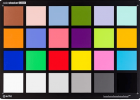
Unless someone took photos with a standard reference, eg:
then there's no way to know for sure, except perhaps recreate the paint, or examine an old tin, and hope it hasn't varied too much.
== Doublepost prevention - post automatically merged: ==
But print images scanned and uploaded for a website - how accurate is the colour in the scan compared to the original? Websites use a lower gamut colour space sRGB.
Let alone the fact that likely no one reading this thread keeps their monitors colour calibrated, unless they are a photographer!
== Doublepost prevention - post automatically merged: ==
Blue was always the "difficult" colour. You only have to look at all those nice summer day photos, including above, to find that the blue sky has rendered a milky white.
That’s more typically the result of exposure issues: the film hadn’t sufficient dynamic range, in modern parlance, to accommodate the brightness of the sky on exposure for the subject.
Positive film would typically have a range of five stops, compared to seven of negative film, so you’d need to have used a graduated neutral density filter to keep the sky from burning out.
That's the gist of the thread so far; we came to the conclusion in 2019 that BR Blue varied from device to device and from photo to photo - and that it might not even have been one specific colour across every loco.
Can someone please explain about the painting of carriages/MUs completely in blue - did this occur before the Blue and Grey period, or contemporaneously with it, but restricted to multiple units, or the Southern Region?
Can someone please explain about the painting of carriages/MUs completely in blue - did this occur before the Blue and Grey period, or contemporaneously with it, but restricted to multiple units, or the Southern Region?
I think it was all part of the new BR image from 1964 (?), with coaches for main line services getting the blue and grey, but DMUs and EMUs for local and suburban services throughout the network were all over blue. The non-corridor coaches were also all over blue if I remember correctly. It was purpose rather than anything else that decided. Certainly, plenty of DMUs were all blue.
Pretty much what Gloster says. Corporate look was blue, but prestige/InterCity-type services were made super-swish with grey. Then someone though all over blue was too boring and the grey appeared on virtually all passenger stock.
Not gonna deny, I love the old all-blue stock pics. Proper BR grime-era, especially with non-corridor stock! Photos like this are thick with atmosphere.
@nlogax Fully agreed. Long before my time, but images like that just ooze atmosphere. As much as I love NSE and Strathclyde Orange/Black & Carmine/Cream, there's something to be said for BR Blue.
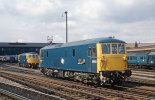
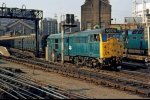
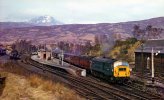
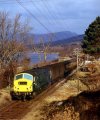
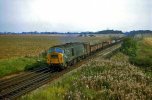
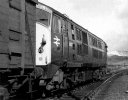
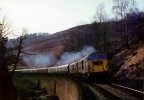
Continuing the theme, here is something a tad different: the re-engineered NBL Type 2s (Class 29s) that made it into Monastral Blue. Whether or not they suited it is debatable, one thing is certain however: these images drip with atmosphere. Considering how difficult it is to find any pics of 21s/29s at all and given the limitations of most home/personal camera equipment of the period, the fact these images look as good as they do is remarkable. Yeah, the 4th image is in B&W, but I couldn't not include it lol
Images #1, #2 & #5 taken by Derek Cross, image #3 courtsey of the Eastbank Model Railway Club (original photographer un-credited) & image #4 taken by C.W.R. Bowman. Image source links here & here.
@nlogax Fully agreed. Long before my time, but images like that just ooze atmosphere. As much as I love NSE and Strathclyde Orange/Black & Carmine/Cream, there's something to be said for BR Blue.
Continuing the theme, here is something a tad different: the re-engineered NBL Type 2s (Class 29s) that made it into Monastral Blue. Whether or not they suited it is debatable, one thing is certain however: these images drip with atmosphere. Considering how difficult it is to find any pics of 21s/29s at all and given the limitations of most home/personal camera equipment of the period, the fact these images look as good as they do is remarkable. Yeah, the 4th image is in B&W, but I couldn't not include it lol
Images #1, #2 & #5 taken by Derek Cross, image #3 courtsey of the Eastbank Model Railway Club (original photographer un-credited) & image #4 taken by C.W.R. Bowman. Image source links here & here.
As noone actually posted it, this is the rail blue page from the corporate manual -
Of course not only do you have to deal with uncorrected monitors, but the scanner too. That is a different colour on two of my monitors & they're the same model!
Indeed, totally different to the EE and Sulzer soundtracks that echoed across the rugged landscape surrounding the WHL for so many years. I can just hear the pair in the last pic in Monessie Gorge now, making themselves heard shifting that heavy train. It's also a shame that none survived into preservation, although I can appreciate that the mainline diesel preservation movement in the early 70s was nowhere near as established as it is now.
It's definitely going towards turquoise, but in a large block ( try viewing the page at full res ) it's more blue than anything on two of my screens, at least. One of them is deliberately calibrated slightly warmer & that does change it's colour, so it's also likely it'd look different at different times of day ( yet another factor to mix in! ).
We are aware of an issue with emails from the Forum to Microsoft-based email accounts (hotmail/outlook/live.com email addresses). This is being looked into currently, thanks for your patience meanwhile.