AFAIK west of Brussels 160 km/h is the plan for the speed. Currently, line 50A is still 140 km/h between Nieuwerkerken and Y Meulewijk, and between Landegem and Brugge. Once they're done 4-tracking Gent-Brugge, the 2 middle tracks should be 160 km/h.There are also quite a few lines where the linespeed could be raised. In particular the long 140 kph sections on the main line between Brugge and Brussels make the journey seem a bit tedious. I understand that line is in a state of flux, with ongoing four-tracking and the replacement of the legacy portal-based electrification with single track cantilevers, so maybe an increase in linespeed to 160 kph or maybe even 200 kph as seen between Brussels and Leuven would make the journey quite a bit quicker.

-
Our new ticketing site is now live! Using either this or the original site (both powered by TrainSplit) helps support the running of the forum with every ticket purchase! Find out more and ask any questions/give us feedback in this thread!
You are using an out of date browser. It may not display this or other websites correctly.
You should upgrade or use an alternative browser.
You should upgrade or use an alternative browser.
Belgium / SNCB/NMBS - random observations
- Thread starter NCT
- Start date
- Status
- Not open for further replies.
Sponsor Post - registered members do not see these adverts; click here to register, or click here to log in
R
RailUK Forums
Bemined
Member
The introduction of the Eurocity Direct also highlighted a capacity problem though, even though there are four tracks between Antwerp and Brussels they could not find the capacity to properly fit in this extra train, resulting in a long stop in Antwerp and having one domestic intercity less between these cities.
Having been in Belgium and The Netherlands two weeks ago I do confer with what the OP has written.
Station dwells in particular take quite a while - When I took an Intercity train from Charleroi-Central to Brussels-Midi there was a 6 minute dwell at Braine-L'Alleud, which added to the sluggish feeling of the line, with most of it having a 120 kph limit with one or two short sections of 140 kph.
Lots of dwell time (padding) has been added to the schedule of line 124 because of the works that are currently taking place, which are sometimes causing unexpected delays. By the way, 7 km of quadrupled track come in service end of next month. The line is a bit curvy, so high speeds are not possible everywhere , but a mix of 140 and 160 km/h should be in place after the works.
One nagging thing about SNCB and Belgian railways in particular is how inconsistent the offering and experience is. On the one hand there are absolutely incredible stations such as Anterwerpen-Centraal and Liège-Guillemins, fairly solid stations such as Brugge and Leuven, but also a lot of very unpleasant and run down stations such as Brussels-Midi and the un-refursbished parts of Mechelen and Ghent-Sint-Pieters.
SNCB has been deeply criticized for building "extravagant" new stations so now resources go for stations that are lacking in functionality or capacity. Mechelen and Gent are in this case. Those un-refurbished parts you mentioned should have disappeared in a few years. Brussels Midi is a special case. Rebuilding this station would require to take out of service one platform and two tracks at a time. With 1200 trains per day, this is not possible with the current track layout. Those modifications are slowly taking shape. Probably 10 more years of preparation work will still be needed before station refurbishment can begin.
The quality of rolling stock is very inconsistent as well, ranging from very nice locomotive hauled trains running on the fast Oostende/Kortrijk to Liège-Guillemins/Welkenraedt/Eupen services, to the commuter-specified Siemens Desiro trains being used on the Liège to Luxembourg services. Having said this the introduction of M7 trailer and motorised carriages is making the allocations of trains on secondary Intercity routes much more consistent.
Had Alstom do its work properly and delivered a reliable M7 vehicle, SNCB would have ordered the 1400 cars that were initially foreseen, and most of this inconsistency would be on its way out. Unfortunately this is not the case and SNCB stopped the damage at half order. We will now have to wait for the completion of the next order to see all already too old equipment disappear.
Regarding Liège Luxembourg, I agree with you that it is very unfortunate, but there really was no choice. Local people asked for an hourly service, and SNCB agreed only if operational costs could be reduced. Desiro was the only available solution.
There are also quite a few lines where the linespeed could be raised. In particular the long 140 kph sections on the main line between Brugge and Brussels make the journey seem a bit tedious. I understand that line is in a state of flux, with ongoing four-tracking and the replacement of the legacy portal-based electrification with single track cantilevers, so maybe an increase in linespeed to 160 kph or maybe even 200 kph as seen between Brussels and Leuven would make the journey quite a bit quicker.
Bruxelles Gent should be 200 km/h, one day. It will require an almost total rebuild, as tracks are too close and it needs a new catenary. Gent Brugge will be 160 km/h only : 200 was planned but after lots of work was already done, regulations changed and most of the work would have to be remade almost from scratch, notably many intermediate stations. So 160 it will be...
But in any case, speed increases are not the top priority for Infrabel right now. They managed to reduce the number of signal towers from 200 to 10 in 20 years, install bidirectional automatic block everywhere, eliminate all mechanical and electro-mechanical (relay rooms) signalling, and will have the whole network covered by ETCS at the end of this year. Plus the quadrupling of most lines radiating out of Brussels. It's a small country. Higher speed delivers minimal time gains over short distances. So it's seen as a luxury best kept for until after many more urgent problems are solved.
My final point of complaint, as with most continental European countries is that cross-border connectivity leaves a lot to be desired. There are countless examples of cross-border sections of track between places either side of the border that are either closed, mothballed, have no passenger service or where a useful Intercity service terminates at the very last or last major station before the border. Belgium has made a great effort in building cross-border high speed railways, however, the services that use them leave a lot to be desired, with trains selling out weeks in advance (eh hem, Eurostar Red), being eye-wateringly expensive (eh hem, all Eurostar services) or not being frequent enough (Brussels to Cologne and Lille really ought to have two trains per hour). The introduction of the NS Eurocity Direct from Brussels to Lelystad is a great step in the right direction though.
Brussels to Cologne is being worked on. Watch the delivery of the new HLE17...
Eurostar, blame SNCF, not us Belgians...
Otherwise, at regional level, we have two hourly connections to Lille, one bi-hourly to Maubeuge, 3 hourly to Luxembourg, one too Aachen, one to Maastricht, and one to Rosendaal. I think it's way better than most neighboring countries manage. I'll also mention that all those cross border relations are operated by SNCB rolling stock. None of the neighbor networks are able to provide anything.
Ah, and by the way, the slow train to Paris is an overwhelming success. SNCB would love to introduce more frequencies. SNCF said no.
It's a success, so SNCF don't want it to be more of a success? Or do SNCF think they'll make more profit by limiting the number of trains?Ah, and by the way, the slow train to Paris is an overwhelming success. SNCB would love to introduce more frequencies. SNCF said no.
Sir Felix Pole
Established Member
Probably don't want to undermine Eurostar Red (Thalys) - for which premium fares are charged (yet the PBA / PBKA units are getting very old and tired).It's a success, so SNCF don't want it to be more of a success? Or do SNCF think they'll make more profit by limiting the number of trains?
Come to think of it, those premium fares are also partly caused by insufficient supply.Probably don't want to undermine Eurostar Red (Thalys) - for which premium fares are charged (yet the PBA / PBKA units are getting very old and tired).
STINT47
Member
Brussels to Paris would benefit from an open access operator on both the High speed and classic lines.
Of course Eurostar/SNCF will have a list of reasons why it cannot be done/work but they seem to have a business model that restricts demand to keep prices high. As we are meant to be encouraging rail use hopefully this business model and the corresponding objections are seen for what they are.
Of course Eurostar/SNCF will have a list of reasons why it cannot be done/work but they seem to have a business model that restricts demand to keep prices high. As we are meant to be encouraging rail use hopefully this business model and the corresponding objections are seen for what they are.
Platforms in Bruxelles Midi look old but are perfectly functional. They are at the correct height, are wide enough to accommodate the volume of passengers, long enough to accommodate 12 car trains, have all lifts and escalators, and passenger information systems. The problem is purely aesthetic. Money is put where stations do not meet capacity or functional requirements. At at least in Belgium we have not built our high speed lines on crumbling bridges...
Touche, but fair enough. I can't quite remember now, but are Brussels North platforms at the right height?
There are still a lot of stations in Belgium that look like Lichtervelde or Kortrijk, and my feeling is that equivalent stations in the Netherlands would be compliant and smart looking.
Then at stations like Mechelen Nekkerspoel and Duffel there are some very uneven paving blocks on the platforms, and again I don't recall seeing similar conditions on the Dutch network.

The issue is that litterally nobody has shown any interest in that side of the Eurostar market, everyone wants London since it's the more prestigiousBrussels to Paris would benefit from an open access operator on both the High speed and classic lines.
When the single London OA operator gets chosen by ORR, the losing candidates may (and IMHO should) get their eyes on that side
== Doublepost prevention - post automatically merged: ==
Anyone should know by now that if it's not a TGV service, SNCF Voyageurs will want very little to do with it (I don't even know what lead to that service to start in the first place) as the cash cow is over there.It's a success, so SNCF don't want it to be more of a success? Or do SNCF think they'll make more profit by limiting the number of trains?
They won't make any more profit on the ouigo side since prices are capped anyways. If they get to shift people from ouigo to their international TGV or to Thalys, that's where profit is made.
I had an idea but it's crayon, the Hauts de France region would make a lot of profits if they worked with SNCB to extend the Lille-Tournai TER with a few direct runs to Brussels.
You can now do Lille-Brussels in 1h40 with a 7-9min change in Tournai. It could be very time competitive to Ouigo to just change in Lille Flandres from a Paris TGV. Sure a TGV takes 40m to do the same route but that doesn't discount the possibility.
Last edited:
STINT47
Member
I wonder if SNCF/Eurostar started the Quigo to stop a competitor?
There is an untapped market for a lower cost service so to stop someone pushing in on their "monopoly" they'll run a few trains that make the market un viable for a new entrant.
There is an untapped market for a lower cost service so to stop someone pushing in on their "monopoly" they'll run a few trains that make the market un viable for a new entrant.
Bemined
Member
At least 4 operators announced they want to start services from The Netherlands to France in the coming years, presumable they will also sell tickets from Brussels to Paris. None of those operators have trainsets they can use so it takes time for those services to be started up, and probably not all announced plans will become reality.Brussels to Paris would benefit from an open access operator on both the High speed and classic lines.
That's news to me, do you know who they are?At least 4 operators announced they want to start services from The Netherlands to France in the coming years, presumable they will also sell tickets from Brussels to Paris. None of those operators have trainsets they can use so it takes time for those services to be started up, and probably not all announced plans will become reality.
Amalie
Member
Personally, all those plans are a case of, I’ll believe it once I see it.At least 4 operators announced they want to start services from The Netherlands to France in the coming years, presumable they will also sell tickets from Brussels to Paris. None of those operators have trainsets they can use so it takes time for those services to be started up, and probably not all announced plans will become reality.
If I recall correctly, one of them is Arriva, who seemingly wants to offer a baffling route to Paris starting from Groningen and having quite a number of stops along the way.
I have a feeling it’s more a way for them to try to chip away the NS monopoly with the service first stopping at the border due to “lacking appropriate rolling stock,” and then mysteriously never gaining any new multisystem stock. Either that, or shortly afterwards splitting the service in two (Amsterdam-Paris and Amsterdam-Groningen).
For the record, I definitely would very much welcome a lot of services to France and Belgium from The Netherlands, but I’m skeptical about all four proposals the same way I’m skeptical about any of the proposals involving running passenger trains through the channel tunnel by companies not named Eurostar.
Touche, but fair enough. I can't quite remember now, but are Brussels North platforms at the right height?
North, Central, Midi platforms are all at the correct height.
There are still a lot of stations in Belgium that look like Lichtervelde or Kortrijk, and my feeling is that equivalent stations in the Netherlands would be compliant and smart looking.
Yes. Lots of intermediate size stations still have low platforms, only partially paved, and not always in a very good state. SNCB has neglected this aspect of its network for a very long time, and at the current rate, it will take decades to get things in correct state.
Then at stations like Mechelen Nekkerspoel and Duffel there are some very uneven paving blocks on the platforms, and again I don't recall seeing similar conditions on the Dutch network.
The obsession of SNCB for paving blocks is for me not understandable . It becomes uneven very quickly, can't be repaired easily, requires to maintain an inventory of spare parts, and lets all sorts of herbs grow in the joints. Herbs that they can't eradicate now that chemicals can't be used for that anymore. As if they didn't have enough problems with that in the ballast already... When will they understand that if they want low maintenance, the solution is concrete or asphalt ?
== Doublepost prevention - post automatically merged: ==
Anyone should know by now that if it's not a TGV service, SNCF Voyageurs will want very little to do with it (I don't even know what lead to that service to start in the first place) as the cash cow is over there.
As far as I know - but ready to accept corrections:
- the initial move came from SNCB, not SNCF. SNCB requested 5 paths in France (I have seen the official document) for Bruxelles to Paris with HLE18 and I11 stock.
- however SNCB was not sure to make those trains a success if they were the only company to sell the tickets. So they proposed a joint operation to SNCF.
- proposition that SNCF accepted but under the following conditions : use the OUIGO brand, internet sales only (although Brussels Midi Also sells it), no interrail. Only concession they made was the first class, which normally does not exist on OUIGO)
But despite using the OUIGO brand, those trains are not operated by the OSLO subsidiary of SNCF, that normally operates all OUIGO trains in France.
And following an article in the last issue of Today's Railways Europe, SNCF firmly says it will be 3 trains and not more.
Last edited:
Thank you for the summaryAs far as I know - but ready to accept corrections:
- the initial move came from SNCB, not SNCF. SNCB requested 5 paths in France (I have seen the official document) for Bruxelles to Paris with HLE18 and I11 stock.
- however SNCB was not sure to make those trains a success if they were the only company to sell the tickets. So they proposed a joint operation to SNCF.
- proposition that SNCF accepted but under the following conditions : use the OUIGO brand, internet sales only (although Brussels Midi Also sells it), no interrail. Only concession they made was the first class, which normally does not exist on OUIGO)
But despite using the OUIGO brand, those trains are not operated by the OSLO subsidiary of SNCF, that normally operates all OUIGO trains in France.
And following an article in the last issue of Today's Railways Europe, SNCF firmly says it will be 3 trains and not more.
What happened to that Izy service from Brussels to Paris that used to run? It used Eurostar class 373s (mostly a unit painted in Izy livery but also Eurostar liveried 373s when that was unavailable) but ran on the ordinary non high speed lines. They suddenly got rid of it about two years ago. I would be curious if anyone knows why they decided to get rid of it?
I would be curious if anyone knows why they decided to get rid of it?
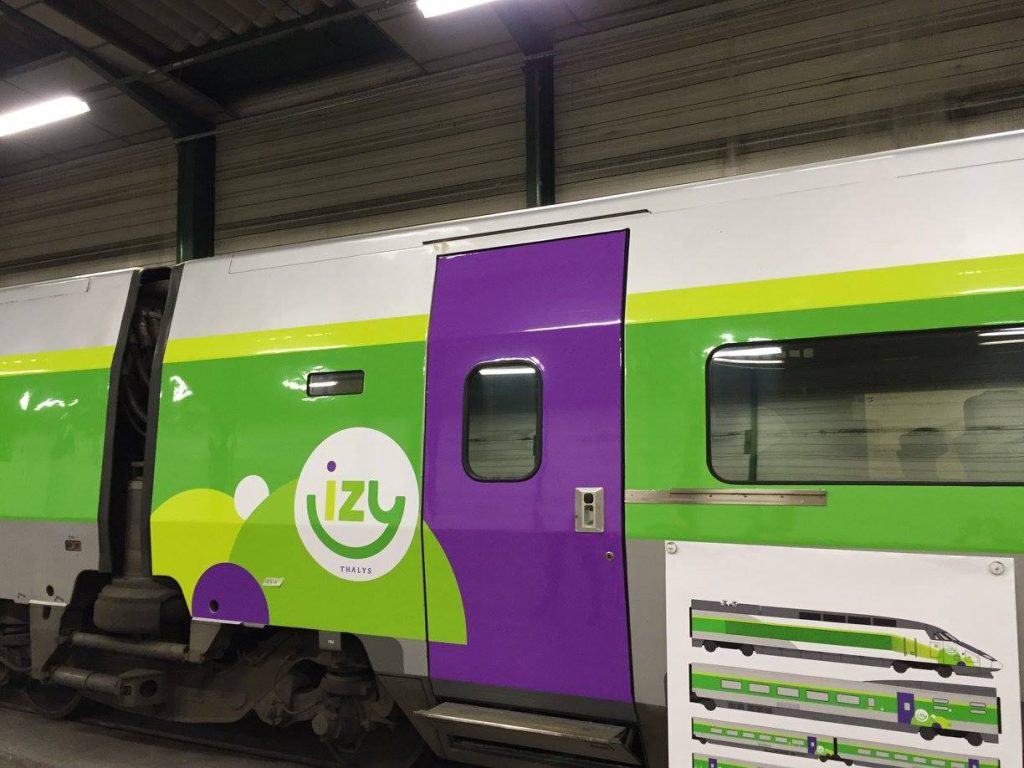
Thalys to stop operating low-cost IZY trains from July
After six years of operating the low-cost trains IZY, Thalys will stop the service as of 10 July. The cheaper, albeit slower, option from the French-Belgian […]
 traveltomorrow.com
The official announcement was
The concept has certainly proven itself in the past, but we have decided to integrate all the connections between Brussels and Paris into the Thalys offer.
“Customers will now be able to use all facilities offered by Thalys and they will also be able to rebook or cancel more easily. Additionally, we guarantee a shorter journey time, as all trains will now run on the fast track.” said Matthias Baertsoen, Thalys spokesperson.
There isn't any other info publically available that I can find, but It's easy to infer the reason
Last edited:
Kortrijk station and the area around it are in the middle of a big redevelopment that supposedly improving the station too - quiet a lot of development has recently happend in that city both along the railway and elsewhere (including 7 new bridges over the Leie).There are still a lot of stations in Belgium that look like Lichtervelde or Kortrijk, and my feeling is that equivalent stations in the Netherlands would be compliant and smart looking.
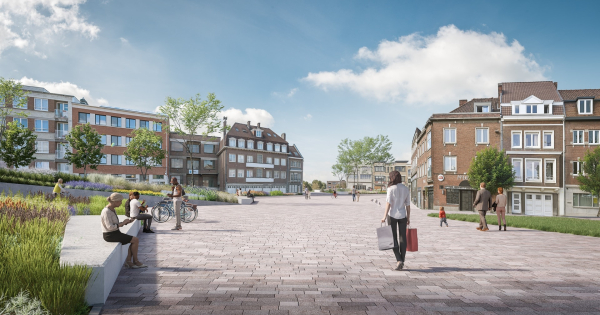
Stationsproject
Al in 2010 ondertekenden de partners een samenwerkingsovereenkomst voor de opmaak van het masterplan. In 2014 ondertekenden ze een tweede samenwerkingsovereenkomst voor de realisatie van de
Those platforms were a shock, but even more odd was one platform had a single up escalator!
Just going through my recent photos ...
On an AM08 - two-unit working on a Brussels suburban service. The guard is in one of the middle cabs, and for conducting duties they have to walk through the passenger compartment. During the station call the cab door is happily left open.

Would such practices be tolerated / allowed in GB? And, come to think of it, does Britain have any rolling stock where the driver's cab is only accessible through the passenger saloon?
On an AM08 - two-unit working on a Brussels suburban service. The guard is in one of the middle cabs, and for conducting duties they have to walk through the passenger compartment. During the station call the cab door is happily left open.
Would such practices be tolerated / allowed in GB? And, come to think of it, does Britain have any rolling stock where the driver's cab is only accessible through the passenger saloon?
Bletchleyite
Veteran Member
Would such practices be tolerated / allowed in GB?
I have seen it particularly on Merseyrail but much less often these days. Before the 1998 refurb the cab doors were not even locked.
And, come to think of it, does Britain have any rolling stock where the driver's cab is only accessible through the passenger saloon?
Classes 156 and 158 sort of, though not into the saloon, just a passenger accessible vestibule. Pacers until they were scrapped. But everything built since privatisation has required a separate cab door, mostly so if the driver has to get out for any reason they can do so without having an open exterior door passengers could then fall out of.
The classic units often ran with the cab door wide open until they finished last year. If the second class was leading, I would sit in the front seat for a forward view. The drivers were not at all concerned. The last time I can recall something similar in the UK was the class 101 that finished 22 years ago.Just going through my recent photos ...
On an AM08 - two-unit working on a Brussels suburban service. The guard is in one of the middle cabs, and for conducting duties they have to walk through the passenger compartment. During the station call the cab door is happily left open.
View attachment 190295
Would such practices be tolerated / allowed in GB? And, come to think of it, does Britain have any rolling stock where the driver's cab is only accessible through the passenger saloon?
A bit different. On a Desiro, the door left opened gives access to all driving controls. on a classical EMU, you could leave the gangway door open, but still close the driver's cabin. Most often, drivers would not close their door because the cabin was quite cramped, but if left unattended, the cabin door would always be secured.The classic units often ran with the cab door wide open until they finished last year. If the second class was leading, I would sit in the front seat for a forward view. The drivers were not at all concerned. The last time I can recall something similar in the UK was the class 101 that finished 22 years ago.
Indeed, unattended cabs were locked, or at least the door was closed. I was just surprised that members of the public could sit a metre from the driver with nothing in between. That would not happen in the UK. On a similar note, I rode the PCC trams in Antwerpen earlier this year. The drivers were quite happy for my dad and me to remain on board around the turning circle at Groenplaats. Two of them wandered off to get a coffee and left us unattended on the tram with the cab door unlocked. Again, this would not happen in the UK. Different world across the English channel.A bit different. On a Desiro, the door left opened gives access to all driving controls. on a classical EMU, you could leave the gangway door open, but still close the driver's cabin. Most often, drivers would not close their door because the cabin was quite cramped, but if left unattended, the cabin door would always be secured.
Indeed, unattended cabs were locked, or at least the door was closed. I was just surprised that members of the public could sit a metre from the driver with nothing in between. That would not happen in the UK. On a similar note, I rode the PCC trams in Antwerpen earlier this year. The drivers were quite happy for my dad and me to remain on board around the turning circle at Groenplaats. Two of them wandered off to get a coffee and left us unattended on the tram with the cab door unlocked. Again, this would not happen in the UK. Different world across the English channel.
A few years ago I got on a train in Belgium made of two units with a gangway connection.
The one I was in was a bit busy so I walked through into the other one.
Except I didn't because it turned out the two units weren't coupled and I'd just walked into the (empty) cab.
The cab door was closed. But not locked.

- Status
- Not open for further replies.