• Our new ticketing site is now live! Using either this or the original site (both powered by TrainSplit) helps support the running of the forum with every ticket purchase! Find out more and ask any questions/give us feedback in this thread!

ballastless track

Status
Not open for further replies.

stockport1

Member
Joined
5 Apr 2011
Messages
169
are there any proposed mainline ballastless installations?

what is the future of this technology in the uk in your educated opinions?

full of questions tonite thx :)
 
Sponsor Post - registered members do not see these adverts; click here to register, or click here to log in
R

RailUK Forums

Aictos

Established Member
Joined
28 Apr 2009
Messages
10,403
I like to know from the trackside workers here what the benefits and negatives are of both a track using ballast and a non ballast using track ie using concrete.
 

stockport1

Member
Joined
5 Apr 2011
Messages
169
wouldnt this be an option for the severn tunnel when electrification comes to give better clearances?
 

swt_passenger

Veteran Member
Joined
7 Apr 2010
Messages
34,256
wouldnt this be an option for the severn tunnel when electrification comes to give better clearances?

It would if there was a problem with existing clearances - but then why would there be? Slab track through tunnels for electrifcation isn't a common requirement, although it's been done a few times recently for gauge clearance to W10, eg Hampstead and Southampton.

But was it ever needed on the ECML at all for OHLE? I think the current idea in tunnels is to use a bar conductor if there is limited clearance, that's certainly been the case in Edinburgh.
 

Wyvern

Established Member
Joined
27 Oct 2009
Messages
1,573
One difficulty is if something goes wrong like the subsrtate shifting. Traditional track is easier to fix.
 

NightatLaira

Member
Joined
14 Jun 2010
Messages
490
Concrete slab footings for track is great in a relatively non-temperate climate where the temperature rarely changes by much (for instance in a tunnel or by the sea). In the longterm it is also cheaper as well (with no need for tamping). But for everywhere else ballast tends to win over - it is also much easier to fix after subsidence - concrete after subsidence can be very costly!
 

AlterEgo

Verified Rep - Wingin' It! Paul Lucas
Joined
30 Dec 2008
Messages
29,302
Location
LBK
The running rails on Platform 4c at Birmingham New Street are set into concrete. There's also a short section northbound out of St Pancras too IIRC...
 

Wyvern

Established Member
Joined
27 Oct 2009
Messages
1,573
It seems to be used mainly on tunnels and bridges where access is difficult but the ground is stable. There's a viaduct somewhere in North London that's laid on concrete.

An article here

It is written by a company that, of course has a vested interest in it. It would be interesting to see how well it fared on the Chat Moss line. It is certainly not true that ballast-laid lines have not progressed since the nineteenth century as the article implies.
 
Last edited:

The Snap

Established Member
Joined
10 Jun 2005
Messages
3,156
I like to know from the trackside workers here what the benefits and negatives are of both a track using ballast and a non ballast using track ie using concrete.

Concrete slab footings for track is great in a relatively non-temperate climate where the temperature rarely changes by much (for instance in a tunnel or by the sea). In the longterm it is also cheaper as well (with no need for tamping). But for everywhere else ballast tends to win over - it is also much easier to fix after subsidence - concrete after subsidence can be very costly!

I was about to respond to ajax103, but then I read NightatLaira's comment and decided there was no need :lol:. Everything NaL said is correct - one thing I would add is that concrete slabs are obviously easier on your feet when walking the line ;).

In the majority, if not all, of new-build railway tunnels, ballasted track is usually not installed because ballast moves slightly under impact of train forces, which can result in encroachment on clearances. This means the track must be adjusted and repacked more frequently. Also, the depth of ballast required is 300mm, as a pose to the 200mm required for a concrete slab base, meaning the size of the tunnel (in terms of excavation) is greater and therefore more expensive.

As someone has said, I wouldn’t be surprised if HS2 utilises slab track quite significantly.

HTH :).
 

route101

Veteran Member
Joined
16 May 2010
Messages
12,262
Glasgow Central Low Level is set on concrete but i think Queen St Low Level is set on Ballast. Berlin U Bahn , well the line i used was Ballast.
 

Ploughman

Established Member
Joined
15 Jan 2010
Messages
3,099
Location
Near where the 3 ridings meet
Slab track used were clearances are tight such as on bridges, in tunnels and platforms.
Using the slab means a reduced clearance tolerance can be used which means the vehicle envelope can be put closer to the structure or to other trains.
 

CarterUSM

Established Member
Joined
4 Jan 2010
Messages
2,495
Location
North Britain
I thought I had read somewhere that concrete slab track was liable to increased railhead wear, is this not the case?
 

boing_uk

Member
Joined
18 May 2009
Messages
619
Location
Blackburn
Indeed.

Subsidence isnt too much of an issue really with slab track as subsidence can be rectified by injecting expanding materials, such as polyurethane as an example.

Slab track does have its own unique disadvantages over ballasted track, not least its high initial cost. As Carter quite rightly states, railhead wear is an issue, with corrugation being much more likely, although I cannot recall where I read it.

It can be resolved with addional dampening measures between the rail and slab to transfer dynamic wheel loads through the rail to the formation, as well as the something to do with rail itself but again, I cannot recall what these are as it has been a while and I cannot be arsed to look for the original source where I read it! :lol:
 

CarterUSM

Established Member
Joined
4 Jan 2010
Messages
2,495
Location
North Britain
Indeed.

Subsidence isnt too much of an issue really with slab track as subsidence can be rectified by injecting expanding materials, such as polyurethane as an example.

Slab track does have its own unique disadvantages over ballasted track, not least its high initial cost. As Carter quite rightly states, railhead wear is an issue, with corrugation being much more likely, although I cannot recall where I read it.

It can be resolved with addional dampening measures between the rail and slab to transfer dynamic wheel loads through the rail to the formation, as well as the something to do with rail itself but again, I cannot recall what these are as it has been a while and I cannot be arsed to look for the original source where I read it! :lol:

Thanks, i'm sure i read it on a thread here somewhere a while back, might have been Old Timer or another one of the infrastructure guys. Though something about track replacement in the Merseyrail area a few years ago rings a bell also.
 

Bald Rick

Veteran Member
Joined
28 Sep 2010
Messages
35,685
Ballastless track systems do of course take an age to install compare to ballasted systems, and are an absolute b*gger to replace. As an example the slab from just south of St Pancras LL to Farringdon is over 30 years old now, showing it's age in many places and is likely to need renewal at some point in the next few years. The possession required will be measured in months rather than hours...
 

The Snap

Established Member
Joined
10 Jun 2005
Messages
3,156
The possession required will be measured in months rather than hours...

But then the next possession to upgrade or replace it again would not be for another 30 years or so. Ballasted track requires more frequent yet shorter possessions while slab requires longer and very infrequent possessions, so they even eachother out.
 

boing_uk

Member
Joined
18 May 2009
Messages
619
Location
Blackburn
Ballastless track systems do of course take an age to install compare to ballasted systems, and are an absolute b*gger to replace. As an example the slab from just south of St Pancras LL to Farringdon is over 30 years old now, showing it's age in many places and is likely to need renewal at some point in the next few years. The possession required will be measured in months rather than hours...

But do they though? Pre-cast systems must surely be quicker to install than, say, slip formed slabs. A slip forming paver can generally get around 200m done in a day; pre-cast obviously much quicker and little/no curing time either.
 

Bald Rick

Veteran Member
Joined
28 Sep 2010
Messages
35,685
But then the next possession to upgrade or replace it again would not be for another 30 years or so. Ballasted track requires more frequent yet shorter possessions while slab requires longer and very infrequent possessions, so they even eachother out.

This is true. Although the shorter possessions required for 'normal' track maintenance are almost exclusively taken overnight when no one notices. Whereas one big possession will affect pretty much everone who uses the line for some time.

Re Pre-cast systems - yes they are quicker to install, although the tolerances are extremely tight and there is absolutely no room for error; once in it can't be moved. However the reason it takes so long is more about getting the old slab out. It took about 4 weeks to get the old slab out of Ipswich Tunnel (330 metres) in 2004. And it was rather unpleasant work too!
 

boing_uk

Member
Joined
18 May 2009
Messages
619
Location
Blackburn
Unless there are clearance issues where the old slab must be removed, surely cracking and seating the slab and then putting new road over the top, like we do when resurfacing concrete road surfaces might be an option.

Of course there are also better ways of breaking up concrete, like chemical demolition agents (expanding grouts) to break up the slab.

4 weeks to get 300m of concrete slab out seems excessive. A road planer could have done the job - probably - in a much quicker time, depending on where the reinforcement is. I assume a pecker was used to break up the concrete?
 

Trog

Established Member
Joined
30 Oct 2009
Messages
1,546
Location
In Retirement.
A road planer could have done the job - probably - in a much quicker time, depending on where the reinforcement is. I assume a pecker was used to break up the concrete?


I would expect a track slab to be much more heavily reinforced than a road slab. Given that trains have larger unsprung weights, and axle loads up to 25 tons. You would also have to be careful not to damage the tunnel while breaking the slab, as if you dig too deep or damage the invert the tunnel could close like a book.
 

swt_passenger

Veteran Member
Joined
7 Apr 2010
Messages
34,256
But do they though? Pre-cast systems must surely be quicker to install than, say, slip formed slabs. A slip forming paver can generally get around 200m done in a day; pre-cast obviously much quicker and little/no curing time either.

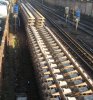
There isn't always a cast pavement. When I watched them do Southampton tunnel, the concrete went in last of all. The track was positioned first, carrying the half sleepers (which were linked with rebar with a rebar mesh hanging underneath), with adjustable jacks to lock it in the exact position, and the 'slab' was then cast around the fully aligned track. Up and down lines were separate, and the whole lot is sitting over the 1980s concrete tunnel floor, that was under the ballasted track.

Track lengths were welded together once in the tunnel.
 

Attachments

  • Southampton track panels.jpg
    Southampton track panels.jpg
    134.6 KB · Views: 42

matchmaker

Established Member
Joined
8 Mar 2009
Messages
1,877
Location
Central Scotland
I would expect a track slab to be much more heavily reinforced than a road slab. Given that trains have larger unsprung weights, and axle loads up to 25 tons. You would also have to be careful not to damage the tunnel while breaking the slab, as if you dig too deep or damage the invert the tunnel could close like a book.

Penmanshiel...................:cry:

http://en.wikipedia.org/wiki/Penmanshiel_Tunnel
 

swt_passenger

Veteran Member
Joined
7 Apr 2010
Messages
34,256
wouldnt this be an option for the severn tunnel when electrification comes to give better clearances?

This month's online edition of Rail Engineer magazine has an interview with the chap running the GWML electrification. Yet again, it is emphasised that electrification of the tunnel is not an issue:

...As for the tunnels – the big one I guess you’re interested in on GW is the Severn which in fact is really quite an electrification-friendly tunnel with quite good clearances. From the initial survey work we’ve done already, we’ve found that the room in the roof of the tunnel is capable of accommodating normal low encumbrance equipment like we put in tunnels elsewhere in the UK. And it would also be perfectly appropriate to use solid beam technology through the tunnel. We will consider both options when we move into the detail design phase.

...You can get solid beam to run up to 125mph. The Swiss have just achieved that and the Germans are not far off getting something similar. With the speed through the Severn Tunnel being well below that, we don’t have a problem. Either of the technologies will suit. What we need to do now is the detailed design so that we can see which has the better cost profile and, importantly, what will fit into the construction programme of the job.

May edition here: http://www.therailengineer.co.uk/Archives

Nothing new here really, but then again people do keep assuming the Severn Tunnel is a major issue for wiring...
 

Trog

Established Member
Joined
30 Oct 2009
Messages
1,546
Location
In Retirement.


Exactly.


I once had a job reballasting through a tunnel with no invert, and was warned by one of the managers on the works side not to dig too deeply. When I asked how I would know what was too deep. He said "When the tunnel shuts like a book you will know you have gone too deep."
 
Status
Not open for further replies.

Top