• Our new ticketing site is now live! Using either this or the original site (both powered by TrainSplit) helps support the running of the forum with every ticket purchase! Find out more and ask any questions/give us feedback in this thread!

Automatic Open Crossings (Remotely Monitored), particularly Rosarie

Status
Not open for further replies.

MadMac

Established Member
Joined
13 Jun 2008
Messages
1,494
Location
Moorpark, CA
I was contacted by a former colleague this morning - he‘s in his homeland of Keith just now and wondered if any others apart from Rosarie still exist on NR? I believe Rosarie is the only one as they were basically “outlawed” post the Lockington collision and the subsequent Stott Report, but there may be a couple still in Northern Ireland. Can anyone confirm?
 
Last edited:
Sponsor Post - registered members do not see these adverts; click here to register, or click here to log in
R

RailUK Forums

Iron_Duke

Member
Joined
29 Nov 2024
Messages
55
Location
On the network
Really quite hard to say. NR published a database of its level crossing types but you can't tell from it the difference between an AOCL and any remaining AOCRs. Suggest that there won't be many left on the national network, perhaps there might be some on private highways/roads.
 

swt_passenger

Veteran Member
Joined
7 Apr 2010
Messages
34,257
There are posts here dating back to 2012 suggesting Rosarie is the only NR example. Some of them written by @MadMac however.
 

Thepinkpig73

Member
Joined
2 Oct 2024
Messages
14
Location
Scotland
A search of the sectional appendix for “AOCR” only returns Rosarie, so I would assume it’s the only one left on NR.
 

godfreycomplex

Established Member
Joined
23 Jun 2016
Messages
1,751
Rosarie is indeed the only one left on NR, and has been since Llanboidy was converted to an AHB in 1993. Even at their peak in 1986 there were only 44 of them, AOCLs were always much more popular.
 

edwin_m

Veteran Member
Joined
21 Apr 2013
Messages
28,619
Location
Nottingham
What is the difference?

Indeed, a list of all the different types would be of interest.
Locally monitored has a flashing light for the driver to confirm the crossing equipment is working. The approach speed has to be limited so the train can stop before the crossing if it isn't.

Remotely monitored means that any faults are reported to the signaller instead, so the driver can assume the crossing is working unless advised otherwise by the signaller.

A crossing without barriers has a greater risk of a road driver disregarding the warnings, and the limited approach speed at an AOCL creates some possibility of the train being able to stop although obviously not if a vehicle appears at the last moment. I think AOCR fell out of favour after some serious collisions. See the Stott Report https://www.railwaysarchive.co.uk/docsummary.php?docID=4828 after the collision at Lockington:

Study of accident records has shown that collisions between vehicles and trains at automatic open crossings are at least twenty times more frequent than at automatic half-barrier crossings for the same traffic loading; at traditional gated crossings and the more modern full-barriers there are very few collisions. Collisions are almost always due to failure of vehicle drivers to observe the signals. ... I recommend that in future automatic open crossings should not be used at sites where the probable fatality rate exceeds one in a hundred years, a rate which I have chosen to correspond with the average performance of the present automatic half-barrier installations. Out of the 250 existing automatic open crossings on the British Rail system, seventy-four are likely to fall this test. I further recommend that those crossings which do not conform to guidelines set out in my Report should be modified, normally by conversion to automatic half-barrier crossings but in some cases by a change of operating speed. in a programme not exceeding five years in duration.

Since then barriers have also been fitted to many AOCLs.

AOCL: Automatic Open Crossing Locally monitored
AOCR: Automatic Open Crossing Remotely monitored
 

Thepinkpig73

Member
Joined
2 Oct 2024
Messages
14
Location
Scotland
Locally monitored has a flashing light for the driver to confirm the crossing equipment is working. The approach speed has to be limited so the train can stop before the crossing if it isn't.
It’s worth noting that drivers are also responsible for checking AOCLs are clear of any obstruction before proceeding, while there is no requirement to do so for an AOCR.
 

MadMac

Established Member
Joined
13 Jun 2008
Messages
1,494
Location
Moorpark, CA
Is there any special circumstance at Rosarie which has led to this one being kept?
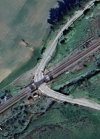
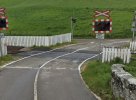
It’s a very lightly used road (I believe it leads to the local dump): replacing it with a bridge was, I believe, looked at but the local “geography“ was deemed unsuitable. Couple of Google Earth images attached.
 

Attachments

  • IMG_7785.jpeg
    IMG_7785.jpeg
    124.4 KB · Views: 54
  • IMG_7786.jpeg
    IMG_7786.jpeg
    675.3 KB · Views: 54

Belperpete

Established Member
Joined
17 Aug 2018
Messages
3,606
Since then barriers have also been fitted to many AOCLs.

AOCL: Automatic Open Crossing Locally monitored
AOCR: Automatic Open Crossing Remotely monitored
An AOCL that has had half-barriers fitted is an ABCL Automatic Barrier Crossing Locally Monitored.

The other type of automatic crossing is the AHB Automatic Half Barriers. If they were being introduced now they would probably be designated as ABCR for consistency, but they got their name when they were the first and only type of automatic crossing in the UK.

An AOCR is basically an AHB without barriers. Both were intended for use on relatively high speed lines. At the point at which the train activates the crossing, it is too late to stop the train if the crossing fails to work. There is therefore no point in providing driver's white lights, and so any failure is indicated to the signaller. This can require an expensive communication link to what are often very rural and isolated crossings. Both these types of crossing seem to have fallen out of favour, with many AHBs also converted to manned barriers.

AOCLs and ABCLs are used on relatively low speed lines. The train will be going slowly enough that it can stop if the driver sees that the crossing is obstructed or the driver's white light isn't flashing. As the crossing status is indicated to the train drivers, there is generally no status indication transmitted to the signaller. Note that the flashing white light at an ABCL generally doesn't prove the barriers down, as doing so would mean the light would start flashing too late causing the driver to start braking.

As the operating and failure modes of the two categories of crossing (locally or remotely monitored) are very different, they have very different control circuits.

Just to muddy the waters slightly, I understand that in Ireland (can't remember now north or south) they have some automatic crossings that are both locally and remotely monitored.

 

Tomnick

Established Member
Joined
10 Jun 2005
Messages
5,933
An AOCL that has had half-barriers fitted is an ABCL Automatic Barrier Crossing Locally Monitored.
Not quite. They're classed (officially) as AOCL+B. There's a subtle difference in the circuitry – not sure what, exactly, but I drive over both ABCL and AOCL+B crossings and it's noticeable that you get the driver's white light much later on the latter.
 

edwin_m

Veteran Member
Joined
21 Apr 2013
Messages
28,619
Location
Nottingham
Both these types of crossing seem to have fallen out of favour, with many AHBs also converted to manned barriers.
Just to point out that although these are classed as manned barriers, most of them will have obstacle detection systems which mean they can operate without human intervention most of the time. This obviously reduces the operating cost of a "manned" crossing relative to an AHB, making it more justifiable to spend on improving safety by providing full rather than half barriers.

Previously manned barriers, whether monitored by CCTV or by someone in an adjacent signal box, required the signaller to press a button after the barriers were down to confirm nobody was trapped on the crossing. Most also needed the signaller to initiate the barrier sequence as well.
 
Status
Not open for further replies.

Top