Our new ticketing site is now live! Using either this or the original site (both powered by TrainSplit) helps support the running of the forum with every ticket purchase! Find out more and ask any questions/give us feedback in this thread!
Looks like there a a few routes available from that signal. Perhaps only certain routes give a proceed signal straightaway?
Edit. Or maybe you only get a proceed signal throughout if the route is set throughout where as if its only set 154 to 150 it will act as a warner route and delay 154 coming off?
My pet niggle at Crewe is CE107 on the Down Fast which only comes off for the routes to Platforms 6 and 11 after a down express has been brought almost to a stand, depending on how defensive the driver is, adding 2-3 minutes to schedules. If anyone can provide an explanation as to why we can't have flashing double yellows at BH11 and a flashing single yellow at CE103 for the routes to Platforms 6 and 11 I'd be very grateful. Is it perhaps because they're controlled by separate signalboxes? Any derogation of approach-control wouldn't need to apply for the routes to platforms 1, 5 or 12.
My recollection is that this was caused by a long-standing failure (of what, I do not remember, sorry!) which was low down the priority list to be fixed. What this might therefore mean is that this has finally been rectified. I agree with you that up trains have been required to come to a stand at CE 154 for a number of years now, not just a number of months.
My recollection is that this was caused by a long-standing failure (of what, I do not remember, sorry!) which was low down the priority list to be fixed. What this might therefore mean is that this has finally been rectified. I agree with you that up trains have been required to come to a stand at CE 154 for a number of years now, not just a number of months.
It would be very nice if this is the case and, whatever the fault was, has been fixed! They have been doing a lot of signal head replacements around Crewe over Christmas so maybe it was resolved at the same time?
It would be very nice if this is the case and, whatever the fault was, has been fixed! They have been doing a lot of signal head replacements around Crewe over Christmas so maybe it was resolved at the same time?
I believe the Temporary Approach Control Link was out for the main routes, effectively enforcing Warner aspect conditions onto the Main routes. This was apparently in response to concerns over substandard restricted overlap lengths at the next signals, in particular the one at the diamond crossing.
Quite why applying approach control to the Main routes (which remove the potential conflict as the full overlaps extend through the junction) does any good in this respect, when the problem is with the Warners, escapes me!
It would be very nice if this is the case and, whatever the fault was, has been fixed! They have been doing a lot of signal head replacements around Crewe over Christmas so maybe it was resolved at the same time?
My pet niggle at Crewe is CE107 on the Down Fast which only comes off for the routes to Platforms 6 and 11 after a down express has been brought almost to a stand, depending on how defensive the driver is, adding 2-3 minutes to schedules. If anyone can provide an explanation as to why we can't have flashing double yellows at BH11 and a flashing single yellow at CE103 for the routes to Platforms 6 and 11 I'd be very grateful. Is it perhaps because they're controlled by separate signalboxes? Any derogation of approach-control wouldn't need to apply for the routes to platforms 1, 5 or 12.
I seem to remember being told a very long time ago that the problem was that there's a faster diverging route ahead of 107 than the one into platform 6, which is 50 — the first of the two crossovers south of the station from the down fast to the up fast (signalled by Position 4 lights on 107) is for 60 (though the second, signalled by "U", is only for 20). So if there were flashing yellows, it would have to be that 60 route they would apply to. (But a question to anyone who knows: if the speed gap between two diverging routes is only 10 mph, can't you use flashing yellows for both?)
As for CE154, hasn't that always been a disaster? Signalling at Crewe both to and from the Manchester line is more restrictive in speed and therefore time terms than it was before the 1980s work was done. Does anyone else recall the early 1960s, when an electrically-hauled train staring away from Crewe would normally pass Sydney Bridge in just two minutes (without extra seconds!), having begun to accelerate well before the point where today's 20 ends?
My pet niggle at Crewe is CE107 on the Down Fast which only comes off for the routes to Platforms 6 and 11 after a down express has been brought almost to a stand, depending on how defensive the driver is, adding 2-3 minutes to schedules. If anyone can provide an explanation as to why we can't have flashing double yellows at BH11 and a flashing single yellow at CE103 for the routes to Platforms 6 and 11 I'd be very grateful. Is it perhaps because they're controlled by separate signalboxes? Any derogation of approach-control wouldn't need to apply for the routes to platforms 1, 5 or 12.
I seem to remember being told a very long time ago that the problem was that there's a faster diverging route ahead of 107 than the one into platform 6, which is 50 — the first of the two crossovers south of the station from the down fast to the up fast (signalled by Position 4 lights on 107) is for 60 (though the second, signalled by "U", is only for 20). So if there were flashing yellows, it would have to be that 60 route they would apply to. (But a question to anyone who knows: if the speed gap between two diverging routes is only 10 mph, can't you use flashing yellows for both?)
A book that I have has a section on Approach control with flashing yellow aspects while it does not mention limits it does start off with saying that 'the diverging route where the approach speed is relatively high and the junction has been specially laid out to allow it'.
I think the only route where this may be considered would be from 107 to 155 via the 60mph crossover as all other possible routes have 50 or 20mph sections. There may also be some considerations with the overlap on the platform signals (and the aspect they are displaying) as the junction at the north end of the platforms starts almost immediately so there may be a reduced overlap in places to free up other routes.
Thank you Senex and 43055 for those illuminating and informative explanations. I'm sure if you tried to explain to an Avanti passenger why their Pendolino is always reduced to a crawl approaching Crewe they'd be suitably baffled!
Can confirm the long standing issue with CE154 has indeed been fixed and you are no longer brought virtually to a stand at it every time.
Over the past year most of the signal heads around Crewe station have been replaced with LEDs. I'm not sure if that is connected to the CE154 issue or just a coincidence, but whatever work was done over Christmas was enough to get it working properly.
I believe the Temporary Approach Control Link was out for the main routes, effectively enforcing Warner aspect conditions onto the Main routes. This was apparently in response to concerns over substandard restricted overlap lengths at the next signals, in particular the one at the diamond crossing.
Quite why applying approach control to the Main routes (which remove the potential conflict as the full overlaps extend through the junction) does any good in this respect, when the problem is with the Warners, escapes me!
Perhaps for the up movement from CE154 to down road CE148 originally had a reduced (rather than restricted) main overlap clear of the diamond that had no approach release because all moves from the signal are slow enough according to the signalling principes at the time of resignalling (all lines 20mph both directions hence no approach release required normally). Subsequent junction risk analysis, (possibly prompted by an incident?) may have identified an unacceptable collision risk for that particular route, for which quick mitigation could have been to apply TACL, a technicians terminal restriction available instantly for any signal, but the collateral is that has to apply to all routes from the signal concerned, including the straighter routes to the upside island with much lower junction collision risk. If engineers have been engaged in modifying interlocking data for (say) revised main filament alarms i.c.w. changing to LED signal heads, then the opportunity may also have been taken to 'tackle' (sorry!) a list of other minor issues in the particular interlocking area, of which 'properly' changing the approach release conditions for certain routes from CE 154 (allowing the TACL control to be removed) may be one. My experience is that most installations have lists of these kinds of issues that are rolled up periodically into a data change.
Can confirm the long standing issue with CE154 has indeed been fixed and you are no longer brought virtually to a stand at it every time.
Over the past year most of the signal heads around Crewe station have been replaced with LEDs. I'm not sure if that is connected to the CE154 issue or just a coincidence, but whatever work was done over Christmas was enough to get it working properly.
Thank you, good that it's been fixed.
It was an actual stand at CE154 of about half a minute from my recollection, it wasn't an approach-release red which cleared on approach but a red which cleared after the train had stopped for about 30 seconds.
The xx.55 Manchester to London also gets delayed by the late-running Wigan-Alderley Edge service before Crewe, and the late-running Liverpool-London at Stafford after Crewe, so at least this fix will alleviate the former delay if not the latter. I'm sure every bit helps.
Perhaps for the up movement from CE154 to down road CE148 originally had a reduced (rather than restricted) main overlap clear of the diamond that had no approach release because all moves from the signal are slow enough according to the signalling principes at the time of resignalling (all lines 20mph both directions hence no approach release required normally). Subsequent junction risk analysis, (possibly prompted by an incident?) may have identified an unacceptable collision risk for that particular route, for which quick mitigation could have been to apply TACL, a technicians terminal restriction available instantly for any signal, but the collateral is that has to apply to all routes from the signal concerned, including the straighter routes to the upside island with much lower junction collision risk. If engineers have been engaged in modifying interlocking data for (say) revised main filament alarms i.c.w. changing to LED signal heads, then the opportunity may also have been taken to 'tackle' (sorry!) a list of other minor issues in the particular interlocking area, of which 'properly' changing the approach release conditions for certain routes from CE 154 (allowing the TACL control to be removed) may be one. My experience is that most installations have lists of these kinds of issues that are rolled up periodically into a data change.
As far as I can tell the restrictions have been lifted for all movements - certainly you can be signalled straight across the WCML and into 6 now and you'd expect that to be the most restrictive move?
Thank you, good that it's been fixed.
It was an actual stand at CE154 of about half a minute from my recollection, it wasn't an approach-release red which cleared on approach but a red which cleared after the train had stopped for about 30 seconds.
The xx.55 Manchester to London also gets delayed by the late-running Wigan-Alderley Edge service before Crewe, and the late-running Liverpool-London at Stafford after Crewe, so at least this fix will alleviate the former delay if not the latter. I'm sure every bit helps.
It wasn't an actual stand - at least not in recent years anyway. Most of the time it would clear when the train was at about a walking pace and about to stop safely short of the signal.
As far as I can tell the restrictions have been lifted for all movements - certainly you can be signalled straight across the WCML and into 6 now and you'd expect that to be the most restrictive move?
The most likely change is that the route from CE154 to CE148 has had approach control from red added as part of a conversion to 'warner' class, which will automatically upgrade to 'main' class when a route is set forward from CE148, resulting in immediate clearance of CE154 wherever the train is on approach. Hence the delayed yellow aspect at CE154 only applies when CE148 is at red. I saw both signals off for a 1Vxx train routed to platform #6 on the open train times map earlier. Now the TACL restriction has been removed, the other routes from CE154 can clear immediately whenever their entire route and overlap extents are clear.
The most likely change is that the route from CE154 to CE148 has had approach control from red added as part of a conversion to 'warner' class, which will automatically upgrade to 'main' class when a route is set forward from CE148, resulting in immediate clearance of CE154 wherever the train is on approach. Hence the delayed yellow aspect at CE154 only applies when CE148 is at red. I saw both signals off for a 1Vxx train routed to platform #6 on the open train times map earlier. Now the TACL restriction has been removed, the other routes from CE154 can clear immediately whenever their entire route and overlap extents are clear.
The Warners existed, along with step-up to Main, so far as I know, but was being overridden at the last point in aspect level by the TACL being out. Prior to this change 154 would sit at red until the berth was occupied (and it's a very short berth, which resulted in trains being almost at a stand) even with the following signal off.
I was told this was over concerns that the restricted overlaps were too short (and possibly coupled with the junction signals only having TSS, no OSS, so the risk of exceeding the overlap is theoretically greater).
I still don't understand how restricting the Main to work like the Warner, when the risk is with the Warner, helps at all. I would have expected the Warners to be disconnected, but I believe they were left working.
The Warners existed, along with step-up to Main, so far as I know, but was being overridden at the last point in aspect level by the TACL being out. Prior to this change 154 would sit at red until the berth was occupied (and it's a very short berth, which resulted in trains being almost at a stand) even with the following signal off.
I was told this was over concerns that the restricted overlaps were too short (and possibly coupled with the junction signals only having TSS, no OSS, so the risk of exceeding the overlap is theoretically greater).
I still don't understand how restricting the Main to work like the Warner, when the risk is with the Warner, helps at all. I would have expected the Warners to be disconnected, but I believe they were left working.
Measured on Google Earth, it looks like there's just over 55m from CE148 to the clearance point for the first conflict at the diamond, which at approach speed of 20mph would be enough theoretically to justify a REDUCED overlap of exactly that figure (rather than RESTRICTED) under principles in force at the time of last resignalling, so possibly no need even for a warner route from CE154 for this particular route on the face of it. (Ref. old Railway Group Standard GK/RT0064 (and earlier similar SSPs) - Provision of Overlaps, Flank Protection and Trapping). It's very tight though (only just over 55m), and a very busy traffic location, so probably scores fairly high on overrun risk assessment, especially considering the next conflict is a merge onto the neighbouring up fast line, then wreckage could end up on down fast... Thus further mitigation is probably well justified and putting an approach control on at CE154 for this route alone, whatever class it's termed, unless CE148 ahead is clear, makes much sense to reduce risk - more yellows & aws warnings further back on approach are the result. I can appreciate ability to hold a short Shrewsbury train close to the junction at CE148 while awaiting a path across the fasts is a useful feature to retain, and all without blocking a following up train from Manchester gaining access to #1 or #5.
From GK/RT0064:
4.3 Reduced Overlaps
4.3.1
In TCB areas with colour light signals where it is not reasonably practicable to provide a full overlap for a main or shunt class route, it is permissible, subject to risk assessment (see section 4.9), for the overlap length to be less than that specified in section 4.2, subject to minimum values set out in Table 2. The overlap lengths quoted in Table 2 represent the absolute minima which are permitted. Wherever reasonably practicable, the reduced overlap length shall be greater than the minimum.
4.3.2
The maximum speed shown in table 2 represents the permissible speed on the
approach to the signal that is located at the start of the overlap under consideration
I think using the TACL control was one of those awful 'sledgehammer to crack a nut' solutions; very effective, but needlessly affecting all routes from the signal. Probably the only option available at the time the risk was identified as unacceptable though, when there was no budget allocated or resources available to do a proper job. It was no doubt a case of accept this highly non-optimal temporary fix or sign the route out of use completely otherwise! And we all know how long temporary solutions can persist on the railway!
I don't disagree, the point I am making is that even with a Main route set, and the conflict at the diamond removed, because the full overlap extends through it, *and* with the forward route set *and* signal off, 154 Main was having Warner class approach release enforced via TACL, allegedly to 'fix' concerns about the risks of the short overlaps. This also applied to the other routes from 154 where the overrun risk was lower.
Unless there are other factors at play, and the TACL was out for another reason, how does restricting the Main class aspect in that manner fix a perceived problem with the Warner?
If the Warner arrangement is deficient, surely the answer is to disable that route, not fiddle with the Main? Doing that would have allowed only the worst Warner to be taken out of use individually, whereas TACL applies to all. I can't help thinking someone has got muddled and done the wrong thing ages ago.
I do know NR performance people wanted it sorting as it was delaying every train, but it seemed that no-one could initiate getting it fixed, possibly as the reasons for the disconnection had got lost over time.
To my understanding, and I'm more than happy to be corrected especially if I am imprecise, a "warner route" set from a signal (such as CE 154) to the next signal (such as CE 148, which would be the route from the up Manchester line to Crewe platform 6) is a route set when a reduced short restricted overlap exists at the next signal. In this case, the first signal is held at red until the track circuit immediately before it is occupied, so that when it does clear the driver is aware and proceeds with caution.
From what I had experienced at Crewe, the same "warner" arrangement had appeared to be in use when the route was set from CE 154 to CE 150, in other words the more "direct" route from the up Manchester line to platform 5.
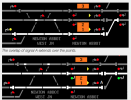
I attach a diagram from the SimSig web site (https://www.simsig.co.uk/Forum/ThreadView/37633) showing the difference between a normal route (first example) and a warner route (second example) set between two signals, and the difference in the overlap at the second signal as a result.
== Doublepost prevention - post automatically merged: ==
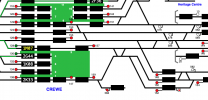
In case it aids understanding also, I also attach a diagram of the layout and signals at Crewe (from Open Train times, https://www.opentraintimes.com/maps/signalling/crewe) which shows some of the signals discussed in this thread.
== Doublepost prevention - post automatically merged: ==
The other term that has been used here is "Temporary Approach Control Link" or "TACL". Again, I'm happy to be corrected, but my research leads me to understand that TACL can be set on a signal (such as CE 154, or perhaps on specific routes from a signal) by a "technician" who sets up the signalling system, in other words it's not something that the signaller can control. By its name, it's clearly meant to be "temporary" and can be used during commissioning of signalling systems when perhaps not everything is in place but there's a need to open the railway anyway. TACL being set causes the signal to act as a "warner" signal in being held at red until the approach berth track is occupied by the arriving train.
I think the implication here might be that "TACL" had been set on CE 154 for quite some time now, for some perfectly good reason, which led to the behaviour which some of us had observed. Indeed, this is what post 6 in this thread by Signal Head has already said, I believe.
I do know NR performance people wanted it sorting as it was delaying every train, but it seemed that no-one could initiate getting it fixed, possibly as the reasons for the disconnection had got lost over time.
My pet niggle at Crewe is CE107 on the Down Fast which only comes off for the routes to Platforms 6 and 11 after a down express has been brought almost to a stand, depending on how defensive the driver is, adding 2-3 minutes to schedules. If anyone can provide an explanation as to why we can't have flashing double yellows at BH11 and a flashing single yellow at CE103 for the routes to Platforms 6 and 11 I'd be very grateful. Is it perhaps because they're controlled by separate signalboxes? Any derogation of approach-control wouldn't need to apply for the routes to platforms 1, 5 or 12.
With this particular issue, there has been too much emphasis in the past on raising the non-stop linespeed through Crewe. Virtually everything stops there - in pre-Covid times there was just the one Euston - Glasgow fast per hour which ran non-stop Euston - Warrington, and even that has ceased running now. Would a speed reduction to (say) 60 mph on the Down Fast enable free approach to the platforms in question? Would the capacity benefits of this outweigh the time loss (how much?) for non-stop services?
With this particular issue, there has been too much emphasis in the past on raising the non-stop linespeed through Crewe. Virtually everything stops there - in pre-Covid times there was just the one Euston - Glasgow fast per hour which ran non-stop Euston - Warrington, and even that has ceased running now. Would a speed reduction to (say) 60 mph on the Down Fast enable free approach to the platforms in question? Would the capacity benefits of this outweigh the time loss (how much?) for non-stop services?
Are there no fast freights that can go through at 75? Surely it's a question of getting the layout and signalling right rather than solving a problem that didn't seem to matter to anyyone when the layout was done by slapping on a PSR.
(Which prompts a thought. With the exception of that 50 turnout DF>DS for platform 6 and the 60 UF>US north of the station, Crewe was rebuilt as the extremely slow layout it always was, though much slimmed down. It was reported at the time that early designs provided a much better junction with the Manchester line, but that cost-cutting removed these. Were there other features that would have made for a faster and more flexible layout removed too? Is there anyone around who has any idea of what the first drafts of the Crewe re-signalling plans were like?)
With this particular issue, there has been too much emphasis in the past on raising the non-stop linespeed through Crewe. Virtually everything stops there - in pre-Covid times there was just the one Euston - Glasgow fast per hour which ran non-stop Euston - Warrington, and even that has ceased running now. Would a speed reduction to (say) 60 mph on the Down Fast enable free approach to the platforms in question? Would the capacity benefits of this outweigh the time loss (how much?) for non-stop services?
I realise that, but it is worth flagging up in the hope that - when the time comes - people might concentrate more on capacity and flexibility and less on non-stop speed.
Hardly any. Most freights run via Basford Hall and / or the Independent Lines. A few e.g. Daventry - Scotland DRS services do run through non-stop on occasion, but they are just as likely to stop for a crew change. So you wouldn't design the layout around non-stop freight speeds in this instance.
I realise that, but it is worth flagging up in the hope that - when the time comes - people might concentrate more on capacity and flexibility and less on non-stop speed.
Hardly any. Most freights run via Basford Hall and / or the Independent Lines. A few e.g. Daventry - Scotland DRS services do run through non-stop on occasion, but they are just as likely to stop for a crew change. So you wouldn't design the layout around non-stop freight speeds in this instance.
Hardly any. Most freights run via Basford Hall and / or the Independent Lines. A few e.g. Daventry - Scotland DRS services do run through non-stop on occasion, but they are just as likely to stop for a crew change. So you wouldn't design the layout around non-stop freight speeds in this instance.
Most of them probably switch tracks somewhere in the Crewe area too, as they will probably be using the Slows to the north or south or both. The Up Slow switches sides through the station so through trains must cross the layout, and a train running through on the Down Slow is speed restricted through the station.
We are aware of an issue with emails from the Forum to Microsoft-based email accounts (hotmail/outlook/live.com email addresses). This is being looked into currently, thanks for your patience meanwhile.