Thanks Mike
The accident report has been published by the German equivalent of RAIB, the Bundesstelle für Eisenbahnunfalluntersuchung (BEU) on Monday. PDF file (4MB) here:
https://www.eisenbahn-unfalluntersuchung.de/SharedDocs/Downloads/BEU/Untersuchungsberichte/2023/247_Geseke.pdf?__blob=publicationFile&v=1
The report mainly finds that it was the driver and his actions that caused the accident, as well as blaming his employer (C&K Logistic GmbH) and the operator of the freight train (Eisenbahngesellschaft Potsdam, EGP) for not properly having a system of controlling their employees.
The driver was supposed to take 28 cement cars from a cement works to Geseke station. Due to an incline in the cement works, this should have been done in around 7 trains of 4 cars each. Instead, the driver made up the trains on the open line outside the cement works and planned to achieve his job by 2 trains with 14 cars each.
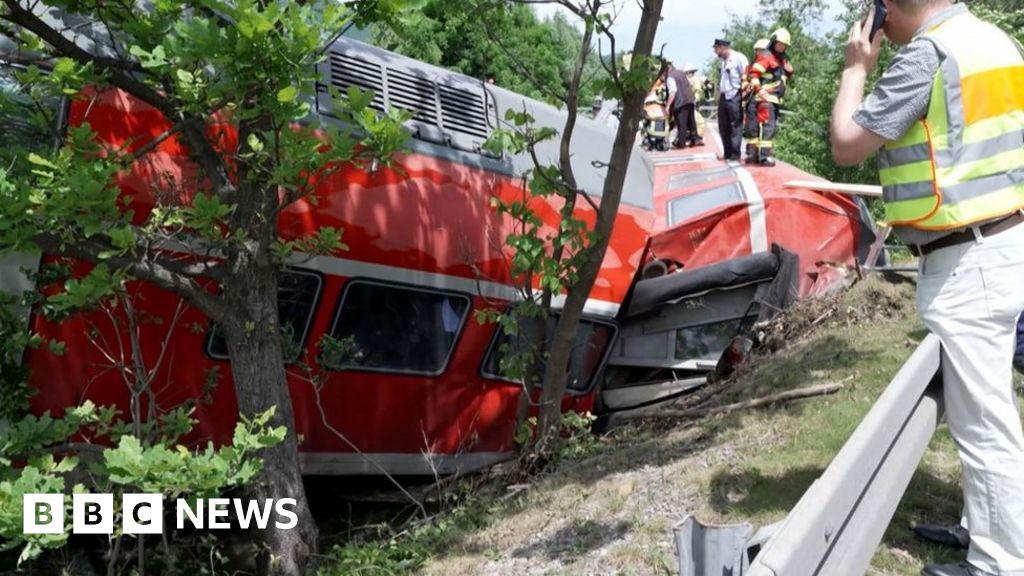
The first load of 14 cars went fine, but for the second one he didn't properly secure the brakes and the train started rolling out of control into Geseke station with driver not in the cab but busy on one of the cars itself. Due to the speed the engine's gearbox burst during the runaway. He managed to phone the signaller at Lippstadt (responsible for Geseke station) when he realised the emergency, so there wasn't another train at risk. In Geseke station, the train then derailed at speed as seen in the news reports, with the driver unfortunately dying in the wreck.
The driver was apparently trying to do his job faster than planned, because after his 11-hour shift for C&L Logistics GmbH / Eisenbahngesellschaft Potsdam (where he was employed part-time) was supposed to end at 20:15 in Lippstadt, he had another shift at 20:16 driving passenger trains for DB Regio AG (where he was employed full-time) from Bestwig station, around 40 km away. Both employers weren't aware that he had another job as well.
Apart from the driver, the report finds that EGP didn't have proper procedures in place to ensure their drivers (or drivers employed for them) did their jobs correctly and safely. For example, the driver only regularly had to do fairly mundane check-up driving at the simulator, but no real checks of the actual jobs done. The report found that there was an insufficient safety culture.
There were a number of other irregularities noted by the report, even though they weren't causal for the accident: the engine used wasn't approved for this line to run on and the driver also didn't properly secure the level crossings on the branch line and into the cement works. The DB InfraGO signallers at Lippstadt also didn't properly follow the correct procedures for operating the cement works line (but they also wouldn't have known the extent to which the driver's actions were improper)



 www.railfreight.com

 www.tagesschau.de