• Our new ticketing site is now live! Using either this or the original site (both powered by TrainSplit) helps support the running of the forum with every ticket purchase! Find out more and ask any questions/give us feedback in this thread!

Amber Semaphore Signals

Status
Not open for further replies.
Joined
22 Oct 2013
Messages
9
Location
Lincolnshire
Hello,
First time poster on here, I have been a reader for a few months, but tended to lurk in the shadows! :lol:

I've seen that some semaphore signals have a second, amber-coloured arm underneath the standard arm of the signal. Can anyone tell me what it's function is? I thought it might be working as a amber/double amber?

Example:
http://s1061.photobucket.com/user/Lincoln_Carper/media/084.jpg.html?sort=3&o=0

Thanks
 
Last edited:
Sponsor Post - registered members do not see these adverts; click here to register, or click here to log in
R

RailUK Forums

Tomnick

Established Member
Joined
10 Jun 2005
Messages
5,930
Firstly, and most importantly for the signalling folk, it's yellow not amber!

To answer your question, though, the lower (yellow) arm is a distant signal, usually worked by the next box - when cleared, indicating that all associated stop signals (usually all those within station limits) are also clear, and when not cleared, giving the driver sufficient time to brake to a stand at the first one. It's roughly equivalent to a yellow (or double yellow if it's an outer distant) in the colour light sequence.
 

TOCDriver

Member
Joined
24 Jan 2013
Messages
609
Hello,
First time poster on here, I have been a reader for a few months, but tended to lurk in the shadows! :lol:

I've seen that some semaphore signals have a second, amber-coloured arm underneath the standard arm of the signal. Can anyone tell me what it's function is? I thought it might be working as a amber/double amber?

Example:
http://s1061.photobucket.com/user/Lincoln_Carper/media/084.jpg.html?sort=3&o=0

Thanks

I can only see the one backboard in that picture i.e the lower arm. The top arm is a stop signal
 

Tomnick

Established Member
Joined
10 Jun 2005
Messages
5,930
The lower arm is (hopefully) the one being referred to.
 
Joined
22 Oct 2013
Messages
9
Location
Lincolnshire
Thanks for the quick replies, they have answered my question fully. Apologies for posting this in the wrong section to start with, but it has now been moved.
 
Joined
6 Sep 2011
Messages
989
Location
Blackpool south Shore
The interlocking between the 2 signal arms is simple but clever.
Their is a heavy counterbalance weight on the opposite side with a T across the normal operating levers & weights. If the signalman (operating the next box down the line) pulls the yellow distant signal off, the yellow distant signal will not move until the red starter signal is pulled off.
 

Tomnick

Established Member
Joined
10 Jun 2005
Messages
5,930
The interlocking between the 2 signal arms is simple but clever.
Their is a heavy counterbalance weight on the opposite side with a T across the normal operating levers & weights. If the signalman (operating the next box down the line) pulls the yellow distant signal off, the yellow distant signal will not move until the red starter signal is pulled off.
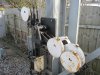
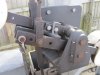
Just to illustrate the point, a couple of photos! The raised weight bar (i.e. the one on its own) operates the distant signal itself, held up by both the nearest weight bar (which operates the stop signal on the same post) and the middle one (worked by the distant lever at the next box - motor-worked in this case, but the principle's exactly the same). The 'T' referred to can be clearly seen in the middle of the 'detail' photo, and the weights on the latter two weight bars are necessarily large to ensure that they're sufficient to overcome the single weight that they're holding up. The rearmost weight bar, for completeness, is attached to a signal reading to a different route, so doesn't play a part in the slotting arrangements.

Clever stuff!
 

Attachments

  • Langham slots.jpg
    Langham slots.jpg
    336.4 KB · Views: 68
  • Langham slots detail.jpg
    Langham slots detail.jpg
    236.4 KB · Views: 56

JoeGJ1984

Member
Joined
7 Nov 2010
Messages
521
Will the lever operating the distant signal physically move if the signalman tries to pull it when the stop signal is on? Or does the signalman have to wait until the other signalman pulls off the stop signal?
 

John Webb

Established Member
Joined
5 Jun 2010
Messages
3,746
Location
St Albans
Will the lever operating the distant signal physically move if the signalman tries to pull it when the stop signal is on? Or does the signalman have to wait until the other signalman pulls off the stop signal?
The lever will move in the box controlling the distant signal - that operates one of the two bars that hold up the distant's weight lever. But it's only when the stop signal is pulled off that it's bar moves down and allows the distant to go to the off position.

In computer terms this 'slotting' system is a solid-state 'AND' gate!
 

spongsdad

Member
Joined
17 Sep 2013
Messages
160
Reading this thread makes me realise how old I have become. When I was a lad, all (well nearly all) the signals were semaphores and we all understood their meaning if not exactly how they worked. Those were the days when "colour light signals" required a little book of explanation as to what their aspects meant especially such niceties as the double yellow. For younger readers, I am talking about the 1950s so it wasnt exactly the dark ages. At night, of course, the spectacle lens of the semaphore was lit from behind by an oil lamp, not too disimilar to those carried on steam locos. Changing the lamps was done by a signal lad shinning up the ladder with a replacement and bringing the empty one down. Not much fun on a wild winter's day on the Settle and Carlisle. On reflection, perhaps those were the dark ages.
 
Joined
30 Sep 2012
Messages
85
done a spot of climbing up signals replenishing oil lamps the art of climbing up signal ladder holding 4 oil lamps in one hand climbing the signal ladder with the other,pre health n safety days still you got a good view of Barton Moss from Barton Moss jnc home signal
--- old post above --- --- new post below ---
Will the lever operating the distant signal physically move if the signalman tries to pull it when the stop signal is on? Or does the signalman have to wait until the other signalman pulls off the stop signal?

Yes the signalman can operate the signal lever for the distant signal but the signal arm will remain at the On position(caution)until the signalman in rear box clears the stop signal,in the signalbox behind the distant signal lever there will be a repeater signal to show the counter weight position(not the position of the distant signal arm)to indicate that the counter weight has operated and the signal arm of the distant will go to the clear position when the stop signal is cleared by the signalman at the box in rear.Distant signals that stand alone will have a repeater showing the position of the signal arm when operated.
 
Status
Not open for further replies.

Top