Our new ticketing site is now live! Using either this or the original site (both powered by TrainSplit) helps support the running of the forum with every ticket purchase! Find out more and ask any questions/give us feedback in this thread!
Move the airport to a greenfield site then and build the necessary transport connections. Stop trying to expand a site right next to a dense urban area and constrained by poor road capacity.
Rail capacity is adequate, but an Essex site for a new airport would also come with the potential for good rail links.
Rail capacity at Heathrow is great if going to west/central London but it is pretty abysmal for anywhere else. I used to live in Surrey and would drive there as there was no good rail connection despite being in a part of the country with the best rail network in the country.
The costs of moving Heathrow to Essex and the huge number of supply chain jobs it supports would be astronomical - and that's before you deal with the Nimbys in Essex. Besides, Essex already has two airport so you would have to close Stansted and Southend.
Gatwick runway is delayed for X years/ months. Gatwick loses profit. That happens because of vexatious pushes for judicial reviews. Those who push for them should bear the financial consequences of their actions, not Gatwick airport.
Yet that’s exactly what happens in Japan, where it is very common for high capacity wide body aircraft to fly short domestic routes.
I get why airlines would prefer to fly 3x150-seat aircraft per day rather than 1x450 seat aircraft per day. But the consequences of that is Heathrow and Gatwick are clogged up with lots of small aircraft. The airports aren’t full, the capacity is utilised inefficiently.
Japan is unique in that regard. Widebody domestic flight are rare in the US, China, India, Australia etc. for comparison (Note the country size. Domestic in the US/ India/ China/ Australia would see you across Europe easily).
I think you don't really get that the idea is only good for increasing passenger numbers. It's bad for the environment, fuel usage, noise profiles, airline profitability, passenger experience, passenger choice/ flexibility etc etc.
There's a reason it's not done outside of Japan.
Move the airport to a greenfield site then and build the necessary transport connections. Stop trying to expand a site right next to a dense urban area and constrained by poor road capacity.
A huge chunk of the West London and M4 corridor economy is based on Heathrow and the jobs it provides. You're probably talking 100k jobs in the area being based on Heathrow being where it is. Are you expecting these people to lose their jobs, move to this new site, commute hours per day? It would be devastating.
Developing a new airport to replace Heathrow with sufficient capacity would cost a huge sum - most likely in the hundreds of billions of pounds range. We can't build simple tram routes or take HS2 to its intended destinations, never mind spend that sum.
People in the UK see greenfied sites as sacrosanct - especially one so huge as would be required. And the UK is fairly densely populated. Anywhere in SE England is going to affect someone with noise.
And Heathrow actually has some really good connections. On the tube and the Elizabeth line. Some good connections to national rail. Super frequent buses down the M4 where it's a huge part of their economy too.
This new greenfield site would undoubtedly have much worse connections and would rip away long standing ones down the M4 corridor which simply couldn't be replaced.
Rail capacity at Heathrow is great if going to west/central London but it is pretty abysmal for anywhere else. I used to live in Surrey and would drive there as there was no good rail connection despite being in a part of the country with the best rail network in the country.
The costs of moving Heathrow to Essex and the huge number of supply chain jobs it supports would be astronomical - and that's before you deal with the Nimbys in Essex. Besides, Essex already has two airport so you would have to close Stansted and Southend.
Tbh if I'm objective, you can fix the poor southern rail connectivity at Heathrow with the Heathrow Southern Railway scheme, if Heathrow wished to (or was obliged to by planning authorities).
The cost would be astronomical, but it would be a once in a generation investment that would create a permanent hub that is mostly unrestricted and has the room for expansion.
I've talked about a Foulness site here before, but there is room for at least 4 runways and the land is already owned by the state.
Southend and possibly London City would close, but Stansted need not cease operations in this scenario.
The revenue from redeveloping the Heathrow site would cover the costs of development, and the unrestricted capacity permits much more significant growth than the existing constrained Heathrow site can take.
A huge chunk of the West London and M4 corridor economy is based on Heathrow and the jobs it provides. You're probably talking 100k jobs in the area being based on Heathrow being where it is. Are you expecting these people to lose their jobs, move to this new site, commute hours per day? It would be devastating.
Developing a new airport to replace Heathrow with sufficient capacity would cost a huge sum - most likely in the hundreds of billions of pounds range. We can't build simple tram routes or take HS2 to its intended destinations, never mind spend that sum.
People in the UK see greenfied sites as sacrosanct - especially one so huge as would be required. And the UK is fairly densely populated. Anywhere in SE England is going to affect someone with noise.
And Heathrow actually has some really good connections. On the tube and the Elizabeth line. Some good connections to national rail. Super frequent buses down the M4 where it's a huge part of their economy too.
This new greenfield site would undoubtedly have much worse connections and would rip away long standing ones down the M4 corridor which simply couldn't be replaced.
The Heathrow site could easily be redeveloped for other high value commercial and residential uses, to create replacement employment for the eastern Thames Valley and West London. The site is massive, it has relatively good connections, and a lot of the surrounding land would be much more valuable if it wasn't blighted by aviation.
I agree that development would cost a lot - but 1) it's a long term investment that has much more potential than shoehorning a new runway onto an existing site with significant limitations
2) the redevelopment of the site would raise billions and billions of pounds, and help solve London's housing crisis with functionally an entirely new borough's worth of housing.
I don't expect the state to fund the majority of the scheme - a new 4 runway airport with road and rail connections on a new site would be an extremely attractive investment prospect, because of the capacity it unlocks.
The opposition to building on a greenfield site in general is why I suggest Foulness.
Yes, you'd have to build good high speed rail, regional rail and road connections (partially) from scratch, but it would provide much more long lasting strategic connections that Heathrow struggles with beyond London.
When HS2 was planned to stop at or near Heathrow, there is a point of view that you could provide better strategic connections, but coach routes, however frequent they are, are not a particularly robust method of mass transit to any airport that cannot be replicated at a new site.
I disagree that a new airport would necessarily have much weaker connections - if the potential is there for a truly modern hub with good transport links, the connections can be built.
The regional rail connections are functionally already there - a short extension from Shoeburyness on the c2c mainline and a branch from Rochford on the Southend Victoria line would provide suitable regional rail capacity to the new airport with moderate upgrades of the existing lines.
High speed rail connections would need to be constructed from scratch and significant road upgrades would be needed, but anything is possible with private investment into an asset that can deliver a much greater return than a 3rd runway at Heathrow.
That is a very, very big claim, and it might help if you could talk through your thinking on that one, giventhat an airport off the Essex Cosst and associated transport links to it (it would need at least two motorways and two railways) would be well to the north of £200bn.
That is a very, very big claim, and it might help if you could talk through your thinking on that one, giventhat an airport off the Essex Cosst and associated transport links to it (it would need at least two motorways and two railways) would be well to the north of £200bn.
Furthermore. Who would want to live there (Heathrow site) once there is no employment at Heathrow ?. Moving Heathrow away could probably release so much existing housing around it anyway !. Would need to build an entire boroughs worth of housing at/near Foulness.
I've talked about a Foulness site here before, but there is room for at least 4 runways and the land is already owned by the state.
Southend and possibly London City would close, but Stansted need not cease operations in this scenario.
The revenue from redeveloping the Heathrow site would cover the costs of development, and the unrestricted capacity permits much more significant growth than the existing constrained Heathrow site can take.
Tbh if I'm objective, you can fix the poor southern rail connectivity at Heathrow with the Heathrow Southern Railway scheme, if Heathrow wished to (or was obliged to by planning authorities).
The cost would be astronomical, but it would be a once in a generation investment that would create a permanent hub that is mostly unrestricted and has the room for expansion.
I've talked about a Foulness site here before, but there is room for at least 4 runways and the land is already owned by the state.
Southend and possibly London City would close, but Stansted need not cease operations in this scenario.
The revenue from redeveloping the Heathrow site would cover the costs of development, and the unrestricted capacity permits much more significant growth than the existing constrained Heathrow site can take.
The Heathrow site could easily be redeveloped for other high value commercial and residential uses, to create replacement employment for the eastern Thames Valley and West London. The site is massive, it has relatively good connections, and a lot of the surrounding land would be much more valuable if it wasn't blighted by aviation.
I agree that development would cost a lot - but 1) it's a long term investment that has much more potential than shoehorning a new runway onto an existing site with significant limitations
2) the redevelopment of the site would raise billions and billions of pounds, and help solve London's housing crisis with functionally an entirely new borough's worth of housing.
I don't expect the state to fund the majority of the scheme - a new 4 runway airport with road and rail connections on a new site would be an extremely attractive investment prospect, because of the capacity it unlocks.
The opposition to building on a greenfield site in general is why I suggest Foulness.
Yes, you'd have to build good high speed rail, regional rail and road connections (partially) from scratch, but it would provide much more long lasting strategic connections that Heathrow struggles with beyond London.
When HS2 was planned to stop at or near Heathrow, there is a point of view that you could provide better strategic connections, but coach routes, however frequent they are, are not a particularly robust method of mass transit to any airport that cannot be replicated at a new site.
I disagree that a new airport would necessarily have much weaker connections - if the potential is there for a truly modern hub with good transport links, the connections can be built.
The regional rail connections are functionally already there - a short extension from Shoeburyness on the c2c mainline and a branch from Rochford on the Southend Victoria line would provide suitable regional rail capacity to the new airport with moderate upgrades of the existing lines.
High speed rail connections would need to be constructed from scratch and significant road upgrades would be needed, but anything is possible with private investment into an asset that can deliver a much greater return than a 3rd runway at Heathrow.
Much as l am opposed to Heathrow expansion l have major issues with your Foulness suggestion too. Firstly years of usage by the MOD for munitions testing likely means an absolutely horrendous clean up bill. Secondly the area is a major part of the transit routes for migrating birds. Large numbers of birds and airports is not a happy combination.
That is a very, very big claim, and it might help if you could talk through your thinking on that one, giventhat an airport off the Essex Cosst and associated transport links to it (it would need at least two motorways and two railways) would be well to the north of £200bn.
This presentation discusses the potential for Heathrow redevelopment.
The Residential Quarter option projects a population of 200,000.
That means around 85,000 houses with an average household size of 2.35 persons in the UK.
Mean average house price in London is £671,609 according to Rightmove, so the sale of residential properties alone would raise around £57 billion
55,000 workers need approximately 4.4 million sq ft of commercial space as a conservative estimate. Rent alone for that commercial space would be several billion a year, freehold value in the region of £10-15 billion.
If you subtract £5 billion for statutory leisure/utilities/highways infrastructure, that still leaves you with minimum £60-£65 billion.
The 3rd runway is estimated to cost £35-£50 billion, but with the Foulness site having a much lower nearby residential population and great access by sea for provision of construction materials, cost of construction should be more comparable to airports like Western Sydney International (WSI). WSI has cost around $19.9 billion Australian Dollars including transport links to construct, or around £10 billion GBP.
Even if you triple the cost of the new airport to account for site purchase from the MoD, new regional rail links from Shoeburyness and Crossrail extension from Shenfield, additional runways, construction of a residential township to serve workers, you still only get to £30 billion.
Add the cost of a high speed rail link (unfortunately I can't find a reliable source for this, but apparently a July 2008 cost estimate costed a central London to Foulness link at £4.5 billion, or around £8 billion with inflation).
Now, here's the sticky point.
If we use the nearby Lower Thames Crossing as an example, construction costs are around £800 million per mile for a road of similar standard to the 2 motorways you describe as a requirement.
I will admit I see 1 motorway, regional rail links, a high speed rail link, and a heavily upgraded A13/A130 as sufficient, but that's just my opinion.
Using the LTC figures, 1 approximately 30 mile motorway link from the M25/A12 interchange at £800 million per mile would cost in the region of £24 billion.
The running total is now £62 billion.
A second brand new motorway link would push the figures into the region of requiring additional investment not covered by the redevelopment of the Heathrow site, but I'd argue that a second motorway should be paid for by private finance and operated on a tolled basis to encourage public transport use to the new airport anyway.
== Doublepost prevention - post automatically merged: ==
Furthermore. Who would want to live there (Heathrow site) once there is no employment at Heathrow ?. Moving Heathrow away could probably release so much existing housing around it anyway !. Would need to build an entire boroughs worth of housing at/near Foulness.
It has great rail links into London, it's right next to the M25 and there are projected to be 55,000 jobs in the new district itself, even if residential redevelopment is prioritised over commercial space.
WSI created nearly 12,000 construction jobs during its construction - even with ongoing airport service and ancillary industries jobs, an entire borough averaging around 250,000-350,000 residents is way too high.
Max 100k population for your Foulness township.
Not to mention that you would close Southend and could close London City if you pursued the Foulness option, which presents additional residential/commercial redevelopment opportunities (especially valuable with London City's proximity to Canary Wharf).
Would the airspace be constrained, or would the closure of Heathrow, Southend and London City allow a large scale reorganisation of airspace in the area to suit the new site of London's hub?
Much as l am opposed to Heathrow expansion l have major issues with your Foulness suggestion too. Firstly years of usage by the MOD for munitions testing likely means an absolutely horrendous clean up bill. Secondly the area is a major part of the transit routes for migrating birds. Large numbers of birds and airports is not a happy combination.
1) Would remediation cost so much if it is redeveloped for use as an airport, rather than residential purposes? We have redeveloped extremely contaminated sites as a nation many times before, like the Corby steelworks complex or numerous military sites, for commercial reuse, without incurring so much expense.
2) I agree that birds are a major issue for the "Boris Island"/Isle of Sheppey based plans, but I don't recall this being an issue for Foulness itself. Perhaps Maplin Sands, but I'm not proposing building on the sands themselves.
Moving the main London airport to the east or south of the city just won't happen. Heathrow not only serves London but a massive portion of the West and Midlands of England. I live in South Birmingham and sometimes it only takes me 45 minutes more to get to LHR than it does to get to BHX, on a good traffic-problem-free run down the M40 Heathrow is less than 90 minutes away.
That means around 85,000 houses with an average household size of 2.35 persons in the UK.
Mean average house price in London is £671,609 according to Rightmove, so the sale of residential properties alone would raise around £57 billion
a) the average value of the housing stock in London includes a lot of high end stuff in central London, Chelsea, Mayfair, etc etc. Heathrow is a suburb of Hounslow, and will have little in the way of high end values, but a lot of low end, ’affordable’ housing ie what London needs. Think something more like Brent Cross development than one Hyde Park.
b) the cost of building them. The actual land value of building, say, £20bn worth of residential property, is about £3bn if you’re lucky,
c) the cost of buying the land itself from its current owners, not all of whom are Heathrow.
Add the cost of a high speed rail link (unfortunately I can't find a reliable source for this, but apparently a July 2008 cost estimate costed a central London to Foulness link at £4.5 billion, or around £8 billion with inflation).
Moving the main London airport to the east or south of the city just won't happen. Heathrow not only serves London but a massive portion of the West and Midlands of England. I live in South Birmingham and sometimes it only takes me 45 minutes more to get to LHR than it does to get to BHX, on a good traffic-problem-free run down the M40 Heathrow is less than 90 minutes away.
Wonderful. So people living in most of London should suffer a degraded quality of life for your convenience? Move the damned thing to Birmingham and doubtless you would have a very different view.
Wonderful. So people living in most of London should suffer a degraded quality of life for your convenience? Move the damned thing to Birmingham and doubtless you would have a very different view.
Heathrow is exceptionally important for the economy of West London, the M4 corridor, the 'south Midlands' and beyond. Moving the airport to the Thames estuary would be devastating for these areas.
The airport was there before most Londoners. London is a global city and needs a global hub.
The airport has a small impact on people's lives in terms of noise and newer more modern aircraft technology and improved airspace management are improving that all the time.
I just wish people would stop talking Britain down and stop stymieing Britain's growth!
Heathrow is exceptionally important for the economy of West London, the M4 corridor, the 'south Midlands' and beyond. Moving the airport to the Thames estuary would be devastating for these areas.
The airport was there before most Londoners. London is a global city and needs a global hub.
The airport has a small impact on people's lives in terms of noise and newer more modern aircraft technology and improved airspace management are improving that all the time.
I just wish people would stop talking Britain down and stop stymieing Britain's growth!
For one, I live next to a major airport which doesn't have a curfew and sees flights departing early and landing late.
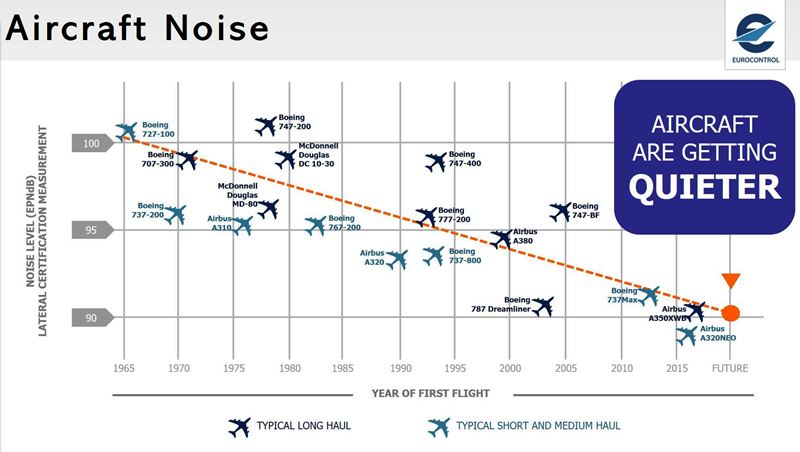
It's simply a fact that modern aircraft are significantly quieter. Compare the image below. The next generation of aircraft will be even quieter again.
Wonderful. So people living in most of London should suffer a degraded quality of life for your convenience? Move the damned thing to Birmingham and doubtless you would have a very different view.
Wonderful. So people living in most of London should suffer a degraded quality of life for your convenience? Move the damned thing to Birmingham and doubtless you would have a very different view.
Lots of people who live in London choose to continue living in London. There are very reasonably priced areas that do not suffer with such ‘degraded quality of life’ as they apparently do by living in a global economic powerhouse and the associated nuisance that results from that.
Truth is that LHR is the hub of the U.K. air travel market. There’s no getting away from that. Airports like BHX would love to capitalise on a decentralised network, but the airlines aren’t interested. It’s the airlines that drive the market as they are the ones to respond to the demand.
Heathrow is exceptionally important for the economy of West London, the M4 corridor, the 'south Midlands' and beyond. Moving the airport to the Thames estuary would be devastating for these areas.
The airport was there before most Londoners. London is a global city and needs a global hub.
The airport has a small impact on people's lives in terms of noise and newer more modern aircraft technology and improved airspace management are improving that all the time.
I just wish people would stop talking Britain down and stop stymieing Britain's growth!
Totally agreed. There are a huge number of businesses based in west London, Reading, Slough etc because of the access they have to Heathrow and its global connections. If the airport was moved to Kent or Essex then they wouldn't move with it but relocate to Amsterdam or Frankfurt.
Moving the main London airport to the east or south of the city just won't happen. Heathrow not only serves London but a massive portion of the West and Midlands of England. I live in South Birmingham and sometimes it only takes me 45 minutes more to get to LHR than it does to get to BHX, on a good traffic-problem-free run down the M40 Heathrow is less than 90 minutes away.
It's important to remember that Heathrow is a London airport first and foremost. Regional connectivity can be catered for using intercity services direct from the airport to larger cities, and for smaller centres of population coaches will suffice.
Heathrow is exceptionally important for the economy of West London, the M4 corridor, the 'south Midlands' and beyond. Moving the airport to the Thames estuary would be devastating for these areas.
It wouldn't. Slough and a lot of other Thames Valley towns are blighted by Heathrow's impact.
Eastern Berkshire would be a much more desirable place to live if it wasn't affected by constant takeoffs, and sufficient high speed/regional rail links to alternative airports would provide replacement connectivity for the companies that really need it.
Perhaps we should have restricted urban growth in the surrounding areas, but it's way too late for that.
If we're expanding a pre existing London airport, Stansted + Gatwick both have much more space for expansion without significant investment and a far lower population density in the areas surrounding them.
a) the average value of the housing stock in London includes a lot of high end stuff in central London, Chelsea, Mayfair, etc etc. Heathrow is a suburb of Hounslow, and will have little in the way of high end values, but a lot of low end, ’affordable’ housing ie what London needs. Think something more like Brent Cross development than one Hyde Park.
b) the cost of building them. The actual land value of building, say, £20bn worth of residential property, is about £3bn if you’re lucky,
c) the cost of buying the land itself from its current owners, not all of whom are Heathrow.
1.) I appreciate London needs affordable housing, but if Heathrow wished to fund a relocation on the basis of redevelopment, they are entitled to charge what they like. £670k for a nice 2 bed with pretty decent local transport connections isn't out of kilter for an area of this prestige. The Olympic Park's presence in Hackney and Newham shows that it doesn't have to condemn the area to the same fate as those areas.
2.) £17 billion to build is very pessimistic. But you could densify to 100k plus homes if you wanted to increase yields even further.
3.) Who is a significant landowner of the Heathrow Airport site proper, other than Heathrow Airport Holdings? BA?
HS2's extreme mismanagement is not inspiring, that much is true, but it does provide a useful opportunity in terms of through trains to a new airport from cities other than London (which could help cut costs).
Using the HS2 route at Old Oak Common to a reinstated HS2-HS1 link and then HS1 via a stop at Stratford to a junction at Purfleet, where you'd start your new high speed link to the airport.
HS1 is apparently underused and you could serve a large percentage of London's population with OOC and Stratford stops.
Finding capacity at St Pancras would be more difficult, although you could potentially build a terminating station on the site of the Tarmac plant at Kings Cross if needed.
1.) I appreciate London needs affordable housing, but if Heathrow wished to fund a relocation on the basis of redevelopment, they are entitled to charge what they like. £670k for a nice 2 bed with pretty decent local transport connections isn't out of kilter for an area of this prestige. The Olympic Park's presence in Hackney and Newham shows that it doesn't have to condemn the area to the same fate as those areas.
The average price of a home for sale in the olympic park is around £500k. ‘Affordable’ homes for social rent or shared ownership usually have little if any development value, and a site like Heathrow would need to have 30%+ of the property in that category.
It isn’t the cost to build. It is the cost to acquire, develop and build. Fortunatley I have some experience in this, both professionally and outside work (and friends who do this for a living), and can advise that developer gain is usually in the range of 10-20% of final sales value for market sales (and usually at the bottom end of thst for large developments), and 0-5% for affordable. Rerun your calculations of total value based on a £500k value per property, with 70% of the properties realising it, and say 15% of that being ‘profit’, and you’ll see the value of Heathrow in terms of realisable development gain is very, very much less than you assume.
Using the HS2 route at Old Oak Common to a reinstated HS2-HS1 link and then HS1 via a stop at Stratford to a junction at Purfleet, where you'd start your new high speed link to the airport.
It will be full at peak times in a few years. The capacity is 20tph if every train did exactly the same thing non-stop. Clearly that’s not going to happen. Realisitc capacity is about 14tph given the international / domestic mix and stops at Stratford. And we’ll be there or thereabouts soon.
Finding capacity at St Pancras would be more difficult, although you could potentially build a terminating station on the site of the Tarmac plant at Kings Cross if needed.
That tarmac plant provides the aggregate and concrete for much of central and north London. It is there for a reason, ie that it needs to be within a certain time of driving a concrete mixer to site. Much of the city was built with concrete from there. Relocating it to somewhere outside central London won’t do.
Would the airspace be constrained, or would the closure of Heathrow, Southend and London City allow a large scale reorganisation of airspace in the area to suit the new site of London's hub?
Yes because we're talking about airspace over the North Sea. Heathrow is already constrained by Amsterdam's airspace (and vice versa). Moving the airport 60 miles closer to Amsterdam increases the conflict.
Yes because we're talking about airspace over the North Sea. Heathrow is already constrained by Amsterdam's airspace (and vice versa). Moving the airport 60 miles closer to Amsterdam increases the conflict.
It's a fair point, but I would ask what percentage of flights at Heathrow (and thus at Foulness if it was relocated) actually depart to the east.
According to Heathrow data, 33.5% head to the Americas or elsewhere in the British Isles, 4% to Africa, 6.6% to non-EU Europe (takeoffs mostly avoiding Dutch airspace).
That leaves around 55.9% heading east, but you could also consider the reductions in easterly departures from closing Southend and London City if a Foulness airport was built.
Maybe this makes a Hoo Peninsula site north of Cliffe/west of Allhallows more appetising. That part of Kent has a lot of deprivation, and might welcome the jobs an airport would provide. A rail link wouldn't be too hard to deliver.
The average price of a home for sale in the olympic park is around £500k. ‘Affordable’ homes for social rent or shared ownership usually have little if any development value, and a site like Heathrow would need to have 30%+ of the property in that category.
It isn’t the cost to build. It is the cost to acquire, develop and build. Fortunatley I have some experience in this, both professionally and outside work (and friends who do this for a living), and can advise that developer gain is usually in the range of 10-20% of final sales value for market sales (and usually at the bottom end of thst for large developments), and 0-5% for affordable. Rerun your calculations of total value based on a £500k value per property, with 70% of the properties realising it, and say 15% of that being ‘profit’, and you’ll see the value of Heathrow in terms of realisable development gain is very, very much less than you assume.
It will be full at peak times in a few years. The capacity is 20tph if every train did exactly the same thing non-stop. Clearly that’s not going to happen. Realisitc capacity is about 14tph given the international / domestic mix and stops at Stratford. And we’ll be there or thereabouts soon.
Is this because of Eurostar/Virgin increasing services, or the domestic side?
Perhaps we could increase capacity by adding a new terminal station somewhere (my favoured option for increasing international services anyway).
That tarmac plant provides the aggregate and concrete for much of central and north London. It is there for a reason, ie that it needs to be within a certain time of driving a concrete mixer to site. Much of the city was built with concrete from there. Relocating it to somewhere outside central London won’t do.
It's a fair point, but I would ask what percentage of flights at Heathrow (and thus at Foulness if it was relocated) actually depart to the east.
According to Heathrow data, 33.5% head to the Americas or elsewhere in the British Isles, 4% to Africa, 6.6% to non-EU Europe (takeoffs mostly avoiding Dutch airspace).
That leaves around 55.9% heading east, but you could also consider the reductions in easterly departures from closing Southend and London City if a Foulness airport was built.
I doubt closing Southend airport and London City airport would free up much East bound paths compared to what Heathrow would require.
Given the approach and takeoff direction alternates on a daily basis at Heathrow that means all of Heathrows traffic will be milling around to the East of this new Foulness airport - it currently ALL comes via Croydon aiui. Are all the stacks and approach paths going to get too near to dutch airspace ?. Gatwick to the South of London will be hamming that in perhaps. The stacks for traffic from the East landing at Heathrow are over the North Downs just South East of Croydon - if Heathrow moved East how close would those stacks be to Dutch airspace, or indeed Belgian or French airspace ?.
Maybe this makes a Hoo Peninsula site north of Cliffe/west of Allhallows more appetising. That part of Kent has a lot of deprivation, and might welcome the jobs an airport would provide. A rail link wouldn't be too hard to deliver.
I fear a lot of existing commercial property around Heathrow would become available very cheaply if Heathrow was moved away.
Do not underestimate the huge amount of ancillary services that provide employment close to Heathrow.
It is a lot to lose in the Heathrow area and it is a lot to set up in a new area.
I think they just avoided spending money on designing something that was seen as unlikely to be of use. It would probably mean creating a through station in London for trains from HS2 to Europe. Not sure what passive provision would be required - maybe just some sites on HS1 and HS2 ready to become tunnel portals.
Given the approach and takeoff direction alternates on a daily basis at Heathrow that means all of Heathrows traffic will be milling around to the East of this new Foulness airport - are all the stacks and approach paths going to get too near to dutch airspace ?. Gatwick to the South of London will be hamming that in perhaps. The stacks for traffic from the East landing at Heathrow are over the North Downs just South East of Croydon how close would those stacks be to Dutch airspace, or indeed Belgian or French airspace ?.
I think Gatwick's expansion is far more likely to happen anyway, but it should be noted that an airport with 4 runways from the outset would need far less aircraft to hold than Heathrow does today.
Not at all - there will be a lot of land available for commercial expansion and a lot of East Berks/South Bucks will become attractive for new residential developments/redevelopment, which will bring service jobs alongside it.
The rest of Medway is, not to mention Swale. There was a recent BBC article about the issue Sheerness faces in particular.
Shivering Sands/Hoo Peninsula have been proposed several times recently, I think the former is too expensive, but Hoo Peninsula perhaps not.
Not at all, there's a lot of rivers/lakes and a whole motorway to build over.
In a lot of the new sites, there's nothing much there and the land is of low value, even for farming.
Foreign travel is much less important for companies since the advent of video conferencing and stricter corporate travel policies. Demand for commercial property in London is always high.
I think they just avoided spending money on designing something that was seen as unlikely to be of use. It would probably mean creating a through station in London for trains from HS2 to Europe. Not sure what passive provision would be required - maybe just some sites on HS1 and HS2 ready to become tunnel portals.
Furthermore. Who would want to live there (Heathrow site) once there is no employment at Heathrow ?. Moving Heathrow away could probably release so much existing housing around it anyway !. Would need to build an entire boroughs worth of housing at/near Foulness.
And all the associated transport and warehousing firms that surround Heathrow would also have to be moved to Foulness or wherever. I think it’s something significant that was pretty much glossed over about the proposal the first time it came up.
Because there was no realistic likelihood of it happening, based on the principle that there were direct links built from St Pancras to the WCML, ECML, and MML 20 years ago, and they haven’t seen a passenger train between them. It would need the UK to join Schengen, and as much as I would personally support that, it appears that not enough people do.
Given the approach and takeoff direction alternates on a daily basis at Heathrow that means all of Heathrows traffic will be milling around to the East of this new Foulness airport - it currently ALL comes via Croydon aiui. Are all the stacks and approach paths going to get too near to dutch airspace ?.
There are four main holds for Heathrow, Bovingdon (NW), Lambourne (NE), Biggin (SE) and Ockham (SW). Traffic from any point of the compass can be directed to any stack, but typically traffic from the east heads to Lambourne or Biggin. If the airport were moved to the Thames estuary, then the eastern stacks would be over the North Sea, rather closer to Dutch (and Belgian) airspace.
The airlines respond to the demands of the market and if that means A319s fly in and out of Heathrow more than you would like it is because that is what the market demands.
They fly A319s because they can't fill A320s. They fly A320s because they can't fill A321s. An A319 has 90 seats fewer than an A321, an A320 has 60 seats fewer. It's the same at Gatwick, most of EasyJet's A319s are now based there.
Airlines can fly what they want and where they want, but if market forces mean they can only fill a piddly little 150-seat jet (or perhaps not even that) then neither Heathrow nor Gatwick are full and neither require expansion.
Heathrow and Gatwick simply don't have the gate capacity for a huge increase in widebody aircraft. Their current terminal designs centre around a fair proportion (for Heathrow) or the majority (for Gatwick) of aircraft being narrow bodies.
The airport in its current guise was there first, yes. If you buy a house on Myrtle Avenue you can't really moan about the noise.
But the expanded Heathrow wasn't there first. That's the problem. The people who live in Colnbrook and Harmondsworth were there first.
I note you don't mention which airport it is that you live near (and I don't expect you to say) but there are no other airports in the UK which have the same level of movements as Heathrow and have them over such a densely packed urban population.
A 10dB reduction in aircraft noise in 50 years isn't anything to brag about.
According to Doctor Google, 85dB is the level at which hearing becomes damaged. Current aircraft are still, according to your chart, operating at 90dB.
The fact that some airlines want the cachet of flying into Heathrow does not, in my opinion, mean that Heathrow requires expansion. There are plenty of other airports in the metropolitan London area they can use if they can't afford or don't want to pay Heathrow prices. There's plenty of capacity at Southend.
I've lived under the Heathrow flight path on and off for 30+ years. It has become notably quieter in that time despite the increase in passenger numbers. An A380 carrying 500 passengers is quieter than a 737-200 carrying 120.
Heathrow provides world class connectivity for London which is the economic powerhouse of the UK. A new third runway should have been built several decades ago. Amsterdam and Frankfurt have built new runways in that time, Munich opened a new (and excellent) airport entirely, Madrid has grown significantly too. Heathrow has not had that runway capacity growth.
Indeed, but anyone who says the UK's infrastructure is "3-4 decades behind continental Europe" really is talking absolute nonsense. In my opinion.
They fly A319s because they can't fill A320s. They fly A320s because they can't fill A321s. An A319 has 90 seats fewer than an A321, an A320 has 60 seats fewer. It's the same at Gatwick, most of EasyJet's A319s are now based there.
Airlines can fly what they want and where they want, but if market forces mean they can only fill a piddly little 150-seat jet (or perhaps not even that) then neither Heathrow nor Gatwick are full and neither require expansion.
Doesn't need to be a widebody, an A321neo has 230-240 seats, which is more than a 3-class Dreamliner. And is 90 seats bigger than an A319.
== Doublepost prevention - post automatically merged: ==
The airport in its current guise was there first, yes. If you buy a house on Myrtle Avenue you can't really moan about the noise.
But the expanded Heathrow wasn't there first. That's the problem. The people who live in Colnbrook and Harmondsworth were there first.
I note you don't mention which airport it is that you live near (and I don't expect you to say) but there are no other airports in the UK which have the same level of movements as Heathrow and have them over such a densely packed urban population.
A 10dB reduction in aircraft noise in 50 years isn't anything to brag about.
According to Doctor Google, 85dB is the level at which hearing becomes damaged. Current aircraft are still, according to your chart, operating at 90dB.
The fact that some airlines want the cachet of flying into Heathrow does not, in my opinion, mean that Heathrow requires expansion. There are plenty of other airports in the metropolitan London area they can use if they can't afford or don't want to pay Heathrow prices. There's plenty of capacity at Southend.
The fact that they don’t use Southend or other airports in the London area proves the point Im making. There will be an argument for more domestic connectivity, whether that’s future proofed by more sustainable/green fuel sources for aircraft remains to be seen. There has to be a bit of a problem when the U.K. regions rely on AMS as their hub and not LHR.