• Our new ticketing site is now live! Using either this or the original site (both powered by TrainSplit) helps support the running of the forum with every ticket purchase! Find out more and ask any questions/give us feedback in this thread!

Airport expansions

Cloud Strife

Established Member
Joined
25 Feb 2014
Messages
2,963
Are you certain on this?

Pretty much, yes. The variant used by Ethiad would need 2100-2150m at maximum take off weight (MTOW) on hot days, and Luton is only 2,162m long. Luton-Doha is already operating close to the range limit, so I'm not convinced that they'd be able to rely on cargo in that direction. The A32xneo does have incredible performance, but not quite good enough to ensure that it could operate in all conditions at MTOW.


A lot of the traffic they take they are very poorly geographically positioned to take. W. Europe to Africa being one big example or Europe to N.E. Asia being another. Even on the Kangaroo route, they are arguably too close to Europe and too far from Oz/ NZ (as Qatar's operational struggles with NZ flights goes to show).

Yes, Western Europe to Africa is where Turkish Airlines is generally doing better, but TK is a...mixed bag when it comes to customer service, so they're not doing as well as they could be. TK's IT is particularly horrific: if you book a flight with them and reserve seats, and then the schedule is changed which happens all the time, you need to get a refund for the seats by calling the helpline and then booking new ones. It's an incredibly frustrating process, although their very generous rebooking / cancellation policies do somewhat make up for it.

I had a situation a couple of years ago where I found very cheap flights from Prague to Ho Chi Ming City, and after the first reschedule, I was able to switch the flights to Warsaw, which were originally priced at nearly 250 Euro more expensive per passenger. Then they changed the schedule yet again, and as I no longer wanted to go, I could get a refund without any fuss whatsoever.

But I wouldn't underestimate just how well placed the ME3 are in terms of transit. They're pretty much 'in the middle' for many flights, and the A321neo might end up turning many flights from widebodies to narrowbodies simply because of how versatile it is. I don't disagree that they have problems with the Kangaroo routes, but they generally are very competitive vs TK on some Asian to North America flights if you don't want to go with something like Asiana. Having said that, TK is nowhere when it comes to things like Spain to Asia, so it's swings and roundabouts.

I think at least part of the appeal of the ME3 isn't even location, but their general reliability. There are many horror stories about transit in Istanbul, but the ME3 seem to be much better at dealing with things when they go wrong.
 
Sponsor Post - registered members do not see these adverts; click here to register, or click here to log in
R

RailUK Forums

Class15

Established Member
Joined
30 Dec 2021
Messages
4,107
Location
North London or Mildmay line
I can’t help feeling that it is such a shame the A380 wasn’t more successful. If it had been, we might be seeing higher capacity planes carrying more people increasing demand. The 747-8I is another higher-capacity airliner that would have helped. Hopefully the 777X is a game-changer.
 

Bald Rick

Veteran Member
Joined
28 Sep 2010
Messages
35,682
Loving the discussion about Luton, ME3 transit and Kangaroo routes.

I saw a Wallaby in the wild a few miles from Luton airport last week, directly under the western approach, and it was a very hot day. Surely that’s a sign….
 

Cloud Strife

Established Member
Joined
25 Feb 2014
Messages
2,963
I can’t help feeling that it is such a shame the A380 wasn’t more successful. If it had been, we might be seeing higher capacity planes carrying more people increasing demand.

I think ultimately, people prefer more frequent planes than once-a-day on a giant plane. If you look at Turkish Airlines, they can fill 3-4 flights a day from many European cities to Istanbul using the A321 / 737 Max-8, and this is far preferable for passengers over a single widebody plane. Then you've got the A350 that can swallow 350-ish passengers, but it can also be easily used on short haul routes too.

The A380 was really a product from a previous era, where it was thought that packing people into the A380 for long haul while the A32x would do for short haul was the way forward. It turned out that passengers prefer point to point travel, so there was no way for the A380 to succeed when it requires wider taxiways among other things.

It is a shame, and I really like the A380 for how ridiculous it is.
 

camflyer

Member
Joined
13 Feb 2018
Messages
1,165
Yet another set of plans published by Heathrow today which claims to be deliverable "within a decade". I'm sure they said that 10 years ago.
 

Wolfie

Established Member
Joined
17 Aug 2010
Messages
7,397
Yet another set of plans published by Heathrow today which claims to be deliverable "within a decade". I'm sure they said that 10 years ago.
For a mere £49Bn from the reports l saw....
 

SynthD

Established Member
Joined
4 Apr 2020
Messages
2,019
Location
UK

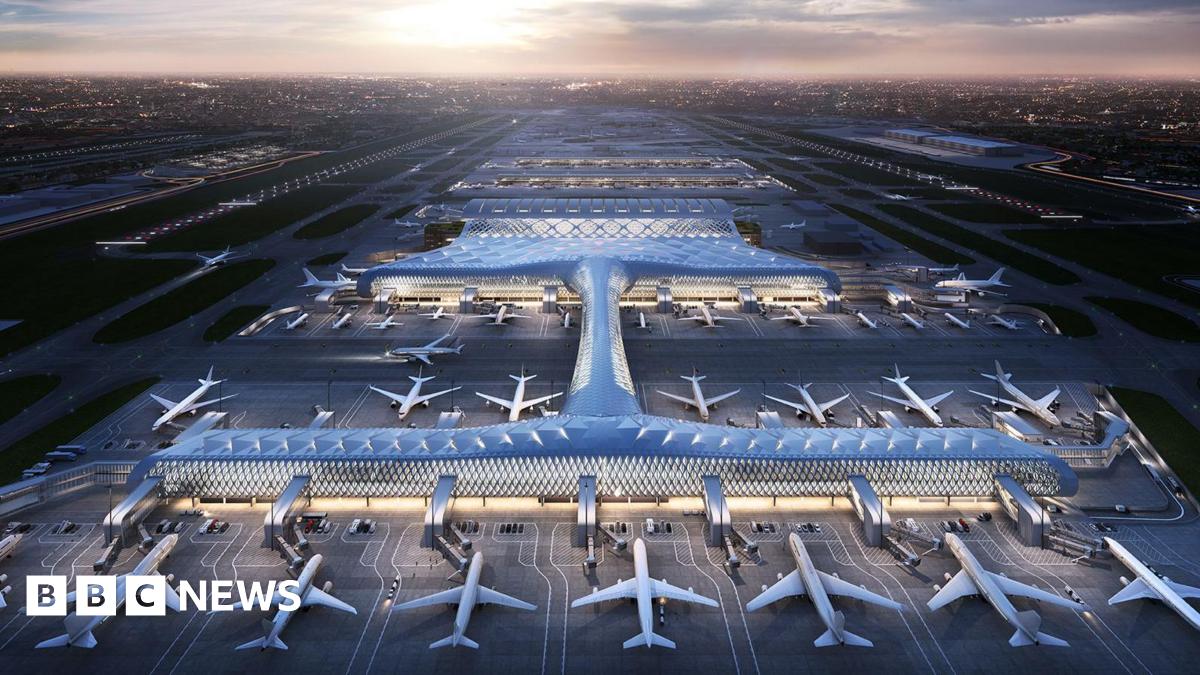
Hotel tycoon Surinder Arora has announced he is submitting a Heathrow expansion plan which rivals a proposal from the airport's owners.

The billionaire's Arora Group said the "primary benefit" of the plan it submitted to the government was a shorter new runway which would avoid the costly and disruptive need to divert the M25 motorway.

Building a 2,800-metre (9,200 ft) third runway instead of the full-length 3,500-metre (11,500 ft) runway planned by the airport would result in "reduced risk" and avoid "spiralling cost", the company said.

The second image in the article shows the shorter runway over the M4 link road. If you're dealing with that, why not buy up Harlington too, and have a full length runway. I imagine there's a reason it stops so far from the M25 at the other end.
 
Joined
2 Feb 2019
Messages
1,039
My concern with all this is that something will happen at some point where airlines put the brakes on or maybe even go backwards. In the case of private sector investment I’d say indeed go ahead. When it comes to public money, well that’s best spent elsewhere. Aviation is cyclical and volatile, public investment is best focussed on surface transport like road and rail which isn’t as susceptible to fluctuations in demand.
I agree. No public money should be spent on airports. Only private sector money should be spent on airports. The owners of Southampton Airport made clear that it receives no public money, all investment is from the private sector and the airport will only continue to operate as long as it makes money. The same must apply to all airports.
 

Snow1964

Established Member
Joined
7 Oct 2019
Messages
11,065
Location
West Wiltshire


The second image in the article shows the shorter runway over the M4 link road. If you're dealing with that, why not buy up Harlington too, and have a full length runway. I imagine there's a reason it stops so far from the M25 at the other end.
Apparently the Arona Group actually own some of the land north of the airport, I guess they bought up certain plots and properties as they came up for sale.

I think Heathrow also owns over 100 homes that it has bought up over many years.

As for full length runway, only really need that for taking off (heavy planes, big fuel and cargo load etc). When landing the braking distance is not much different for wide bodies and smaller single aisle planes, they all arrive at about same speed, and a 2500m long runway would be more than enough for all landings.

If you look at the renderings of Heathrow's third runway, will see all the exit (look like slip roads), starting about two thirds way along its 3500m length. Only the taxiways for joining runway are perpendicular to the runway. On busy airports often two or three of these each end so that smaller aircraft can be separated from large heavy planes, regardless of order they leave terminals. They tend to be sent in batches by size with a pause before first smaller plane (so smaller single aisle planes don't take off promptly into the turbulent wash of a heavy). Also being busy, all the taxiways are full length and dual (like a dual carriageway, one for each direction), useful when there are terminals both ends as planes could be going both ways.
 

camflyer

Member
Joined
13 Feb 2018
Messages
1,165
I agree. No public money should be spent on airports. Only private sector money should be spent on airports. The owners of Southampton Airport made clear that it receives no public money, all investment is from the private sector and the airport will only continue to operate as long as it makes money. The same must apply to all airports.

There might be a case for public subsidy of airports for remote (e.g island) communities but certainly big airports themselves should be privately financed and the money regained from passengers and businesses. The grey area is where the funding comes for the provision of the supporting road and rail infrastructure
 

TravelDream

Member
Joined
7 Aug 2016
Messages
1,162
I agree. No public money should be spent on airports. Only private sector money should be spent on airports. The owners of Southampton Airport made clear that it receives no public money, all investment is from the private sector and the airport will only continue to operate as long as it makes money. The same must apply to all airports.

That isn't the typical global norm though.

Most airports are the world receive public subsidy. Some lots and some little, but almost all do.

Airports are drivers of economic growth so for many cities/ countries/ regions, they are great economic development investment tools.
 

philosopher

Established Member
Joined
23 Sep 2015
Messages
1,513
Airports are drivers of economic growth so for many cities/ countries/ regions, they are great economic development investment tools.
How true is this in the UK though. Most air travel in the UK I suspect are UK residents going on holiday rather than foreign tourists visiting the UK or business related travel. Heathrow and maybe Gatwick and Edinburgh, which I reckon have a high proportion of UK inbound tourists and business travellers are perhaps exceptions to this.

I read somewhere that half the UK population does not fly in a given year. Therefore I am not sure it is good use of government money to spend it on expanding airports to allow the generally wealthier half of the population to go on more overseas holidays.
 

Bald Rick

Veteran Member
Joined
28 Sep 2010
Messages
35,682
I read somewhere that half the UK population does not fly in a given year. Therefore I am not sure it is good use of government money to spend it on expanding airports to allow the generally wealthier half of the population to go on more overseas holidays.

I forget the stats, but about half the UK population does not use the railway in a given year…
 

JamesT

Established Member
Joined
25 Feb 2015
Messages
4,836
How true is this in the UK though. Most air travel in the UK I suspect are UK residents going on holiday rather than foreign tourists visiting the UK or business related travel. Heathrow and maybe Gatwick and Edinburgh, which I reckon have a high proportion of UK inbound tourists and business travellers are perhaps exceptions to this.

I read somewhere that half the UK population does not fly in a given year. Therefore I am not sure it is good use of government money to spend it on expanding airports to allow the generally wealthier half of the population to go on more overseas holidays.
The report linked from https://commonslibrary.parliament.uk/research-briefings/sn06022/ says there were 38m inbound trips in 2023, versus 86m outbound. So it is a majority, but the foreign visitors are still fairly significant.

Outbound tourists will still be generating some UK economic activity, so the question for government investment should be whether it generates an overall net positive for the economy and how that return compares to other potential investments.
 

TravelDream

Member
Joined
7 Aug 2016
Messages
1,162
I read somewhere that half the UK population does not fly in a given year. Therefore I am not sure it is good use of government money to spend it on expanding airports to allow the generally wealthier half of the population to go on more overseas holidays.

What an incredibly off opinion.
What's the difference between that and: 'I haven't used the NHS in years - cut NHS funding' or 'I'm not a pensioner - cancel all state pensions'?

Governments spend a hell of a lot of money on things most people don't use* or have no interest in.
*Though, given the amount of air cargo traffic, I guess 99.9% of Brits use airport services whether directly or indirectly.

Plus, have you ever bought a rail ticket? Rail travel would be hit incredibly hard if investment was only made in areas where the less wealthy half of the populous would be the prime user. Another difference with rail investment and air investment is increased investment in rail doesn't see fares get cut. Increase airport investment would undoubtedly see the cost of air travel decrease.

The prime question should be does public investment provide a net return for the British/ local economy.
Given the potential cost of Heathrow's expansion, the answer may be no. But that should still be the prime question.
 
Joined
2 Feb 2019
Messages
1,039
The main purpose of the railway is to take as much car and lorry traffic off the roads as possible to reduce road traffic congestion by diverting passenger journeys and freight transport on to the railway. People making journeys by car therefore benefit from the railway even if they never travel by train. Airports do not provide any similar benefit.
 

pug1

Member
Joined
6 Nov 2022
Messages
515
Location
Humber
That isn't the typical global norm though.

Most airports are the world receive public subsidy. Some lots and some little, but almost all do.

Airports are drivers of economic growth so for many cities/ countries/ regions, they are great economic development investment tools.
Airports are not economic drivers, they reflect the economy of the area they purport to serve. Big inbound tourist destinations of course require airports to enable ease of access. Business travel is down and continues to be squeezed due to technology such as Microsoft Teams which negates the expensive travel services bills for many companies now. Some economic activity relies on air travel, think of my local Humberside for instance which has an offshore oil/gas/wind sector and shipping which generates passengers for the KLM services due to a constant stream of people positioning to and from the area.

Most U.K. airports bread and butter is outbound holiday makers. This is a net cost to a given region. Even direct employment at airports tends to be low paid, unsociable hours type of jobs that offer little more to a local economy than a Tesco or an Amazon warehouse. Most people in the U.K. have access to at least one airport within 60 minutes, some might say the U.K. has too many airports. So I fail to see how public subsidy is justified in the U.K. airport sector.
 

camflyer

Member
Joined
13 Feb 2018
Messages
1,165
Airports are not economic drivers, they reflect the economy of the area they purport to serve. Big inbound tourist destinations of course require airports to enable ease of access. Business travel is down and continues to be squeezed due to technology such as Microsoft Teams which negates the expensive travel services bills for many companies now. Some economic activity relies on air travel, think of my local Humberside for instance which has an offshore oil/gas/wind sector and shipping which generates passengers for the KLM services due to a constant stream of people positioning to and from the area.

Most U.K. airports bread and butter is outbound holiday makers. This is a net cost to a given region. Even direct employment at airports tends to be low paid, unsociable hours type of jobs that offer little more to a local economy than a Tesco or an Amazon warehouse. Most people in the U.K. have access to at least one airport within 60 minutes, some might say the U.K. has too many airports. So I fail to see how public subsidy is justified in the U.K. airport sector.

If airports aren't economic drivers then why are so many national and city governments as well as private investors putting money into major airport expansions? Look at Dublin and Warsaw in Europe, Newark and LA in the States and Sydney in Australia.

This is a rail forum so I would expect the readership to be pro-rail but that doesn't necessarily mean you have to be anti-car or anti-aviation. All three can - and should - coexist in an integrated infrastructure system.
 

philosopher

Established Member
Joined
23 Sep 2015
Messages
1,513
What an incredibly off opinion.
What's the difference between that and: 'I haven't used the NHS in years - cut NHS funding' or 'I'm not a pensioner - cancel all state pensions'?

Governments spend a hell of a lot of money on things most people don't use* or have no interest in.
*Though, given the amount of air cargo traffic, I guess 99.9% of Brits use airport services whether directly or indirectly.

Plus, have you ever bought a rail ticket? Rail travel would be hit incredibly hard if investment was only made in areas where the less wealthy half of the populous would be the prime user. Another difference with rail investment and air investment is increased investment in rail doesn't see fares get cut. Increase airport investment would undoubtedly see the cost of air travel decrease.

The prime question should be does public investment provide a net return for the British/ local economy.
Given the potential cost of Heathrow's expansion, the answer may be no. But that should still be the prime question.
Almost everyone will need to use to the NHS at some point and when they use it is likely to be essential that they use it for their overall health. In terms of rail, even if you do not use railways, you still benefit from reduced road traffic congestion and improved air quality due to rail use reducing road vehicle trips. For those who do use rail, many will be using it to get to work, take away rail they may be forced to change jobs. Finally, similar air cargo, I suspect almost everyone will use products that have been transported by rail

However, most people can get away with not using airports during their life as for most people use of airports is more for discretionary spending, i.e going on holiday. I do appreciate some will need to use airports to keep in contact with relatives overseas or for business reasons, but I suspect most airport users do not fall into category. Therefore while airport expansion may benefit the economy, I do not think in terms of government spending priorities, it can be put in the same category as NHS or rail spending.
 

TravelDream

Member
Joined
7 Aug 2016
Messages
1,162
Airports are not economic drivers

This is just so incredibly wrong, I am not sure where to begin.

Aviation in the UK to estimated to have a direct output of £32 billion and directly employ 340,000 people. Note direct. The indirect output and jobs created are multiples higher than the direct.

40% of the UK's exports (by value) leave the country by air.

Countries across the world invest massively in airports and aviation as they are economic drivers. Whether in America, Europe, Asia, Oceania, government see the huge importance of connectivity and how connections by air can be a massive catalyst for economic development and growth.
 

daodao

Established Member
Joined
6 Feb 2016
Messages
3,601
Location
Dunham/Bowdon
@TravelDream

There is more than enough spare capacity at existing UK airports to handle expansion of air cargo, which is far less location sensitive.

So many existing air services from the UK are for outgoing holidaymakers, unlike the rest of the world, which is actually a drain on the country's economic resources. I am old enough to remember when the UK imposed foreign exchange controls on British tourists travelling overseas to reduce fiscal losses.
 
Last edited:

The exile

Established Member
Joined
31 Mar 2010
Messages
9,335
Location
Somerset
I am old enough to remember when the UK imposed foreign exchange controls on British tourists travelling overseas to reduce fiscal losses.
Thus spawning the all inclusive package holiday business - but that’s straying off topic. What is certainly true is that many continental local authorities have been quick to promote the use of ex-military bases as civil airports, even though their passenger services can hardly be great money spinners (Weeze, Memmingen, Baden etc), so they must see them as overall net contributors.
 

camflyer

Member
Joined
13 Feb 2018
Messages
1,165
@TravelDream

There is more than enough spare capacity at existing UK airports to handle expansion of air cargo, which is far less location sensitive.

So many existing air services from the UK are for outgoing holidaymakers, unlike the rest of the world, which is actually a drain on the country's economic resources. I am old enough to remember when the UK imposed foreign exchange controls on British tourists travelling overseas to reduce fiscal losses.

I can see any scenario where restoring currency controls and restricting flights is going to be politically popular. Those were the days when only the wealthy could afford to go abroad on holiday. When I was at school, I can only remember one girl in my class having been abroad (her dad was a solicitor so we thought she was posh) - she had been to Majorca which for the rest of us may have been the moon.

While I agree that much of the air travel market is outgoing (not many people in Spain dream of a weekend in the East Midlands), this certainly isn't the case with Heathrow and that is where the extra capacity is required.

Online meetings have certainly revolutionised work - I can remember flying to Switzerland or Germany regularly for a one hour meeting - but there is still a lot of demand for travel for work. A future where we all sit at home and only communicate with others via a computer screen doesn't sound much fun.
 

TravelDream

Member
Joined
7 Aug 2016
Messages
1,162
There is more than enough spare capacity at existing UK airports to handle expansion of air cargo, which is far less location sensitive.

The majority of cargo traffic to/from the UK is carried on passenger aircraft, not specialist cargo planes. Therefore it is location sensitive.

It won't come as any surprise to find out Heathrow is the UK's busiest cargo airport by tonnage.

Thus spawning the all inclusive package holiday business - but that’s straying off topic. What is certainly true is that many continental local authorities have been quick to promote the use of ex-military bases as civil airports, even though their passenger services can hardly be great money spinners (Weeze, Memmingen, Baden etc), so they must see them as overall net contributors.

Very true. In Europe, the States and now many parts of Asia, every region and city wants their own airport because of the economic contribution they make to their area.

I can see any scenario where restoring currency controls and restricting flights is going to be politically popular. Those were the days when only the wealthy could afford to go abroad on holiday. When I was at school, I can only remember one girl in my class having been abroad (her dad was a solicitor so we thought she was posh) - she had been to Majorca which for the rest of us may have been the moon.

I think this is another core problem with 'flying is just for the rich so airports shouldn't have public money'.
Flying nowadays is open to the vast majority. I know plenty of people on minimum wage type roles/ on benefits who travel abroad at least once or twice a year.
I can fly to Malaga or Barcelona or Rome or Berlin or Palma or Faro or many other places for significantly less than it would cost to take a train to London.
The expansion of aviation has seen prices fall dramatically and further expansion will see prices continue to be more accessible.
 

Tetchytyke

Veteran Member
Joined
12 Sep 2013
Messages
17,474
Location
Isle of Man
If airports aren't economic drivers then why are so many national and city governments as well as private investors putting money into major airport expansions? Look at Dublin and Warsaw in Europe, Newark and LA in the States and Sydney in Australia.
They're not economic drivers, they reflect the economy of the areas in which they are located.

Private investors are putting money into expansions of major airports in thriving economic areas. They're not putting money into expansions of minor airports in deprived economic areas.

The problem is that airports are like crack to egotistical local politicians, so we end up with huge sums of taxpayer money being poured into basket-case local airports.
In Europe, the States and now many parts of Asia, every region and city wants their own airport because of the economic contribution they make to their area.

It's all about ego, it's not about the economics. The economics simply don't stack up, never have and never will, which is why these airports are a bottomless pit of subsidy.

The obvious examples in the UK are Teesside and Doncaster but the hubris goes far beyond the UK.

Lubeck is a great example, the local taxpayers have lost fortunes into that airport over the years but they don't seem to have learned the lesson, they've just poured a fortune more into the place to get Ryanair to restart service earlier this year. In three years, when the subsidy runs out, I'm sure Ryanair will leave again and the place will go bust again. Repeat ad nauseum ad infinitum.

"Build it and they will come" has been proven time and time and time again to be a complete nonsense. Montreal proved it with Mirabel, the Spanish proved it with Ciudad Real, and Pakistan are proving it with Gwadar. Australia are about to prove it again with Badgerys Creek.

The expansion of aviation has seen prices fall dramatically and further expansion will see prices continue to be more accessible.
So prices are falling but the sector requires more state subsidy? Hmm.
 

The exile

Established Member
Joined
31 Mar 2010
Messages
9,335
Location
Somerset
Lubeck is a great example, the local taxpayers have lost fortunes into that airport over the years but they don't seem to have learned the lesson, they've just poured a fortune more into the place to get Ryanair to restart service earlier this year. In three years, when the subsidy runs out, I'm sure Ryanair will leave again and the place will go bust again. Repeat ad nauseum ad infinitum.
Having been a regular user in the days when you could still park for free around the perimeter fence, I’m inclined to agree about Luebeck - though one of the main problems there is precisely that it doesn’t have a huge runway. What did for it around 2009 was the refusal of permission to extend the runway and associated infrastructure, without which Ryanair weren’t going to make it their northern hub. Once the Fehmarn tunnel (bridge?) is complete it would otherwise be a useful competitor to both Hamburg and Copenhagen.
 

TravelDream

Member
Joined
7 Aug 2016
Messages
1,162
What did for it around 2009 was the refusal of permission to extend the runway and associated infrastructure, without which Ryanair weren’t going to make it their northern hub

I have no idea about the infrastructure, but Luckeck's runway is 2,102m long. That's plenty long enough for a Ryanair base.

Bristol, by comparison, is 2,011m and Ryanair, Jet2 and tui are all happy to base 737 aircraft there operating 4+ hour flights routinely.

Any suggestion that a short runway caused Ryanair not to base planes is clearly nonsense.
 

Tetchytyke

Veteran Member
Joined
12 Sep 2013
Messages
17,474
Location
Isle of Man
Once the Fehmarn tunnel (bridge?) is complete it would otherwise be a useful competitor to both Hamburg and Copenhagen.
Spending huge sums of money to steal customers from the city next door seems utterly pointless to me. The primary economic benefits flow to those cities. Other than a few low-paid baggage handling or retail jobs, the benefits are negligible. Tourists using you as a cheap bridgehead don't increase your economy.

I used Luebeck a few times back when Ryanair first went there. My sole contribution to Luebeck's economy was to buy a bottle of water and a KitKat before boarding the express coach to Hamburg ZOB. It was Hamburg which received all my money, not Luebeck. Yet Luebeck's taxpayers were chucking vast sums of money into the airport.
 

The exile

Established Member
Joined
31 Mar 2010
Messages
9,335
Location
Somerset
I have no idea about the infrastructure, but Luckeck's runway is 2,102m long. That's plenty long enough for a Ryanair base.

Bristol, by comparison, is 2,011m and Ryanair, Jet2 and tui are all happy to base 737 aircraft there operating 4+ hour flights routinely.

Any suggestion that a short runway caused Ryanair not to base planes is clearly nonsense.
It may have been the associated infrastructure rather than the actual runway lengthening but Ryanair’s move to Bremen followed the refusal of permission to expand Luebeck.

== Doublepost prevention - post automatically merged: ==

Tourists using you as a cheap bridgehead don't increase your economy.

I used Luebeck a few times back when Ryanair first went there. My sole contribution to Luebeck's economy was to buy a bottle of water and a KitKat before boarding the express coach to Hamburg ZOB. It was Hamburg which received all my money, not Luebeck. Yet Luebeck's taxpayers were chucking vast sums of money into the airport.
No - I suppose that an airport is considered likely to be a pull factor for company locations. As the location of “Head office” is critical for determining who gets the company’s local taxes in Germany, that’s quite important.
 

Top