

YorkRailFan
Established Member
The aircraft was being flown by a remote pilot on a test flight at 30 ft agl when a propeller blade detached from the electric propulsion unit 3 forward motor due to a failure of the adhesive bond between the propeller blade sheath and spar. Large out-of-balance loads generated by the blade release caused structural failure of the right inboard pylon, resulting in damage to the aircraft’s wiring harnesses. This caused a loss of thrust from motors 4 and 7. Whilst the aircraft’s flight control system was able to maintain a level attitude, the high rate of descent caused by the loss of vertical thrust resulted in substantial damage to the aircraft when it struck the ground.
The aircraft manufacturer was, at the time of the accident, in the process of introducing a blade design that, amongst other things, eliminated the bonding failure mode that caused the blade release. The manufacturer’s investigation identified 36 product and process improvements resulting from findings of the investigation.
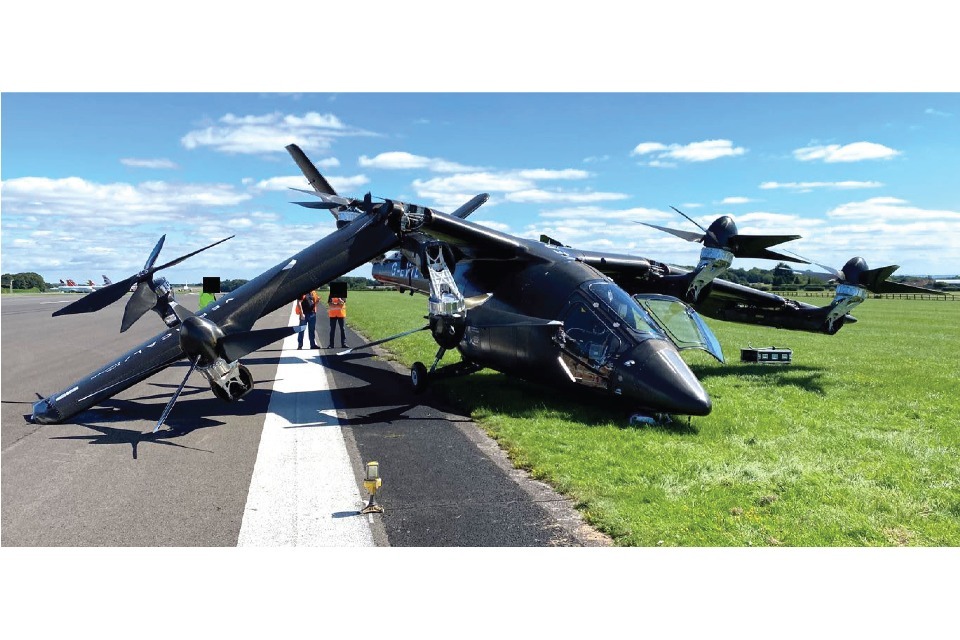
AAIB Report: VA-1X, G-EVTL, on 9 August 2023
Report into an accident involving an VA-1X (G-EVTL), which suffered a forced landing following power unit failure, Cotswold Airport (Kemble), Gloucestershire on 9 August 2023
Still a long way to go before these are flying (I have my doubts about their efficiency and use), the AAIB didn't publish any recommendations publically for Vertical Aerospace (the manufacturer) or for other EVTOL companies. The AAIB found that the propellor blade which failed was within its normal RPM when it detached so its certainly interesting that there wasn't redundancy on this model.
Vertical Aerospace for their part said:
Vertical Aerospace (Vertical) [NYSE: EVTL], a global aerospace and technology company that is pioneering zero-emissions aviation, today welcomes the publication of the Air Accidents Investigation Branch (AAIB) investigation report into its flight test accident last summer.
Both the AAIB’s and Vertical’s reports concluded that the primary cause of the accident was due to an adhesive bond failure of a propeller blade. Vertical had already redesigned the early generation propeller prior to the accident and is no longer using the same supplier.
At the time of the accident Vertical immediately conducted a thorough investigation and worked closely with the AAIB to share the findings. Vertical strongly believes transparency and openness are fundamental to the safety of aerospace.

AAIB publishes investigation report · Vertical Aerospace
AAIB publishes investigation report
 vertical-aerospace.com
Vertical Aerospace naturally has an interest in the report to see what went wrong and what they can fix to avoid this.