• Our new ticketing site is now live! Using either this or the original site (both powered by TrainSplit) helps support the running of the forum with every ticket purchase! Find out more and ask any questions/give us feedback in this thread!

A very short question about Class 373 (e300)

Status
Not open for further replies.

ijmad

Established Member
Joined
7 Jan 2016
Messages
1,856
Location
UK
What is behind the grilled area at the front of the first passenger coach and at the rear of the last passenger coach adjacent to the power cars?

Is it more engine/machine/plant?

Or is it just a guard's office or luggage store styled to match the power cars?

This bit right here if I'm not clear:

26B4xx6.jpg
 
Last edited:
Sponsor Post - registered members do not see these adverts; click here to register, or click here to log in
R

RailUK Forums

Peter Mugridge

Veteran Member
Joined
8 Apr 2010
Messages
17,841
Location
Epsom
It's more power equipment.

The front three bogies at each end are powered - the two on the power car and the first one on the rake.
 

ijmad

Established Member
Joined
7 Jan 2016
Messages
1,856
Location
UK
It's more power equipment.

The front three bogies at each end are powered - the two on the power car and the first one on the rake.

Blimey, those are some big engines.

Hypothetically, could the 373 operate without them, perhaps in a shorter formation?
 

Peter Mugridge

Veteran Member
Joined
8 Apr 2010
Messages
17,841
Location
Epsom
I'm not sure... but there are some Eurostar people on this forum who would probably know. Bear in mind, though, that the shorter North of London sets still had the same arrangement - although it's possible that might have just been for standardisation purposes.
 

ijmad

Established Member
Joined
7 Jan 2016
Messages
1,856
Location
UK
I'm not sure... but there are some Eurostar people on this forum who would probably know. Bear in mind, though, that the shorter North of London sets still had the same arrangement - although it's possible that might have just been for standardisation purposes.

I just realised they are the only coaches that have a separate bogie, so they have to be in the formation because the power cars don't share bogies with the front coach.
 

NotATrainspott

Established Member
Joined
2 Feb 2013
Messages
3,304
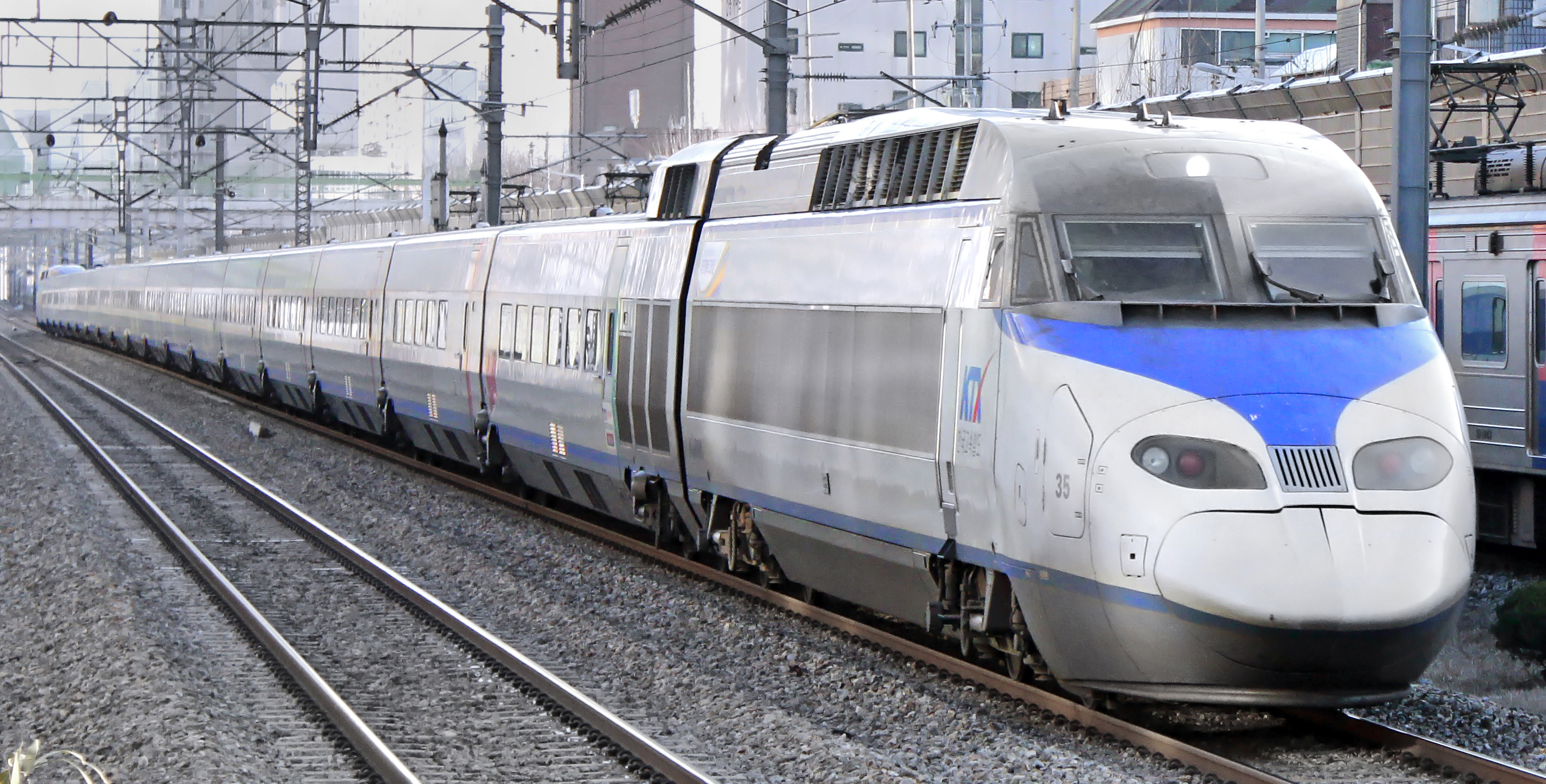
A good comparison will be with the South Korean KTX-I trains, which are 400m fixed-formation TGV-derived units similar to the Eurostar 373s. They're about a decade newer, are built to the standard European loading gauge and don't have the complex multi-system and Channel Tunnel safety requirements but they seem to have a similar grille.

KTX-I.jpg
 

ijmad

Established Member
Joined
7 Jan 2016
Messages
1,856
Location
UK
A good comparison will be with the South Korean KTX-I trains, which are 400m fixed-formation TGV-derived units similar to the Eurostar 373s. They're about a decade newer, are built to the standard European loading gauge and don't have the complex multi-system and Channel Tunnel safety requirements but they seem to have a similar grille.

Nice, I see that one has an identical bogie configuration to the 373 as well.
 

delticdave

Member
Joined
13 Apr 2017
Messages
450
Location
Essex UK
I just realised they are the only coaches that have a separate bogie, so they have to be in the formation because the power cars don't share bogies with the front coach.
The 9th & 10th cars, (of the 18 passenger cars) also have end bogies, so that the set can be split in 1/2, usually for wheel turning at North Pole depot. Each 1/2 set carries its own set number.
 

dazzler

Member
Joined
6 Apr 2018
Messages
260
Location
York
The earlier, but similar, first generation Paris Sud Est TGV sets have a similar configuration with a small equipment room in the coach immediately next to the power cars. This is to accommodate the power electronics for the power bogie underneath it.

The motors for the first generation TGV were not powerful enough to propel the train at the design speed with only 4 motors, so the other 2 had to go somewhere! This also applied to the class 373 Eurostar trains, as they were to the same design.

TGV - Train à Grand Vitesse (French for "High Speed Train")
 
Last edited:

dazzler

Member
Joined
6 Apr 2018
Messages
260
Location
York
Nice, I see that one has an identical bogie configuration to the 373 as well.

All TGVs (and their derivatives) have the same arrangement of bogies - two bogies underneath each power car, then one bogie fully under the end of the carriage next to the power car. All the other bogies being shared between two carriages (known as a Jacobs bogie) - with the exception noted above by @delticdave on the class 373 Eurostar sets.
 

Wilts Wanderer

Established Member
Joined
21 Nov 2016
Messages
3,199
All TGVs (and their derivatives) have the same arrangement of bogies - two bogies underneath each power car, then one bogie fully under the end of the carriage next to the power car. All the other bogies being shared between two carriages (known as a Jacobs bogie) - with the exception noted above by @delticdave on the class 373 Eurostar sets.

They have the same bogie arrangement, but all TGV units from the Atlantique / Reseaux fleets onwards have more powerful traction motors and therefore the extra power equipment on the bogies under the leading / trailing coach are not required.

The exception being Eurostar, although not quite right to equate them to a Sud-EST set. The 373 is technologically equal to Atlantique/Reseaux (ie second generation TGV), the extra power bogies were required due to the sheer size of the train compared to a standard 2+8 Reseaux or 2+10 Atlantique.
 

SHD

Member
Joined
18 Jul 2012
Messages
571
They have the same bogie arrangement, but all TGV units from the Atlantique / Reseaux fleets onwards have more powerful traction motors and therefore the extra power equipment on the bogies under the leading / trailing coach are not required.

The exception being Eurostar, although not quite right to equate them to a Sud-EST set. The 373 is technologically equal to Atlantique/Reseaux (ie second generation TGV), the extra power bogies were required due to the sheer size of the train compared to a standard 2+8 Reseaux or 2+10 Atlantique.

Regarding traction equipment, 373s are very different technologically than Atlantique / Réseau TGVs which have self-piloted synchronous motors. 373s were high-speed pioneers of three-phased asynchronous motors (quite a bold choice in the early 1990s).

TGV Sud-Est trainsets use “good old” DC motors, and their sheer longevity (40 + years) is quite a testament to the quality of their technological design!
 

43096

On Moderation
Joined
23 Nov 2015
Messages
18,843
373s were high-speed pioneers of three-phased asynchronous motors (quite a bold choice in the early 1990s).
Although DB’s ICE-1 sets were built with three phase asynchronous motors and pre-dated Eurostar by two or three years, so not exactly “pioneers”.
 

SHD

Member
Joined
18 Jul 2012
Messages
571
Although DB’s ICE-1 sets were built with three phase asynchronous motors and pre-dated Eurostar by two or three years, so not exactly “pioneers”.

Indeed, but two people can be pioneers together, cannot they?
 

43096

On Moderation
Joined
23 Nov 2015
Messages
18,843
Indeed, but two people can be pioneers together, cannot they?
As the dictionary definition is “develop or be the first to use or apply (a new method, area of knowledge, or activity)“ and DB’s ICE-V (Experimental) was a mid-1980s development then, no, I would say DB was the pioneer.
 

ijmad

Established Member
Joined
7 Jan 2016
Messages
1,856
Location
UK
As the dictionary definition is “develop or be the first to use or apply (a new method, area of knowledge, or activity)“ and DB’s ICE-V (Experimental) was a mid-1980s development then, no, I would say DB was the pioneer.

Simultaneous invention is a common thing in human history though. Just look at Liebnitz and Newton both inventing calculus.
 

SHD

Member
Joined
18 Jul 2012
Messages
571
But it is indeed true, there has been a gap of slightly more than three years between the entry in service of ICE 1 (June 1991 for high-speed operation) and TMSTs (November 1994).
 

43096

On Moderation
Joined
23 Nov 2015
Messages
18,843
Simultaneous invention is a common thing in human history though. Just look at Liebnitz and Newton both inventing calculus.
Eurostar was but a far-off dream when DB’s first ICE with asynchronous motors was first run. This was not a simultaneous development: DB categorically pioneered this use.
 

swt_passenger

Veteran Member
Joined
7 Apr 2010
Messages
34,280
Blimey, those are some big engines.
They aren’t “big engines”. These are just bigger than usual electric locomotives and have “motors” and associated transformers and control equipment. That in itself is more complex than normal because they can run off a number of different power supplies as well as the removed SR style DC.
 

SHD

Member
Joined
18 Jul 2012
Messages
571
Eurostar was but a far-off dream when DB’s first ICE with asynchronous motors was first run. This was not a simultaneous development: DB categorically pioneered this use.

Thank you for the Klarifikazion!

They aren’t “big engines”. These are just bigger than usual electric locomotives and have “motors” and associated transformers and control equipment. That in itself is more complex than normal because they can run off a number of different power supplies as well as the removed SR style DC.

Yes indeed. The electric motors themselves are quite small as you can see. (Not from a TMST but very typical of TGV design)

bogie_tgv.gif


Essieu = Axle
Moteur = Motor
Réducteur moteur/de pont = Reduction gearbox (two types)
Cardan = Homocinetic joint
Bâti mécano-soudé = Frame
Suspension primaire = Primary suspension
 
Last edited:

Peter Mugridge

Veteran Member
Joined
8 Apr 2010
Messages
17,841
Location
Epsom
I just realised they are the only coaches that have a separate bogie, so they have to be in the formation because the power cars don't share bogies with the front coach.

Yes, but that in itself wouldn't prevent a variant being built without the motors there would it? I think your original question boils down to whether or not a shorter rake would be able to work at full speed without the additional powered bogies - and we are still waiting for the answer?
 

ijmad

Established Member
Joined
7 Jan 2016
Messages
1,856
Location
UK
Yes, but that in itself wouldn't prevent a variant being built without the motors there would it? I think your original question boils down to whether or not a shorter rake would be able to work at full speed without the additional powered bogies - and we are still waiting for the answer?

I'm not that personally bothered by the answer to this, as it may just not be a scenario they ever designed the things to deal with, either on a software or mechanical level. But if anyone wants to throw in an answer, obviously they are free to do so!

I have seen a photo of two power cars coupled back to back as they were transferred to the National Rail Museum, although I'm not sure they went anywhere under their own motive power in that configuration.
 

flash

Member
Joined
27 Jan 2014
Messages
128
R1 (1st Coach) powered area, has battery chargers for powered bogies 2 & 3 as well as compressor and electronics for powered bogie 3. If a powercar is moved on its own only 1 powered bogie works (bogie 1). TMST's quite happily run around with 1 powered bogie inoperative, 2 inoperative is more of a struggle.
Regarding removing coaches - it gets more complicates as each half set has 2 coaches with batteries and 2 with chargers (not R1 or R9) so the shortest it could be would be 6 vehicles - if that was possible with the software!
 
Status
Not open for further replies.

Top