• Our new ticketing site is now live! Using either this or the original site (both powered by TrainSplit) helps support the running of the forum with every ticket purchase! Find out more and ask any questions/give us feedback in this thread!

4 track railway: line pairings discussion

edwin_m

Veteran Member
Joined
21 Apr 2013
Messages
28,760
Location
Nottingham
Trains can terminate at Neasden too but I assume that means going empty into the yard and crossing the London bound Met.
If I recall correctly there's a diveunder to get into the depot.
Until electrification in the 1970s Kings Cross operated with traditional arrivals and departures sides. Furthermore, the tracks to and from the Widened Lines were on the outside. The station throat was also paired by direction!
I believe there was a previous flyover on a similar alignment for trains heading towards the goods yards and the curve up to the North London Line. Some parts of it might even have been re-used for the passenger flyover.
Surprised nobody has mentioned Gloucester Road Junctions, with it's flying junctions to interface the lines from London Bridge, Victoria and East Croydon/Brighton which were all 4 track (or more), but all paired differently!

Extra flying junctions were added in the 1980s, when the lines to East Croydon were reconfigured.
Despite several flyovers there are also still multiple flat junctions in that area, including Gloucester Road Junction itself which has two other tracks passing right over it. It would need three or possibly four levels to segregate everything. The London Bridge line (paired by direction) merges with the Victoria-Brighton line (paired by use).
 
Sponsor Post - registered members do not see these adverts; click here to register, or click here to log in
R

RailUK Forums

etr221

Established Member
Joined
10 Mar 2018
Messages
1,610
Other than the Met Line/Chiltern line section through Northwest London is there any other cases of Slows on the inside and fasts going around it?
The intriguing case used to be the ex-LSWR Windsor Line out to Barnes - while the centre pair of tracks have, AFAIK, always been designated as 'fast' (with the slows outside), for many years they were used by the slow (stopping) trains, with the fast (non-stopping) trains on the slow lines, and the stations were modified to have passenger facilities (ticket office, etc.) on the centre island platforms.
 

Lucan

Established Member
Joined
21 Feb 2018
Messages
1,265
Location
Wales
At Woking it is quite inconvenient that the terminating train must cross to the middle of the through tracks
Not as inconvenient as if they terminated in a bay outside the tracks in which case all lines would need to be put at red at the same time either for arrival or departure.

The centre platform bay has been put in since I was using Woking, when no trains terminated there, at least not during rush hours. I have always thought it crazy that the junction at Woking for Portsmouth, arguably the most important junction on the SW main line, (the Barnes lines at Clapham are already separate from Waterloo) is not a flying one, while the branches for Hampton Court, Alton, Kingston,and the freight-only chord to Chertsey and Staines are. It must be a major service constraint and there would be room for a flyover given the under-used goods yard area around. I guess it is because Woking junction was the first historically.

Another advantage of directional pairing with slows on the outside is that all lines can remain straight through those stations with no fast line platforms, like Berrylands.
 

35B

Established Member
Joined
19 Dec 2011
Messages
5,582
Not as inconvenient as if they terminated in a bay outside the tracks in which case all lines would need to be put at red at the same time either for arrival or departure.

The centre platform bay has been put in since I was using Woking, when no trains terminated there, at least not during rush hours. I have always thought it crazy that the junction for Portsmouth, arguably the most important on the SW main line, (the Barnes lines at Clapham are already separate from Waterloo) is not a flying one, while the branches for Hampton Court, Alton, Kingston,and the freight-only chord to Chertsey and Staines are. It must be a major service constraint and there would be room for a flyover given the under-used goods yard area around. I guess it is because Woking junction was the first historically.

Another advantage of directional pairing with slows on the outside is that all lines can remain straight through those stations with no fast line platforms, like Berrylands.
The Woking flyover has been on wishlists for a very long time, and platform usage at Woking is sometimes, erm, weird (e.g. catching Waterloo fasts off the Portsmouth Direct on p1). The positioning isn't great, and ultimately it will be expensive and disruptive while it goes in. But the others reflect the history of the LSW main line as a, well, main line and took the constraints of slow moving trains crossing the fasts out of the equation (remember, a chunk of that traffic would once have been unbraked goods).

Having grown up on the SWML, and now living by the ECML, I'm a fan of pairing by direction. It makes day to day regulation a lot easier, at the relatively limited cost of a flyover at Durnsford Road or Copenhagen Tunnel. It does though have a cost when more extensive work is required - it doesn't support closing one pair of lines (as with the WCML) - and some engineering moves can be tricky (I remember doing some interesting reversals at Brookwood one Sunday).

I don't think it's that important for station design - they're now built, and reflect the railway that they were built for.
 

Snow1964

Established Member
Joined
7 Oct 2019
Messages
11,261
Location
West Wiltshire
Flyover was built in 1936, I am guessing from the style of the concrete construction the nearby signal box is about the same date.
The flyover, colour light signalling at Wimbledon was all part of the capacity improvements as part of the Portsmouth/Alton electrification scheme.

Previously the LSWR had started six-tracking and some of the earthworks and bridges between New Malden and Earlsfield were actually done until work stopped during WW1. After the war it was found the better performance of electric suburban units (introduced 1916) meant six tracking could be deferred. The Kingston bypass (A3) bridge allowed for 6 tracks

Conversely having the fasts in the middle makes it easier to build stations which serve only the slow lines, like Raynes Park or Berrylands. Cf Welham Green etc on the GN.
West of Surbiton, the extra tracks were added on both sides, and many of the road underbridges still have masonry arches of 1838 with metal spans on the later outside tracks

ETA it also makes the burrowing junction for the Kingston branch (cf Stevenage) much easier than if one of the slows had to come up in the middle of the layout. But I also remember a discussion on here somewhere which says the original arrangement was not the same as it is now, which explains why there is an unused bore at the Elm Road underbridge.
The original Kingston branch was from Twickenham ending at a lower level station (near where bay platform is now). The current through tracks at Kingston via Norbiton were added later (it's why the through tracks at Kingston don't t line up with river bridge, but bay platform does). This line passed under the mainline and ran parallel to join the Tooting loop line. The central tracks between New Malden and Wimbledon have been swapped as was for few years two parallel 2 track lines.

Beyond about Weybridge, third track was added, and 4th later, hence odd arrangement at West Byfleet. Some of the 4 tracking further west was done on one side (mainly south side) for ease with tracks slewed, Farnborough had centre island platforms for years, but some had them on outer tracks only.

For completeness work also stopped during WW1 on four-tracking Eastleigh-Southampton, some work was done eg 4 track span Wide Lane bridge replacing a level crossing, and new station building at Swaything being set back (an arrangement that still exists) to allow the platforms to be converted to islands.
 

swt_passenger

Veteran Member
Joined
7 Apr 2010
Messages
34,313
For completeness work also stopped during WW1 on four-tracking Eastleigh-Southampton, some work was done eg 4 track span Wide Lane bridge replacing a level crossing, and new station building at Swaything being set back (an arrangement that still exists) to allow the platforms to be converted to islands.
I suppose the very wide up platform at St Denys with the building and canopy set well back is also a feature of a potential future four tracking?
 

MarkyT

Established Member
Joined
20 May 2012
Messages
7,616
Location
Torbay
I believe there was a previous flyover on a similar alignment for trains heading towards the goods yards and the curve up to the North London Line. Some parts of it might even have been re-used for the passenger flyover.
It was a complete reconstruction on a revised alignment.

The original goods flyover, of steel and brick construction, crossed four tracks to the eastern extremity of the alignment.

The new one has a concrete box over the fasts and eases curvature, dropping to ground level further west.

The western bore of Copenhagen tunnel was constructed at a higher level than the other two so the flyover could be built very close to the north portal.

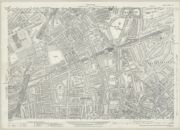
Here's an early 20th-century map of the area:
 
Last edited:

Belperpete

Established Member
Joined
17 Aug 2018
Messages
3,702
Having grown up on the SWML, and now living by the ECML, I'm a fan of pairing by direction. It makes day to day regulation a lot easier, at the relatively limited cost of a flyover at Durnsford Road or Copenhagen Tunnel. It does though have a cost when more extensive work is required - it doesn't support closing one pair of lines (as with the WCML)
Having the centre pair of lines reversible does partly help with that on the widened part of the WCML. Although not where the stations only have platforms on the outer tracks.
 

edwin_m

Veteran Member
Joined
21 Apr 2013
Messages
28,760
Location
Nottingham
Having the centre pair of lines reversible does partly help with that on the widened part of the WCML. Although not where the stations only have platforms on the outer tracks.
As far as I know the only route that does this is the Trent Valley line widened in the 2000s as part of the WCML upgrade.
 

MarkyT

Established Member
Joined
20 May 2012
Messages
7,616
Location
Torbay
As far as I know the only route that does this is the Trent Valley line widened in the 2000s as part of the WCML upgrade.
The 1990s ~four mile GWML widening between Wantage Road and Challow has this arrangement. New signalling retained bi di on the mains, originally provided in the 1970s HST upgrades, and provided unidirectional working on the new reliefs either side.
 

CW2

Established Member
Joined
7 May 2020
Messages
2,231
Location
Crewe
Where switching between fast and slow lines is more common, some lines transition between the two configurations - e.g. the WCML is paired by use south of Rugby, but paired by direction through the station and up to Colwich Jn. Interestingly at 2 places on the WCML the Down fast is outside the Down Slow, for deconfliction reasons - Rugby to Brinklow and Hartford Jn to Acton Bridge.

The primary reason why lines generally haven't been reconfigured since is the cost of rebuilding the lines where the Up Slow now needs to become the Down Fast, or similar.
The two WCML locations quoted (Rugby - Brinklow and Hartford Jn - Acton Bridge) were deliberate design choices made during the West Coast Route Modernisation of the early 2000s.

In the case of Rugby, you can run a northbound freight (or passenger) off the Northampton line in parallel with non-stop northbound passenger services. The only conflict occurs at Brinklow where the two Down lines merge into a single line - but at least the signaller has good visibility of the traffic flows and can regulate accordingly.

In the case of Hartford Jn - Acton Bridge, the curve from Hartford CLC Jn to Hartford LNW Jn is relatively low speed, and normally only used by freight traffic (often slow and heavy). If the Down Slow was on the outside (western) side, you would need to get a slot across all 4 lines in order to get your freight on the move. By putting the Down Fast on the outside, you remove any conflicts with that - although you still need a slot across both Up lines to reach the Down Slow. So, it is an imperfect solution, but partially mitigates the conflicts.

These solutions came about because the WCRM team fostered strong relationships between the timetable planners, the infrastructure designers, and the various TOCs and FOCs involved - not forgetting the SRA. Consultation and collaboration came up with solutions which worked.
 

AM9

Veteran Member
Joined
13 May 2014
Messages
16,063
Location
St Albans
In the case of London-Bedford, there would be major disadvantages.

Most important is the requirement to terminate and start slow line trains part way along the route at St Albans City and Luton. The former has a turnback siding, between the down and up slow lines. The latter has an additional platform, with platform 3 the down slow, platform 1 the up slow, and terminating trains using platform 2 in between. With a paired by direction layout both would require flyovers to allow terminating or starting trains to cross the fast lines.

Another factor is location of carriage sidings. Paired by direction would have major implications for movements onto the carriage sidings at both Cricklewood and Bedford.
Given the requirement to move Thameslink fast trains from the core on the slows, then over to the fasts before West Hampstead, (and vice versa southbound), the availability of the two ladders at either end of the Belsize tunnel mitigates some of the requirements to fully stop both fasts and slows. Down TL fasts cross over at Carlton Road junction on a 50mph slow down to fast down move, - up fasts take the ladder just south of West Hampstead before the tunnel. This give the benefit of the tunnel length, (just over a mile), acting as an extended overlap* for the down slow and up fast, which in busy times is often used to minimise the delay to trains that don't need to transfer S-F or F-S.

* I'm not a signalling expert so maybe this is the wrong term. ;)
 

Lucan

Established Member
Joined
21 Feb 2018
Messages
1,265
Location
Wales
The original Kingston branch was from Twickenham .... The current through tracks at Kingston via Norbiton were added later .... This line passed under the [south-west] mainline and ran parallel to join the Tooting loop line. The central tracks between New Malden and Wimbledon have been swapped as was for few years two parallel 2 track lines.
I guess this has something to do with the subsequent odd arrangement at Surbiton where the up fast and up slow each have a platform edge each side of an island, the down fast does not, while the down slow has both sides of an island (one side normally for the Hampton Court branch). Was that latter island for those Kingston-Tooting trains?
 

zwk500

Veteran Member
Joined
20 Jan 2020
Messages
18,663
Location
Northampton
The two WCML locations quoted (Rugby - Brinklow and Hartford Jn - Acton Bridge) were deliberate design choices made during the West Coast Route Modernisation of the early 2000s.

In the case of Rugby, you can run a northbound freight (or passenger) off the Northampton line in parallel with non-stop northbound passenger services. The only conflict occurs at Brinklow where the two Down lines merge into a single line - but at least the signaller has good visibility of the traffic flows and can regulate accordingly.

In the case of Hartford Jn - Acton Bridge, the curve from Hartford CLC Jn to Hartford LNW Jn is relatively low speed, and normally only used by freight traffic (often slow and heavy). If the Down Slow was on the outside (western) side, you would need to get a slot across all 4 lines in order to get your freight on the move. By putting the Down Fast on the outside, you remove any conflicts with that - although you still need a slot across both Up lines to reach the Down Slow. So, it is an imperfect solution, but partially mitigates the conflicts.

These solutions came about because the WCRM team fostered strong relationships between the timetable planners, the infrastructure designers, and the various TOCs and FOCs involved - not forgetting the SRA. Consultation and collaboration came up with solutions which worked.
Very encouraging to hear, especially the last paragraph!
 

MarkyT

Established Member
Joined
20 May 2012
Messages
7,616
Location
Torbay
Given the requirement to move Thameslink fast trains from the core on the slows, then over to the fasts before West Hampstead, (and vice versa southbound), the availability of the two ladders at either end of the Belsize tunnel mitigates some of the requirements to fully stop both fasts and slows. Down TL fasts cross over at Carlton Road junction on a 50mph slow down to fast down move, - up fasts take the ladder just south of West Hampstead before the tunnel. This give the benefit of the tunnel length, (just over a mile), acting as an extended overlap* for the down slow and up fast, which in busy times is often used to minimise the delay to trains that don't need to transfer S-F or F-S.

* I'm not a signalling expert so maybe this is the wrong term. ;)
9T26 and 9T35 doing exactly that, just recently, from open train times.

9T26 was stopped at WH227 for a while waiting for 1D43 to pass on the fast, rather than carrying on to WH231, where it might have crossed over instead, after 9T35 had passed. The two ladders working together might be termed a 'distributed double junction'.

I think you mean to say the distance and three signal blocks through the tunnel act as a 'buffer' zone, so up and down crossing movements don't have to be perfectly synchronised to make best use of capacity.

Not related to overlaps in the signalling meaning. I also probably shouldn't use the term buffer zone in a railway sense not connected to actual buffer stops!
1791549647553.png
 
Last edited:

AM9

Veteran Member
Joined
13 May 2014
Messages
16,063
Location
St Albans
9T26 and 9T35 doing exactly that, just recently, from open train times.

9T26 was stopped at WH227 for a while waiting for 1D43 to pass on the fast, rather than carrying on to WH231, where it might have crossed over instead, after 9T35 had passed. The two ladders working together might be termed a 'distributed double junction'.

I think you mean to say the distance and three signal blocks through the tunnel act as a 'buffer' zone, so up and down crossing movements don't have to be perfectly synchronised to make best use of capacity.

Not related to overlaps in the signalling meaning. I also probably shouldn't use the term buffer zone in a railway sense not connected to actual buffer stops!
View attachment 213022

Thanks for the explanation. As a fairly regular leisure traveller, I've often been entertained by the slow/fast/slow dance that the TL fasts do four times per hour (off-peak). Aided by RTT and OTT Maps, it explains why the 'mini delays' can occur at any time.
Many years ago I commuted on the GEML between Colchester and Seven Kings/Ilford. There the LST to Southend intermediates sitched to fasts at Stratford and back on to the slows just east of Gidea Park sidings. I didn't have the online tools to monitor the other trains, but reading the signals on the fasts enabled me to get a good idea if I would make the change from a slow to fast at Shenfield, where the Platform 3 down stoppers were few and far between in the peaks.
 

renegademaster

Established Member
Joined
22 Jun 2023
Messages
2,224
Location
Croydon
Another question in this area, the Victoria branch of the Brighton Mainline is paired by use but the London Bridge branch is done by Direction. Is there any reasoning behind why each was chosen?
 
Joined
11 Jan 2015
Messages
973
Another question in this area, the Victoria branch of the Brighton Mainline is paired by use but the London Bridge branch is done by Direction. Is there any reasoning behind why each was chosen?
For a short period around 1900 the line south of Clapham Junction was paired by direction. I’m guessing Balham Junction where slow trains off the Streatham Hill line was a constraint, plus getting up slow trains from the Westernmost tracks over Grosvenor Bridge to the suburban platforms.

Streatham North Jct would have worked as would West Croydon to Selhurst via the now closed emergency spur which joined what are now the fast tracks just south of Selhurst.
 

devon_belle

Member
Joined
21 Jul 2022
Messages
666
Location
Surrey
Bristol is (was) an interesting case where the tracks are paired by use North of the station and by direction South of the station.
Another question in this area, the Victoria branch of the Brighton Mainline is paired by use but the London Bridge branch is done by Direction. Is there any reasoning behind why each was chosen?
Off the top of my head, north of Balham was changed from paired by direction to paired by use some point in the 1900s. Possibly 1906? I'd have to check my copies of the London Railway Record articles by @Steven Taylor

I guess the change was to do with simplifying moves at Victoria, although I believe it was slightly more piecemeal than the SWML's conversion.

London Bridge being paired by direction may be related to the London & Croydon's atmospheric railway. But I'm not sure.
 

zwk500

Veteran Member
Joined
20 Jan 2020
Messages
18,663
Location
Northampton
Bristol is (was) an interesting case where the tracks are paired by use North of the station and by direction South of the station.
Crewe is also an example of this (by Direction North of the Station, by use South of the station), and Slade Lane Jn in Manchester (by use North, by direction south). Another thread has had the plans for converting the Paired by direction section of Stockport - Slade Lane Jn to paired by use throughout.
 

LNW-GW Joint

Veteran Member
Joined
22 Feb 2011
Messages
21,947
Location
Mold, Clwyd
The two WCML locations quoted (Rugby - Brinklow and Hartford Jn - Acton Bridge) were deliberate design choices made during the West Coast Route Modernisation of the early 2000s.

In the case of Rugby, you can run a northbound freight (or passenger) off the Northampton line in parallel with non-stop northbound passenger services. The only conflict occurs at Brinklow where the two Down lines merge into a single line - but at least the signaller has good visibility of the traffic flows and can regulate accordingly.

In the case of Hartford Jn - Acton Bridge, the curve from Hartford CLC Jn to Hartford LNW Jn is relatively low speed, and normally only used by freight traffic (often slow and heavy). If the Down Slow was on the outside (western) side, you would need to get a slot across all 4 lines in order to get your freight on the move. By putting the Down Fast on the outside, you remove any conflicts with that - although you still need a slot across both Up lines to reach the Down Slow. So, it is an imperfect solution, but partially mitigates the conflicts.

These solutions came about because the WCRM team fostered strong relationships between the timetable planners, the infrastructure designers, and the various TOCs and FOCs involved - not forgetting the SRA. Consultation and collaboration came up with solutions which worked.
Added to which, in both WCML cases the newly laid outer track became the fast (125mph) lines, leaving the old fast inner line (now the down slow) untouched at 110mph.

For WCRM, both Stafford-Crewe and Cheadle Hulme-Slade Lane (through Stockport) were considered for conversion to pairing by direction.
The Stafford-Crewe idea was stalled by the impact on Crewe station working (with upgrades not planned as the layout was still rather new at that point), and Stockport was started but abandoned by the "Manchester South" signalling fiasco, with the existing layout, and the "Stockport 5" manual signal boxes, retained.
 

Falcon1200

Established Member
Joined
14 Jun 2021
Messages
6,612
Location
Neilston, East Renfrewshire
The two WCML locations quoted (Rugby - Brinklow and Hartford Jn - Acton Bridge) were deliberate design choices made during the West Coast Route Modernisation of the early 2000s.

It has always seemed strange that the LNWR did not complete 4-tracking between Crewe and Weaver Jc, especially given the work done for the Independent Lines at the former place and grade separation at the latter. Did they run out of money, or did WW1 intervene there too, I wonder?
 

Dr Hoo

Established Member
Joined
10 Nov 2015
Messages
5,713
Location
Hope Valley
It has always seemed strange that the LNWR did not complete 4-tracking between Crewe and Weaver Jc, especially given the work done for the Independent Lines at the former place and grade separation at the latter. Did they run out of money, or did WW1 intervene there too, I wonder?
I would have thought that the two viaducts over the River Weaver - Vale Royal and Dutton - were the problem.
 

Top