
I certainly shall!Does the five minute 1962 BTF film Lets Go To Birmingham follow this route?
Let's Go to Birmingham | Replay
player.bfi.org.uk
If so @Skiddaw might want to view it. It’s a speeded up cab ride in a Blue Pullman train.

-
Our new ticketing site is now live! Using either this or the original site (both powered by TrainSplit) helps support the running of the forum with every ticket purchase! Find out more and ask any questions/give us feedback in this thread!
You are using an out of date browser. It may not display this or other websites correctly.
You should upgrade or use an alternative browser.
You should upgrade or use an alternative browser.
4.50 from Paddington query
- Thread starter Skiddaw
- Start date
- Status
- Not open for further replies.
Sponsor Post - registered members do not see these adverts; click here to register, or click here to log in
R
RailUK Forums

On a not entirely unrelated note, by (I think) the early 1990s the 16.50 (SuO?) from Paddington was one of the last remaining loco-hauled Bristol trains. Used it several times (I wonder why?) but am pleased to say I never witnessed a murder.
norbitonflyer
Established Member
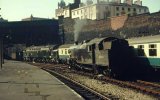
Takes some liberties with the plot though, as Margaret Rutherford's Miss Marple is not only the detective, but also the witness, and the housekeeper she gets placed in Ackenthorpe Hall (changed from Rutherford Hall in the book) to investigate. They are three different people in the book.The Margaret Rutherford film version (Murder She Said - 1961) also has some great GWML action, shot near Taplow. D603 features in those sequences. Paddington and some spurious WCML stock shots also feature as well as her train overtaking 2221 with its numberplate reversed!
Snow hill staggered on with trains to Wolverhampton until 1972, demolition followed in 1977Living in Birmingham in the early 1960s, Snow Hill - Paddington via Banbury was the preferred route to London, as the WCML was so disrupted by electrification and associated works. I think that the timetable had been enhanced because of the extra traffic transferring from the Euston route.
Once the new electrified WCML timetable came into use, the New St - Euston route became so much quicker (around 90 minutes vs 2 & 1/2 hours), and quieter and cleaner, that demand for the GWR route disappeared. The old GWR Snow Hill station was closed and demolished within a few years.
Oxfordblues
Member
- Joined
- 22 Dec 2013
- Messages
- 1,118
I was at Wrexham (General) on that fateful day. After seeing the Castles streak majestically through I walked to Croes Newydd roundhouse where three pannier-tanks were still simmering before their imminent withdrawal. I still regret not having a camera to record the sad scene (sorry: off-topic!)I was there (and I think some other current members too), at Chester on that last day.
Sir Felix Pole
Established Member
The key question is what train was the 4.50? It is not one of the regular clockface express departures from Paddington at that time. St. Mary Mead must be a secret station somewhere between Paddington and Didcot on the quadruple section to be able to pass the murder's train.
Gloster
Veteran Member
The key question is what train was the 4.50? It is not one of the regular clockface express departures from Paddington at that time. St. Mary Mead must be a secret station somewhere between Paddington and Didcot on the quadruple section to be able to pass the murder's train.
Edmund Crispin wrote about The Moving Toyshop, but Christie managed a moving village. St Mary Mead has been within 25 miles of London, within 25 miles of Alton, in Kent, only 12 miles from from two different seaside locations and other locations.
Christie was known not to particularly bother about most details of her books other than means of murder and other matters directly connected with the crime, so you will just have to accept that it is wherever it is…this time. When it was written her main home was near Wallingford, so she was presumably familiar with the trains out of Paddington

Bevan Price
Established Member
- Joined
- 22 Apr 2010
- Messages
- 8,321
In the final year or two, steam worked only as far south as Shrewsbury. Chester to Birkenhead was not 100% steam - an occasional Class 40 worked into Birkenhead Woodside.I was there (and I think some other current members too), at Chester on that last day. Two enthusiasts' excursions were run, hauled by preserved Castles, but there was still some steam operation to the end, and the Chester (reversal) to Birkenhead final leg was all steam, with a few Black 5 turns on down to Wolverhampton. There was commonly only half the train formation run north of Wolverhampton.
The express service from Paddington to Birmingham had actually been substantially enhanced for the last few years, with the Euston service cut right back for electrification work.
Attachments
There is a similar timing issue with the opening of Larkin's poem The Whitsun Weddings:The key question is what train was the 4.50?
That Whitsun I was late getting away, not until about one-twenty on that sunlit Saturday
The Saturday lunchtime Hull-Kings Cross train departed at 12.20 in the timetable.
Was there a Whitsun Saturday when it was an hour late start?
Gloster
Veteran Member
There is a similar timing issue with the opening of Larkin's poem The Whitsun Weddings:
The Saturday lunchtime Hull-Kings Cross train departed at 12.20 in the timetable.
Was there a Whitsun Saturday when it was an hour late start?
Note that it is he that is late getting away, not the train: he could have been delayed at work. In 1962 the London train was at 12.20 p.m., but there was one to Bradford at 1.25 p.m. (unlikely) and a stopper to Doncaster at 1.29 p.m., although the latter doesn’t seem to offer any advantage over waiting for the 2.32 p.m. Hull to Sheffield.
So with a bit of poetic licence he could have got the 1.29. But it is all poetic licence in a poem.
So with a bit of poetic licence he could have got the 1.29. But it is all poetic licence in a poem.
In the poem the train is clearly going to London and there is nothing to suggest that there was a a change of trains en route.
But poetic licence is for poets!
If you want real trains and real locations, best try Dorothy Sayers and "Five Red Herrings". IIRC, there was a formal dinner or similar occasion when Sayers called out to Christie, "Aren't you sick of Poirot, Agatha? God, I'm sick of Wimsey!" Perhaps creating Miss Marple helped.
Last edited:
I've always imagined St Mary Mead as being based on Cholsey (as has been said, Agatha Christie lived near Wallingford at the time. Her grave- and very impressive it is- is in Cholsey churchyard).The key question is what train was the 4.50? It is not one of the regular clockface express departures from Paddington at that time. St. Mary Mead must be a secret station somewhere between Paddington and Didcot on the quadruple section to be able to pass the murder's train.

Fawkes Cat
Established Member
- Joined
- 8 May 2017
- Messages
- 5,262
It'll be interesting when it coincides in space and time with the Simpsons' home town of Springfield.Edmund Crispin wrote about The Moving Toyshop, but Christie managed a moving village. St Mary Mead has been within 25 miles of London, within 25 miles of Alton, in Kent, only 12 miles from from two different seaside locations and other locations.
Sir Felix Pole
Established Member
In the 1958 WR timetable - the nearest available on Timetable World to view - the 4.45 'Cathedrals Express' to Hereford / Kidderminster (non stop to Oxford) overtakes the 4.38 semi-fast to Worcester. The 4.38 has a connection at Reading for St. Mary Mead (aka Cholsey) - maybe this was AC's regular service and gave her the idea?I've always imagined St Mary Mead as being based on Cholsey (as has been said, Agatha Christie lived near Wallingford at the time. Her grave- and very impressive it is- is in Cholsey churchyard).
Gloster
Veteran Member
In the poem the train is clearly going to London and there is nothing to suggest that there was a a change of trains en route.
But poetic licence is for poets!
I was awoken from a nap
By a man in a black cap
The Devil! No, a porter
Who told me I didn’t oughter
Stay there in my seat
For it was just not meet
So in the town of Doncaster
I changed to a train much faster
That took me to the big city
And the year is nineteen sixty-three.
The 4.45 from Paddington definitely doesn't sound as poetic!In the 1958 WR timetable - the nearest available on Timetable World to view - the 4.45 'Cathedrals Express' to Hereford / Kidderminster (non stop to Oxford) overtakes the 4.38 semi-fast to Worcester. The 4.38 has a connection at Reading for St. Mary Mead (aka Cholsey) - maybe this was AC's regular service and gave her the idea?
Gloster
Veteran Member
In the 1958 WR timetable - the nearest available on Timetable World to view - the 4.45 'Cathedrals Express' to Hereford / Kidderminster (non stop to Oxford) overtakes the 4.38 semi-fast to Worcester. The 4.38 has a connection at Reading for St. Mary Mead (aka Cholsey) - maybe this was AC's regular service and gave her the idea?
Although it is irrelevant to the main thread, as Christie’s home was just beyond the southern edge of Wallingford it is quite possible that she would have taken a taxi to and from Cholsey. As the distance from Wallingford station was sufficiently far to probably justify a taxi, why go away from the junction station to catch a train back to it: the distance to Cholsey wasn’t that much further?
(Spellcheck: who, what or where is Chelsey…or even ChOlsen?)
LickeyIncliner
Member
Edmund Crispin wrote about The Moving Toyshop, but Christie managed a moving village. St Mary Mead has been within 25 miles of London, within 25 miles of Alton, in Kent, only 12 miles from from two different seaside locations and other locations.
Christie was known not to particularly bother about most details of her books other than means of murder and other matters directly connected with the crime, so you will just have to accept that it is wherever it is…this time. When it was written her main home was near Wallingford, so she was presumably familiar with the trains out of Paddington
She may well have invented the departure time of the train precisely to avoid getting a ton of letters telling her what she'd got wrong about the details of the train and its operation !
(I hasten to add that I'm often fascinated to read such details, in a forum such as this - why else would I be here? I'm only suggesting that Christie probably wasn't.)
Gloster
Veteran Member
If you want real trains and real locations, best try Dorothy Sayers and "Five Red Herrings". IIRC, there was a formal dinner or similar occasion when Sayers called out to Christie, "Aren't you sick of Poirot, Agatha? God, I'm sick of Wimsey!" Perhaps creating Miss Marple helped.
In some of her books Christie had a recurring character called Ariadne Oliver, a detective novelist who in turn had a fictional serial detective (or perhaps cereal detective) called Sven Hjerson. Sven Hjerson was a vegetarian Finn, which allowed Christie to make Oliver say things that seem to express Christie’s occasional frustration about having chosen a fastidious Belgian as a detective.
norbitonflyer
Established Member
Sayers once answered a query as to why she made Wimsey have such expensive tatses by saying that she owed her literary success to him, so he had earned it.IIRC, there was a formal dinner or similar occasion when Sayers called out to Christie, "Aren't you sick of Poirot, Agatha? God, I'm sick of Wimsey!" Perhaps creating Miss Marple helped.
And it didn't cost her any more to give him a Daimler instead of a Morris 8.
Sayers was knowledgeable about cars of various shapes and sizes - she constructed a plot line around the ignition arrangements on a 3-wheeled Morgan and compared it with that rare beast, the part oil-cooled Belsize-Bradshaw. Christie could have had fun putting 18000 at the head of the 4.50 of course!Sayers once answered a query as to why she made Wimsey have such expensive tatses by saying that she owed her literary success to him, so he had earned it.
And it didn't cost her any more to give him a Daimler instead of a Morris 8.
norbitonflyer
Established Member
Sayers was knowledgeable about cars of various shapes and sizes - she constructed a plot line around the ignition arrangements on a 3-wheeled Morgan and compared it with that rare beast, the part oil-cooled Belsize-Bradshaw.
However, in the same story she has a vehicle with an impossible number plate. Surprising, as in another story a number plate provides a clue to the informed reader (albeit not picked up by Wimsey) that someone has connections with a different part of the country than they claim. In the same story a character owns a Renault, signifying somewhat exotic tastes (in the 1930s, motor vehicle taxes in most countries, including the UK's RAC formula, tended to make running imported cars expensive - Renault was, however, the commonest imported make to the UK)
Sayers was also a keen motorcyclist. see the short story "The Fantastic Horror oft he Cat in the Bag"
https://standardebooks.org/ebooks/d...xt/the-fantastic-horror-of-the-cat-in-the-bag,
which describes a motorcycle chase up the Great North Road, describing the machines in great detail. (The contents of the bag are not actually a cat)
Gloster
Veteran Member
However, in the same story she has a vehicle with an impossible number plate. Surprising, as in another story a number plate provides a clue to the informed reader (albeit not picked up by Wimsey) that someone has connections with a different part of the country than they claim. In the same story a character owns a Renault, signifying somewhat exotic tastes (in the 1930s, motor vehicle taxes in most countries, including the UK's RAC formula, tended to make running imported cars expensive - Renault was, however, the commonest imported make to the UK)
Sayers was also a keen motorcyclist. see the short story "The Fantastic Horror oft he Cat in the Bag"
https://standardebooks.org/ebooks/d...xt/the-fantastic-horror-of-the-cat-in-the-bag,
which describes a motorcycle chase up the Great North Road, describing the machines in great detail. (The contents of the bag are not actually a cat)
In those days you had to make up a number plate: the county offices did not provide a service equivalent to DVLA's current one which will provide a suitable unused and blocked number.
You had the risk that if you chose a number at random, you might find that it had been allocated and an aggrieved owner was suing you: I believe there was at least one instance of the legal process being started.
There was a case in recent years when a TV drama used a car belonging to one of the crew for a child molester (or similar) and after transmission the owner found himself accosted by people who couldn’t tell fact from fiction (that was roughly what happened: it is a while since I read about it).
norbitonflyer
Established Member
Indeed, but it could at least look plausible. O1 O1 O1 (whether the O's are letters or numbers) is not in a format ever used in the UK.In those days you had to make up a number plate: the county offices did not provide a service equivalent to DVLA's current one which will provide a suitable unused and blocked number.
You had the risk that if you chose a number at random, you might find that it had been allocated and an aggrieved owner was suing you: I believe there was at least one instance of the legal process being started.
"Have His Carcase" was published in 1932, the year that the last two-letter marks were issued in Great Britain (although NI and the RoI were still issuing 2 letter marks in the 70s) and three letter marks started to appear. Maybe it was actually OIO 101 - a mark that would have been issued by Co Meath in 1974 had they not skipped from NIO to PIO, or Belfast mark OI 101 with a spurious leading zero?
Dorothy Sayers was usually careful about such things. In "Unnatural Death" (1927) the supposed victim's car has a London XX registration (issued in 1925).
MarlowDonkey
Established Member
- Joined
- 4 Apr 2013
- Messages
- 1,844
I had always assumed so. Fonts and spacing could be adjusted to make it read OI OI OIMaybe it was actually OIO 101 - a mark that would have been issued by Co Meath in 1974 had they not skipped from NIO to PIO, or Belfast mark OI 101 with a spurious leading zero?
norbitonflyer
Established Member
OYO 101 would have worked, albeit not issued (by London County Council) until 1954I had always assumed so. Fonts and spacing could be adjusted to make it read OI OI OI
O 10101, if Birmingham missed the memo and went beyond 9999 (reached in 1913)
There are several previous threads on this topic but it's quite a fascinating history.
As stated they originally ran via High Wycombe but by the 1970s had become a mostly two-hourly clockface service via Oxford, generally alternating with Worcester services though with some variation.
From 1979 there was big growth in the South Coast to Birmingham via Reading services, though the roughly-clockface pattern remained until around 1981. In 1982 there were still several Paddington-Birmingham services (timetable available for free on Timetable World) but more irregularly timed.
From 1983 and especially 1984 the number of services started winding down with the growth in South Coast services, though there was IIRC a slight increase in the late 80s and the 90s and they remained into the Virgin era.
As stated they originally ran via High Wycombe but by the 1970s had become a mostly two-hourly clockface service via Oxford, generally alternating with Worcester services though with some variation.
From 1979 there was big growth in the South Coast to Birmingham via Reading services, though the roughly-clockface pattern remained until around 1981. In 1982 there were still several Paddington-Birmingham services (timetable available for free on Timetable World) but more irregularly timed.
From 1983 and especially 1984 the number of services started winding down with the growth in South Coast services, though there was IIRC a slight increase in the late 80s and the 90s and they remained into the Virgin era.
didcotdean
Member
- Joined
- 25 Jun 2013
- Messages
- 169
The 1961 film adaptation starts with an announcement for the train which is said to call at Ealing Broadway, Hanwell, Hayes, West Drayton, Langley, Taplow, Milchester & Brackhampton. Milchester had a hospital and a university so could be Reading but there is apparently a lot of argument over how Christie's geography corresponds to real places.
Gloster
Veteran Member
The 1961 film adaptation starts with an announcement for the train which is said to call at Ealing Broadway, Hanwell, Hayes, West Drayton, Langley, Taplow, Milchester & Brackhampton. Milchester had a hospital and a university so could be Reading but there is apparently a lot of argument over how Christie's geography corresponds to real places.
Quite simply: it often doesn’t. Neither here nor in many other books.
- Status
- Not open for further replies.