
-
Our new ticketing site is now live! Using either this or the original site (both powered by TrainSplit) helps support the running of the forum with every ticket purchase! Find out more and ask any questions/give us feedback in this thread!
You are using an out of date browser. It may not display this or other websites correctly.
You should upgrade or use an alternative browser.
You should upgrade or use an alternative browser.
379001 - broken buttons and worn seats.
- Thread starter jon0844
- Start date
- Status
- Not open for further replies.
Sponsor Post - registered members do not see these adverts; click here to register, or click here to log in
R
RailUK Forums

Nym
Established Member
Does anyone (Nym?) know if they just changed the spec of the button - i.e. metal to plastic, or whether they're a cheaper option - perhaps by only a few pence - that hasn't really paid off?
I'll see if I can find a copy of the old EAO Type 56 catalog when I get back into the rolling stock office next week, that is what is fitted to parts of the stock that I've worked on.
EAO are likely to have significantly changed the design from type 56 to type 57 though, assuming they are the EAO buttons and Bombardier haven't moved to another manufacturer.
We have some of the newer types kicking around at my company, but not the passenger operated types, mainly the 22mm ones, but housed in a sealed switch panel that is interchangeable, as mods are still going on, they haven't failed yet, but they haven't reached life expiry either.
I did work on some of the older EAO buttons, industrial modular ones that are very much out of manufacture, due to reliability issues on one of the fleets I was looking into a campaign service and/or replacement. The push buttons are up to a lifespan of around 10,000,000 operations now at a minimum and the contractors (switches) are living between 500,000 and 2,000,000 operations. I doubt that those BT are using have lived that long.
Everything I have used, the moving parts that bend in any way, or provide retention have been steel, or rarely in the case of push buttons there is a molded plastic spring. I rarely see plastic in things I put out for use on the trains, and even when it is, it's usually solid plastic with steel spring.
Last edited:
edwin_m
Veteran Member
"fell off the side of a train"
Still no progress?
To answer the question regarding if there was a change of design, yes there does appear to be one in the last few years.
This old one is from 450566

This new one is from 377708

(The ring for the light is more raised on the new design which means less of the silver edge of the button is showing).
The 379s have this new design.
II noticed that the button seemed to flex a lot when I pressed it on the edge (flex as in the opposite edge of the button coming outwards fairly noticeably when I was pressing down). The old one hardly did this.
To answer the question regarding if there was a change of design, yes there does appear to be one in the last few years.
This old one is from 450566
This new one is from 377708
(The ring for the light is more raised on the new design which means less of the silver edge of the button is showing).
The 379s have this new design.
II noticed that the button seemed to flex a lot when I pressed it on the edge (flex as in the opposite edge of the button coming outwards fairly noticeably when I was pressing down). The old one hardly did this.
Last edited:

Is it me or are the new batch of buttons being applied to some of the Cross Country Voyager Fleets as well? The 221 I had yesterday had a few of the external surrounds missing just retaining the button and in one case a twig of a button (the small button underneath the circular main plastic one!).
When there's no button, just the contact underneath, I cannot see how this button is suitable for visually impaired people - or indeed anyone that now has to be very precise.
It's quite amazing that nobody has said anything, and AGA just says it will feed back to the engineering team.
Erm, I think they probably know about the problem by now! But they're also doing sod all about it.
It's quite amazing that nobody has said anything, and AGA just says it will feed back to the engineering team.
Erm, I think they probably know about the problem by now! But they're also doing sod all about it.
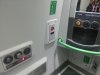
I found a few buttons missing in the big toilet of 377602. The worst one was the Close button, which was also missing the nub! Luckily these new ones have a close button outside too. The nearest inter-car door button was like this too.
theres a few missing their button all through the train now.
Last edited:
Not surprised, this was taken on 5 August. Do recall seeing one or two missing on 608 or 618 recently. One of the doors on 608, the open and close arrows were the wrong way roundtheres a few missing their button all through the train now.

Not surprised, this was taken on 5 August. Do recall seeing one or two missing on 608 or 618 recently. One of the doors on 608, the open and close arrows were the wrong way round
well thats it, maybe they are easily removable rather than broken and people have been swapping them round!
The LM door buttons on the 172s are apparently all being replaced as so many are falling off/being removed. The manufacturer have admitted quality issues with them. Would think if they are being done other fleets suffering the same issue would follow.

Sparks807Evo
Member
- Joined
- 22 Aug 2010
- Messages
- 465
I've noticed London Midland seem to be replacing any that have dropped off the 172s fortunately - thought at first it was vandalism but then after loading up the forum find the true explanation!
More like they've got spare buttons and someone didn't know which one went where.
Easy to do. How many times have you been in a lift and confused the door open / close buttons when looking quickly? Just me? Oh.
They did say Open and Close on the grey base
 . I'd have gone straight for the wrong button if I wasn't paying attention . On 608 I was actually paying attention for the A/C system, as the inner 1/3 of the leading DMCO had heating on in that section only! Everywhere else was fine, although I did enjoy the heat that evening .
The LM door buttons on the 172s are apparently all being replaced as so many are falling off/being removed. The manufacturer have admitted quality issues with them. Would think if they are being done other fleets suffering the same issue would follow.
They probably exceed Bombardier's own expectations though!
They probably exceed Bombardier's own expectations though!
Its kind of interesting to note that it seems to be only Bombardier built rolling stock that has these issues though - 172s, 220/221s, 377 & 379s. I wonder how little or long it'll be before the 387s suffer the same issues? But to see it on the fairly new 379s was bad enough, but for it to appear on nearly new 377/6s is bad enough too!

Its kind of interesting to note that it seems to be only Bombardier built rolling stock that has these issues though - 172s, 220/221s, 377 & 379s. I wonder how little or long it'll be before the 387s suffer the same issues? But to see it on the fairly new 379s was bad enough, but for it to appear on nearly new 377/6s is bad enough too!
For 221's I've never seen missing buttons on Virgin's ones. Although could just been when i have traveled with them and not seen.

Class377/5
Established Member
- Joined
- 19 Jun 2010
- Messages
- 5,594
Its kind of interesting to note that it seems to be only Bombardier built rolling stock that has these issues though - 172s, 220/221s, 377 & 379s. I wonder how little or long it'll be before the 387s suffer the same issues? But to see it on the fairly new 379s was bad enough, but for it to appear on nearly new 377/6s is bad enough too!
Fact its also reported on the 377/7 is worrying sign too. The units are brand new!
Sparks807Evo
Member
- Joined
- 22 Aug 2010
- Messages
- 465
You'd have thought they'd have changed the design or type of button by now. They've had the same problem on the 172s, 379s etc. since 2011 - three years down the line and nothing has changed. At least LM bother to fix the problem and replace the buttons. Anyone want a bet the Aventras on Crossrail will have the fault
BurtonM
Member
There are certainly quality issues with the plastic faced buttons on 379s.
But what's that weird loud metallic pop/clang some trains make on a regular basis? Always gives me quite a shock, it sounds like someone opening some kind of airlock while slamming the vestibule bin lid.
But what's that weird loud metallic pop/clang some trains make on a regular basis? Always gives me quite a shock, it sounds like someone opening some kind of airlock while slamming the vestibule bin lid.
swtandgw
Member
If it's in the PTSO and you're near the pantograph well, that would be the VCB opening and closing when passing a neutral section. They seem to be the most loud on Electrostar units.There are certainly quality issues with the plastic faced buttons on 379s.
But what's that weird loud metallic pop/clang some trains make on a regular basis? Always gives me quite a shock, it sounds like someone opening some kind of airlock while slamming the vestibule bin lid.
- Status
- Not open for further replies.