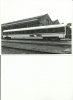
‘The International Coach’
Very interesting responses to ‘timmydunn’ enquiry. Some further elaboration of the story may also be of interest.
The attached photograph, is from the original supplied by Adtranz, which still survives and is the one shown in the post by ‘dubscottie’.
This coach was a mock up for demonstration only purposes.
It had lain deteriorating at Adtranz, Litchurch Lane, Derby for many years. Rather than it be scrapped, it was donated by Adtranz in 2000 and came to the Great Central Railway (Nottingham) based at Ruddington.
Following enquires at the time for information on this coach, Adtranz kindly provided the following information in a letter dated 23 October 2000.
“Unfortunately, we do not have much information on the original international coach, but it is known that the vehicle was built to a standard UIC loading gauge cross section, and was the standard UIC length of 26.4m.
The vehicle was built in 1983-84, and was the subject of a major presentation to an audience of senior railway managers from many countries in April 1984.
The main objective of the programme was to adapt the well-established structural principles used in the British Rail Mark 111 coach to develop a modular coach bodyshell, which could be manufactured within a given range of lengths, widths and loading gauge profiles. In this way, export markets could be offered a vehicle with the high safety reputation of the Mark 111.
This demonstration coach was built to be a static exhibit. It was never intended for main line operation, and the running gear, including couplers were therefore only suitable for low speed shunting within the works complex.
Following the unveiling of the coach, orders were received from West Africa to supply coaches to CFCO, Congo and OCTRA, Gabon. Some of the latter vehicles had an unusual interior layout, being part open saloon seating, part side corridor couchette compartments. There were also elements of the design used in the coaches supplied to larnrod Eireann, Ireland, although the design of these vehicles was much closer to the BR Mark 111.
Unfortunately, 1984 was about the time at which opinion started turning against locomotive hauled rolling stock in favour of fixed formation (largely multiple units) trains, and this is why no further development took place.” Ends...
The coach consisted of end vestibule with WC, two side corridor compartments, one with drop down bunks, the other six seated with luggage racks above. Next was a buffet section with non-operational hob, oven, and fridge, under cupboards and substantial worktop preparation areas all formed in stainless steel and entered off the customer serving area with its counter and roller shutter closure. A circulation area with a floor to ceiling pole and circular drinks counter attached
This entered via a sliding glass door into an open plan 2 + 1 reclining seat arrangement approx. 5/6 rows aside the walk through to another glass sliding door into the other end vestibule with WC.
It was situated next to a temporary platform at GCRN and used as a visitor facility. The buffet counter served drinks/snacks for visitors awaiting the next train. The open plan section with original seats removed, provided occasional seating/tables as a meeting room/film show and photo exhibit boards. It provided almost 10 years of service, so it did enter into service, albeit static.
It was mounted on new B4 or Commonwealth bogies. Although not powered up, it had working air conditioning and the doors powered, opening outward and back onto the coach side.
The temporary platform mentioned had long out lived its safe working use and following the opening of a newly constructed 10 coach platform named ‘Ruddington Fields’ in 2009, the temporary structure was removed for further major redevelopment work leaving the ‘International Coach’ marooned on a section of isolated rail. Despite the best efforts of this poster to retain the coach for further use and historical interest, its time was up!
In August 2010 its last resting place was C F Booths, Rotherham. Its legacy was a very useful sum to the support charity, LNER (GC) Heritage Trust and two 'as new' bogies.