1S81 20:50 Carlisle - Perth was a lovely train, pretty much guaranteed a "Roarer" (class 81-85) ex Carlisle, then a class 27 ex Mossend. It connected at Perth into both the northbound Glasgow QS / Edinburgh overnight and the 01:05 to Aberdeen. You were pretty much committed to doing an overnight once you joined 1S81.

-
Our new ticketing site is now live! Using either this or the original site (both powered by TrainSplit) helps support the running of the forum with every ticket purchase! Find out more and ask any questions/give us feedback in this thread!
You are using an out of date browser. It may not display this or other websites correctly.
You should upgrade or use an alternative browser.
You should upgrade or use an alternative browser.
1970-1974 WCML Weaver Jct -Glasgow electrification
- Thread starter GRALISTAIR
- Start date
Sponsor Post - registered members do not see these adverts; click here to register, or click here to log in
R
RailUK Forums
Falcon1200
Established Member
You were pretty much committed to doing an overnight once you joined 1S81.
One could take 1S81 the short distance from Motherwell to Coatbridge Central and travel behind two lovely locos! Although what you would then do in Coatbridge at that time of night is another thing.....
From the stories I heard, what people did was worry about getting out in one piece.One could take 1S81 the short distance from Motherwell to Coatbridge Central and travel behind two lovely locos! Although what you would then do in Coatbridge at that time of night is another thing.....
I never did the Coatbridge Central move, but I did get the DMU from Springburn to Cumbernauld to intercept 1S81 there. It was a once in a lifetime experience, I never did it again.

D6130
Established Member
Walk as quickly as possible to Sunnyside and take a Blue Train into Glasgow?One could take 1S81 the short distance from Motherwell to Coatbridge Central and travel behind two lovely locos! Although what you would then do in Coatbridge at that time of night is another thing.....


GraphitProjekt
Member
I found a very enlightening article on the opening of Glasgow North I'll link here (Railway Gazette vol. 113 iss. 19 4 Nov. 1960 p536) it's only 1 and a half pages, I'm not giving anyone homework here!The Motherwell feeder also fed the North electrics via a cable to the Sunnyside area. The need to replace the cable was a factor in the decision to electrify Mossend-Gartsherrie.
But it makes the assertion that Parkhead feeder itself supplied 2x 25kV cables going to Finnieston and Westerton substations. The implication being that at those locations there were 25/6.25kV transformers. But I suppose this also makes sense for feeding 25kV over to Helensburg if Dalreoch was out of use. Comparing the article with these images of layout of electrified lines you can see they call Westerton and Finnieston "sub-feeder stations", presumbaly for this reason. Coatbridge is also a "sub feeder station" because of the cable up from Motherwell.
I think by 1980 the 6.25kV had been removed and so imagine there was no use for those cables from that point.
Interesting that replacing the cable was an influencing factor in electrifying that section because as far as I'm aware, the alternative configuration for Parkhead fully out of use is have Bathgate FS feed all the way to Parkhead form the East, and Eglinton Street from the west via Rutherglen. There isn't actually a substation sectioning the two lines as they cross around Coatbridge, I'm sure there's isolator switches that could do it though. If anything, it's more like a benefit of A2B that the Motherwell-Coatbridge cable could be decomissioned.

43096
On Moderation
- Joined
- 23 Nov 2015
- Messages
- 18,741
Indeed... I well remember being behind a Siemens ES64F4 arriving at München Ost, doing well over 60mph at the platform end. Dynamic brake in and stopped perfectly at the required stopping point! Very impressive.Continental locomotives have very powerful rheostatic brakes, in Germany in particular it was and is possible to brake from 160km/h to low speed the whole train on the loco's rheostatic (and these days regenerative) brake within their very tight classic line braking distances.

GRALISTAIR
Established Member
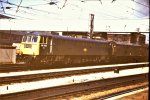
Was that the real reason why those three were refitted that way? Or was it to simply be as testbeds / technology demonstrators for the class 87?I remember flexicoil suspension being fitted to class 86s - because of the unsprung mass and high speed problem. Here is 86102 fitted with them at Preston circa late 1974 ish?
If the intention really was to reduce the unsprung mass then surely the rest of the fleet would have been so treated? Instead the 86/2 fleet were created to solve the problem

hexagon789
Veteran Member
102 was one of the three Class 86 Class 87-prototypes modfied in 1972 to gain experience with the new design of bogie, transformer and frame-mounted traction motors as would be fitted to the 87s.I remember flexicoil suspension being fitted to class 86s - because of the unsprung mass and high speed problem. Here is 86102 fitted with them at Preston circa late 1974 ish?
In later years, when Class 87s began being passed for 110mph when equipped with new BW high-speed pantographs, the three 86/1s were also passed for the higher speed.
== Doublepost prevention - post automatically merged: ==
They were basically prototypes for the 87s, modified so experience could be gained with the changes incorporated in the Class 87 design.Was that the real reason why those three were refitted that way? Or was it to simply be as testbeds / technology demonstrators for the class 87?
If the intention really was to reduce the unsprung mass then surely the rest of the fleet would have been so treated? Instead the 86/2 fleet were created to solve the problem

hexagon789
Veteran Member
Yes, 19 of the 86/0s (those without modified suspension and restricted to 80mph as a result), were fitted with SAB resilient wheels to allow them to operate at 100mph in the late-70s and classified 86/3.Were resilient wheels not also fitted to some 86s to obviate the track forces problem?
Unfortunately, it was found in practice to not offer the reduction in track forces desired and so the 86/3s and remaining 86/0s were all ultimately fitted with flexicoil suspension from 1984 onwards, collectively becoming 86/4s.

d9009alycidon
Member
One could take 1S81 the short distance from Motherwell to Coatbridge Central and travel behind two lovely locos! Although what you would then do in Coatbridge at that time of night is another thing.....
Well for me it was round to the fountain for a bus home to Coatdyke!

Helvellyn
Established Member
- Joined
- 28 Aug 2009
- Messages
- 2,568
I think the three 86/1s got new bogies, as fitted to the 87s along with the same traction motors. For rostering purposes they were treated as 87s due to higher tractive output.Was that the real reason why those three were refitted that way? Or was it to simply be as testbeds / technology demonstrators for the class 87?
If the intention really was to reduce the unsprung mass then surely the rest of the fleet would have been so treated? Instead the 86/2 fleet were created to solve the problem
My understanding is that the 86/2s, and later 86/4s, had the original bogies modified to take the flexicoil suspension. If 86101-3 did indeed get new bogies that would have given three sets of spares to assist with the flexicoil modifications.
Don't forget Zebedee - the testbed for flexicoil and streamlined noses!
Thanks for that. I remember seeing a cutaway diagram of the wheels - I think the resilience came from a stratum of rubber or somesuch in the wheel assembly. I thought it looked a bit optimistic, but then again I'm no engineer.Yes, 19 of the 86/0s (those without modified suspension and restricted to 80mph as a result), were fitted with SAB resilient wheels to allow them to operate at 100mph in the late-70s and classified 86/3.
Unfortunately, it was found in practice to not offer the reduction in track forces desired and so the 86/3s and remaining 86/0s were all ultimately fitted with flexicoil suspension from 1984 onwards, collectively becoming 86/4s.
Resilient wheels had a long history even then, they first came to prominence in the USA-designed PCC tram design of the 1930s, of which many thousands were built, running on into rapid transit cars with the same technology, and I never heard of any issue with them. Something tells me they were originally patented by a Swedish manufacturer. Didn't Dowty or another have the UK patent rights?Thanks for that. I remember seeing a cutaway diagram of the wheels - I think the resilience came from a stratum of rubber or somesuch in the wheel assembly. I thought it looked a bit optimistic, but then again I'm no engineer.
edwin_m
Veteran Member
I recall SAB being mentioned in relation to resilient wheels on 86s. I don't know what it stood for or who they were.
D6130
Established Member
Wasn't that E3183?Don't forget Zebedee - the testbed for flexicoil and streamlined noses!
E3173 I think. I was very taken with its streamlining at the time - I daresay that experiment contributed at least a little something to the APT and HST nose designs.Wasn't that E3183?
From memory there were some bad European accidents with resilient wheels separating / delayering. Mainly in trams???Resilient wheels had a long history even then, they first came to prominence in the USA-designed PCC tram design of the 1930s, of which many thousands were built, running on into rapid transit cars with the same technology, and I never heard of any issue with them. Something tells me they were originally patented by a Swedish manufacturer. Didn't Dowty or another have the UK patent rights?
hexagon789
Veteran Member
The ICE at Eschede is the infamous one, but that was fatigue fracturing rather than delayering.From memory there were some bad European accidents with resilient wheels separating / delayering. Mainly in trams???
It does reduce track forces but seemingly not enough in an 86 with axle-hung motors running at 100mph.Don't forget Zebedee - the testbed for flexicoil and streamlined noses!
Thanks for that. I remember seeing a cutaway diagram of the wheels - I think the resilience came from a stratum of rubber or somesuch in the wheel assembly. I thought it looked a bit optimistic, but then again I'm no engineer.
The design was originally invebted for Trams I believe and developed from there.
43096
On Moderation
- Joined
- 23 Nov 2015
- Messages
- 18,741
Most notably the Eschede catastrophe in June 1998 involving a DB ICE running at 200km/h.From memory there were some bad European accidents with resilient wheels separating / delayering. Mainly in trams???
That was especially visible at Lancaster P4 with rail burns both from slides under braking and wheel spin trying to pull away up the incline southboundIt does reduce track forces but seemingly not enough in an 86 with axle-hung motors running at 100mph.
Gloster
Veteran Member
I recall SAB being mentioned in relation to resilient wheels on 86s. I don't know what it stood for or who they were.
SAB was Svenska Aktiebolaget Bromsregulator (Swedish Brake Control Company) founded in Malmö circa 1916. It had tried out resilient wheels on a local tramcar in 1933 and later on a French railcar. Svenska Järnvägar fitted them to the large rod-driven Dm/Dm3 used on the Iron Ore Line and later to the Da locos, also rod-driven. If a picture in a brochure tells it true, they were also fitted to the two Bristol four-wheeled railbuses.
GRALISTAIR
Established Member
43096
On Moderation
- Joined
- 23 Nov 2015
- Messages
- 18,741
Looks like they both have flexicoil suspension?In this one taken at Euston I have Class 86 with and without Flexicoil
edwin_m
Veteran Member
That's not related to track forces, it's to do with poor adhesion. The WCML Bo-Bos were quite lightweight relative to their power so wheelslip was a significant risk, particularly on the steep gradients of the Weaver-Glasgow section where weather was often damp and misty.That was especially visible at Lancaster P4 with rail burns both from slides under braking and wheel spin trying to pull away up the incline southbound
Flexicoils (or to a lesser extent resilient wheels) reduce the unsprung mass, which hammers the track with a large force wherever there is a slight imperfection. This tended to make the imperfection worse and ultimately pulverised the ballast leaving a patch of mud that "pumped" every time a train went over. The 81-85 had the traction motors attached to the bogie frame and driving the axles through a flexible drive, so they were not part of the unsprung mass. The 86s tried to make this simpler/cheaper this by adopting nose-suspended traction motors with a non-flexible gearing to the axle and the other end of the motor attached to the bogie frame by a pivot. Thus, the motor had to move up and down with the axle, pivoting at the other end, and much of the weight of the motor was therefore unspung. Southern EMUs had the same arrangement, but at lower speed and with less weight on the axle so weren't as bad for track damage.
As mentioned above, the 87s reverted to a flexible drive. The APT and Class 91 reduced track forces still further by attaching the motors to the body so they were above both the primary (between the axle boxes and the bogie frame) and secondary (between the bogie frame and the body) suspension.
both seem to be numbered as 86/2Looks like they both have flexicoil suspension?
D6130
Established Member
Yes.... you're right!E3173 I think. I was very taken with its streamlining at the time - I daresay that experiment contributed at least a little something to the APT and HST nose designs.
== Doublepost prevention - post automatically merged: ==
You could have fooled me, judging by the incidence of clay pumping spots (also known as 'wet beds') on the various Southern Region main lines over the last fifty years....particularly the Brighton main line, which is the the most intensively-used of them all. However, I digress and am wandering off-topic.Southern EMUs had the same arrangement, but at lower speed and with less weight on the axle so weren't as bad for track damage.
Last edited:
edwin_m
Veteran Member
The amount of damage per axle was probably less, but the Brighton line would have a lot more motored axles passing over per hour than the WCML.Yes.... you're right!
== Doublepost prevention - post automatically merged: ==
You could have fooled me, judging by the incidence of clay pumping spots (also known as 'wet beds') on the various Southern Region main lines over the last fifty years....particularly the Brighton main line, which is the the most intensively-used of them all. However, I digress and am wandering off-topic.

TheHovisKid
Member
I remember those bring there, but weren't they well back, north of Westborne Road bridge?That was especially visible at Lancaster P4 with rail burns both from slides under braking and wheel spin trying to pull away up the incline southbound