
• Our new ticketing site is now live! Using either this or the original site (both powered by TrainSplit) helps support the running of the forum with every ticket purchase! Find out more and ask any questions/give us feedback in this thread!

(Fantasy) A through-running commuter rail tunnel for Birmingham

squingo44

Member
Joined
5 Jan 2026
Messages
176
Location
London
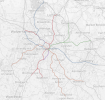
I tried coming up with the most reasonable way of getting all local services out of Birmingham New Street, freeing it up to run regional and intercity services more reliably. I came up with the following network, aiming to minimise the amount of tunnelling and the number of underground stations:

- Quadruple the track from Wolverhampton to Soho South Junction, from Bescot Stadium to Perry Barr North Junction, from Landor Street Junction to Water Orton East Junction, from University to King's Norton, and from Adderley Park to Rugby
- Build two tunnelled railways under Birmingham City Centre, from Soho South Junction to Adderley Park and from Church Road Junction to Duddeston
- Build three new underground stations: a Birmingham Central underground station with cross-platform interchange between the two underground lines and direct interchange with New Street, Moor Street, and Curzon Street, a Five Ways replacement station and a Ladywood station
- Expand the following stations with additional platforms and turnbacks to support terminating more services: Wolverhampton, Rugeley Trent Valley, Lichfield Trent Valley, Tamworth, Nuneaton, Coventry East (proposed), King's Norton, and Bromsgrove.

This builds on the Midland Rail Hub proposals to expand Moor Street station. It ought to leave most of the capacity on the existing lines free for new services, especially Birmingham New Street. In particular, it could support more Thameslink-style outer commuter services, such as Stafford-Rugby, Shrewsbury-Leicester, and Worcester-Derby.

Junctions such as Aston North, Water Orton East, Barnt Green and Soho South can be grade separated as necessary to increase service capacity.
 

Attachments

  • map.png
    map.png
    2.4 MB · Views: 75
Sponsor Post - registered members do not see these adverts; click here to register, or click here to log in
R

RailUK Forums

The Planner

Veteran Member
Joined
15 Apr 2008
Messages
19,630
Why would it make it more reliable, the nature of long distance services suggests that they get delayed getting to New St, not by it as a location.
Landor St to Water Orton is nigh on 4 tracked anyway and as for the others, taking the cross city out of the station isn't actually going to free a lot up. Adderley Park to Rugby is being 4 tracked, its called HS2. Bescot to Perry Barr is far from full. All of this would cost billions which would be better spent on finishing HS2.
 

Sprinter107

Member
Joined
26 Mar 2019
Messages
1,090
Between Five Ways and Bournville, the line is on the edge of the Birmingham and Worcester canal. Where are the extra pair of lines going to go ?
 

Zomboid

Established Member
Joined
2 Apr 2025
Messages
2,209
Location
Oxford
A chord at Smethwick Galton Bridge or Soho to allow Shrewsbury services to divert to Snow Hill lines
How full are they? And would it actually help if Soho to Wolverhampton is still taking the same amount of trains as today?
 

Topological

Established Member
Joined
20 Feb 2023
Messages
4,256
Location
Swansea
I always liked the idea of a suburban tunnel for Birmingham. It feels like there are crossing moves. However, when you look at the junctions the actual moves are not so bad. The CrossCity trains coming in from Five Ways use the higher number platforms and then go out over the top of the lines from the lower number platforms, they do not cross on the level.

The issue is more the two tracks down to Kings Norton, the two tracks to Wolverhampton and the two tracks on the corresponding North East and London routes. Those two track sections mean you have longer distance trains being held by locals. HS2 will help with Wolverhampton since Birmingham to Manchester should be quicker via HS2, but that is possibly only one train. Birmingham to Coventry will be eased slightly, but the likely replacements for the Avanti will not be stopping that often between Birmingham and Coventry.

I am not 100% sure what the answer is. More dynamic loops probably. Expensive to add on what is often actually built as a two-track line, but still cheaper than a tunnel.
 

Zomboid

Established Member
Joined
2 Apr 2025
Messages
2,209
Location
Oxford
The Camp Hill lines mean there are 4 tracks (of a sort) to Kings Norton, though it's a flat junction and both routes have stopping trains now, so not necessarily that easy to path that many fasts (how many does the route need?)

HS2 should make the Coventry line simpler as the remaining London trains won't need to be in a hurry on the busiest section.

The Wolverhampton line is probably the trickiest one now?
 

squingo44

Member
Joined
5 Jan 2026
Messages
176
Location
London
Between Five Ways and Bournville, the line is on the edge of the Birmingham and Worcester canal. Where are the extra pair of lines going to go ?
Some residential land take would be necessary, but this could be accommodated by taking larger blocks, redeveloping them into higher density residential land, and building more stations along the line.

== Doublepost prevention - post automatically merged: ==

I always liked the idea of a suburban tunnel for Birmingham. It feels like there are crossing moves. However, when you look at the junctions the actual moves are not so bad. The CrossCity trains coming in from Five Ways use the higher number platforms and then go out over the top of the lines from the lower number platforms, they do not cross on the level.

The issue is more the two tracks down to Kings Norton, the two tracks to Wolverhampton and the two tracks on the corresponding North East and London routes. Those two track sections mean you have longer distance trains being held by locals. HS2 will help with Wolverhampton since Birmingham to Manchester should be quicker via HS2, but that is possibly only one train. Birmingham to Coventry will be eased slightly, but the likely replacements for the Avanti will not be stopping that often between Birmingham and Coventry.

I am not 100% sure what the answer is. More dynamic loops probably. Expensive to add on what is often actually built as a two-track line, but still cheaper than a tunnel.
All four main line railways into Birmingham New Street have space to be quad-tracked quite some way into the city centre, the point at which you need to enter a tunnel being determined by your appetite for taking over residential land.

But every single one of those lines is busy enough to justify complete segregation, on top of HS2.

== Doublepost prevention - post automatically merged: ==

The Camp Hill lines mean there are 4 tracks (of a sort) to Kings Norton, though it's a flat junction and both routes have stopping trains now, so not necessarily that easy to path that many fasts (how many does the route need?)

HS2 should make the Coventry line simpler as the remaining London trains won't need to be in a hurry on the busiest section.

The Wolverhampton line is probably the trickiest one now?
Any railway line near the centre of Birmingham should have extremely high frequencies - both lines via Kings Norton should be quadrupled.

HS2 doesn’t help with Coventry to Birmingham particularly much, the line could still support demand for a full set of local services and a full set of express services. HS2 will, if anything, only further induce demand on the line for both kinds of service.
 
Last edited:

6Gman

Established Member
Joined
1 May 2012
Messages
9,184
Some residential land take would be necessary, but this could be accommodated by taking larger blocks, redeveloping them into higher density residential land, and building more stations along the line.
Confiscation of land and property tends to be unpopular, for obvious reasons.
 

The Planner

Veteran Member
Joined
15 Apr 2008
Messages
19,630
Some residential land take would be necessary, but this could be accommodated by taking larger blocks, redeveloping them into higher density residential land, and building more stations along the line.

== Doublepost prevention - post automatically merged: ==


All four main line railways into Birmingham New Street have space to be quad-tracked quite some way into the city centre, the point at which you need to enter a tunnel being determined by your appetite for taking over residential land.

But every single one of those lines is busy enough to justify complete segregation, on top of HS2.

== Doublepost prevention - post automatically merged: ==


Any railway line near the centre of Birmingham should have extremely high frequencies - both lines via Kings Norton should be quadrupled.

HS2 doesn’t help with Coventry to Birmingham particularly much, the line could still support demand for a full set of local services and a full set of express services. HS2 will, if anything, only further induce demand on the line for both kinds of service.
The question you have to answer is "why". What is it you are trying to provide and why? I don't see where the land is to 4 track the Cov corridor, nor out to Kings Norton, nor on the Camp Hill. Cross City will eventually go back to 6tph, how many more does it need to be, why does it need to be more? Same goes for all the other routes, how many trains need to serve those stations? Are all the current trains full, all day? Can you provide the capacity by making them longer, or is the case you need 6tph (pretty much turn up and go) on all lines? The only stations between New St and Wolves that have a relatively poor service are Rolfe St, Dudley Port and Tipton at 2tph. The rest are at 4tph minimum.
 

HSTEd

Veteran Member
Joined
14 Jul 2011
Messages
20,265
Massive compulsory purchase for surface trackwork is unlikely to work out cheaper than simply tunneling once the massive fights with the local population are accounted for.
 

squingo44

Member
Joined
5 Jan 2026
Messages
176
Location
London
The question you have to answer is "why". What is it you are trying to provide and why? I don't see where the land is to 4 track the Cov corridor, nor out to Kings Norton, nor on the Camp Hill. Cross City will eventually go back to 6tph, how many more does it need to be, why does it need to be more? Same goes for all the other routes, how many trains need to serve those stations? Are all the current trains full, all day? Can you provide the capacity by making them longer, or is the case you need 6tph (pretty much turn up and go) on all lines? The only stations between New St and Wolves that have a relatively poor service are Rolfe St, Dudley Port and Tipton at 2tph. The rest are at 4tph minimum.
Like the rest of the country, the West Midlands needs to decarbonise its transport network and densify development around the city centre. The only way to achieve this is a massive expansion of their commuter rail network far beyond current capacity. More than anywhere else, the West Midlands has seen explosive growth in usage of its passenger rail network, and incremental improvements aren't going to be enough after merely a few years. For all stations within half an hour of central Birmingham, 6 TPH should be the floor, not the ceiling.

== Doublepost prevention - post automatically merged: ==

Massive compulsory purchase for surface trackwork is unlikely to work out cheaper than simply tunneling once the massive fights with the local population are accounted for.
I think that there are many ways to sell the proposals for widening the existing corridors. Everywhere that a meaningful number of single-family residential homes must be demolished in order to widen the corridor, a new station should be proposed and the project widened further into a full-fledged neighbourhood regeneration. For instance, between Wolverhampton and Birmingham New Street, there would be room for several infill stations and capacity for a full >20 TPH stopping service. Likewise between New Street and Coventry, there would be room for several infill stations to sell the benefit of the expansion.

Purchasing land for expansion of the railways at the surface is only more expensive than tunnelling when the land is high-value and densely developed. You don't need to get that far away from Birmingham City centre for the price to go in favour of surface expansion over tunnelling.

Finally, the most realistic way to deliver this transformational improvement to the network would be to do so in stages. You could build just the central tunnels first, in effect quadrupling the lines into Birmingham New Street, and expand the quad-tracking gradually outwards section by section to simplify delivery and apply the proper focus to each local community affected. Everyone benefits from a better-functioning railway network, not least because New Street is so connected to so much of the national network.

== Doublepost prevention - post automatically merged: ==

I always liked the idea of a suburban tunnel for Birmingham. It feels like there are crossing moves. However, when you look at the junctions the actual moves are not so bad. The CrossCity trains coming in from Five Ways use the higher number platforms and then go out over the top of the lines from the lower number platforms, they do not cross on the level.
The cross city trains cross the western station throat actually, because the junction between the cross city lines and the derby line east of New Street is not grade separated. Grade separating Proof House junction is just yet another improvement the west mdlands network needs.
The issue is more the two tracks down to Kings Norton, the two tracks to Wolverhampton and the two tracks on the corresponding North East and London routes. Those two track sections mean you have longer distance trains being held by locals.
Yup, they need to be fixed. Quad-track on the surface as far into the city centre as you can get from King's Norton, then enter a tunnel.
I am not 100% sure what the answer is. More dynamic loops probably. Expensive to add on what is often actually built as a two-track line, but still cheaper than a tunnel.
Partial quadrupling of the two track railway is a good start, and builds towards the eventual goal of complete quad-tracking, but ultimately I think complete quad-tracking is necessary.
 
Last edited:

Topological

Established Member
Joined
20 Feb 2023
Messages
4,256
Location
Swansea
I would have thought you would get all the benefits you need from a few dynamic loops.

New Street has 6 platforms per pair that go in and out, so you are not too constrained there. Even allowing for the Manchester to Camp Hill crossing between pairs of lines, most can be handled through the availability of platforms.

More concerning is where the CrossCountry that goes via Five Ways (and the Hereford/Cardiff to an extent) can pass the increased CrossCity line trains. When I am looking what is happening with CrossCountry for Bristol Parkway to the South West, there are always delays added between Birmingham and Kings Norton.

6 trains per hour should be plenty for all stations and efforts should be made to ensure they are all 6-car 730s or longer.

Towards Wolverhampton there are more options for dynamic loops and many have been explored as workable on threads in this section.

== Doublepost prevention - post automatically merged: ==

The cross city trains cross the western station throat actually, because the junction between the cross city lines and the derby line east of New Street is not grade separated. Grade separating Proof House junction is just yet another improvement the west mdlands network needs
I just split this part out.

CrossCity head for Lichfield and that is grade-separated.

Proof House towards Derby also uses the south side of the formation and then goes under the London line. That is grade-separated. Crucially, it is not electrified and so it is not the primary through route for birmingham suburban trains.

I am wondering if you are confusing the services here?
 

HSTEd

Veteran Member
Joined
14 Jul 2011
Messages
20,265
I think that there are many ways to sell the proposals for widening the existing corridors. Everywhere that a meaningful number of single-family residential homes must be demolished in order to widen the corridor, a new station should be proposed and the project widened further into a full-fledged neighbourhood regeneration. For instance, between Wolverhampton and Birmingham New Street, there would be room for several infill stations and capacity for a full >20 TPH stopping service. Likewise between New Street and Coventry, there would be room for several infill stations to sell the benefit of the expansion.

Purchasing land for expansion of the railways at the surface is only more expensive than tunnelling when the land is high-value and densely developed. You don't need to get that far away from Birmingham City centre for the price to go in favour of surface expansion over tunnelling.

The area around the line line between Wolverhampton and Birmingham, at least, does look heavily developed.

This is a world where compulsory purchase of a house is on the order of half a million pounds at least (it will be substantially higher than the open market cost once legal fees and inducements etc are included).

Replacing road bridges with ones suitable for a four track railway will cost tens of millions each, and even stations will require access arrangements and structures likely to require demolitions even beyond their upfront cost.

It might sound expensive up front, but I would not be surprised if a metro tunnel with stations bored from Wolverhampton to Coventry worked out cheaper than attempting to do the same on surface, especially including costs of the legal battles. Engineering problems are way easier to solve than political ones.

Ofcourse a new tunnel solution also allows you to embrace all the features of a modern metro which would bear fruit in the long run.
 

Sprinter107

Member
Joined
26 Mar 2019
Messages
1,090
Some residential land take would be necessary, but this could be accommodated by taking larger blocks, redeveloping them into higher density residential land, and building more stations along the line.

== Doublepost prevention - post automatically merged: ==


All four main line railways into Birmingham New Street have space to be quad-tracked quite some way into the city centre, the point at which you need to enter a tunnel being determined by your appetite for taking over residential land.

But every single one of those lines is busy enough to justify complete segregation, on top of HS2.

== Doublepost prevention - post automatically merged: ==


Any railway line near the centre of Birmingham should have extremely high frequencies - both lines via Kings Norton should be quadrupled.

HS2 doesn’t help with Coventry to Birmingham particularly much, the line could still support demand for a full set of local services and a full set of express services. HS2 will, if anything, only further induce demand on the line for both kinds of service.
So four tracks out to Kings Norton, it would mean both Church Road and Pershore Road tunnels being doubled in width, some of Hallfields school being demolished. Residential properties in Farquhar Road Edgbaston being flattened, other buildings in Vincent Drive coming down, houses in Raddlebarn Road Selly Oak coming down, part of Cadburys being demolished, then either residential properties in York Close, the site of what was Bournville shed being flattened, or industrial units off Charlotte Road on the other side of the line being demolished. There would be an absolute uproar. Thats besides major reconstruction of University, Selly Oak, and Bournville stations. All for the sake of increasing what is already a frequent local service. And as for additional stations, the ones we already have are very close together as it is.
 

Topological

Established Member
Joined
20 Feb 2023
Messages
4,256
Location
Swansea
Selly Oak to Bourneville looks possible, but may need some new retaining walls to replace slopes a la the Trent Valley 4-tracking in Tamworth.

Going the other way, Selly Oak to University looks doable, but there you have the issue that University was just modernised as a two-platform.
 

Zomboid

Established Member
Joined
2 Apr 2025
Messages
2,209
Location
Oxford
If a tunnel is essential, then how about using it for the fast lines. Dig a tunnel Kings Norton to Washwood Heath. Build a 4x 300m platform station under the bullring with exits at either end to New St and Moor/ Curzon St.

The XC Cardiff - Nottingham and Plymouth to Edinburgh trains can go that way. Worcester/ Hereford line trains and the Stansted service can turn around in the platforms.

Of course, a bunch of that replicates what the Moor St expansion does, so pretty pointless really.
 

squingo44

Member
Joined
5 Jan 2026
Messages
176
Location
London
On the basis that the highest avoidable cost of building in this country is underground stations, how about a crossrail solution that takes the regional and intercity services out of Birmingham New Street instead?

Here's a new design that takes into account the feedback that I've tried to quad-track too many sections of track that are tightly surrounded by residential development. In the case of the cross-city/crosscountry line, there are sections that are already quad-tracked, making it easy to extend the tunnel all the way to those sections and avoiding the hassle of widening the existing corridors.

King's Norton station may require being moved west a little to make room for a tunnel portal east of the station (and it would be easier to align the tunnel portal with the camp hill line, which is adjacent to some commercial land up for grabs). King's Norton would probably require at least 6 platforms, and grade separation of the junction. There's plenty of space between Duddeston Junction and Washwood Heath for a tunnel portal, and the tunnel could potentially be extended on a spur to fit a depot north of the HS2 depot on the other side of the M6.

For the WCML towards Wolverhampton, I extended the tunnelled section to just short of Sandwell & Dudley, which is just beyond the stretch of railway most confined by residential land one side and the Birmingham Canal on the other. Some residential land take may be necessary between Dudley and Wolverhampton, but I expect that to be cheaper than tunnelling further beyond. Especially because this plan would require an expansion of Sandwell & Dudley station to have more platforms and turnback capacity for some services.

For the WCML towards Coventry, surfacing the tunnel beyond Lea Hall means that the only sections of track requiring residential land take would be Marston Green and Earsldon and Binley in Coventry. I think this strikes the right balance between avoiding the cost of residential land take close to Birmingham city centre while avoiding growing the cost of tunnelling too much.

In order to minimise the complexity and cost of the central Birmingham station, there would only be 4 platforms - more like a central-London Elizabeth line station than a big box station like Old Oak Common. Since it would be for regional and intercity services, it would be necessary to expand the capacity of every surrounding shoulder station to maintain the reliability of the timetable. But it's a lot cheaper to expand stations like Nuneaton, Bromsgrove, Birmingham International, and Lichfield Trent Valley than it is to build a larger underground station in central Birmingham.

== Doublepost prevention - post automatically merged: ==

If a tunnel is essential, then how about using it for the fast lines. Dig a tunnel Kings Norton to Washwood Heath. Build a 4x 300m platform station under the bullring with exits at either end to New St and Moor/ Curzon St.

The XC Cardiff - Nottingham and Plymouth to Edinburgh trains can go that way. Worcester/ Hereford line trains and the Stansted service can turn around in the platforms.
I would avoid turning around services in central Birmingham like the plague - a huge unnecessary capacity sink. Build a big shoulder station on the cross country line at Nuneaton or Tamworth and turn around services there.

Of course, a bunch of that replicates what the Moor St expansion does, so pretty pointless really.
What makes you think that this additional capacity would replicate, rather than complement, the moor street expansion?
 

Attachments

  • regional_tunnel.png
    6.1 MB · Views: 6

Zomboid

Established Member
Joined
2 Apr 2025
Messages
2,209
Location
Oxford
What makes you think that this additional capacity would replicate, rather than complement, the moor street expansion
Birmingham doesn't need jubilee line frequency, e population just isn't dense enough. Most suburban stations would be well enough served with an evenly spaced 4tph.
 

The Planner

Veteran Member
Joined
15 Apr 2008
Messages
19,630
Like the rest of the country, the West Midlands needs to decarbonise its transport network and densify development around the city centre. The only way to achieve this is a massive expansion of their commuter rail network far beyond current capacity. More than anywhere else, the West Midlands has seen explosive growth in usage of its passenger rail network, and incremental improvements aren't going to be enough after merely a few years. For all stations within half an hour of central Birmingham, 6 TPH should be the floor, not the ceiling.

== Doublepost prevention - post automatically merged: ==
Decarbonising doesn't need what you are proposing, OLE does that. You haven't answered where the need is, what is lacking, where does the increase in capacity need to be and what is it for? Why does everywhere within 30 minutes need 6tph? A lot of London only just achieves that, Liverpool, Manchester and Leeds come nowhere near.
I think that there are many ways to sell the proposals for widening the existing corridors. Everywhere that a meaningful number of single-family residential homes must be demolished in order to widen the corridor, a new station should be proposed and the project widened further into a full-fledged neighbourhood regeneration. For instance, between Wolverhampton and Birmingham New Street, there would be room for several infill stations and capacity for a full >20 TPH stopping service. Likewise between New Street and Coventry, there would be room for several infill stations to sell the benefit of the expansion.
That's genuinely bonkers, what you are suggesting is a tram network as that many stations on a heavy rail network would actually put people off as the journey time would increase monumentally. For example if you look at Wolverhampton to New St now, that is a 27 minute journey stopping at 6 stations. Add in 4 or 5 more and that journey is likely increasing towards the 40 minute mark. How are you fitting 20tph at New St, even with your underground plan on just a single corridor? Now add on the Coventry side, Cross City, Walsall, Camp Hill etc.
The cross city trains cross the western station throat actually, because the junction between the cross city lines and the derby line east of New Street is not grade separated. Grade separating Proof House junction is just yet another improvement the west mdlands network needs.
How are you doing that without building more tunnels into New St and more platforms?
Partial quadrupling of the two track railway is a good start, and builds towards the eventual goal of complete quad-tracking, but ultimately I think complete quad-tracking is necessary.
Why?

New Street has 6 platforms per pair that go in and out, so you are not too constrained there. Even allowing for the Manchester to Camp Hill crossing between pairs of lines, most can be handled through the availability of platforms.

It varies by pair, Coventry corridor can do 1-12, Derby 1-12, Wolves 1-12, Five Ways 5-12. Aston 1-12
 

The Pelican

Member
Joined
3 Oct 2025
Messages
391
Location
London
Birmingham (Snow Hill) and Wolverhampton have had a tram connection between them since 1999, improved since 2016 with direct access to Birmingham New Street and more recently to Wolverhampton station, and a new route to Edgbaston Village. Later this year, a new line to Dudley will open from a triangular junction with the existing route. A planned line will run past the HS2 station eastwards, potentially to the NEC and HS2 Birmingham Interchange station.

It's interesting to speculate what this tram line would have looked like as a grade seperated metro line, which was an option considered at various stages, perhaps looking like the Tyne and Wear metro or the DLR. It would probably have run into the old Low Level station at the Wolverhampton end, and had a single tunnel from Snow Hill to New Street at the Birmingham end. The Dudley extension (which uses an existing railway line) might have gone ahead, although with stations futher out from the town centre, but it seems unlikely the Edgbaston branch would have been affordable to tunnel.
 

Top