• Our new ticketing site is now live! Using either this or the original site (both powered by TrainSplit) helps support the running of the forum with every ticket purchase! Find out more and ask any questions/give us feedback in this thread!

Pros and cons of Continuous Welded Rail (CWR)

ainsworth74

Forum Staff
Staff Member
Global Moderator
Joined
16 Nov 2009
Messages
31,067
Location
Redcar
There are also a lot of internet people who seem to think the rail in this country is Chinese.
Possibly getting themselve confused between the, until recent, owner of British Steel Jingye Group and where the actual plant that makes rail in this country.
Are there? I see one person with such a view on this thread, unless I am missing something...
Thankfully our Forum members are in general more informed buy if you take a scroll through Twitter and similar the place was rife with that sort of poorly informed nonsense :rolleyes:
 
Sponsor Post - registered members do not see these adverts; click here to register, or click here to log in
R

RailUK Forums

D6130

Established Member
Joined
12 Jan 2021
Messages
8,924
Location
West Yorkshire/Tuscany
It's just possible that the section had staggered joints.
I certainly remember a few, Usually accompanied by a slight rocking from side to side because joints are never as level as continuous rail.
There are still a couple of short sections like that on the Oban and Mallaig lines
 

furnessvale

Established Member
Joined
14 Jul 2015
Messages
4,897
There are still a couple of short sections like that on the Oban and Mallaig lines
I'm amazed staggered joints have survived. The are absolute suicide in propagating twist in track geometry a major cause of derailments.
 

edwin_m

Veteran Member
Joined
21 Apr 2013
Messages
28,586
Location
Nottingham
I'm amazed staggered joints have survived. The are absolute suicide in propagating twist in track geometry a major cause of derailments.
I thought they'd been banned because of the risk of hitting a resonance with the sway frequency of a vehicle, which might make it sway more and more until it fell off the track.
 

furnessvale

Established Member
Joined
14 Jul 2015
Messages
4,897
I thought they'd been banned because of the risk of hitting a resonance with the sway frequency of a vehicle, which might make it sway more and more until it fell off the track.
I can't argue with you on that. It sounds like a technical description of what we, in the late 1960s, called twist which when applied alternately to opposite sides of a vehicle, would produce that result.

When measured by a track recording trolley, a 1 in 300 twist would produce a dash of yellow paint and a twist of 1 in 240 a red dash, each directly applied in the 4ft. Staggered joints would quickly empty the paint pots! :D
 

Annetts key

Established Member
Joined
13 Feb 2021
Messages
3,787
Location
West is best
And for those on a train a con is you can't count the rail joints in, I recall, 41 seconds to get the speed of the train in mph......
Unless the joints are staggered or 60 foot rails have been cut in half so are only 30 foot long (this is done to reduce the cost of fixing defects).

Also, in some places, several lengths of 60 foot rail may have been welded together...
 

martin butler

Member
Joined
9 Oct 2018
Messages
847
For approx. 10-11 months of the year, the track tends to behave as expected, the stressing done, really is a compromise, stress for too hot, and you lose some of the resistance to cold, stress for normal conditions, that we get in the UK, and for maybe one month, you risk buckling and breakages, if we get untypical heat spells,

A greater problem is the track bed being affected by weather extremes, such as, wash outs, slips, clay drying out and shrinking, undermining the base the track rests on,
 

Merle Haggard

Established Member
Joined
20 Oct 2019
Messages
3,850
Location
Northampton
Unless the joints are staggered or 60 foot rails have been cut in half so are only 30 foot long (this is done to reduce the cost of fixing defects).

Also, in some places, several lengths of 60 foot rail may have been welded together...

Having done it in the days when jointed track was common I am sure that I would have quickly noticed the difference in rhythm.

Apart from being able roughly to estimate the speed, the rhythm of a bogie coach travelling over 30' rails would not be the familiar diddly - dar. ... diddly dar. On 60' rails the rear bogie of a coach makes a sound from passing over a railjoint and very soon after that the front bogie passes over the railjoint in front of the one just passed over.

In other words, the sound is not made by both bogies passing over the same railjoint sequencially, so the sound is different. I've never knowingly travelled over 30' rails but I have over (uniformly) staggered 60' track and the resulting is a continuous da da da da da da.

Sadly, I never managed to travel in a 70 foot coach but presumably both bogies would pass over rail joints nearly simultaneously.

As I mentioned above, welds could be detected in those days. In my opinion, better than trying to record times passing successive quarter mile posts by simultaneously noting then in exactly the same position relevant to the window while looking at a stopwatch.
 

AndrewE

Established Member
Joined
9 Nov 2015
Messages
7,300
I'm amazed staggered joints have survived. The are absolute suicide in propagating twist in track geometry a major cause of derailments.
I well remember being on trains on the continent, probably French couchettes - but day trains as well, and noting the dum-dum-dum rhythm, rather than diddly da! I knew we weren't in a 12-wheel coach so I concluded it was from staggered rail joints. Their track maintenance must have been good as the ride was brilliant.
 

edwin_m

Veteran Member
Joined
21 Apr 2013
Messages
28,586
Location
Nottingham
I can't argue with you on that. It sounds like a technical description of what we, in the late 1960s, called twist which when applied alternately to opposite sides of a vehicle, would produce that result.

When measured by a track recording trolley, a 1 in 300 twist would produce a dash of yellow paint and a twist of 1 in 240 a red dash, each directly applied in the 4ft. Staggered joints would quickly empty the paint pots! :D
Yes I think broadly the same thing.

Resonance is like when someone is being pushed on a swing. If pushed each time at the moment the swing is going in that direction anyway, then the swing swings higher. Pushing at any other time doesn't have this effect and the swing hardly moves at all.

Similarly if a rail vehicle sways and each staggered joint gives it a push in the direction it is already swaying. Joints opposite each other don't induce swaying because they push both wheels at the same time, although they could create a sort of back and forth pitching.
 

Taunton

Veteran Member
Joined
1 Aug 2013
Messages
12,218
I'm amazed staggered joints have survived. The are absolute suicide in propagating twist in track geometry a major cause of derailments.
Curiously the USA has the opposite perspective, and on jointed track there staggered joints are normal, with various reasons given why they are better than what they tend to call "square" joints, UK style.

One is that square jointed track is more susceptible to developing kinking in extreme temperatures than staggered, which more inherently holds itself together. Another is the hammer blow for the wheels and axles is taken alternately, rather than both sides simultaneously. USA staggers are commonly not equal, but at one third-two thirds spacing, to overcome any harmonics.

Deterioration of the sleepers nearest the joint is minimised if the joints are staggered.
 

furnessvale

Established Member
Joined
14 Jul 2015
Messages
4,897
Curiously the USA has the opposite perspective, and on jointed track there staggered joints are normal, with various reasons given why they are better than what they tend to call "square" joints, UK style. One is that square jointed track is more susceptible to developing kinking in extreme temperatures than staggered, which more inherently holds itself together. Another is the hammer blow for the wheels and axles is taken alternately, rather than both sides simultaneously. USA staggers are commonly not equal, but at one third-two thirds spacing, to overcome any harmonics. Deterioration of the sleepers nearest the joint is minimised if the joints are staggered.
All quite valid in the setting of the USA with bogie vehicles. The UK had a preponderance of 2 axle vehicles, and 10ft wheelbase at that, which produced different problems.
 

Annetts key

Established Member
Joined
13 Feb 2021
Messages
3,787
Location
West is best
Are there? I see one person with such a view on this thread, unless I am missing something...

Edit: just to add, there is an interesting US-based article here:

It explains why rails no longer need to have joints to manage expansion, and explains various benefits of CWR, along with methods deployed to avoid buckling.

However, unless I missed it, the article doesn't quite seem to explicitly state whether CWR is more or less prone to buckling than jointed track; it's more a case of explaining why jointed track is no longer necessary and that there are many benefits to CWR.

I tried to find some research that actually states either way and couldn't find anything definitive, but maybe someone else can?
A steel rail without external forces and without being fixed in place is free of stress. It can expand and contract as the temperature changes. However, problems occur if you have a really long rail that is fixed at both ends (rail fixings don't prevent the rail from expanding or contracting).

In order to reduce the chances of CWR/LWR from buckling when it's hot, before the summer, the rail is cut leaving a gap, then both rails are pulled together by a stressing kit so that they are under tension. In other words, they are subjected to a force to stretch them to partly close the gap that was made earlier. Once the required tension has been applied, then the thermite weld is made to join the rails.

Thus when they get hot in the summer, they should not buckle, as the expansion of the steel will just reduce the amount of tension. The problems arise if either, the temperature goes above the designed "stress free" temperature (as any further rise in temperature may eventually cause the rail to buckle) or the rail stressing was not done when it should have been done or was not done correctly.

Jointed rails work very differently, because each rail is typically 60 feet in length, the management of expansion is done by ensuring in winter that a suitable side gap is left between each rail at the fishplated joint. The holes are drilled a defined distance from the end of the rail so that the gap is the correct size.

In summer, on a hot day, the gap between the rails will be a lot smaller that it is in winter, and may close up completely. Further rail expansion may increase the risk of bucking. As well as this, the expansion often damaged IRJ (Insulated Rail Joints) which then cause track circuits to fail and show occupied with no train present.

Clearly it's much easier to re-stress CWR/LWR (which covers many miles) than it is to re-rail jointed track if the gap at the joints is/was incorrect or unable to cope with the temperature swings.

In other words, you can adjust the stress free temperature of CWR/LWR after it has been laid, but this is impractical for jointed track. So with all the other advantages of CWR/LWR...

I thought they'd been banned because of the risk of hitting a resonance with the sway frequency of a vehicle, which might make it sway more and more until it fell off the track.
I'm not a P.Way guy, but as an S&T technician, I have spent plenty of time walking the track (S&T have to fit "bonding" wires across every fishplated rail joint for a track circuited line), watching the P.Way at work and occasionally chatting to them. So I don't know what restrictions exist. But I do know that on curves, it's not uncommon for the joints to become partly staggered. Or when there has been spot renewals using a different length of rail compared to what was originally fitted.
 
Last edited:

Bald Rick

Veteran Member
Joined
28 Sep 2010
Messages
35,581
The problems arise if either, the temperature goes above the designed "stress free" temperature (as any further rise in temperature may eventually cause the rail to buckle) or the rail stressing was not done when it should have been done or was not done correctly.

It’s not a problem if the temperature goes above the SFT (Stress Free temperature). The desired SFT in nearly all circumstances is 27C.

What is a problem is the Critical Rail Temperarture, CRT, of the rail. There are three levels of CRT:

CRT (W) which means ’Watchman’ (Watchperson now I guess), ie someone needs to be out there checking the temperature (can be done remotely).

CRT (30/60) means a 30/60mph Emergency Speed Restriction ESR must be applied

CRT (20) means a 20mph ESR must be applied.

Each and every rail has a CRT.

For undisturbed track, on good ballast well consolidated, the CRT (W) is SFT +32C, ie 59C. CRT 30/60 is another +5C (64C) and CRT 20 a further 5C (69C). To get to CRT 30/60 with a rail temp of 64C requires an unshaded rail in an airtemp of 44/45C in full sunlight on a high summer afternoon. Note there is no ‘block the line’ CRT. Also note these ESRs serve two purposes, a) to reduce the force on the rail thereby reducing the risk of a buckle, and 2) to reduce the consequence of any derailment.

There are then various adjustments made to the CRTs if the track is not undisturbed on good ballast, well consolidated. Mostly downwards.

For example, recent minor tamping reduces CRT (W) to SFT +22C (30/50mph another +4C, 20mph a further +3C) Major tamping is lower still. Recent renewals with new ballast all in place CRT (W) is SFT+15C (30/60mph another +3C, 20mph a further +2C). These CRTs rise over the days immediately following the work, assuming of course trains are passing over to consolidate the ballast.

There are other reductions to CRT for short radius curves, eg all CRTs are reduced by 4C for curves of radii 800m - 1500m, and more for lower radii. Similarly for non-concrete sleepers (-9C) or bullhead rail on any sleeper (-9C). There are many other factors to apply given localised site conditions.

The upwards adjustments are for where sleeper spacing is 28 per length (60foot) +2C, and 30 per length +4C.

So for the vast majority of track in this country, the CRT (W) is 59C (SFT 27C +22) and not an issue even on the hottest days. However on tightly curved sections, or after recent works, or with less robust components, the temperature can be much lower. As it can be where the SFT is not 27C, for whatever reason. It is the job of the relevant Rail Management Engineer in each Maintenance Depot to retain the Stressing records for every site, and to hold the CRTs, and action any mitigations. The exception is sites still under the control of renewals colleagues, where it will be the responsibility of the relevant engineer in that organisation.

I have mentioned before how I had to impose heat ESR in February for a renewal job. The track and rail was installed on a cold (lets say -4C) February night, we had to get out without stressing to avoid an overrun, it was on curve and naturally the ballast wasn’t consolidated. SFT was -4C. CRT was SFT -4C +15C for unconsolidated ballast, and -4C for the curve, so CRT = 7C. Weather next day was sunny with an airtemp of 13C. Rail temp the same. 20mph Speed restriction imposed, and I basically had to explain what I have written above in a long email to the then TOC MD.


This is all per my (old, but still this century) copy of the Pway maintenance manual. Some elements may have changed, but not much, as the laws of physics haven’t, as far as I’m aware. Finally, I should say that although this is based on decades of science, research and investigations following buckling incidents, it is still about risk management. Putting speed restrictions on does not eliminate the risk of buckles, but it does reduce the probability and consequence to a reasonable level. Sometimes other factors come into play, which means the risk control measures are ‘overtopped’ so to speak.

I hope this helps to explain what is a fairly complex subject.

 
Last edited:

Aventra

Member
Joined
17 Feb 2018
Messages
41
It’s a near on impossible situation in the UK due to the massively fluctuating weather conditions.

If you stress it too much for higher temperatures you risk broken rails in the winter. If you don’t stress it enough, you risk buckling in the summer. Combine that with the current dry conditions which have been similar the last few years, then the immensely wet winters where you end up with banks slipping (Oxenholme), so it’s a near on impossible situation.

As now realistically do you re-stress the network twice a year?
 

Starmill

Veteran Member
Joined
18 May 2012
Messages
27,143
Location
Bolton
I think some of the arguments have been that a higher stress free temperature would lower the risk of buckles in summer and raise the risk of contraction fractures in winter. I'm not sure if I really buy that idea though, at least not without a thorough assessment of the cost (both of safety of trains and neighbours, and also of repairs) of one buckle vs 1,000 fractures. While I take the point that one buckle is inherently very much more dangerous than one fracture, where's the break even point?

Either way, I'm not sure there's really anything convincing to suggest that the current approach to very high or very low temperatures is fundamentally wrong. At least not compared to the more obvious problems such as renewals having been deferred or simply having the infrastructure wear out faster because more moves over it.
 

Bald Rick

Veteran Member
Joined
28 Sep 2010
Messages
35,581
It’s a near on impossible situation in the UK due to the massively fluctuating weather conditions. If you stress it too much for higher temperatures you risk broken rails in the winter. If you don’t stress it enough, you risk buckling in the summer. Combine that with the current dry conditions which have been similar the last few years, then the immensely wet winters where you end up with banks slipping (Oxenholme), so it’s a near on impossible situation. As now realistically do you re-stress the network twice a year?

There’s no need to restress twice a year, almost all track is fine. That might be an option for the Siberian steppes with much higher temperature ranges, but not here.

One option is not to do any trackwork in the summer where there is a risk of temps above 34C (say). But that does mean any alignment defects - of which we have a great many at present due to embankment / formation shrinkage - have to have long standing (potentially months) TSRs on until it cools down. And a whole load of disruptive engineering works to fix them all from September just when the schools / colleges are back and the network is at it’s busiest.

Another option is to insist that all track work is fully welded and stressed before being brought into service, but that could be extremely disruptive - much more so than what we have now - and grossly inefficient.

== Doublepost prevention - post automatically merged: ==

I think some of the arguments have been that a higher stress free temperature would lower the risk of buckles in summer and raise the risk of contraction fractures in winter. I'm not sure if I really buy that idea though, at least not without a thorough assessment of the cost (both of safety of trains and neighbours, and also of repairs) of one buckle vs 1,000 fractures. While I take the point that one buckle is inherently very much more dangerous than one fracture, where's the break even point?

Various track engineers over the past 50 or so years have settled on 27C. We tend to have far fewer temperature induced buckles than rail breaks. Naturally we are in buckle season now, in the first sub zero cold snap in November / December we will have a spate of broken rails. (rather fewer than 25 years ago, though).
 
Last edited:

Taunton

Veteran Member
Joined
1 Aug 2013
Messages
12,218
There’s no need to restress twice a year, almost all track is fine. That might be an option for the Siberian steppes with much higher temperature ranges, but not here.

One option is not to do any trackwork in the summer where there is a risk of temps above 34C (say).
One does wonder how Union Pacific and BNSF manage across the southwest deserts in the USA, where summer day temperatures over 46C are common, nights notably cold, while the same areas can get significantly sub-zero snowfall in winter, with sometimes even a daily range over 40C - which militates against twice-yearly restressing!

Incidentally, these are some of the highest speed routes in the USA outside the NE Corridor, with even Amtrak doing over 100mph for long stretches - and they always have been.
 
Last edited:

Bald Rick

Veteran Member
Joined
28 Sep 2010
Messages
35,581
One does wonder how Union Pacific and BNSF manage across the southwest deserts in the USA, where summer day temperatures of 46C are common, while the same areas can get significantly sub-zero snowfall in winter, with sometimes even a daily range over 40C - which militates against twice-yearly restressing!

Incidentally, these are some of the highest speed routes in the USA outside the NE Corridor, with even Amtrak doing over 100mph for long stretches - and they always have been.

They have a higher SFT, and are content with more rail breaks and buckles - see the US railroads’ derailment rate.

Also they typically have a larger rail section (reducing the risk of breaks) and I bet they don’t do much work to the track in Summer.
 

Nicholas Lewis

Established Member
Joined
9 Aug 2019
Messages
7,980
Location
Surrey
It’s not a problem if the temperature goes above the SFT (Stress Free temperature). The desired SFT in nearly all circumstances is 27C.

What is a problem is the Critical Rail Temperarture, CRT, of the rail. There are three levels of CRT:

CRT (W) which means ’Watchman’ (Watchperson now I guess), ie someone needs to be out there checking the temperature (can be done remotely).

CRT (30/60) means a 30/60mph Emergency Speed Restriction ESR must be applied

CRT (20) means a 20mph ESR must be applied.

Each and every rail has a CRT.

For undisturbed track, on good ballast well consolidated, the CRT (W) is SFT +32C, ie 59C. CRT 30/60 is another +5C (64C) and CRT 20 a further 5C (69C). To get to CRT 30/60 with a rail temp of 64C requires an unshaded rail in an airtemp of 44/45C in full sunlight on a high summer afternoon. Note there is no ‘block the line’ CRT. Also note these ESRs serve two purposes, a) to reduce the force on the rail thereby reducing the risk of a buckle, and 2) to reduce the consequence of any derailment.

There are then various adjustments made to the CRTs if the track is not undisturbed on good ballast, well consolidated. Mostly downwards.

For example, recent minor tamping reduces CRT (W) to SFT +22C (30/50mph another +4C, 20mph a further +3C) Major tamping is lower still. Recent renewals with new ballast all in place CRT (W) is SFT+15C (30/60mph another +3C, 20mph a further +2C). These CRTs rise over the days immediately following the work, assuming of course trains are passing over to consolidate the ballast.

There are other reductions to CRT for short radius curves, eg all CRTs are reduced by 4C for curves of radii 800m - 1500m, and more for lower radii. Similarly for non-concrete sleepers (-9C) or bullhead rail on any sleeper (-9C). There are many other factors to apply given localised site conditions.

The upwards adjustments are for where sleeper spacing is 28 per length (60foot) +2C, and 30 per length +4C.

So for the vast majority of track in this country, the CRT (W) is 59C (SFT 27C +22) and not an issue even on the hottest days. However on tightly curved sections, or after recent works, or with less robust components, the temperature can be much lower. As it can be where the SFT is not 27C, for whatever reason. It is the job of the relevant Rail Management Engineer in each Maintenance Depot to retain the Stressing records for every site, and to hold the CRTs, and action any mitigations. The exception is sites still under the control of renewals colleagues, where it will be the responsibility of the relevant engineer in that organisation.

I have mentioned before how I had to impose heat ESR in February for a renewal job. The track and rail was installed on a cold (lets say -4C) February night, we had to get out without stressing to avoid an overrun, it was on curve and naturally the ballast wasn’t consolidated. SFT was -4C. CRT was SFT -4C +15C for unconsolidated ballast, and -4C for the curve, so CRT = 7C. Weather next day was sunny with an airtemp of 13C. Rail temp the same. 20mph Speed restriction imposed, and I basically had to explain what I have written above in a long email to the then TOC MD.


This is all per my (old, but still this century) copy of the Pway maintenance manual. Some elements may have changed, but not much, as the laws of physics haven’t, as far as I’m aware. Finally, I should say that although this is based on decades of science, research and investigations following buckling incidents, it is still about risk management. Putting speed restrictions on does not eliminate the risk of buckles, but it does reduce the probability and consequence to a reasonable level. Sometimes other factors come into play, which means the risk control measures are ‘overtopped’ so to speak.

I hope this helps to explain what is a fairly complex subject.
How are they deploying watchmen with the ban on Red Zone Working?
 

edwin_m

Veteran Member
Joined
21 Apr 2013
Messages
28,586
Location
Nottingham
Also they typically have a larger rail section (reducing the risk of breaks)
Does the rail section actually have any effect? It makes the rail more resistant to tension and compression forces, but because the forces come from thermal expansion they will be greater with a larger rail section! It does mean that a flaw or wheelburn has a relatively smaller impact, however they also have higher axle weights which probably make wheelburns worse.
 

trebor79

Established Member
Joined
8 Mar 2018
Messages
4,884
Does the rail section actually have any effect? It makes the rail more resistant to tension and compression forces, but because the forces come from thermal expansion they will be greater with a larger rail section! It does mean that a flaw or wheelburn has a relatively smaller impact, however they also have higher axle weights which probably make wheelburns worse.
The longitudinal expansion and strain will be the same as a thinner section rail for a given temperature difference. The thicker section means the rail can withstand higher forces.
 

edwin_m

Veteran Member
Joined
21 Apr 2013
Messages
28,586
Location
Nottingham
The longitudinal expansion and strain will be the same as a thinner section rail for a given temperature difference. The thicker section means the rail can withstand higher forces.
However, the extra cross-section means the force necessary to keep the rail at the correct length will be higher. The thicker section will be more resistant to buckling, but it's not clear to me which of these effects dominates.
 

8ace

Member
Joined
25 Dec 2019
Messages
270
Location
Brighton
It’s not a problem if the temperature goes above the SFT (Stress Free temperature). The desired SFT in nearly all circumstances is 27C.

What is a problem is the Critical Rail Temperarture, CRT, of the rail. There are three levels of CRT:

CRT (W) which means ’Watchman’ (Watchperson now I guess), ie someone needs to be out there checking the temperature (can be done remotely).

CRT (30/60) means a 30/60mph Emergency Speed Restriction ESR must be applied

CRT (20) means a 20mph ESR must be applied.

Each and every rail has a CRT.

For undisturbed track, on good ballast well consolidated, the CRT (W) is SFT +32C, ie 59C. CRT 30/60 is another +5C (64C) and CRT 20 a further 5C (69C). To get to CRT 30/60 with a rail temp of 64C requires an unshaded rail in an airtemp of 44/45C in full sunlight on a high summer afternoon. Note there is no ‘block the line’ CRT. Also note these ESRs serve two purposes, a) to reduce the force on the rail thereby reducing the risk of a buckle, and 2) to reduce the consequence of any derailment.

There are then various adjustments made to the CRTs if the track is not undisturbed on good ballast, well consolidated. Mostly downwards.

For example, recent minor tamping reduces CRT (W) to SFT +22C (30/50mph another +4C, 20mph a further +3C) Major tamping is lower still. Recent renewals with new ballast all in place CRT (W) is SFT+15C (30/60mph another +3C, 20mph a further +2C). These CRTs rise over the days immediately following the work, assuming of course trains are passing over to consolidate the ballast.

There are other reductions to CRT for short radius curves, eg all CRTs are reduced by 4C for curves of radii 800m - 1500m, and more for lower radii. Similarly for non-concrete sleepers (-9C) or bullhead rail on any sleeper (-9C). There are many other factors to apply given localised site conditions.

The upwards adjustments are for where sleeper spacing is 28 per length (60foot) +2C, and 30 per length +4C.

So for the vast majority of track in this country, the CRT (W) is 59C (SFT 27C +22) and not an issue even on the hottest days. However on tightly curved sections, or after recent works, or with less robust components, the temperature can be much lower. As it can be where the SFT is not 27C, for whatever reason. It is the job of the relevant Rail Management Engineer in each Maintenance Depot to retain the Stressing records for every site, and to hold the CRTs, and action any mitigations. The exception is sites still under the control of renewals colleagues, where it will be the responsibility of the relevant engineer in that organisation.

I have mentioned before how I had to impose heat ESR in February for a renewal job. The track and rail was installed on a cold (lets say -4C) February night, we had to get out without stressing to avoid an overrun, it was on curve and naturally the ballast wasn’t consolidated. SFT was -4C. CRT was SFT -4C +15C for unconsolidated ballast, and -4C for the curve, so CRT = 7C. Weather next day was sunny with an airtemp of 13C. Rail temp the same. 20mph Speed restriction imposed, and I basically had to explain what I have written above in a long email to the then TOC MD.


This is all per my (old, but still this century) copy of the Pway maintenance manual. Some elements may have changed, but not much, as the laws of physics haven’t, as far as I’m aware. Finally, I should say that although this is based on decades of science, research and investigations following buckling incidents, it is still about risk management. Putting speed restrictions on does not eliminate the risk of buckles, but it does reduce the probability and consequence to a reasonable level. Sometimes other factors come into play, which means the risk control measures are ‘overtopped’ so to speak.

I hope this helps to explain what is a fairly complex subject.
Thanks, great explanation - very interesting. :)
 

ac6000cw

Established Member
Joined
10 May 2014
Messages
3,884
Location
Cambridge, UK
One does wonder how Union Pacific and BNSF manage across the southwest deserts in the USA, where summer day temperatures over 46C are common, nights notably cold, while the same areas can get significantly sub-zero snowfall in winter, with sometimes even a daily range over 40C - which militates against twice-yearly restressing!

Incidentally, these are some of the highest speed routes in the USA outside the NE Corridor, with even Amtrak doing over 100mph for long stretches - and they always have been.
AFAIK, it's been a very long time since Amtrak trains have run at more than 90mph on the ex-ATSF/Santa Fe mainline in the southwest, and even 90mph needed working automatic train-stop equipment (ATS). As far as I'm aware the ATS has slowly been removed over the years due to age, so it's 79mph max nowadays - but it's still one of the fastest Amtrak long-distance routes.

They have a higher SFT, and are content with more rail breaks and buckles - see the US railroads’ derailment rate.

Also they typically have a larger rail section (reducing the risk of breaks) and I bet they don’t do much work to the track in Summer.

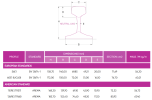
For interest, attached is a comparison of a couple of the heaviest US and European/UK rail sections (info copied from the Arcelor Mittal website).

Also (when looking for something else!), Google found this 'Extreme Heat Taskforce Final Engineering Report' (from 2023) on the NR website - https://www.networkrail.co.uk/wp-co...xtreme-Heat-Task-Force-Engineering-Report.pdf
 

Attachments

  • US vs UK rail sections 1.png
    US vs UK rail sections 1.png
    86.7 KB · Views: 40

trebor79

Established Member
Joined
8 Mar 2018
Messages
4,884
However, the extra cross-section means the force necessary to keep the rail at the correct length will be higher. The thicker section will be more resistant to buckling, but it's not clear to me which of these effects dominates.
Stress is exactly the same
 

Top