• Our new ticketing site is now live! Using either this or the original site (both powered by TrainSplit) helps support the running of the forum with every ticket purchase! Find out more and ask any questions/give us feedback in this thread!

"Mini Switzerland" trial - a good use of £12m?

Joined
1 Aug 2014
Messages
435
Does anyone else share my concerns that the Mini Switzerland scheme in Derbyshire isn't going to provide very useful learning in return for its £12m investment?

(Note - £12m, not the widely-quoted £6m, as page 32 of this document shows that the government's £6m is matched by £6m from the East Midlands Combined Council Authority).

Assuming that the spending does achieve an increase in multi-mode usage at Hope Valley stations (net of cannibalisation of usage via Buxton), what will that tell us?

It will have shown that more frequent, better-timed public transport (at a cost that would be unthinkable if scaled up for other rural areas) will attract additional use. (I think we already know that).

I trust that such an expensive scheme will collect good enough information that we will be able to separate how much of the increase comes from:

a) modal shift (car users who could have come by car but are attracted by the better timetabling to use public transport instead)

b) new journeys: people without use of a car who wouldn't otherwise have made the trip (valuable if you are Visit Peak District, and valuable if your are a government body aiming to improve quality of life, but not a "win" if your objective is reduction of pollution or congestion).

My fear is that a scheme that has been funded primarily on the basis of modal shift will in fact deliver plenty of quality-of-life benefit but precious little modal shift.

Think of the reality of a journey from where people live in Greater Manchester to the Peak District - a walk to a station, a local train to Piccadilly (at best, or to Victoria and then a tram across the centre), the wait for an hourly train, and then only to have decent connections to a very limited subset of places in the Peak District that are served by direct buses from the rail hub. Or get in the car and leave when you like and go where you like.

But even if it did achieve some useful modal shift, I am not sure that the Mini Switzerland results will be very replicable elsewhere - because the timetabling challenge for the Hope Valley is a limited (and distinctly special) case.

Trains in the two directions pass each other at Hope station, so you can offer tight connections in both directions with buses that call just once per hour. Bamford is only a little less balanced. So the Mini Switzerland scheme has half of the challenge that would face a more typical case where trains from the dominant source called at say 20 past the hour, and trains back called at 40 past the hour. In Switzerland that is typically handled - expensively - by having a bus meet the dominant flow (towards town in the morning, back in the evening) with 4- or 9-seat DRT handling the other flow. But Mini Switzerland doesn't face that challenge.

And coordinated timetabling falls apart if your passengers want to go somewhere that isn't on a direct service from the rail-bus hub. They are going to need to change from a bus service optimised for connections at that hub, to a second bus that is (at best) going to be optimised for connections somewhere else.

A Manchester visitor to Haddon Hall near Bakewell may arrive in Bakewell on a bus that neatly linked with a train at Hope or Hathersage. But the change onto a subsequent bus is likely to involve a much less elegant timing - that bus would be on a route timed to make rail connections at Buxton or Matlock.

So this £12m seems to be great for those in the Hope Valley. Some of those will now use public transport to Sheffield or Manchester where they previously drove. But there aren't that many people in or near the Hope Valley - perhaps 6,000 (the population of the whole Peak District is only about 30,000).

And it seems great as a quality-of-life improvement for those in Manchester or Sheffield without a car who will now be able to make less-difficult public transport journeys to the Peak District.

But what about the professed purposes of the scheme?

Making a meaningful reduction in Peak District traffic? No

Acting as a model for schemes elsewhere? Hardly.
 
Sponsor Post - registered members do not see these adverts; click here to register, or click here to log in
R

RailUK Forums

DDB

Member
Joined
11 Sep 2011
Messages
726
You seem to be both saying a trial isn't necessary as the outcome is obvious to everyone while also saying the outcome will be different to what some people think. I don't think you can have it both ways.

You also argue that the bus part won't work because they aren't coordinated but that is the point and why they are looking at coordinating everything as one system regardless of mode or operating company.

It is being explicitly funded as a trial and therfore model for other places hence the national funding. There are plenty of rural places in the UK with mixed train and bus transport and no co-ordination. Indeed there is at least one more just in the peak district with the Matlock line.
 
Joined
1 Aug 2014
Messages
435
Coordination is so much harder than it sounds.

I was at Matlock on a recent Sunday and saw the hourly Transpeak bus to Buxton pull away from the railway station just as the hourly train was pulling in.

Before plotting a complaint, I thought I had better check timetables. The non-comnection at Matlock was in fact per the timetable. How idiotic?

Perhaps not so idiotic. The run time Matlock to Buxton is 70 mins and the gap between hourly Marltlock train arrival and two-hourly Buxton train departure is 78 mins. The gap could certainly be better spread for maximum Northbound resilience. But short of trying to recast EMR and Northern rail timetables around the particular needs of those using the Transpeak, you are going to face passengers with a substantial wait at one end or other.

Well coordinated connections are thinkable for hub-and-spoke (eg a Swiss rail station serving one or more valleys). But for a mesh network (which is more typical away from mountains) it is impossible to coordinate everything.
 

DDB

Member
Joined
11 Sep 2011
Messages
726
While it is true it is impossible to coordinate everything it is possible to coordinate some things and at the moment almost nothing is.

There are plenty of other buses that go from either Matlock or Buxton but none of them are formally integrated by timetable or tickets with the train at either station.

It is hard which is presumably in part why it is a five year trial as it will take a lot of setting up due to the need to do things like change timetables.
 

Ballyheigue

Member
Joined
11 Sep 2025
Messages
313
Location
Leeds
I think the 12 million would have been better spent not trying to co ordinate everything in the Hope Valley, but instead used to better serve all those intensivley popular areas not served all that often, if at all by public transport.

The 173 for example should see it's core timetable increased to hourly, but also have the first bit around the Monsal area operate as a Park and Ride type service from Bakewell with buses running up the valley for walkers every 20 minutes, that way you wouldn't see the likes of Cresswell get jammed.
 

chessie

Member
Joined
12 Apr 2013
Messages
171
I agree with your thoughts in all fairness but its far to early to judge something that hasn't got off the ground yet

I live in Chesterfield and dont drive so I am used to the bus but under the current plans I see nothing to reduce car journeys. Its OK running everything down the Hope Valley but theres got to be more thought into how people actually get there
 

Simon75

On Moderation
Joined
25 May 2016
Messages
1,498
I cant see anything west/south west of Buxton to benefit ie Leek/Ashbourne
 

Megafuss

Member
Joined
5 May 2018
Messages
884
Location
Spalding
This is essentially PlusBus but with extra money thrown in for "connecting" buses.

Personally, the document lost me when it talked about "guaranteed connections". The reality is, that only works one way. Buses can wait for late-running trains. Trains don't wait for buses.

It's all very well having warm words from Northern, but the reality is this scheme lives or dies by its reliability. If you find yourself stranded at Bamford Station for 50 minutes because the train didn't wait while your bus was stuck behind a tractor, I'm not sure you'd be impressed by the "integration".

I could go on about school bus flows, vehicle types and the effects on PVR, but I won't bore you further.

You cannot copy Switzerland's timetable synchronisation without Switzerland's infrastructure, priority controls, and long-term funding structures. As it stands, this appears to be a heavy subsidy PlusBus experiment waiting to hit real-world operational walls.
 

ALEMASTER

Member
Joined
18 Aug 2011
Messages
486
For those of us likely to use the network in question it is a game changing excellent use of funding assuming what is delivered is as proposed. I always worry about local authorities wasting money on research trips, consultants, public engagement events etc!

The backbone being built on is a fairly good Hope Valley train service between Sheffield and Manchester every hour from early until late along with some local bus routes that provide reasonable coverage but in many cases have no evening or Sunday services and/or are infrequent.

The bus proposals see a number of existing routes enhanced to run every hour all day every day coupled with some new shuttle routes with the core corridor of Castleton-Hope-Bamford-Hathersage and Calver-Stoney Middleton-Eyam seeing a combined frequency of every 20 minutes and timings designed to allow connections with trains at Hope Valley railway stations.

The buses are
62 Buxton to Edale
63/64 Edale to Castleton circular (NEW)
65 Buxton to Sheffield via Millers Dale, Litton, Tideswell, Great Hucklow, Foolow, Eyam, Stoney Middleton, Calver, Grindleford, Grindleford station, Fox House and Ecclesall (to run every 2 hours coordinated with the 66)
66 Tideswell to Chesterfield via Great Hucklow, Foolow, Eyam, Stoney Middleton, Calver, Baslow and Brookside (to run every 2 hours coordinated with the 65)
173 Castleton to Bakewell via Hope, Bradwell, Great Hucklow, Tideswell, Litton, Wardlow/Cressbrook, Monsal Head, Longstone and Ashford in the Water.
256 Castleton to Eyam via Hope, Bamford station, Hathersage (inc station), Grindleford, Calver and Stoney Middleton (NEW)
257 Sheffield to Bakewell via Broomhill, Crosspool, Yorkshire Bridge, Bamford village, Bamford station, Hathersage (inc station), Grindleford, Calver, Stoney Middleton, Eyam and Baslow.
258 Bamford station to Fairholmes Visitor Centre via Bamford village and Yorkshire Bridge (NEW)
272 Castleton to Sheffield via Hope, Bamford station, Hathersage, Fox House and Ecclesall.

In addition there is work on ticketing to improve the joint rail/bus options available. At the moment there is a Derbyshire Wayfarer day ticket available for the entire county but that is about it. There are also conversations about the design of the railway stations and connected bus stops to make connecting between train and bus an easy and pleasant experience.

So what is there to learn? Well does improving the service and operating as a co-ordinated wider network increase patronage? And does that increased patronage contribute enough to the farebox to reduce the amount of subsidy required to deliver it to any meaningful degree? Either way, both local residents and visitors get much better public transport, in an area where most villages don't have evening buses and some don't have a Sunday service.

I would add a comment that to get results it needs proper publicity and information rather than just simply building it and hope they come! However some hope there can be held out looking at the success of the Peak Sightseer open top bus tours with Stagecoach, the Peak National Park authority and local businesses all working together to promote each other.

There is also of course concern about poor timekeeping of the trains - I've regularly been on Northern trains from Sheffield/Dore that have been looped to allow a late running Transpennine Express to overtake with the result of missing a bus connection to Castleton from Hope station!
 

TheGrandWazoo

Veteran Member
Joined
18 Feb 2013
Messages
22,842
Location
Somerset with international travel (e.g. across th
I agree with your thoughts in all fairness but its far to early to judge something that hasn't got off the ground yet

I live in Chesterfield and dont drive so I am used to the bus but under the current plans I see nothing to reduce car journeys. Its OK running everything down the Hope Valley but theres got to be more thought into how people actually get there
I do agree with the sentiment that, in this case, we can't really judge something before its implementation. It's a trial and we should appreciate that.

My hesitancy is two fold... Firstly, the blurb in the report states that is a test bed environment and therefore there are no pre-formed views on what success looks like. That feels a bit of a cop out... Surely you've created a business case and are creating a solution that will deliver success. It's not some blind "throw it against the wall" exercise so that's one thing.

At its core, Mini Switzerland is a national demonstrator. Its purpose is to show how a fully integrated rural transport network performs in practice, what changes in behaviour it generates and what challenges and opportunities emerge. To achieve this, the project must collect a clear, structured set of data from the outset. The focus is not on evaluation in the sense of pre-defining “success,” but on learning: understanding how an integrated rural network behaves, and providing insights that can inform other rural areas across the UK.
Data collection will therefore concentrate on: • what happens when rural buses and trains are fully integrated • how quickly demand grows • how passengers use the network over time • how visitor travel patterns respond to credible alternatives to the car • what it takes operationally to make rural connections work consistently • what challenges arise in real-world delivery Britain’s statutory transport passenger watchdog and research organisation Transport Focus is supportive of the proposal and has offered to do some before-and-after research to help measure the impact.
The other aspect is that it's £6m that is narrowly focussed on bus and rail integration which is why I guess that Ashbourne or Leek don't get a look in. It does pre-suppose that bus/rail is the game in town when in a complex environment like the Peak District, it'll be more than that.

I'll be interested to see the outcome of this but without clear and meaningful metrics up front, it is difficult to say what "success" actually looks like.
 

DDB

Member
Joined
11 Sep 2011
Messages
726
I cant see anything west/south west of Buxton to benefit ie Leek/Ashbourne
Surely that is because that is outside the area scope of this specific trial.

Lots of rural areas around the country have the chance to benefit from whatever is learnt from this trial.
 

Magrar

On Moderation
Joined
20 Jun 2026
Messages
186
Location
Reading
I think it's worth a trial, but based on my reading of the report, here's a few thoughts....

Repeatable hourly clockface blah blah

This was presumably fantastic in the pre-digital world, but come on. It's never been easier to quickly and easily figure out specific routes and times using apps. All that matters now, is frequency and connectivity.

It's certainly curious that a project that speaks a lot about subsidy and operational matters, specifically for bus services, doesn’t seem to appreciate the waste inherent in viewing daytime and evening, peak and off peak, as if they were all the same. There will either be waste, or delay. So probably waste. And as anyone knows, waste is cost.

"Hourly rural bus services are the base point"

Really? This might suit Swiss people, but I think it's already pretty obvious the average Brit today views an hourly rural bus as next to useless. Definitely a last resort "lifeline" rather than a modal choice.

Certainly not a compelling alternative to the car. Where it is not remotely feasible to offer a higher frequency than hourly (average wait: 30 minutes) then quite obviously, this is where demand responsive solutions are the obvious choice.

I cannot be the only person who remembers that even after privatisation, even as car ownership boomed, as recently as the mid-90s, it was typical for rural villages to have an hourly bus service. Maybe not in the most remote areas, but places only an hour or two from a city, definitely.

And since they were lightly loaded even at peak times, but the operator didn't feel the need to run it with a dedicated small bus, it was logical to think these were either subsidised lifeline services, or loss making as a route but sustainable as a for profit network.

Reliability Reliability Reliability

They have indeed correctly identified that if you want bus services to connect with trains, and they envision this as a bus arriving shortly before and then leaving shortly after each train, reliability is key.

Occasional delays are simply not a factor here, Brits are well used to that, and as a fair minded lot, we are tolerant of the fact things can and do go wrong now and then, so we're happy to suck it up and potentially wait a long time (i.e. up to an hour).

The issue this report curiously fails to mention, particularly as it does speak about the need to reduce the impact of railway engineering works, is road works.

As the UK finally wakes up to the cost of not renewing water and gas infrastructure at a decent rate, and it wakes up to the future of communications, we can now see the cost - roadworks are an almost permanent feature.

I know of one small town with me that currently has multiple road closures. Anyone who drives a lot, now spends quite a lot of time in queues for temporary traffic light controlled traffic flows, across all types of road, including rural roads and urban bottlenecks (for obvious reasons, when one understands how infrastructure layouts typically follow the road/path network). A Swiss paradise, we are not.

The implications on reliability for a network that seeks to have buses connecting with trains on a scale of minutes, are obvious. And yet I didn't even see the word council or highways authority mentioned in the document unless I missed it.

Ticketing

Don't even waste your time on the multiple different ticketing brands and offerings that are being promoted here as offering integration (without new tech), such as PlusBus. Most people don't care. Certainly the people you are trying to attract.

If it takes more than a few minutes to explain, if it takes significant effort to research, you have already failed to create a system that is simple enough to meet your goals.

The simplicity should be customer facing and intuitive, such as a brand linked day ticket. It'a up to operators and bureacrats to shoulder the entire burden of the complexity that then arises from systems where you need to track usage and share out revenues. Anything less will fail, because the car is simplicity writ large, even with the hassle of parking.

Branding

Their network map, specifically the bus network, is still too complex to appeal to occasional, new or tourist use. A mass of similar 2 and 3 digit route numbers, presumably hailing from the NBC era, is inherently un-rememberable.

They even speak of a new bus route, an hourly circular connecting villages and tourist attractions to a hub. If ever there was a bus route crying out for an eye-catching route specific brand, it's that. But no. It's presented as the "63" and "64" from Ebale.

Why even bother having clockface hourly repeating departures for a bus route that is so forgettable, you have to keep opening an app or looking at a map to remember its number?

It's the combination of strong branding, quick research (via apps), real time information and ease of use by design (e.g. day tickets), that now makes UK public transport useful in general, but particularly attractive to tourists, who by definition do not need to know this stuff for more than a week or two. Not clockface nonsense or stretched comparisons to foreign countries.

Northumberland Line

It's all well and good saying your goals are to create new travel opportunities for people without cars, to serve tourists, locals and workers, but the experience of another recently opened line with this exact same TOC, the nationalised Northern, with presumably these same goals, has been anything but it seems.

In design and implemention, it feels far more like the only way the Northumberland Line ever can or will attract people out of cars, is as a park and ride service. And there's little to no attractiveness to tourists or non-car owners, certainly not in any journey involving bus and train transfer. And thus, if Northern behaves the same here, the bus improvements will see little to no increase in ridership or wider goals being met.

Hopefully this scheme is different. On the Northumberland Line, certainly the stations in villages and remote towns, you literally cannot connect buses and trains in the way described, because the walking times from a bus to a train are on the order of 5 to 10 minutes, not 1 or 2. So hopefully where this scheme talks about such things, they are aiming for the latter.

Real world

The UK has far more Hope Valleys than Londons or Manchesters, so as a very real test of the theory that an integrated network is worth the investment, it is laudible.

Hopefully we can have full conficence in the results, where the data collected literally speaks for itself.
 

edwin_m

Veteran Member
Joined
21 Apr 2013
Messages
28,589
Location
Nottingham
Repeatable hourly clockface blah blah

This was presumably fantastic in the pre-digital world, but come on. It's never been easier to quickly and easily figure out specific routes and times using apps. All that matters now, is frequency and connectivity.

It's certainly curious that a project that speaks a lot about subsidy and operational matters, specifically for bus services, doesn’t seem to appreciate the waste inherent in viewing daytime and evening, peak and off peak, as if they were all the same. There will either be waste, or delay. So probably waste. And as anyone knows, waste is cost.
A regular pattern at the same minutes past each hour is a good selling point. And as the train is regular hourly the buses have to be the same to give the connectivity.
"Hourly rural bus services are the base point"

Really? This might suit Swiss people, but I think it's already pretty obvious the average Brit today views an hourly rural bus as next to useless. Definitely a last resort "lifeline" rather than a modal choice.

Certainly not a compelling alternative to the car. Where it is not remotely feasible to offer a higher frequency than hourly (average wait: 30 minutes) then quite obviously, this is where demand responsive solutions are the obvious choice.
In the absence of a "turn up and go" service, generally reckoned to be every 15min or better which clearly isn't viable here, a regular repeating time each hour is the way to go.

Demand responsive transport is a red herring. Unless there are a huge number of vehicles that spend most of their time carrying one passenger or empty, the time you book is essentially random. It's intended to cope with very low passenger numbers, hopeless for making connections unless the connecting service is aa turn-up-and-go frequency, and the costs per passenger are huge.
 

BULLSAREMAGIC

Member
Joined
2 Dec 2025
Messages
67
Location
DERBYSHIRE
No matter what the end scheme looks like unless parking enforcement is vigourous the first bank holiday/sunny weekend/snowfall the system will grind to a halt as all of us who've struggled to drive buses and coaches in the peak will know only too well
 

ALEMASTER

Member
Joined
18 Aug 2011
Messages
486
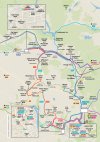
This map may be of interest to some, showing the current bus and train network in the area with pubs marked on.

Current service level:
62 - a few trips a day. No evening service.
65 - every 2 hours, daytime only.
66 - once a day
X66 - once a day
173 - every two hours, Monday to Saturday daytime. No evening or Sunday service.
218 - half hourly daytime, limited evening service Mon to Sat.
257 - hourly, Monday to Saturday daytime. 257a and 257b are school and college time variations.
272 - hourly daytime, limited evening service.
 

Attachments

  • Messenger_creation_D70B8AA9-C676-4901-89D9-3F4839C4E5BE.jpeg
    Messenger_creation_D70B8AA9-C676-4901-89D9-3F4839C4E5BE.jpeg
    396.6 KB · Views: 66

Baxenden Bank

Established Member
Joined
23 Oct 2013
Messages
4,743
As a tangent to routeing and timing.

Will they provide decent waiting facilities? By which I mean a seat that you can actually sit on, comfortably, for up to an hour. Rather than those non-parallel bars which are designed to perch on but are pretty uncomfortable even for that. Plus a shelter which actually shelters ie not just a one-side cantilever.

I must say I was surprised to see decent stone shelters appear at Dungeon Ghyll and Chapel Stile (Lake District) a few years ago, only 100 years (give or take) after the service started running!

I was also surprised to discover that there are no longer any buses to Derwent Fairholmes, any day of the week. It's a long walk from the next nearest stop at Ladybower Inn. The shuttle / park and ride service had various terminal points over the years including Bamford Station. For a good while it was a two-bus operation but was cut to just a single bus until its demise.
 

ALEMASTER

Member
Joined
18 Aug 2011
Messages
486
As a tangent to routeing and timing.

Will they provide decent waiting facilities? By which I mean a seat that you can actually sit on, comfortably, for up to an hour. Rather than those non-parallel bars which are designed to perch on but are pretty uncomfortable even for that. Plus a shelter which actually shelters ie not just a one-side cantilever.

I must say I was surprised to see decent stone shelters appear at Dungeon Ghyll and Chapel Stile (Lake District) a few years ago, only 100 years (give or take) after the service started running!

I was also surprised to discover that there are no longer any buses to Derwent Fairholmes, any day of the week. It's a long walk from the next nearest stop at Ladybower Inn. The shuttle / park and ride service had various terminal points over the years including Bamford Station. For a good while it was a two-bus operation but was cut to just a single bus until its demise.
The most recent service at Fairholmes was the Sunday service on route 257 diverted off and did a double run down there, however the 257 no longer has a Sunday service!

To be honest the bit to Fairholmes was never well used and regularly got delayed by parked cars and queueing traffic whilst on a Saturday the 257 carries good numbers from Sheffield to Yorkshire Bridge.

== Doublepost prevention - post automatically merged: ==

I think it's worth a trial, but based on my reading of the report, here's a few thoughts....

Repeatable hourly clockface blah blah

This was presumably fantastic in the pre-digital world, but come on. It's never been easier to quickly and easily figure out specific routes and times using apps. All that matters now, is frequency and connectivity.

It's certainly curious that a project that speaks a lot about subsidy and operational matters, specifically for bus services, doesn’t seem to appreciate the waste inherent in viewing daytime and evening, peak and off peak, as if they were all the same. There will either be waste, or delay. So probably waste. And as anyone knows, waste is cost.

"Hourly rural bus services are the base point"

Really? This might suit Swiss people, but I think it's already pretty obvious the average Brit today views an hourly rural bus as next to useless. Definitely a last resort "lifeline" rather than a modal choice.

Certainly not a compelling alternative to the car. Where it is not remotely feasible to offer a higher frequency than hourly (average wait: 30 minutes) then quite obviously, this is where demand responsive solutions are the obvious choice.

I cannot be the only person who remembers that even after privatisation, even as car ownership boomed, as recently as the mid-90s, it was typical for rural villages to have an hourly bus service. Maybe not in the most remote areas, but places only an hour or two from a city, definitely.

And since they were lightly loaded even at peak times, but the operator didn't feel the need to run it with a dedicated small bus, it was logical to think these were either subsidised lifeline services, or loss making as a route but sustainable as a for profit network.

Reliability Reliability Reliability

They have indeed correctly identified that if you want bus services to connect with trains, and they envision this as a bus arriving shortly before and then leaving shortly after each train, reliability is key.

Occasional delays are simply not a factor here, Brits are well used to that, and as a fair minded lot, we are tolerant of the fact things can and do go wrong now and then, so we're happy to suck it up and potentially wait a long time (i.e. up to an hour).

The issue this report curiously fails to mention, particularly as it does speak about the need to reduce the impact of railway engineering works, is road works.

As the UK finally wakes up to the cost of not renewing water and gas infrastructure at a decent rate, and it wakes up to the future of communications, we can now see the cost - roadworks are an almost permanent feature.

I know of one small town with me that currently has multiple road closures. Anyone who drives a lot, now spends quite a lot of time in queues for temporary traffic light controlled traffic flows, across all types of road, including rural roads and urban bottlenecks (for obvious reasons, when one understands how infrastructure layouts typically follow the road/path network). A Swiss paradise, we are not.

The implications on reliability for a network that seeks to have buses connecting with trains on a scale of minutes, are obvious. And yet I didn't even see the word council or highways authority mentioned in the document unless I missed it.

Ticketing

Don't even waste your time on the multiple different ticketing brands and offerings that are being promoted here as offering integration (without new tech), such as PlusBus. Most people don't care. Certainly the people you are trying to attract.

If it takes more than a few minutes to explain, if it takes significant effort to research, you have already failed to create a system that is simple enough to meet your goals.

The simplicity should be customer facing and intuitive, such as a brand linked day ticket. It'a up to operators and bureacrats to shoulder the entire burden of the complexity that then arises from systems where you need to track usage and share out revenues. Anything less will fail, because the car is simplicity writ large, even with the hassle of parking.

Branding

Their network map, specifically the bus network, is still too complex to appeal to occasional, new or tourist use. A mass of similar 2 and 3 digit route numbers, presumably hailing from the NBC era, is inherently un-rememberable.

They even speak of a new bus route, an hourly circular connecting villages and tourist attractions to a hub. If ever there was a bus route crying out for an eye-catching route specific brand, it's that. But no. It's presented as the "63" and "64" from Ebale.

Why even bother having clockface hourly repeating departures for a bus route that is so forgettable, you have to keep opening an app or looking at a map to remember its number?

It's the combination of strong branding, quick research (via apps), real time information and ease of use by design (e.g. day tickets), that now makes UK public transport useful in general, but particularly attractive to tourists, who by definition do not need to know this stuff for more than a week or two. Not clockface nonsense or stretched comparisons to foreign countries.

Northumberland Line

It's all well and good saying your goals are to create new travel opportunities for people without cars, to serve tourists, locals and workers, but the experience of another recently opened line with this exact same TOC, the nationalised Northern, with presumably these same goals, has been anything but it seems.

In design and implemention, it feels far more like the only way the Northumberland Line ever can or will attract people out of cars, is as a park and ride service. And there's little to no attractiveness to tourists or non-car owners, certainly not in any journey involving bus and train transfer. And thus, if Northern behaves the same here, the bus improvements will see little to no increase in ridership or wider goals being met.

Hopefully this scheme is different. On the Northumberland Line, certainly the stations in villages and remote towns, you literally cannot connect buses and trains in the way described, because the walking times from a bus to a train are on the order of 5 to 10 minutes, not 1 or 2. So hopefully where this scheme talks about such things, they are aiming for the latter.

Real world

The UK has far more Hope Valleys than Londons or Manchesters, so as a very real test of the theory that an integrated network is worth the investment, it is laudible.

Hopefully we can have full conficence in the results, where the data collected literally speaks for itself.
It's a network, including both bus and train. Core corridors will have buses every 20 mins and the villages will get buses hourly at the same time each hour all day every day.

TravelMaster run all operator ticketing in South Yorkshire and Derbyshire, including the Wayfarer day and weekly tickets and they have an app and smart cards, so as far as ticketing infrastructure goes it's there, just need some new products - possibly including single/return through tickets between bus and train.

The big ticket selling this trial is all about integration and longer distance travel via bus and train connections, ultimately though it's mainly improved bus services that will benefit both locals and visitors.

Just the introduction of evening services could be a game changer, for example people who work in pubs and hotels that have to drive at present as well as opening up other opportunities
 
Last edited:

Baxenden Bank

Established Member
Joined
23 Oct 2013
Messages
4,743
The most recent service at Fairholmes was the Sunday service on route 257 diverted off and did a double run down there, however the 257 no longer has a Sunday service!

To be honest the bit to Fairholmes was never well used and regularly got delayed by parked cars and queueing traffic whilst on a Saturday the 257 carries good numbers from Sheffield to Yorkshire Bridge.

== Doublepost prevention - post automatically merged: ==


It's a network, including both bus and train. Core corridors will have buses every 20 mins and the villages will get buses hourly at the same time each hour all day every day.

TravelMaster run all operator ticketing in South Yorkshire and Derbyshire, including the Wayfarer day and weekly tickets and they have an app and smart cards, so as far as ticketing infrastructure goes it's there, just need some new products - possibly including single/return through tickets between bus and train.

The big ticket selling this trial is all about integration and longer distance travel via bus and train connections, ultimately though it's mainly improved bus services that will benefit both locals and visitors.

Just the introduction of evening services could be a game changer, for example people who work in pubs and hotels that have to drive at present as well as opening up other opportunities
I admire your enthusiasm and that of the promoters. I wish it every success but cannot bring myself to accept that it will not simply die a death by a thousand tweakings and cuts over the five year period and then mostly disappear. The 65/66 was hourly for a while from Buxton. There was an hourly? service from Edale via Mam Tor to Castleton. Even the 272 is shrinking back from a regular hourly service.

My first visit to Derwent Fairholmes had me waiting for the bus back to Sheffield and then having to stand all the way. Admittedly that was 30 years ago.

Are train / bus tickets still inter-available on the Hope Valley / 272 routes?
 

ALEMASTER

Member
Joined
18 Aug 2011
Messages
486
I admire your enthusiasm and that of the promoters. I wish it every success but cannot bring myself to accept that it will not simply die a death by a thousand tweakings and cuts over the five year period and then mostly disappear. The 65/66 was hourly for a while from Buxton. There was an hourly? service from Edale via Mam Tor to Castleton. Even the 272 is shrinking back from a regular hourly service.

My first visit to Derwent Fairholmes had me waiting for the bus back to Sheffield and then having to stand all the way. Admittedly that was 30 years ago.

Are train / bus tickets still inter-available on the Hope Valley / 272 routes?
I'm not convinced the Edale-Castleton, Bamford-Fairholmes or Castleton-Eyam services will survive.

Some might say to not bother with the 66 and instead make the Sheffield to Tideswell part of the 65 hourly. After all currently the 66 only really exists because the buses need to start and end in Chesterfield as the depot is there.

I do believe that improving key bus services - 62, 65, 173, 218, 257 and 272 - and promoting them has a lot of potential.
 

Llandudno

Established Member
Joined
25 Dec 2014
Messages
2,738
Location
Matlock
Coordination is so much harder than it sounds.

I was at Matlock on a recent Sunday and saw the hourly Transpeak bus to Buxton pull away from the railway station just as the hourly train was pulling in.

Before plotting a complaint, I thought I had better check timetables. The non-comnection at Matlock was in fact per the timetable. How idiotic?

Perhaps not so idiotic. The run time Matlock to Buxton is 70 mins and the gap between hourly Marltlock train arrival and two-hourly Buxton train departure is 78 mins. The gap could certainly be better spread for maximum Northbound resilience. But short of trying to recast EMR and Northern rail timetables around the particular needs of those using the Transpeak, you are going to face passengers with a substantial wait at one end or other.

Well coordinated connections are thinkable for hub-and-spoke (eg a Swiss rail station serving one or more valleys). But for a mesh network (which is more typical away from mountains) it is impossible to coordinate everything.
The easiest way to improve connections at both Matlock and Buxton stations is to run the TransPeak Bus every 30 minutes with through train/bus ticketing and extend the hours of operation until 2300.

This would be more beneficial in increasing public transport accessibility to the Peak District than some of the expensive hair brained proposals in the mini-Switzerland scheme!
 

ALEMASTER

Member
Joined
18 Aug 2011
Messages
486
The easiest way to improve connections at both Matlock and Buxton stations is to run the TransPeak Bus every 30 minutes with through train/bus ticketing and extend the hours of operation until 2300.

This would be more beneficial in increasing public transport accessibility to the Peak District than some of the expensive hair brained proposals in the mini-Switzerland scheme!
Given the Transpeak runs from Derby would many be getting a train from Derby to Matlock to connect with it?

Id suggest running the local Matlock buses that serve the villages on an hourly frequency at times that connect with the trains would be more beneficial, perhaps that might be one to roll out if the concept is proved in the Hope Valley.
 

Llandudno

Established Member
Joined
25 Dec 2014
Messages
2,738
Location
Matlock
Unfortunately the TransPeak picks up at Derby Bus Station a good 15 minutes walk from the railway station. A walk at certain times of the day or in the dark can be quite off putting to say the least!
I suppose you can break up the walk by popping into the Alexandra or Brunswick for an excellent pint or two!
 

U-Bahnfreund

Member
Joined
6 Feb 2015
Messages
552
Location
Germany
Well coordinated connections are thinkable for hub-and-spoke (eg a Swiss rail station serving one or more valleys). But for a mesh network (which is more typical away from mountains) it is impossible to coordinate everything.
Switzerland is not all mountains. Two thirds of its population, and consequently most of its public transport, is located in non-mountainous areas such as the Mittelland.
 

ox_chap

Member
Joined
7 Jun 2026
Messages
56
Location
Oxfordshire
Well don’t knock clockface departures because they are easy to remember. The idea “just look at your smartphone” might be the very last thing walkers want to do, as they have a break from the day-to-day of life which may involve never escaping a screen!
 

Dwarfer1979

Member
Joined
24 Feb 2025
Messages
437
Location
Leicester
My issue with the original "mini-switzerland" proposal was it seemed to have been drawn up by someone with little idea of the actual local network and the reasons it existed and was designed purely around this theoretical idea that train connection is all important, but if this project is instead managed by people with a more detailed understanding of why the local network is structured as it is.

The 62 is a big case in point, it is Buxton to Castleton and the primary purpose of the service is to connect the residents of Castleton & Hope to their nearest large supermarkets in Chapel & Buxton (mostly Morrisons at Chapel) which can't be achieved with a train connection. That it is actually able to maintain good connections at Edale station to/from trains from Manchester for Castleton travel is a bonus not the point of the service so splitting it at Edale makes the service to local residents worse for a theoretical idea of what buses should be.

In reference to the Transpeak connection at Matlock, this is of course much more complicated than a single (or even two) railway connection. There is an attempt to co-ordinate with the times of the sixes (which is a complicated corridor in itself) between Matlock & Bakewell where the two parallel and there are no other public transport links and at the Buxton end through Harpur Hill with the town services. None of this in insurmountable but it makes hitting one specific connection difficult and there is always that issue with train connections that they may change with little consultation with the operators at dates that do not match with bus service change dates (built around school term dates) that can make maintaining a connection more difficult.
 

The exile

Established Member
Joined
31 Mar 2010
Messages
9,305
Location
Somerset
Well don’t knock clockface departures because they are easy to remember. The idea “just look at your smartphone” might be the very last thing walkers want to do, as they have a break from the day-to-day of life which may involve never escaping a screen!
Or indeed be able to.
In any case, making public transport part of people’s lives means getting things into people’s heads - not their screens. So you establish a repeated time (doesn’t matter if it’s 3 minutes past the hour at some hours and 5 past others as long as connections etc are maintained - what’s in people’s heads is “just gone the hour “) and then you stick to it. Barrng really major developments (both positive and negative) the timetable in 2026 should still be useable in 2031 - no “tinkering”
 

Bletchleyite

Veteran Member
Joined
20 Oct 2014
Messages
112,941
Location
"Marston Vale mafia"
I've not looked at this in detail yet (been away) but I do wonder if Windermere may have been a better pilot, or maybe Betws y Coed (though this is devolved of course). Integrating with a single railway terminus is much easier than with a line with multiple stops none of which are notably busier than the others and where there's demand from both ends. In the single terminus, you can easily do "bus in, train in, train out, bus out" with all services.

== Doublepost prevention - post automatically merged: ==

Demand responsive transport is a red herring. Unless there are a huge number of vehicles that spend most of their time carrying one passenger or empty, the time you book is essentially random. It's intended to cope with very low passenger numbers, hopeless for making connections unless the connecting service is aa turn-up-and-go frequency, and the costs per passenger are huge.

Many to many DRT is pointless. It's awkward and hugely costly. Subsidising taxis would provide better value than almost all of these schemes, and park and ride/railheading is more effective for almost all use cases in rural areas if people drive, leaving only the non drivers to deal with.

One to many DRT has potential, i.e. there's a bus waiting there when the train arrives which then serves the points people want to go to in a reasonable area, and this also picks people up to get back for the next train. I'm not sure how well this would work for the Hope Valley given the patterns of demand, though, probably not that well - it might work better somewhere like the Lakes.
 
Last edited:

mangad

Member
Joined
20 Jun 2014
Messages
707
Location
Stockport
I've not looked at this in detail yet (been away) but I do wonder if Windermere may have been a better pilot, or maybe Betws y Coed (though this is devolved of course). Integrating with a single railway terminus is much easier than with a line with multiple stops none of which are notably busier than the others and where there's demand from both ends. In the single terminus, you can easily do "bus in, train in, train out, bus out" with all services.
Turn up at Windermere between April and October though and you will find there are plenty of buses and - as long as you are going to Ambleside or Grasmere (which many are) a 20 minute frequency. Buses in other directions are more limited but the local councils and Stagecoach have been very good at introducing additional services to meet demand. Other than integrated ticketing (already being experimented with in Penrith and Keswick) it's hard to see what can be improved that would provide learning.

The Peak District however has a poor bus service, an inadequate train service and lots of scope for improvement. Whether these proposals are right I cannot judge. But it seems a fair place to start.
 

Bletchleyite

Veteran Member
Joined
20 Oct 2014
Messages
112,941
Location
"Marston Vale mafia"
Turn up at Windermere between April and October though and you will find there are plenty of buses and - as long as you are going to Ambleside or Grasmere (which many are) a 20 minute frequency. Buses in other directions are more limited but the local councils and Stagecoach have been very good at introducing additional services to meet demand. Other than integrated ticketing (already being experimented with in Penrith and Keswick) it's hard to see what can be improved that would provide learning.

Fair point. There are some obvious improvements that could be made there, either running more buses back to Windermere (the double change for Langdale and Coniston is annoying, a few run through but basically just buses that are going to/from the depot) or properly integrating Ambleside with a new bus station on the car park rather than the overcrowded layby, but it is obvious at least what works there and there is some use in having a bit of a layover there to pop into Booths for the shopping.

The Peak is much more complex though, unless you just did stuff like circular shuttles timed for specific trains.
 

Nicholas Lewis

Established Member
Joined
9 Aug 2019
Messages
7,983
Location
Surrey
In addition there is work on ticketing to improve the joint rail/bus options available. At the moment there is a Derbyshire Wayfarer day ticket available for the entire county but that is about it. There are also conversations about the design of the railway stations and connected bus stops to make connecting between train and bus an easy and pleasant experience.
Key to success in Europe is integrated ticketing or actually one ticket that covers all modes of local transport. If this isn't delivering that its not going to deliver modal shift. You also get Switzerland Canton tickets that come with your accommodation maybe the price is slightly higher but you have the ticket anyhow and easy material to see how you can use it. Also Switzerland doesnt sweat the assets so a bus can afford to wait a few mins for a late running train and if its schedules too tight to ensure a return journey connects they will just add an additional vehicle even if that increases unproductive time.
 

Top