TheGrandWazoo is correct in what they say above. The bigger problem is the dark in an unlit village. You need a torch to flash at the driver, to show that you are at the stop and would like them to stop. On the return journey, you have to tell the driver where to stop.

-
Our new ticketing site is now live! Using either this or the original site (both powered by TrainSplit) helps support the running of the forum with every ticket purchase! Find out more and ask any questions/give us feedback in this thread!
You are using an out of date browser. It may not display this or other websites correctly.
You should upgrade or use an alternative browser.
You should upgrade or use an alternative browser.
Bus stops on country roads that have no visible markings that they exist
- Thread starter jon0844
- Start date
Sponsor Post - registered members do not see these adverts; click here to register, or click here to log in
R
RailUK Forums

izvor
Member
I would usually advise passengers to turn their mobiles on (when these became commonplace) and wave them at the driver. Enough light generated to catch their attention without dazzling. You can then acknowledge with a quick flash of the headlights.The bigger problem is the dark in an unlit village. You need a torch to flash at the driver, to show that you are at the stop and would like them to stop. On the return journey, you have to tell the driver where to stop.
Dwarfer1979
Member
With a torch we would normally advise the customer to point it at themselves with their arm outstretched so the driver can see them waiting without the light of the torch dazzling the driver and causing a safety hazard. With a mobile it can be done differently because, as you say, the light is smaller and less dazzling for an oncoming driver. Spotting waiting passengers on dark nights is difficult even in lit areas with streetlights, brighter coloured clothes and/or a very conscious effort by the waiting passenger to position themselves to be visible is always advisable in these occasions.I would usually advise passengers to turn their mobiles on (when these became commonplace) and wave them at the driver. Enough light generated to catch their attention without dazzling. You can then acknowledge with a quick flash of the headlights.
Morebus issued official advice last winter:
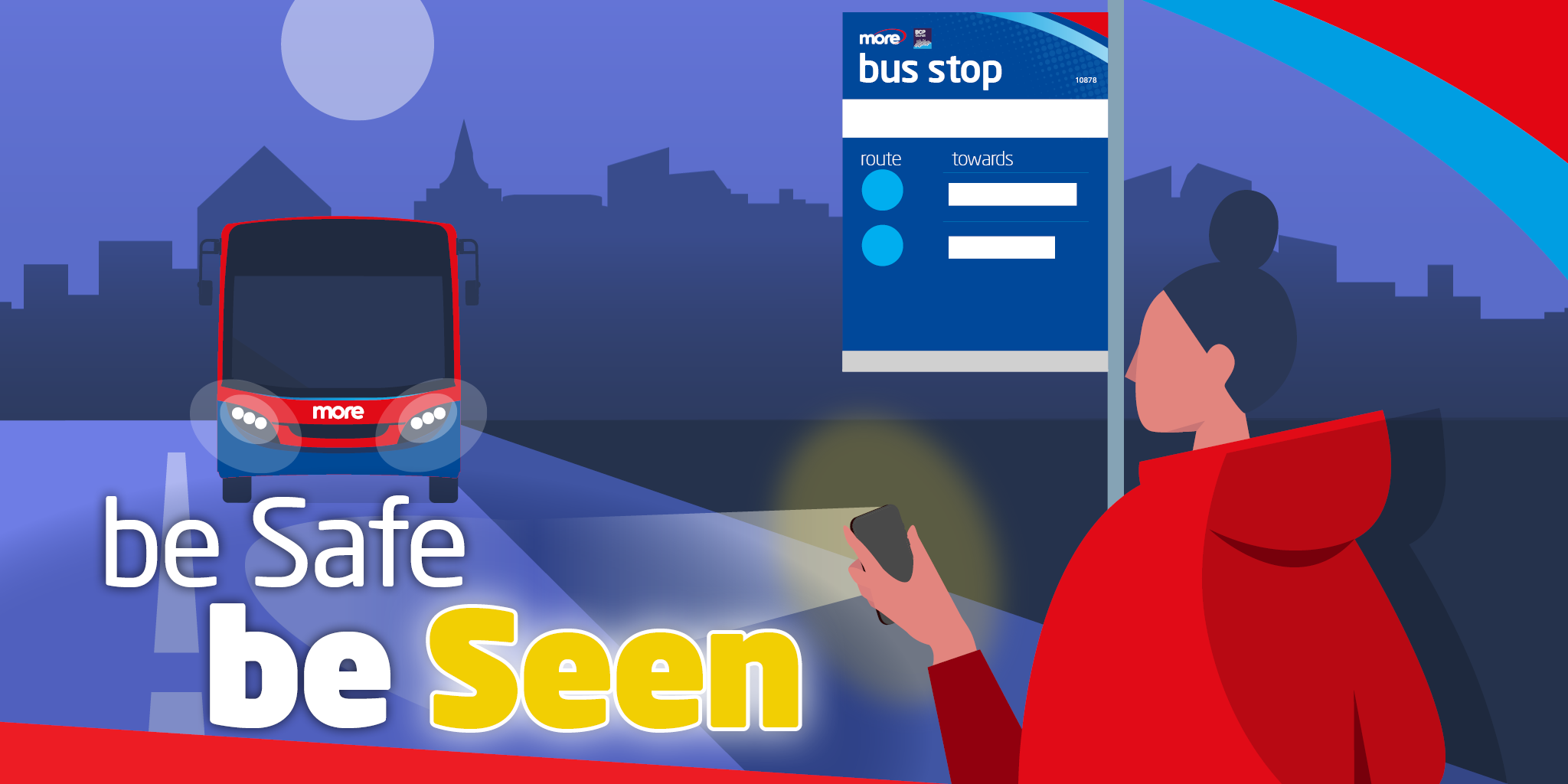
 www.morebus.co.uk
We are asking people to help our drivers at these unlit stops to see them, by shining a light onto the road, and gradually rotating it as the bus approaches - being careful not to shine it into our driver’s eyes.
Be safe and be seen this winter
Help our drivers to see you as the days start to get darker...
www.morebus.co.uk
Oh, an urban bureaucrat's approach. In past times country buses would always stop where hailed, just like a taxi. There's no requirement for taxis to have stopping points. Nor for car drivers who see their friends roadside.For my employer, to give the flexibility to meet customer needs, almost all services have the wording that "in rural areas & roads with no marked bus stops Hail & Ride will be in operation" though in the last year the Licensing Office have begun tightening up a bit and wanting to clarify which sections this particularly applies to

Tetchytyke
Veteran Member
I suppose it is a sign of how things have evolved, both in urban and in rural areas.I genuinely didn't know this was a thing and bet most people living in a town or city have no clue.
When I was growing up in Bradford the estate buses were all hail-and-ride and people were very familiar with standing in a sensible spot and waving down the bus. Over time some stops became much more established as a number of people all came to the same conclusion that it was the best place to wait. To the extent that there were a lot of complaints when they converted the route to fixed stops and quite a few of the fixed stops were nowhere near where people had previously been hailing the buses.
== Doublepost prevention - post automatically merged: ==
This is what causes confusion, IMO. I'm used to hail-and-ride, both in urban and rural areas, but now I'm never quite sure whether it still applies or not.Oh, an urban bureaucrat's approach. In past times country buses would always stop where hailed, just like a taxi.

Man of Kent
Member
- Joined
- 5 Jul 2018
- Messages
- 903
An unintended consequence of trying to drive information down to stop level accuracy. You need to know where the stops are in order to provide the information!This is what causes confusion, IMO. I'm used to hail-and-ride, both in urban and rural areas, but now I'm never quite sure whether it still applies or not.
As has been observed elsewhere, it is possible to be clear or to be comprehensive, but rarely both at the same time.

TheGrandWazoo
Veteran Member
Very much a particular era.I suppose it is a sign of how things have evolved, both in urban and in rural areas.
When I was growing up in Bradford the estate buses were all hail-and-ride and people were very familiar with standing in a sensible spot and waving down the bus. Over time some stops became much more established as a number of people all came to the same conclusion that it was the best place to wait. To the extent that there were a lot of complaints when they converted the route to fixed stops and quite a few of the fixed stops were nowhere near where people had previously been hailing the buses.
== Doublepost prevention - post automatically merged: ==
This is what causes confusion, IMO. I'm used to hail-and-ride, both in urban and rural areas, but now I'm never quite sure whether it still applies or not.
Prior to 1984/5, urban routes were very much in the hands of conventional buses. Hail and ride came with minibuses as smaller vehicles enabled penetration into hitherto unserved areas and avoided the need to create new stops, as well as being a competitive/defensive tactic.
On rural routes, it was always the case that whilst there were formal stops in villages, it was always the case that as long as you waited in a safe place and signalled clearly and in good time, the bus would stop.
Whilst the OP has concerns, I'm not aware that this is an issue that is generally experienced across the country.
May be the case in certain parts of the country, but by no means all.On rural routes, it was always the case that whilst there were formal stops in villages, it was always the case that as long as you waited in a safe place and signalled clearly and in good time, the bus would stop.
My experience in Somerset/Dorset back in the 1960s till now was that while most stops were not marked, hail-and-ride was not accepted as standard and if you tried it you'd get ignored. Stops then (and still now) were well-established and fixed, even if they weren't marked in any way. Thinking about it, many were at pubs - presumably a hangover from stagecoach days where horses would be changed and passengers fed. Others were at road junctions (to villages/hamlets off-route), village squares / marketplaces, and to a lesser extent former turnpike gates.
Not my experience in Somerset in just that era. Western National would stop anywhere, certainly outside Taunton, and even if you were just walking along a country lane and a bus came along it would slow, and possibly open the front door, for you to shout up "No thank you". Or get in - "What a good thing a bus came along" my mother might say. People would otherwise shake their heads if not or stand aside, a bit like those at formal bus stops when you are waiting for a different route.May be the case in certain parts of the country, but by no means all.
My experience in Somerset/Dorset back in the 1960s till now was that while most stops were not marked, hail-and-ride was not accepted as standard and if you tried it you'd get ignored. Stops then (and still now) were well-established and fixed, even if they weren't marked in any way. Thinking about it, many were at pubs - presumably a hangover from stagecoach days where horses would be changed and passengers fed. Others were at road junctions (to villages/hamlets off-route), village squares / marketplaces, and to a lesser extent former turnpike gates.
It was just what was sensible. The independent Hutchings & Cornelius (H&C, or 'Hot & Cold' to us boys) bus ran through several large villages into Taunton, and the one coming in at 0845 would have two buses provided which came in convoy. But only one conductor, who worked back and forth between the buses as they ran along collecting everyone's fares. Was this allowed? I suspect it was actually. Had any city official envisaged doing this? Probably not.
Last edited:

markymark2000
On Moderation
The area that I find particularly bad is Pembrokeshire and Carmarthenshire. The authorities don't like flags because 'they can't enforce the bus stop' (direct quote) and so insist on road markings being the only way to identify stops. Issue is, they rarely actually paint any road markings and the road markings which have been painted, fade over time and don't get replaced as quickly so a lot of stops are just unmarked. So unless there is a very old flag or shelter in place, good luck knowing where the bus stops are in these areas. This isn't just even on the rural country roads, but even in the more build up urban areas.
I wish Transport for West Midlands followed the guidance though. They keep refusing to add stops and details into Naptan for hail and ride stops and sections (neither adding HAR stops nor a spluttering of CUS stops). Whole estates on the Diamond 54/54A and 74A for example are just missing and stops on journey planners as TFWM won't add new HAR or CUS stops to the areas. It's a bit of a farce.
This seems to vary by area. Sometimes an unmarked stop opposite a marked stop is MKD (marked, marked by a flag opposite) and sometimes it's CUS (unmarked) and I believe even DFT under their previous contractor for naptan seemed happy for 'both sides of the road stops' to be marked either as CUS or MKD which makes it even more confusing as then journey planners can't reliably give such information to passengers about if a stop is marked, unmarked when all areas seem to be doing something different in relation to marked/unmarked.And to add to this, where there is a marked stop on one side of the road that shows 'both sides of the road' then the 'unmarked' stop on the other side of the road should have its own stop number / code and be includes as a 'custom' stop, rather than buses in both directions being shown as calling at the single marked stop.
The issue with the HAR stuff on Naptan though is that the HAR section isn't shown on any journey planner anywhere so while it's great from a data perspective, it's as good as useless for passengers as there is no difference between a CUS unmarked stop and a HAR hail and ride stop in terms of what is shown to passengers.NAPTAN also has the capacity to have 'hail and ride' sections of road marked separately - these are entered as 'stops' (and will be shown as such in things like Google Maps) but if they are set up correctly, the data will include the start and end of the hail and ride area for each 'stop'. I think the guidance says that each individual street should be set up as a separate hail and ride 'stop', and if one road is long enough, there should be a 'stop' every X distance.
I wish Transport for West Midlands followed the guidance though. They keep refusing to add stops and details into Naptan for hail and ride stops and sections (neither adding HAR stops nor a spluttering of CUS stops). Whole estates on the Diamond 54/54A and 74A for example are just missing and stops on journey planners as TFWM won't add new HAR or CUS stops to the areas. It's a bit of a farce.
Dwarfer1979
Member
The explanation I received when I queried it was that it was related to the introduction of PSVAIR (the regulation requiring next stop announcements) as I think you should really be announcing the beginning (and end?) of Hail & Ride sections on the announcements so they wanted to make sure the operator knows which section it actually applies to. Slightly bureaucratic and somewhat frustrating to the person having to complete the paperwork who now needs to review each route but it doesn't prevent you including it (& it has always needed to be explicitly included to my knowledge, at least under the current deregulation registration system) and there are always anomalies in rules that cause issues - we have a couple of town services that still have Hail & Ride in application everywhere that dates back to when the routes were introduced with 16-seat minibuses in the eighties even though there are marked bus stops everywhere so you never actually enter or leave a Hail & Ride area and there are always stops to be announced.Oh, an urban bureaucrat's approach. In past times country buses would always stop where hailed, just like a taxi. There's no requirement for taxis to have stopping points. Nor for car drivers who see their friends roadside.
There's surely nothing to prevent just announcing the name of the timing point in the village ("Kingston, The Swan" etc), where Western National used to erect their board with the timetable pasted to it. But otherwise the bus can stop wherever. If Mrs Miggins is going to get off at her house at the other end of the village, that's separate.
If visitors don't know their whereabouts they invariably will ask the driver.

If visitors don't know their whereabouts they invariably will ask the driver.
Last edited:
TheGrandWazoo
Veteran Member
My experience in the netherworld of Co Durham/North Yorkshire was that there were defined stops in the villages - often more than one but with a single timing point which invariably was a pub but not necessarily. Stops were usually identified with a cast iron pole and sign or, latterly, a concrete post and flag.There's surely nothing to prevent just announcing the name of the timing point in the village ("Kingston, The Swan" etc), where Western National used to erect their board with the timetable pasted to it. But otherwise the bus can stop wherever. If Mrs Miggins is going to get off at her house at the other end of the village, that's separate.
However, there were loads of "informal" stops that had no signage out in the sticks. They might be at a road end from a cluster of houses. Had there been an insistence on getting on at a formal designated stop, people would have to walk along a road without a footpath for half a mile to catch the bus - no, as long as you stood in a safe place and signalled in good time, you'd be fine.
ChrisC
Established Member
I’m currently staying in a hotel in the village of Bransford a few miles south of Worcester on the 417 route between Worcester and Ledbury. It’s very infrequent with just 4 buses a day. There appears to be no bus stop near the hotel, farm shop, garage etc in the centre of the village. There’s an unmarked stop at a road junction as you enter the village from Worcester and another unmarked stop along the busy main road with no pavement, around a mile away in the other direction. It’s so hot, and the buses are so infrequent that I have decided to use my car all week, but if I had used the bus to Ledbury I would have stood on the main road close to my hotel, put my hand out, and hoped for the best.
May be the case in certain parts of the country, but by no means all.
My experience in Somerset/Dorset back in the 1960s till now was that while most stops were not marked, hail-and-ride was not accepted as standard and if you tried it you'd get ignored. Stops then (and still now) were well-established and fixed, even if they weren't marked in any way. Thinking about it, many were at pubs - presumably a hangover from stagecoach days where horses would be changed and passengers fed. Others were at road junctions (to villages/hamlets off-route), village squares / marketplaces, and to a lesser extent former turnpike gates.
I think the reality was somewhere in between. In villages, people were expected to congregate at the main village bus stop, marked with a timetable and possibly a stop flag. Depending on the size of the village, there would also be other [often un]marked places where buses would stop to pick up; particularly at the council houses on the edge of the village. Some villages being quite linear and other not. [Drivers would generally be more liberal at the quantity of stops when housewives laden with shopping were alighting] . Some bus companies erected more stops than others; this often depended on the frequency of buses.
In the countryside the unmarked stops would be at farm lane ends, labourers cottages, road junctions (to villages/hamlets off route) etc., but why would the bus be stopping anywhere else? If 'outsiders' were out walking and hailed the bus [an uncommon occurrence in reality] the driver would stop if hailed, unless circumstances made it unsafe. Sometimes the driver would stop a way past the passengers, almost as if to emphasise the favour they were doing! However, one has to remember that in the days of crash gearboxes, vacuum brakes and 5 pot Gardner engines, that every stop was a major physical effort on the drivers' part! In essence I entirely agree with @TheGrandWazoo
Yes, but doing so means that the local authority is making that change by formalising a previous informal arrangement and thereby requiring all the things that @Dwarfer1979 mentioned. It isn't as easy as putting up a sign or painting something on the road.
The economics simply won't stack up and "pay off in the long term" for many of these. The example I showed is TWO stops (i.e. both directions) and the thousands it would cost simply wouldn't meet any form of cost benefit calculation.
That example sounds like it would benefit from infrastructure if there are regular walkers e.g. it's close to a particular attraction or an entry point onto a notable national path like the Cotswold Way. However, for most of these, the cost benefit for local authorities isn't worth it.
Well quite. Nobody has yet come up with a suggestion as to what other activity the Local Authority should cease in order to upgrade these stops. The Local Authority of my residence has about 4,000 stops , mostly in Naptan but a proportion not. Taking a wild guess, I should think 20% at most (almost all in urban or peri-urban locations) are marked, with flag, road marking, hard standing, disabled access and timetable information of some sort. That leaves a huge number needing upgrading at a huge cost. Sadly, any legal requirement to upgrade, without the funding to go with, would result in large scale abandonment of stops and routes. Poles have to erected by workers with Street Work licences and insurance, road marking positions, hard standing, tactile paving, dropped kerbs etc by Highway Design and then the work paid for, Road Safety Audits etc
I genuinely didn't know this was a thing and bet most people living in a town or city have no clue.
The only thing I've ever noticed is a local(ish) bus stop that has a pole/sign on one side of the road only and says 'Both sides of the road'. Before I saw the text on the other side, I wrote to the council and they never responded, as I wondered why a bus stop outside a University hall for events, conferences, parties etc had no visible bus stop, no paved area to stand, no timetable and no access for wheelchairs (it's slightly banked and with loads of grass).
You can see it here, and it looks like there might be two people waiting at the ghost stop. If you go back in time, it shows the text on the opposite stop in 2011 but in 2008 it just says 'Temporary sign'.
I am prepared to test your theory out, but think this is ridiculous and if it's so widespread then no wonder rural buses struggle. Clearly me going once or twice a month for a walk and using a bus isn't going to be the difference between a bus route running or being axed, but I am pretty sure I am not the only one.
I can use apps to see where the stop is supposed to be. I can use bustimes.org to see what buses are meant to run, and hopefully track them, but I am not going to feel comfortable - so, yes, I would be anxious especially if there's a long gap in service.
I have full confidence in using trains anywhere, but I spent a lot of my life never considering buses outside of my home county, or London. From confusing ticket prices, not knowing where exactly you needed to go, not knowing when on the bus where your stop was (and asking the driver to shout at you didn't always work) and the issue of late or cancelled buses, put me off. I was one of the many who disregarded buses as a viable method of transport outside of my 'comfort zone'.
We've come a LONG way but still don't seem to have got everything sorted, and all this time I had no clue about ghost stops.
Am I supposed to tell anyone else to give it a go? They'd drive, get a cab, or not go there at all if I explained how you have these secret stops and you can look online to see what colour the bus is, what type it is, where it is (maybe, but remember the tracking has a delay so take that into account) and then make sure you clearly signal the driver and hope s/he stops.
This is perhaps one of the best bits of news ever when it comes to buses! Once you know what is, and isn't, running you can make more educated decisions on what to do if you're left hanging around.
I get the odd Tweet/X post about bus cancellations but a lot of the time they're posted a long time after the bus should have run, so it's really not that relevant at that point. I've had drivers tell me that they can have a large number of uncovered runs that are known about at the start of the day.
While I accept their controllers will be trying to juggle things around and maybe call in favours from drivers off that day, I do think they make even railway operators look organised by comparison!!
Sometimes 'both sides of the road' is used because the expense of a pole being erected (there being no convenient lamp standard) cannot be justified. (Can't just stick a pole in the ground - heaven knows what utilities may be under there!), but also often because erecting bus stops raises the ire of local residents and their perception that it will devalue their property. Same goes with hail and ride sections, particularly in relatively recent housing estates, where it is too much hassle from residents to position fixed stops.
I don't think that investing in marking rural bus stops would pay off and be the saviour of rural bus services. The locals (by far the greatest number of users) know where the buses stop - they see them stopping, see passengers waiting and, if they can't see that, they ask their neighbour. By all means have it as an aim, but it is just not going to be affordable and a priority, however desirable it may be. Concentrate on the heaviest used, (mainly urban and peri-urban) stops first.
The railways have about 2,000 stations across the country. There are probably a 150 times more bus stops. When the bus industry gets the sort of funding that the rail industry gets then perhaps upgrading them will become possible.
Last edited:
Fenchurch SP
Member
I intended to alight at one in Cornwall (Portscatho Highertown) but the driver claimed no knowledge of its existence and carried on to the next stop. It is listed as a Major Stop on the timetable!It's not just rural routes. Round here there are stops in both Bawtry and Gainsborough that appear on bustimes.org and on the new PIS. There is no sign of them on the ground and I've never risked trying to stop a bus there!

Even more of an inconvenience in some rural areas can be the long distances between bus stops. Unmarked bus stops can cause problems, but their locations can usually be determined by a bit of research on the various bus apps and bustimes.org. However, a bus stop with no visible markings is better than no bus stop at all. There are many routes where there are bus stops in the villages but no stops sometimes for a significant distance between villages.
Sometimes when I have been out walking it can be difficult to find a bus stop close to the beginning or end of a walk. I don‘t expect to find bus stops in a completely isolated location where there are no houses, but sometimes buses don’t stop when there is somewhere like a pub, hotel, garden centre or other attraction close by. This can sometimes result in a long walk along a busy road with no pavement to a bus stop in the nearest village. This is most frustrating when the bus travels along that road but there are no bus stops. A couple of years ago I stayed in a hotel in Norfolk where the bus passed by the hotel gate but it was a half mile walk along a busy road to reach the nearest bus stop.
...
I understand that there are many rural routes where bus drivers will stop at locations where there is no official bus stop but as a visitor to an area it is not easy to have information about this.
I went to a Funeral in Holwell near Hitchin last month. The nearest bus stop was a mile away. Annoyingly, half of that distance was along the bus route to the turn for the crematorium.
I don't expect every bus to turn into the crematorium, but it was surprising for it to be so needlessly inconvenient.
One of my local routes in West Yorkshire started in the late 70s and had a long hail and ride section - I used to come home from school in the eighties and nineties and ask to stop by a bench (there was a footpath down the side but it wasn't visible until you were past the bench). It was further from home than the main road, but a walk downhill instead of up. When they put fixed stops in, in the late 90s, they chose some very awkward places - the nearest to my path was about 100 m past the path but 200m before the next few houses. The fixed stops are all "both sides" with a long section having no pavement and a wall right up to the road on the other side.
At least in West Yorkshire the timetables were very clear which sections of route were Hail and ride.I suppose it is a sign of how things have evolved, both in urban and in rural areas.
When I was growing up in Bradford the estate buses were all hail-and-ride and people were very familiar with standing in a sensible spot and waving down the bus. Over time some stops became much more established as a number of people all came to the same conclusion that it was the best place to wait. To the extent that there were a lot of complaints when they converted the route to fixed stops and quite a few of the fixed stops were nowhere near where people had previously been hailing the buses.
Last edited:
Ballyheigue
Member
Over in Ireland at the village of Ballyheigue, there are 4 unmarked bus stops as well as others in the surrounding hamlets, but you really need to know where to stand as well as for what bus.
Unmarked stops 1 and 2 are very close to each other, for stop 1 is the school services stop. Kids wait next to Costcutter then at the very first sight of the bus on the road ahead of them, they dart over the road to the side of a car park ready for it. if they don't wait there, ready for boarding, it naturally sails past as it can't do a handbrake turn to Costcutter and can't really wait in the middle of a road junction blocking a car park exit lol. Stop 2 is for the 274 Tarbert to Tralee bus and this unmarked stop is on the other side of the small car park opposite the toilet block. You wait on the toilet block path so you don't get ran over, then go over the car park entry/exit road and wait opposite the toilets when you see the bus come around the corner.
Now this is where the confusion comes in if you're not in the know. Unmarked stop 3 is for the R22 Kerry Head via Ballyheigue to Tralee service, this is a shoppers bus but anyone can use it. Now you'd think it would share the same stop as the 274 as it's a smaller bus than the 274 so can easily swing round the car park access road to pick up people at the toilets on it's way back down from Kerry Head, but nope, it has it's own unique stop in the village, and you have to know where to stand as it's not at the Post Office like it says in the timetable lol. You have to wait about 100 yards further up next to a side street.
Unmarked stop 4 is more or less oppposite the Garda station on the main road which skirts the outskirts of the village, but again you need to know which house to stand in front of!
Unmarked stops 1 and 2 are very close to each other, for stop 1 is the school services stop. Kids wait next to Costcutter then at the very first sight of the bus on the road ahead of them, they dart over the road to the side of a car park ready for it. if they don't wait there, ready for boarding, it naturally sails past as it can't do a handbrake turn to Costcutter and can't really wait in the middle of a road junction blocking a car park exit lol. Stop 2 is for the 274 Tarbert to Tralee bus and this unmarked stop is on the other side of the small car park opposite the toilet block. You wait on the toilet block path so you don't get ran over, then go over the car park entry/exit road and wait opposite the toilets when you see the bus come around the corner.
Now this is where the confusion comes in if you're not in the know. Unmarked stop 3 is for the R22 Kerry Head via Ballyheigue to Tralee service, this is a shoppers bus but anyone can use it. Now you'd think it would share the same stop as the 274 as it's a smaller bus than the 274 so can easily swing round the car park access road to pick up people at the toilets on it's way back down from Kerry Head, but nope, it has it's own unique stop in the village, and you have to know where to stand as it's not at the Post Office like it says in the timetable lol. You have to wait about 100 yards further up next to a side street.
Unmarked stop 4 is more or less oppposite the Garda station on the main road which skirts the outskirts of the village, but again you need to know which house to stand in front of!
Borders Council has a number of stops without flag and pole officially designated as Hail & Ride. In one case (Eshiels Mill, X62) there is a flag on one side of the road only and the Hail and Ride designation is only used for the opposite side. They still seem to be willing to stop at other places such as farm road ends.
I happened to notice one of these things recently, funnily enough, while searching for a farm (basically double checking a postcode).
On Google Maps, it's fully identified as a both sides of the road stop, next to the farm, and it lists the services. It has the blue stop markings on OSM. Bustimes has it as a timing stop.
But in the real world, there's literally nothing else there except the lane and the farm. It is a wholly virtual bus stop. Unsurpringly, the stop is named after the farm. Also unsurprisingly, it is only served by two, once a day bus routes, seemingly schools routes.
Here's the seriously disturbing part. Although rural in the sense it's a farm in the middle of nowhere surrounded by fields and with literally only this road and one bridleway connecting it to anywhere else you could travel legally by any means, it's not remote by any stretch of the imagination.
The nearest villages are 1km in either direction up/down the road. There are decent sized towns all over the place within a few miles in every direction. This is unsurprising, since just 500m to the north, is the boundary of a Metropolitan Borough.
According to bustimes the last buses to use these routes were a Solo SR and an Enviro200, but this is an area where deckers happily roam the rural roads, and I didn't see any reason why this particular one would be off limits.
That's the scary part in all this. Because of how populated this area is, this is one hell of a dangerous country road, with cars travelling along it at very high speeds, as people do when they have the false sense of security of hedges/trees and a line of sight.
Being only a farm on a straight section of lane, it doesn't appear to warrant a temporary reduction in the otherwise posted national speed limit. Nor is there any signage indicating any risk at all, much less the farm's impending location. The farm's entrance wasn't particularly concealed.
But there are enough trees and shrubs to give it that tunnel like feel as you approach, until things briefly open up by the farm to just a small hedge on the far side. I certainly didn't see the farm until late enough that I felt it necessary, due to a tail gating moron, to continue on and find a safe place to double back. The lack of one for some distance, only added to the feel of unease.
The lane is easily wide enough for cars to travel at speed, if you're not the sort of person who thinks in terms of what's the worst that could happen. People who habitually tailgate. But also, given the complete lack of road markings either at the verge or centrally, not wide enough to be anything more than what it is, a country lane not remotely warranting even a B road classification.
Whether planned this way or not, notably, while definitely a straigt A to B route, fueling people's urge to travel quickly no doubt, the lane is only particularly straight for a short section by the farm, with gentle curves beginning at about 300m and 500m in both directions.
There is a single long strip of gravel on one side, the farm side, at most 100 feet in length, only one lane wide, that some might view as a layby or even a bus stop. In reality, having stopped there and stood on it, it is quite obviously part of the farmer's land, not a road in any shape or form, other than it can take the wieght of a heavy vehicle.
The low (road surface level) continous kerb no doubt was there to mark the legal boundary between the King's land and a private farm. Private or not, there's certainly no reason to assume it would always be free of traffic, since it is both the logical place for any heavy trucks calling at the farm to pull in, and indeed, was faced directly onto by the opening of farmer's own machinery shed.
It amazes me to think that in this world of health and safety, where literally the only way a bus could serve this stop in either direction, is to literally stop in the traffic lane, and where the only conceivable regular user of this bus stop would be the farmer's school age children, that this madness is still tolerated.
It is quite literally an accident waiting to happen. And at those speeds, likely serious or even fatal. The only reason it hasn't happened, I assume, is that I'd be truly amazed if the farmer even lets their kids use the stop. He/she would be absolutely mad to. And any other use would be extremely unusual, perhaps a forum member trying to use every stop in an area.
So I doubt any bus driver has even stopped here in a good long time, thus reducing the risk to near zero. That being the other problem - it feels like a situation where if a driver did need to stop here, it really would be a case of the kid telling the driver where to stop, literally giving him a heads up that that patch of gravel is the stop, but not the stop.
Tough ask for a kid, so you'd hope the famer has them well trained. The alternative, a kilometre long walk down this particular road, feels equally dangerous.
And you would hope the driver is well trained enough to know it isn't a layby, and so no matter how tempting, to not pull into it even if it's on the right side of the road and it's a clear dry day. But of course, it would be your natural instinct to do so, both to protect your bus and the kid about to get off it.
It would surely be a case of dangerous driving or criminal negligence to pull into it from the far side direction, but you can see how a novice bus driver with a queue of traffic behind him, and the speed at which traffic comes from the approaching direction, might make that terrible split second decision.
Quite where you're even supposed to stand to catch the bus, given such a long stretch that could conceivably be the "stop", is a good question. It sets up a dangerous scenario where a kid, justifiably, assumes that when going in the far side direction, you stand at the far end of the layby, on the wrong side, as the bus driver sees it. And the novice bus driver stops where the kid is, albeit on the right side of the road, not where the safest place to stop is.
Thereby ensuring cars approaching from the rear have a poor view of oncoming traffic, which will be approaching at speed, and the temptation to pass the bus from the rear, will be great. Thereby crossing into an oncoming lane where a kid has just walked into the road.
Just from a perspective of where everyone might be (and needs to be) looking in that scenario in each case, the bus driver, the kid, the two car drivers, is inherently unsafe. And this was of course me looking at it on a clear summer day. There are far worse conditons, even just later on this day with the low sun, when the bus was of course due to be calling at this stop.
If this was aviation, rail or even heavy trucking, you'd expect and demand drivers be fully briefed on the risks, signed off on the route before they drive it. Better yet, install a proper stop and associated warning signs/markings on the approaches.
But on the buses? I seriously doubt that happens.
But if the worst happens, who is liable? The farmer has used what, as far anyone can tell, and persumably even is, an official, legal bus stop. The bus is a proper bus run by a proper company with properly trained drivers. The council has seemingly done all that is legally necessary, from a highways perspective.
This madness should have ended decades ago. It's scary to think that a mere 500km, assuming in a few years the metropolitan borough gains full control (and thus liability) of buses, might be the difference between it ending, or just carrying on until the worst happens.
If it is deemed necessary and desirable that the farmer's kids travel to school by bus, then at the very least, it's a clear case of discrimination to not treat their safety as somehow less than the kids living less than 1km away.
Whatever else happens in properly rural Britain, these kids, given where they live and who their peers are, where their school is, are very unlikely to be nearly as streetwise or smart as kids who do live in genuinely rural places with all their inherent dangers (and benefits).
The farmer in this case definitely felt like he had his head screwed on, but as we all know that these days, there's no guarantee of even that anymore.
On Google Maps, it's fully identified as a both sides of the road stop, next to the farm, and it lists the services. It has the blue stop markings on OSM. Bustimes has it as a timing stop.
But in the real world, there's literally nothing else there except the lane and the farm. It is a wholly virtual bus stop. Unsurpringly, the stop is named after the farm. Also unsurprisingly, it is only served by two, once a day bus routes, seemingly schools routes.
Here's the seriously disturbing part. Although rural in the sense it's a farm in the middle of nowhere surrounded by fields and with literally only this road and one bridleway connecting it to anywhere else you could travel legally by any means, it's not remote by any stretch of the imagination.
The nearest villages are 1km in either direction up/down the road. There are decent sized towns all over the place within a few miles in every direction. This is unsurprising, since just 500m to the north, is the boundary of a Metropolitan Borough.
According to bustimes the last buses to use these routes were a Solo SR and an Enviro200, but this is an area where deckers happily roam the rural roads, and I didn't see any reason why this particular one would be off limits.
That's the scary part in all this. Because of how populated this area is, this is one hell of a dangerous country road, with cars travelling along it at very high speeds, as people do when they have the false sense of security of hedges/trees and a line of sight.
Being only a farm on a straight section of lane, it doesn't appear to warrant a temporary reduction in the otherwise posted national speed limit. Nor is there any signage indicating any risk at all, much less the farm's impending location. The farm's entrance wasn't particularly concealed.
But there are enough trees and shrubs to give it that tunnel like feel as you approach, until things briefly open up by the farm to just a small hedge on the far side. I certainly didn't see the farm until late enough that I felt it necessary, due to a tail gating moron, to continue on and find a safe place to double back. The lack of one for some distance, only added to the feel of unease.
The lane is easily wide enough for cars to travel at speed, if you're not the sort of person who thinks in terms of what's the worst that could happen. People who habitually tailgate. But also, given the complete lack of road markings either at the verge or centrally, not wide enough to be anything more than what it is, a country lane not remotely warranting even a B road classification.
Whether planned this way or not, notably, while definitely a straigt A to B route, fueling people's urge to travel quickly no doubt, the lane is only particularly straight for a short section by the farm, with gentle curves beginning at about 300m and 500m in both directions.
There is a single long strip of gravel on one side, the farm side, at most 100 feet in length, only one lane wide, that some might view as a layby or even a bus stop. In reality, having stopped there and stood on it, it is quite obviously part of the farmer's land, not a road in any shape or form, other than it can take the wieght of a heavy vehicle.
The low (road surface level) continous kerb no doubt was there to mark the legal boundary between the King's land and a private farm. Private or not, there's certainly no reason to assume it would always be free of traffic, since it is both the logical place for any heavy trucks calling at the farm to pull in, and indeed, was faced directly onto by the opening of farmer's own machinery shed.
It amazes me to think that in this world of health and safety, where literally the only way a bus could serve this stop in either direction, is to literally stop in the traffic lane, and where the only conceivable regular user of this bus stop would be the farmer's school age children, that this madness is still tolerated.
It is quite literally an accident waiting to happen. And at those speeds, likely serious or even fatal. The only reason it hasn't happened, I assume, is that I'd be truly amazed if the farmer even lets their kids use the stop. He/she would be absolutely mad to. And any other use would be extremely unusual, perhaps a forum member trying to use every stop in an area.
So I doubt any bus driver has even stopped here in a good long time, thus reducing the risk to near zero. That being the other problem - it feels like a situation where if a driver did need to stop here, it really would be a case of the kid telling the driver where to stop, literally giving him a heads up that that patch of gravel is the stop, but not the stop.
Tough ask for a kid, so you'd hope the famer has them well trained. The alternative, a kilometre long walk down this particular road, feels equally dangerous.
And you would hope the driver is well trained enough to know it isn't a layby, and so no matter how tempting, to not pull into it even if it's on the right side of the road and it's a clear dry day. But of course, it would be your natural instinct to do so, both to protect your bus and the kid about to get off it.
It would surely be a case of dangerous driving or criminal negligence to pull into it from the far side direction, but you can see how a novice bus driver with a queue of traffic behind him, and the speed at which traffic comes from the approaching direction, might make that terrible split second decision.
Quite where you're even supposed to stand to catch the bus, given such a long stretch that could conceivably be the "stop", is a good question. It sets up a dangerous scenario where a kid, justifiably, assumes that when going in the far side direction, you stand at the far end of the layby, on the wrong side, as the bus driver sees it. And the novice bus driver stops where the kid is, albeit on the right side of the road, not where the safest place to stop is.
Thereby ensuring cars approaching from the rear have a poor view of oncoming traffic, which will be approaching at speed, and the temptation to pass the bus from the rear, will be great. Thereby crossing into an oncoming lane where a kid has just walked into the road.
Just from a perspective of where everyone might be (and needs to be) looking in that scenario in each case, the bus driver, the kid, the two car drivers, is inherently unsafe. And this was of course me looking at it on a clear summer day. There are far worse conditons, even just later on this day with the low sun, when the bus was of course due to be calling at this stop.
If this was aviation, rail or even heavy trucking, you'd expect and demand drivers be fully briefed on the risks, signed off on the route before they drive it. Better yet, install a proper stop and associated warning signs/markings on the approaches.
But on the buses? I seriously doubt that happens.
But if the worst happens, who is liable? The farmer has used what, as far anyone can tell, and persumably even is, an official, legal bus stop. The bus is a proper bus run by a proper company with properly trained drivers. The council has seemingly done all that is legally necessary, from a highways perspective.
This madness should have ended decades ago. It's scary to think that a mere 500km, assuming in a few years the metropolitan borough gains full control (and thus liability) of buses, might be the difference between it ending, or just carrying on until the worst happens.
If it is deemed necessary and desirable that the farmer's kids travel to school by bus, then at the very least, it's a clear case of discrimination to not treat their safety as somehow less than the kids living less than 1km away.
Whatever else happens in properly rural Britain, these kids, given where they live and who their peers are, where their school is, are very unlikely to be nearly as streetwise or smart as kids who do live in genuinely rural places with all their inherent dangers (and benefits).
The farmer in this case definitely felt like he had his head screwed on, but as we all know that these days, there's no guarantee of even that anymore.
Last edited:
Since when were heavy haulage drivers required to sign off a route? And why should your policy, by your arguments, not be extended to ALL drivers of any type of motor vehicle on all roads?
If the pedestrians are not safe at the side of the road it is the driving behaviour of those that use the road you need to be addressing.
If the pedestrians are not safe at the side of the road it is the driving behaviour of those that use the road you need to be addressing.
I happened to notice one of these things recently, funnily enough, while searching for a farm (basically double checking a postcode).
On Google Maps, it's fully identified as a both sides of the road stop, next to the farm, and it lists the services. It has the blue stop markings on OSM. Bustimes has it as a timing stop.
But in the real world, there's literally nothing else there except the lane and the farm. It is a wholly virtual bus stop. Unsurpringly, the stop is named after the farm. Also unsurprisingly, it is only served by two, once a day bus routes, seemingly schools routes.
Here's the seriously disturbing part. Although rural in the sense it's a farm in the middle of nowhere surrounded by fields and with literally only this road and one bridleway connecting it to anywhere else you could travel legally by any means, it's not remote by any stretch of the imagination.
The nearest villages are 1km in either direction up/down the road. There are decent sized towns all over the place within a few miles in every direction. This is unsurprising, since just 500m to the north, is the boundary of a Metropolitan Borough.
According to bustimes the last buses to use these routes were a Solo SR and an Enviro200, but this is an area where deckers happily roam the rural roads, and I didn't see any reason why this particular one would be off limits.
That's the scary part in all this. Because of how populated this area is, this is one hell of a dangerous country road, with cars travelling along it at very high speeds, as people do when they have the false sense of security of hedges/trees and a line of sight.
Being only a farm on a straight section of lane, it doesn't appear to warrant a temporary reduction in the otherwise posted national speed limit. Nor is there any signage indicating any risk at all, much less the farm's impending location. The farm's entrance wasn't particularly concealed.
But there are enough trees and shrubs to give it that tunnel like feel as you approach, until things briefly open up by the farm to just a small hedge on the far side. I certainly didn't see the farm until late enough that I felt it necessary, due to a tail gating moron, to continue on and find a safe place to double back. The lack of one for some distance, only added to the feel of unease.
The lane is easily wide enough for cars to travel at speed, if you're not the sort of person who thinks in terms of what's the worst that could happen. People who habitually tailgate. But also, given the complete lack of road markings either at the verge or centrally, not wide enough to be anything more than what it is, a country lane not remotely warranting even a B road classification.
Whether planned this way or not, notably, while definitely a straigt A to B route, fueling people's urge to travel quickly no doubt, the lane is only particularly straight for a short section by the farm, with gentle curves beginning at about 300m and 500m in both directions.
There is a single long strip of gravel on one side, the farm side, at most 100 feet in length, only one lane wide, that some might view as a layby or even a bus stop. In reality, having stopped there and stood on it, it is quite obviously part of the farmer's land, not a road in any shape or form, other than it can take the wieght of a heavy vehicle.
The low (road surface level) continous kerb no doubt was there to mark the legal boundary between the King's land and a private farm. Private or not, there's certainly no reason to assume it would always be free of traffic, since it is both the logical place for any heavy trucks calling at the farm to pull in, and indeed, was faced directly onto by the opening of farmer's own machinery shed.
It amazes me to think that in this world of health and safety, where literally the only way a bus could serve this stop in either direction, is to literally stop in the traffic lane, and where the only conceivable regular user of this bus stop would be the farmer's school age children, that this madness is still tolerated.
It is quite literally an accident waiting to happen. And at those speeds, likely serious or even fatal. The only reason it hasn't happened, I assume, is that I'd be truly amazed if the farmer even lets their kids use the stop. He/she would be absolutely mad to. And any other use would be extremely unusual, perhaps a forum member trying to use every stop in an area.
So I doubt any bus driver has even stopped here in a good long time, thus reducing the risk to near zero. That being the other problem - it feels like a situation where if a driver did need to stop here, it really would be a case of the kid telling the driver where to stop, literally giving him a heads up that that patch of gravel is the stop, but not the stop.
Tough ask for a kid, so you'd hope the famer has them well trained. The alternative, a kilometre long walk down this particular road, feels equally dangerous.
And you would hope the driver is well trained enough to know it isn't a layby, and so no matter how tempting, to not pull into it even if it's on the right side of the road and it's a clear dry day. But of course, it would be your natural instinct to do so, both to protect your bus and the kid about to get off it.
It would surely be a case of dangerous driving or criminal negligence to pull into it from the far side direction, but you can see how a novice bus driver with a queue of traffic behind him, and the speed at which traffic comes from the approaching direction, might make that terrible split second decision.
Quite where you're even supposed to stand to catch the bus, given such a long stretch that could conceivably be the "stop", is a good question. It sets up a dangerous scenario where a kid, justifiably, assumes that when going in the far side direction, you stand at the far end of the layby, on the wrong side, as the bus driver sees it. And the novice bus driver stops where the kid is, albeit on the right side of the road, not where the safest place to stop is.
Thereby ensuring cars approaching from the rear have a poor view of oncoming traffic, which will be approaching at speed, and the temptation to pass the bus from the rear, will be great. Thereby crossing into an oncoming lane where a kid has just walked into the road.
Just from a perspective of where everyone might be (and needs to be) looking in that scenario in each case, the bus driver, the kid, the two car drivers, is inherently unsafe. And this was of course me looking at it on a clear summer day. There are far worse conditons, even just later on this day with the low sun, when the bus was of course due to be calling at this stop.
If this was aviation, rail or even heavy trucking, you'd expect and demand drivers be fully briefed on the risks, signed off on the route before they drive it. Better yet, install a proper stop and associated warning signs/markings on the approaches.
But on the buses? I seriously doubt that happens.
But if the worst happens, who is liable? The farmer has used what, as far anyone can tell, and persumably even is, an official, legal bus stop. The bus is a proper bus run by a proper company with properly trained drivers. The council has seemingly done all that is legally necessary, from a highways perspective.
This madness should have ended decades ago. It's scary to think that a mere 500km, assuming in a few years the metropolitan borough gains full control (and thus liability) of buses, might be the difference between it ending, or just carrying on until the worst happens.
If it is deemed necessary and desirable that the farmer's kids travel to school by bus, then at the very least, it's a clear case of discrimination to not treat their safety as somehow less than the kids living less than 1km away.
Whatever else happens in properly rural Britain, these kids, given where they live and who their peers are, where their school is, are very unlikely to be nearly as streetwise or smart as kids who do live in genuinely rural places with all their inherent dangers (and benefits).
The farmer in this case definitely felt like he had his head screwed on, but as we all know that these days, there's no guarantee of even that anymore.
Rather a lot of hyperbole here. 'seriously disturbing part' of something that happens the length and breadth of the land, outside of urban areas. The roads are not race tracks. They are not designed for all vehicles to be travelling at the maximum permitted speed. Any driver has to drive within their length of sight and be prepared to stop for any unexpected obstruction. 'an accident waiting to happen' - well, if there is an obstruction (such as a bus stopped to pick up or set down passengers, or a broken down vehicle, or a slow agricultural or heavy goods vehicle turning into a farmyard) then the approaching driver must slow down and be prepared to stop. If they are travelling too fast for the conditions and they collide with said obstruction it will be their fault (and likely, if colliding with a bus, they will come off worse). The legal position would be that the moving vehicle colliding with the stationary vehicle is liable.
I do not think there is a large number of accidents to buses or waiting passengers in rural areas in the scenario you mention. Far more of impatient drivers overtaking standing and/or moving buses and HGV's in inappropriate places/traffic conditions; entirely the impatient drivers' fault - it is they who are the 'accident waiting to happen'
'This madness' is entirely an issue of money. Who is going to pay for the installation of laybys, road signage etc of probably tens of thousands of rural bus stops each used by a few passengers a day? What other Council function do you suggest is cut, so budget can be transferred for such an endeavour? Which Politician is going to go for this?
U-Bahnfreund
Member
Fascinating discussion to read. Just to add some experience from outside the UK: over here in Germany, all bus stops must, by law, have at least a sign (with the yellow-green "H") and a timetable. This has been the case for roundabout 80 years. You can find rural stops like this all over the country: https://maps.app.goo.gl/TYLMKTtSHgtyBTF36
New-fangled on-demand app-based services sometimes have virtual stops that aren't marked on the ground, as far as I know these still have to be legally defined. There are also a few services that I know of, where at night, buses may stop at any safe place along the road to minimise walking distances (for drop-off only). And of course I'm not saying it never happens in rural areas that regular users and drivers agree on unofficial stops. In general, I would say this is very unusual though.
Accessibility is a thing here of course too, and many bus stops are rebuild with new kerbs etc. every year. However, it is still possible to create new bus stops that aren't accessible. The local Nahverkehrsplan must contain decisions about sequence and exceptions in bus stop accessibility rebuilding.
New-fangled on-demand app-based services sometimes have virtual stops that aren't marked on the ground, as far as I know these still have to be legally defined. There are also a few services that I know of, where at night, buses may stop at any safe place along the road to minimise walking distances (for drop-off only). And of course I'm not saying it never happens in rural areas that regular users and drivers agree on unofficial stops. In general, I would say this is very unusual though.
Accessibility is a thing here of course too, and many bus stops are rebuild with new kerbs etc. every year. However, it is still possible to create new bus stops that aren't accessible. The local Nahverkehrsplan must contain decisions about sequence and exceptions in bus stop accessibility rebuilding.

GusB
Established Member
Kids living on a farm will likely face much bigger hazards on the farm itself. They're likely to have used the road on numerous occasions, possibly on bikes, horses or tractors (if they're old enough), and will be well aware of any dangers it poses; thousands of farm-dwelling bairns up and down the land will also have done so for generations!It is quite literally an accident waiting to happen. And at those speeds, likely serious or even fatal. The only reason it hasn't happened, I assume, is that I'd be truly amazed if the farmer even lets their kids use the stop. He/she would be absolutely mad to. And any other use would be extremely unusual, perhaps a forum member trying to use every stop in an area.
A bus driver who covers a route regularly will get to know their passengers and where they board and alight. Didn't you say that the route is only served by two buses a day on "seemingly school routes"? It's likely that a driver will know where to stop, both when picking up and dropping off.So I doubt any bus driver has even stopped here in a good long time, thus reducing the risk to near zero. That being the other problem - it feels like a situation where if a driver did need to stop here, it really would be a case of the kid telling the driver where to stop, literally giving him a heads up that that patch of gravel is the stop, but not the stop.
We are talking about people who: a) have to pass a test in order to be qualified to drive the bus in the first place; b) have to hold a CPC (Certificate of Professional Competence) before they can drive one for a living and; c) will more than likely have had some kind of route training before being sent out on their own.And you would hope the driver is well trained enough to know it isn't a layby, and so no matter how tempting, to not pull into it even if it's on the right side of the road and it's a clear dry day. But of course, it would be your natural instinct to do so, both to protect your bus and the kid about to get off it.
I travelled to school on a regular service bus for six years, along a B-class road that has a couple of long straight sections. I can think of three or four locations along that route where people used to board and alight with no marked stops. In those days people weren't even expected to stick their arms out; the fact that they were standing where they were was a clear indication that they wanted to catch the bus. The bus approaches the unmarked stop, the driver slows down and uses their indicators to signal that they're stopping. Other drivers should then be aware that there are pedestrians in the area who may or not have seen them and should act accordingly. Are there hazards involved? Of course there are, but there are also hazards in towns and cities when using marked bus stops.
To make one final point, the fact that a stop appears to only serve one or two dwellings is meaningless. People in rural areas who use public transport will often have to walk or cycle a considerable distance to get to their nearest stop. One of my classmates had over a mile to go to catch the bus; he simply chained his bike up in the woods by the stop and left it there all day. I did once read a story about a farmer who'd take his pony and trap down to the road end when he wanted to take the bus into town. He'd then send the pony back to the farm with the empty trap and it would would be waiting patiently for him on the return journey!
It's just part of rural life and catching a bus around here isn't rocket science!

stevieinselby
Established Member
Even more of an inconvenience in some rural areas can be the long distances between bus stops. Unmarked bus stops can cause problems, but their locations can usually be determined by a bit of research on the various bus apps and bustimes.org. However, a bus stop with no visible markings is better than no bus stop at all. There are many routes where there are bus stops in the villages but no stops sometimes for a significant distance between villages.
A little while ago, I was looking at whether I could get to my aunt's house by public transport – she lives in a village just off the A5, where there is a semi-regular service along the A5 but no registered stop at the entrance to her village nor for 2 miles either side. After emailing Stagecoach to ask if this counted as a "rural area without marked bus stops" where the bus would stop on request, it became clear that the person I was corresponding with was in a generic call centre somewhere and had no idea where this route was or probably even where (or what?) the A5 was, so rather than taking a chance and then finding I had a 2 mile walk back because the driver wouldn't stop (or worse, missing my bus back to the station because that driver didn't stop), I gave up worrying about it and went by car.and what's worse is where driver A will stop at a particular unmarked 'stop' and driver B the next time won't.
JKP
Member
Perhaps you should have asked the Council about bus stops along the A5. They should be able to tell you.A little while ago, I was looking at whether I could get to my aunt's house by public transport – she lives in a village just off the A5, where there is a semi-regular service along the A5 but no registered stop at the entrance to her village nor for 2 miles either side. After emailing Stagecoach to ask if this counted as a "rural area without marked bus stops" where the bus would stop on request, it became clear that the person I was corresponding with was in a generic call centre somewhere and had no idea where this route was or probably even where (or what?) the A5 was, so rather than taking a chance and then finding I had a 2 mile walk back because the driver wouldn't stop (or worse, missing my bus back to the station because that driver didn't stop), I gave up worrying about it and went by car.
It was just what was sensible. The independent Hutchings & Cornelius (H&C, or 'Hot & Cold' to us boys) bus ran through several large villages into Taunton, and the one coming in at 0845 would have two buses provided which came in convoy. But only one conductor, who worked back and forth between the buses as they ran along collecting everyone's fares. Was this allowed? I suspect it was actually. Had any city official envisaged doing this? Probably not.
On the legality of that - not entirely sure. If one or both buses were open platform, then almost certainly not. If they were all buses that could have been run 'one person operated' then probably OK - think I've read this was standard practice with some 'express' services (e.g. Lancashire towns - Blackpool) where it was done by some of the larger companies, and think there was an agreement that one conductor could do X number of buses.
This seems to vary by area. Sometimes an unmarked stop opposite a marked stop is MKD (marked, marked by a flag opposite) and sometimes it's CUS (unmarked) and I believe even DFT under their previous contractor for naptan seemed happy for 'both sides of the road stops' to be marked either as CUS or MKD which makes it even more confusing as then journey planners can't reliably give such information to passengers about if a stop is marked, unmarked when all areas seem to be doing something different in relation to marked/unmarked.
Some of the guidance is / was open to interpretation and has changed over time - and a lot of the initial NAPTAN surveys (now getting on for 25 years ago) were farmed out to contractors whose accuracy was not always great.
And yes - it's a failing of the system that while marked / unmarked stops are (in theory) identified in the data, I've yet to see any journey planner tell the public this. I think hail + ride stops should have the 'hail and ride' as part of the stop name, though.
Then there's stops that become 'custom' because the bus stop flag falls down / gets lost when lamp posts are renewed, and councils don't have the resources to go round checking these things proactively. Sometimes a passenger or bus operator will report it, sometimes they won't.
The issue with the HAR stuff on Naptan though is that the HAR section isn't shown on any journey planner anywhere so while it's great from a data perspective, it's as good as useless for passengers as there is no difference between a CUS unmarked stop and a HAR hail and ride stop in terms of what is shown to passengers.
I thought 'hail and ride' should be included as part of the stop name where it happens. Again, this may be a bit of guidance that's changed over time.
as TFWM won't add new HAR or CUS stops to the areas. It's a bit of a farce.
Yes.
but also often because erecting bus stops raises the ire of local residents and their perception that it will devalue their property.
I am aware of a couple of incidents in rural areas - one where a bus service was increased from one bus a week to a few a day with BSIP funding. Some local residents were most unhappy about this, and there were occasions where cars were parked legally but in a way that made it impossible for the bus to get through. And a week or so later the (wooden) bus shelter that had been there since there had been a more regular service, caught fire in mysterious circumstances.
And another somewhere else rural where 'unmarked' bus stops were replaced with bus stop posts complete with bus stop flag, timetable case and timetable. Some months later when there was a timetable change, it was found that all the new bus stop posts had gone missing.
My example is Wardlow Mires in Derbyshire on Andrew's route 173 (Bakewell-Castleton). The stop on the B6465 appears on Google Maps and in the timetable data but isn't physically there, which can lead to an occasional incident of new drivers refusing to stop there and a negotiation with the driver being required on every trip there! This is the stop you use for the Three Stags Heads pub, a classic that has been frozen in time which only opens at the weekend!

